
Shopee Seller Fees 2026: How Much Does Shopee Take?
Shopee takes about 15-25% of every sale in 2026: 7.6-15% commission, 3.27% transaction, plus an optional Promo Xtra service fee. See exactly what you keep and how to pay less.

Shopee takes about 15-25% of every sale in 2026: 7.6-15% commission, 3.27% transaction, plus an optional Promo Xtra service fee. See exactly what you keep and how to pay less.
Shopee seller fees take about 15–25% of your selling price in 2026, following Shopee’s 1 January 2026 fee restructure. The three core fees every seller pays are the commission fee (7.6–12% for non-Mall sellers, up to about 15% for Mall, by category and Promo Xtra membership), the transaction fee (3.27% on every sale), and an optional Promo Xtra service fee (3.27–5.45%, formerly the Coins Cashback programme). New sellers pay 0% base commission for their first 120 days, and shipping is charged via Shopee’s seller-paid shipping rates. Here’s exactly how each fee works, what it actually costs you, and how to keep more of every sale.
Skip the maths: Use the free Shopee Fee Calculator to see your exact commission, transaction, and service fees for any Shopee market (SG, MY, PH, ID, TH, VN, and more), by seller tier and category, in seconds.
On a typical sale, Shopee takes between 15% and 25% of your selling price. Here’s the quick breakdown for Singapore sellers in 2026:
| Fee | Rate | When It Applies |
|---|---|---|
| Commission Fee | 7.6–12% non-Mall, up to 15% Mall | Every sale (category and Promo Xtra membership) |
| Transaction Fee | 3.27% | Every sale (payment processing) |
| Promo Xtra Service Fee | 3.27–5.45% | Only if you join Promo Xtra |
New sellers in 2026: You pay 0% base commission for your first 120 days (all local Marketplace and Mall sellers), plus 0% Promo Xtra service fee for your first 30 days. During the commission waiver, you only pay the 3.27% transaction fee plus any optional service fee.
Quick maths: On a S$50 item with no optional programmes, a non-Mall seller pays roughly S$2.09 in total fees (commission + transaction). With both optional programmes, that jumps to roughly S$5.59–S$7.09. Use our dedicated Shopee fee calculator to model the exact maths for your market (SG, MY, PH, ID, TH, VN), seller tier, and category, or the broader profit margin calculator if you sell across multiple platforms.
Shopee restructured its fee schedule on 1 January 2026, and the changes were significant. Fees went up across the board. Here’s what changed compared to 2025:
| Change | 2025 | 2026 |
|---|---|---|
| Transaction fee | 2.18% | 3.27% (raised from 2% to 3% before GST) |
| Base commission (non-Mall) | mid-single digits | 7.6–12% by category |
| Base commission (Mall) | roughly 5–9% | up to 15.26% |
| Coins Cashback programme | 3–5% service fee | renamed Promo Xtra Programme (PXP), 3.27–5.45% |
| Commission-free period | 90 days, up to 200 orders/month | 120 days (all local Marketplace and Mall sellers) |
| Commission discount lever | Preferred Seller status | Promo Xtra membership (preferential rates) |
| GST rate | 9% (included in fees) | 9% (unchanged) |
The headline change is that fees rose sharply. The transaction fee moved from 2% to 3% before GST (2.18% to 3.27% GST-inclusive), and base commission roughly doubled in most categories. The old Coins Cashback programme is now the Promo Xtra Programme (PXP): joining it lowers your base commission but adds a service fee, so it is a calculated trade-off rather than a pure add-on.
Actionable Insight: If you priced your listings under the 2025 schedule, re-run your margins now. A product that cleared a healthy margin at 2% commission and a 2.18% transaction fee can be underwater at 11.99% commission and 3.27% once you add an optional programme. Use the Shopee Fee Calculator to check every SKU against the current rates.
Shopee seller fees are the costs you pay to sell on Singapore’s largest e-commerce marketplace. Think of them as the rent for your digital shop space, covering the platform’s technology, payment processing, and access to millions of active shoppers.
Understanding these fees is the first step toward protecting your profit margins. You can’t price your products effectively without knowing exactly what your costs are.
Shopee uses a layered fee system rather than a single charge. This structure lets you opt into marketing programmes while ensuring the basic platform costs are covered for all sellers. For anyone selling in Singapore, getting these numbers right before setting your final price is essential for building a profitable business.
Before we dive deep, here’s a quick look at the main fees you’ll come across on Shopee Singapore. This table breaks down what each fee is for and gives you a general idea of the rates.
| Fee Type | What It Covers | Typical Rate (Example) |
|---|---|---|
| Commission Fee | Shopee’s charge for providing the platform and access to its customer base. | 7.6% - 12% non-Mall, up to 15% for Mall, by category and Promo Xtra membership. |
| Transaction Fee | The cost of processing the buyer’s payment through various gateways (credit card, ShopeePay, etc.). | A flat 3.27% on the final payment amount, including shipping. |
| Service Fees | Optional charges for joining Shopee’s Promo Xtra marketing programme to boost visibility and sales. | 3.27% - 5.45% for the Promo Xtra Programme (formerly Coins Cashback). |
This is just a snapshot, of course. The real power comes from understanding the details behind each one and how they all add up.
The fees you’ll pay generally fall into three buckets. Each one serves a different purpose, and you won’t necessarily pay all of them on every order.
Commission Fee: This is the core platform fee, charged as a percentage of your item’s price after you’ve applied your own shop discounts. The exact rate depends on whether you’re a non-Mall seller or a Shopee Mall store, whether you have joined the Promo Xtra Programme, and which product category you sell in.
Transaction Fee: Think of this as a payment processing fee. It’s a small, fixed percentage charged on the total amount the buyer pays. That includes the product price plus whatever they paid for shipping. It covers the costs of using credit card networks and other payment gateways and applies to every successful order.
Service Fees: These are completely optional. You only pay them if you join Shopee’s Promo Xtra Programme (formerly Coins Cashback). Joining lowers your base commission and boosts your visibility, but adds a service fee on each order, so it is a trade-off worth calculating.
Actionable Insight: Once you understand how each fee is calculated, you can start making smarter decisions. For example, if you sell high-margin items, the extra visibility from a Service Fee program might be worth the cost. For low-margin items, it’s often better to opt-out and compete on price.
Knowing which levers to pull, which programs are a good investment for your specific products, and how to use the services you’re paying for will help you grow your sales and build a more profitable business. For guidance on how to track and reconcile all these fees in your accounting software, see our ecommerce bookkeeping guide.
To get a true grip on your Shopee store’s finances, you must know exactly where your money is going. The platform’s fee structure is layered, with different costs kicking in at various stages of a sale. Let’s unpack each component you’ll come across as a seller in Singapore.
This flowchart gives you a bird’s-eye view of the main fee categories that add up to your total cost of selling on Shopee.
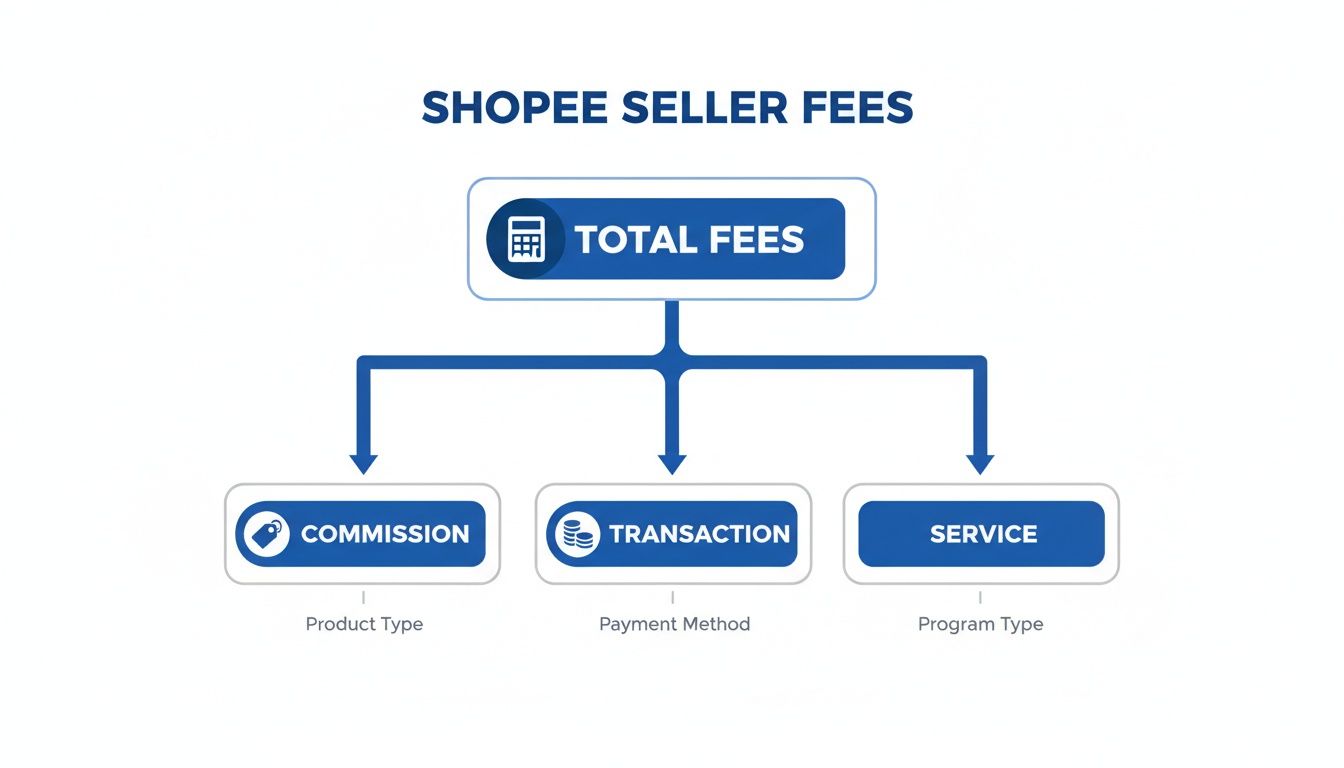
As you can see, your final payout gets trimmed by a mix of mandatory and optional fees, and each one is calculated a little differently.
First up is the Commission Fee. This is the main charge for using the Shopee platform, think of it as the ‘rent’ for your digital shop space. It’s calculated as a percentage of your product’s listed price, but only after any discounts you’ve funded yourself (like shop vouchers) have been applied.
This fee isn’t a flat rate for everyone. It changes based on two main factors:
Practical Example: A non-Mall seller pays about 11.99% commission on a fashion item. A Shopee Mall brand is charged up to 15.26% for the same item. New sellers pay 0% base commission for their first 120 days, which is a great chance to build early momentum.
Here’s a breakdown of typical commission rates for popular categories. Rates vary by seller tier, Non-Mall sellers pay less but get fewer visibility perks, while Mall sellers pay more but benefit from the trust badge and priority placement.
| Category | Non-Mall Seller | Shopee Mall |
|---|---|---|
| Mobile Phones & Tablets | 9.81% (capped S$30/item) | 10.9% (capped S$80/item) |
| Other Electronics | 11.99% (capped S$30/item) | up to 15.26% (capped S$80/item) |
| Fashion & Apparel | 11.99% | 15.26% |
| Health & Beauty | 11.99% | 15.26% |
| Home & Living | 11.99% | 15.26% |
| Milk Formula, Diapering & Pets | 9.81% | 13.08% |
| Sports & Outdoor | 11.99% | 15.26% |
| Toys, Kids & Babies | 11.99% | 15.26% |
| Alcoholic Beverages | 9.81% | 13.08% |
Standard rates effective 1 January 2026, GST-inclusive. Promo Xtra members pay preferential (lower) rates. Electronics commission is capped per item. Always confirm the latest schedule in your Shopee Seller Centre dashboard.
Knowing your category’s rate is essential for accurate profit margin calculations. A few points of commission difference can be the difference between a profitable product and a loss-maker, especially on lower-priced items.
Not all sellers pay the same rates. Your commission depends on whether you sell as a non-Mall or Mall seller and whether you have joined the Promo Xtra Programme. Understanding the differences helps you plan your growth path.
| Feature | Non-Mall Seller | Non-Mall on Promo Xtra | Shopee Mall |
|---|---|---|---|
| Commission rate | Standard (about 9.8–12%) | Preferential (from about 7.6%) | Higher (up to 15.26%) |
| Service fee | None | 3.27–5.45% Promo Xtra fee | Optional Promo Xtra fee |
| Trust badge | None | None | Green “Mall” badge |
| Visibility boost | Standard search ranking | Promo Xtra placement + vouchers | Top priority + dedicated Mall tab |
| Requirements | None | Join Promo Xtra in Seller Centre | Registered brand, business entity, Shopee approval |
| Best for | Low-volume or high-margin sellers | Sellers wanting lower commission + reach | Brands wanting premium positioning |
Actionable Insight: Promo Xtra membership lowers your base commission but adds a service fee. It pays off when the extra reach and the lower commission outweigh the service fee, which is usually the case for higher-margin products. Run your category through the Shopee Fee Calculator to see whether joining nets out positive for you.
If you’re a brand considering Shopee Mall, factor in the higher commission rates against the increased conversion that comes with the Mall trust badge. Mall sellers typically see 20–30% higher conversion rates compared to regular sellers, according to Shopee Seller University, which can offset the higher fees.
Next, we have the Transaction Fee. This is applied to every successful order to cover the costs of processing payments, whether your customer uses a credit card, debit card, or ShopeePay.
The fee is a flat 3.27% of the total final amount the customer pays. That includes the product price plus any shipping fees paid by the buyer, after all vouchers have been used.
Practical Example: A customer buys an item for S$50 and pays S$1.49 for shipping. Their total bill is S$51.49. The Transaction Fee will be 3.27% of S$51.49, which comes out to S$1.68. This fee hits every order, regardless of your seller status or product category.
This fee is consistent and predictable, so it’s easy to factor into your pricing as a standard cost of doing business online.
This is where you have control. Service Fees are charges for opting into Shopee’s various marketing and growth programmes. They’re designed to help you attract more customers, but they come with an extra cost.
The main optional programme in Singapore is:
Actionable Insight: Before joining, calculate your profit margin on a best-selling product. Then, subtract the service fee to see if the item is still profitable. For high-margin products, the sales lift from these programmes often makes the fee worthwhile. For low-margin items, you’ll need to calculate carefully to ensure you remain profitable.
A critical detail for sellers in Singapore is the Goods and Services Tax (GST). All seller fees quoted by Shopee are inclusive of Singapore’s 9% GST.
This means you don’t have to add GST on top of the fee percentages you see; it’s already included. When you add everything up, commission (which can reach 15.26% for Mall categories), service fees, and transaction fees, the total platform charges can quickly climb towards 25% or more of your item’s price. To dig into the specific rates, it’s always a good idea to check out the official details on Shopee’s seller education hub.
Understanding this layered structure allows you to accurately predict your costs and price your products for long-term growth.
Knowing the individual Shopee seller fees is one thing, but seeing how they combine to impact your final payout is what truly matters. Let’s walk through the calculation step-by-step to see the real-world impact of these costs.
The core formula is straightforward. You start with your product’s price and subtract each fee.
Final Payout = (Original Product Price - Seller Vouchers) - Commission Fee - Service Fee - Transaction Fee
Let’s apply this formula to a couple of real-world scenarios to see how your seller type and program choices change the final numbers.
Imagine you’re an established non-Mall seller in Singapore, selling a hoodie for S$80. You’ve joined the Promo Xtra Programme for lower commission and extra reach. A customer buys your hoodie and applies one of your S$5 seller-funded shop vouchers at checkout.
Here’s how the fees stack up:
Now, let’s run these numbers through our formula.
Here’s a table breaking down the entire calculation for this order.
Sample Fee Calculation for a Shopee Order
| Line Item | Calculation Detail | Amount (SGD) |
|---|---|---|
| Original Price | The listed price of your hoodie. | S$80.00 |
| Seller Voucher | The discount you funded for the customer. | - S$5.00 |
| Adjusted Price | The base amount for calculating fees. | S$75.00 |
| Commission Fee | 9.81% of S$75 (GST-inclusive). | - S$7.36 |
| Service Fee | 5.45% of S$75 for the Promo Xtra Programme. | - S$4.09 |
| Transaction Fee | 3.27% of S$75 for payment processing. | - S$2.45 |
| Final Payout | The amount you receive from Shopee. | S$61.10 |
After an S$80 sale, you walk away with S$61.10. The total fees were S$13.90, which is over 18% of your adjusted selling price. This example shows just how quickly the different fees can stack up under the 2026 rates.
Now let’s look at an established Shopee Mall fashion brand selling a dress for S$120. They participate in the Promo Xtra Programme. The customer doesn’t use any seller vouchers.
For a Mall seller, the fee structure is higher:
Let’s do the maths for this S$120 dress:
Here, the total fees took a 19.6% bite out of the selling price. This is a significant amount and highlights why you must factor these costs into your pricing strategy. If you import products, use our landed cost calculator to determine the true cost of goods before adding marketplace fees. Then use price monitoring tools to track competitor prices and ensure you’re pricing competitively while still maintaining healthy margins.
To understand how Shopee fees affect your bottom line, it’s vital to know your break-even point. Use our break-even calculator with a built-in Shopee preset to see exactly how many units you need to sell to cover your costs.
Calculating your true profit margins on every product is essential for a healthy business. To save time and avoid spreadsheet errors, you can use our free ecommerce profit margin calculator. It lets you quickly see how fees are impacting each product’s profitability.
The official list of Shopee seller fees only tells part of the story. To understand the true cost of selling, you need to look at your effective take rate. This is the real percentage of your sales that Shopee keeps after every single cost is factored in.
Think of it like buying a car. The commission fee is the sticker price, but the effective take rate is the final on-the-road price you actually pay, including registration and taxes. It’s the number that truly matters for your bottom line. Understanding how these fees compress your gross margin vs gross profit is essential for accurate per-channel profitability analysis.
Knowing this all-in cost is vital for making smart business decisions and comparing the profitability of different channels. For a deep dive into the two biggest platforms in the region, check out our guide on Lazada vs Shopee. If you are considering expanding beyond Southeast Asia, our Temu seller fees breakdown compares Temu’s commission structure (2–15% depending on seller model) against Shopee’s rates. For sellers exploring a Shopify store as a DTC channel alongside Shopee, our Shopify fees guide breaks down all plan costs, payment processing rates, and transaction fees.
Several factors can quietly increase your total platform expenses, turning a low commission rate into a much larger effective take rate. It’s critical to build these into your financial planning.
Here are the main culprits behind those hidden costs:
Actionable Insight: Track these additional costs separately. In your bookkeeping, create categories for “Campaign Costs” and “Shopee Ads” alongside standard fees. This gives you an accurate view of your true profitability and prevents you from thinking a product is more profitable than it really is.
In 2025–2026, it’s not uncommon for the effective take rate for sellers across South-east Asia to climb as high as 20–25% of post-discount sales. Reports on seller economics show that total deductions, including shipping, transaction charges, and marketing co-investments, can significantly reduce a seller’s net income. This aligns with analyses showing that Shopee’s revenue growth is partly fueled by monetizing its sellers through these programs. You can read more in this analysis of Shopee’s rising take rates.
Let’s break it down. Imagine you sell an item for S$100. The standard fees (commission, service, transaction) might add up to 15%, or S$15.
Then, a major campaign rolls around. You spend S$5 on Shopee Ads to promote the item and you’re required to fund a S$5 voucher. Suddenly, the total platform-related cost for that sale is S$15 + S$5 + S$5 = S$25.
Your effective take rate has just shot up from 15% to 25%.
Seeing this complete financial picture is necessary for anyone serious about building a sustainable business on Shopee. It allows you to make smarter decisions about your budget, pricing strategy, and inventory.
Knowing what Shopee charges is one thing; actively reducing those fees is how you protect your profit margins. Instead of accepting these charges as fixed costs, you can make smart decisions that lower your expenses and increase your take-home pay from every sale.
Think of fees as a variable cost you can influence. By matching your pricing, promotions, and program choices to your product margins, you can make the fee structure work for you.
If you’re new to the platform, Shopee Singapore offers a 120-day commission-free period for new stores in 2026, applied to all local Marketplace and Mall sellers. You pay 0% base commission for your first 120 days, a golden opportunity to build momentum.
For these first 120 days, your only major platform costs are transaction fees and any optional Promo Xtra service fee you join. This break gives you a unique chance to build sales momentum, collect customer reviews, and establish your store’s reputation without commissions impacting your early profits.
Actionable Insight: Your goal during this 120-day period should be aggressive growth. Use the extra margin to run more competitive promos or invest a small budget into Shopee Ads to increase visibility. A strong sales history early on builds a solid foundation for success long after the waiver ends.
The Promo Xtra Programme is an effective tool for attracting buyers and it lowers your base commission, but its service fee can be costly. Whether you join should be a calculated decision based on your product margins.
High-Margin Products: For items with healthy profit margins, like custom accessories or unique fashion pieces, the sales boost from these programmes can easily cover the costs. The higher conversion rate often makes the service fee a worthwhile marketing expense.
Low-Margin Products: If you sell essentials or low-margin goods like basic supplies, these programmes can be risky. The extra fee could eliminate your profit. It might be smarter to opt out and compete on a lower base price.
Actionable Insight: Run a simple A/B test. Turn on the programmes for two weeks and track your sales volume and net profit per item. Then, switch them off for the next two weeks and compare the numbers. The data will provide a clear answer on whether the investment is paying off for your products.
Another way to reduce the impact of Shopee’s fees is to increase your average order value (AOV). When a customer buys more in a single checkout, your fixed costs per order are spread thinner, making each sale more profitable.
Product bundling is one of the most effective ways to do this.
A Practical Example of Bundling: Imagine you sell phone cases for S$15 and screen protectors for S$10.
Additionally, use seller-funded vouchers strategically. A small S$2 voucher might be the final nudge a customer needs to complete a purchase, helping you move more inventory and improve your overall profitability.
Manually tracking your Shopee seller fees across hundreds of orders is time-consuming and prone to errors. Digging through the Shopee Seller Centre to match payments, fees, and payouts can quickly become overwhelming as your business grows.
Mistakes in these calculations can give you a skewed picture of your actual profitability. To make smart decisions, you need a system that automates the process and delivers clear, actionable insights without requiring you to live in a spreadsheet.
The most effective way to manage your finances is to bring all your data into one central place. A multi-channel platform like OneCart provides a single dashboard where you can see a real-time overview of your business performance across every sales channel, including Shopee.
Instead of logging into multiple seller accounts, a consolidated view turns scattered data into a powerful strategic asset.
Centralizing your data saves countless hours and replaces guesswork with hard numbers, freeing you to focus on growing your business. This approach transforms fee tracking from a tedious chore into a competitive advantage.
A unified dashboard does more than just display numbers; it helps you understand what they mean. With smart analytics, you can spot trends and identify opportunities that would otherwise remain hidden in the raw data from the Shopee Seller Centre.
Actionable Insight: Use an automated tracking system to shift from reactive bookkeeping to proactive business strategy. The system handles the tedious calculations, freeing you to analyze performance and make faster decisions that directly impact your bottom line.
For example, you can quickly see which products have the healthiest margins on Shopee after all fees and ad spend are factored in. This insight is invaluable. It lets you optimize your product catalogue, adjust your marketing budget, and focus on what’s genuinely making you money.
For more advanced reporting, you can also learn about exporting e-commerce finance data from OneCart to integrate with your existing accounting software.
Got questions about Shopee fees? You’re not the only one. Even experienced sellers sometimes need a quick refresher on the specifics.
Let’s clear up some of the most common queries we hear from sellers in Singapore.
Yes, they do.
All fees Shopee Singapore quotes, whether for Commission, Transactions, or any Service programs, already have the Goods and Services Tax (GST) included. You don’t need to do any extra math to add tax on top.
So, if you join Promo Xtra with a 5.45% service fee, that 5.45% is exactly what will be deducted. It’s a crucial detail for keeping your bookkeeping clean and avoiding surprises in your payouts.
Shopee is generally fair about this. If a customer returns an item and you issue a full refund, the Commission and Service Fees tied to that sale are usually reversed and credited back to your seller account.
The one fee that typically remains is the Transaction Fee. This fee covers the cost of processing the original payment, a service that was already completed. This means you might be out of pocket for that small percentage, even on a fully refunded order. For your own accounting records, always issue a credit note when processing marketplace refunds to keep your books accurate. The unrecovered Transaction Fee is just one line in the true cost of a return, outbound shipping, the return label, payment-fee retention, inspection labour, and inventory write-downs typically push parcel-sized returns to US$13–US$30 all-in before you account for the marketplace claw-back. Build it into your unit economics using our ecommerce returns cost framework.
Shopee handles this automatically, deducting all fees before the money reaches your account. You don’t have to manually pay for anything.
Here’s how it works:
This way, the amount you see in your balance is your actual take-home pay for that sale, which helps you manage your cash flow effectively.
The exact amount depends on your seller tier and which programmes you’ve joined, but here’s a quick reference for common price points:
| Selling Price | Fees (No Promo Xtra) | Fees (With Promo Xtra) | You Keep (No Promo Xtra) | You Keep (With Promo Xtra) |
|---|---|---|---|---|
| S$20 | ~S$3.05 (15.26%) | ~S$3.71 (18.53%) | S$16.95 | S$16.29 |
| S$50 | ~S$7.63 (15.26%) | ~S$9.27 (18.53%) | S$42.37 | S$40.73 |
| S$100 | ~S$15.26 (15.26%) | ~S$18.53 (18.53%) | S$84.74 | S$81.47 |
| S$200 | ~S$30.52 (15.26%) | ~S$37.06 (18.53%) | S$169.48 | S$162.94 |
Based on a non-Mall seller at 11.99% commission (general merchandise). Your actual rates will vary by category and Promo Xtra membership.
For non-Mall sellers, commission rates are fixed by Shopee and cannot be negotiated individually. However, Shopee Mall sellers working directly with a Shopee account manager may have some room to negotiate commission rates, especially if they bring significant volume or are an established brand.
The practical way to lower your fees is to join the Promo Xtra Programme, which gives you preferential (lower) base commission rates in exchange for a service fee and extra visibility. Run the numbers first: for higher-margin products the trade usually nets out positive, and for thin-margin items it may not.
You can view a detailed breakdown of fees for every order in your Shopee Seller Centre:
Shopee also sends a bi-monthly income statement that summarises all fee deductions for the payout period. Download these from your Seller Centre for your accounting records.
Technically, no. The 3.27% transaction fee applies to every sale, even during your commission-free period. However, new sellers in 2026 can get close to “free” by skipping optional programmes and leveraging the 120-day commission waiver. During this window, your only platform cost is 3.27% per sale.
After the commission-free period ends, you’ll pay the standard commission for your category on top of the transaction fee. There are no monthly subscription fees or listing fees on Shopee, you only pay when you make a sale.
If you sell on multiple platforms, or you’re deciding which marketplace to join, it helps to see how Shopee’s fees compare with the competition. Here’s a side-by-side look at the major marketplaces available to Singapore-based sellers.
| Platform | Commission | Transaction/Payment Fee | Optional Programme Fees | Effective Take Rate |
|---|---|---|---|---|
| Shopee SG | 7.6–15% | 3.27% | 3.27–5.45% Promo Xtra | 15–25% |
| Lazada SG | 1–6% | 2% | Co-funded vouchers vary | 8–18% |
| TikTok Shop | 1–5% | 1% payment fee | Affiliate commissions (1–20%) | 5–25% |
| Etsy | 6.5% transaction | 3–4% + S$0.35 payment | 15% offsite ads (optional) | 12–25% |
| eBay | 3–15% final value | 2.35% + S$0.50 | Promoted listings (2–20%) | 8–35% |
Key takeaway: Shopee’s base fees are competitive in the Southeast Asian market. Where costs escalate is when you opt into multiple marketing programmes simultaneously. The same is true for most platforms. Our full TikTok Shop seller fees guide shows how TikTok’s 6% flat rate balloons past 20% once you layer affiliates, and eBay’s fees vary wildly by category.
Actionable Insight: Don’t choose a platform based on fees alone. A platform with higher fees but better conversion rates for your products may deliver more profit per order. Use our markup calculator to set prices that account for each platform’s fee structure, and track per-channel profitability with a tool like OneCart.
For a detailed comparison of the two biggest Southeast Asian marketplaces, read our guide on Lazada vs Shopee.
Yes, but profitability depends on your margins, category, and how strategically you use (or avoid) optional programmes.
Here’s the honest picture: if your product’s cost of goods is 50% or less of the selling price, you have enough margin to absorb Shopee’s fees and still profit. If your COGS is above 60–70%, the maths gets tight quickly, especially with optional programmes.
A realistic example for a S$30 product:
| Scenario | COGS | Total Shopee Fees | Profit | Margin |
|---|---|---|---|---|
| Without Promo Xtra | S$12.00 | S$4.58 (15.3% total) | S$13.42 | 44.7% |
| With Promo Xtra | S$12.00 | S$5.56 (18.5% total) | S$12.44 | 41.5% |
Even under the higher 2026 rates, this S$30 item at a healthy COGS still delivers a solid margin. The key is knowing your numbers before you opt in.
Use our COGS calculator to nail down your true product costs, then feed those into the profit margin calculator to see exactly what you’ll keep after Shopee takes its share.
For sellers managing inventory across multiple channels, understanding your dead stock costs and maintaining accurate safety stock levels are just as important as fee management for overall profitability. If you’re selling on Shopee alongside other platforms, a multichannel listing tool can save hours of manual work by syncing your products and inventory across Shopee, Lazada, TikTok Shop, and your own website simultaneously.
Many sellers also find that connecting Shopee to their accounting software, whether QuickBooks or Xero, helps them track per-platform profitability more accurately than relying on Shopee Seller Centre reports alone. Our ecommerce accounting guide walks through how to set up the chart of accounts, reconciliation flow, and reporting cadence that turns marketplace fee data into channel-level profitability numbers.
Selling on other platforms too? Check our fee calculators for Lazada, TikTok Shop, Etsy, eBay, and Facebook Marketplace to compare your costs across marketplaces. You can also explore our full list of ecommerce platforms in Singapore to find the best channels for your products.
Ready to price with confidence? Run your numbers through the free Shopee Fee Calculator to see exactly what you keep on every sale, then set prices that protect your margin.
Keeping track of fees is a critical piece of the puzzle, but it’s not the whole picture. OneCart gives you a single, unified dashboard to see your real-time profitability across Shopee, Lazada, and TikTok Shop. We turn that messy financial data into a clear strategic advantage. Stop guessing and start making decisions with confidence by visiting https://www.getonecart.com.
OneCart syncs your Shopee inventory and orders with every other marketplace you sell on — no more overselling, no more manual updates.
Connect Shopee freeUsed by hundreds of merchants in Singapore & Southeast Asia