What Is Lead Time in E-Commerce and How to Shrink It for Success 2026
Confused about what is lead time? Learn to calculate, manage, and reduce it to boost sales and customer satisfaction on Shopee, Lazada, and TikTok Shop.
Confused about what is lead time? Learn to calculate, manage, and reduce it to boost sales and customer satisfaction on Shopee, Lazada, and TikTok Shop.
In e-commerce, lead time is the total time it takes from when a customer clicks ‘buy’ to when the package is in their hands. It’s the entire waiting period, covering every single step in between. Getting this number as low as possible is a sure sign of an efficient, customer-focused operation.
Think about the last time you ordered your favourite bubble tea from an app. The time that passed from confirming your order to taking that first satisfying sip? That’s its lead time. E-commerce works on the same principle, just with a few more moving parts. It’s the complete waiting game your customer plays, and it directly shapes how they feel about your brand.
For sellers on hyper-competitive platforms like Shopee, Lazada, or TikTok Shop, getting a grip on this metric is essential. It’s about making sure the whole sequence of events—from the moment you see the order to the second you hand it off to the courier—runs like a well-oiled machine. This entire process adds up to the delivery promise you make to your customers.
A shorter lead time almost always leads to happier customers, better seller ratings, and a healthier bottom line. It’s one of the most powerful levers you can pull to boost your store’s performance and build real customer loyalty.
To understand lead time, it helps to break it down into its main stages. Each part has its own challenges, but they all stack up to form the total time a customer has to wait.
Let’s look at a quick summary of the key stages that make up the total lead time for an online order.
| Component | Description | Practical Example |
|---|---|---|
| Order Processing | The internal time it takes your team to see, confirm, and prepare an order for packing after it’s been placed. | Acknowledging a new order in your seller dashboard and printing the pick list. |
| Fulfillment | The physical work of finding the item in your warehouse, packing it securely, and printing the right shipping label or airway bill. | Your staff grabbing an item from a shelf, putting it in a poly mailer, and sticking on the J&T Express label. |
| Shipping & Delivery | The time from when the courier picks up the package until it’s successfully delivered to the customer’s doorstep. | The package’s journey from your warehouse, through the courier’s sorting hub, and out for last-mile delivery. |
Basically, from the moment an order hits your system to the final delivery scan by the courier, every minute counts. Understanding these three parts is the first step to finding where you can speed things up.
To get a handle on lead time, it helps to see it as a chain of connected timelines. Each link in that chain adds to the total time your customer has to wait, and making each one stronger and faster is how you boost your overall speed and efficiency.
For anyone selling online, there are a few specific types of lead time that really matter.
The one your customers care about most is the Customer Lead Time. This is the whole journey, from the second they click “Confirm Order” to the moment that package lands on their doorstep. It’s the entire experience they have with you, and it’s the main yardstick they’ll use to measure how good your store is.
But to make that customer-facing timeline as short as possible, you’ve got to get your own house in order first. And that starts with your supply chain.
First up is Procurement Lead Time. This is how long it takes to get the supplies you need. It covers the entire period from when you place an order with your supplier to when the goods are physically in your warehouse, ready to be used. For international sourcing, this timeline also includes customs clearance — you’ll typically need a proforma invoice to lock in pricing and a commercial invoice for customs processing. If your procurement time is long or unpredictable, you’ll be forced to keep more safety stock on hand, which ties up your cash.
Then there’s Production Lead Time. This applies if you make or assemble your own products. It’s the time required to turn your raw materials into a finished product that’s ready to be sold.
Here is a practical example. Imagine you’re a seller on TikTok Shop in Singapore, and you create custom gift hampers.
Both of these timelines happen before a customer even thinks about buying from you, but they have a huge impact on your ability to fulfil an order quickly when it does come in.
The moment a customer places an order, a different clock starts ticking inside your business. This is your Order Handling and Delivery Lead Time. It’s the sum of all the actions you take to get the package out of your warehouse and into the hands of a courier. This includes everything from picking the items off the shelf, packing them up securely, printing the shipping label, and finally, the actual transit time to the customer.
This diagram shows the simple, three-step journey from your customer’s point of view.
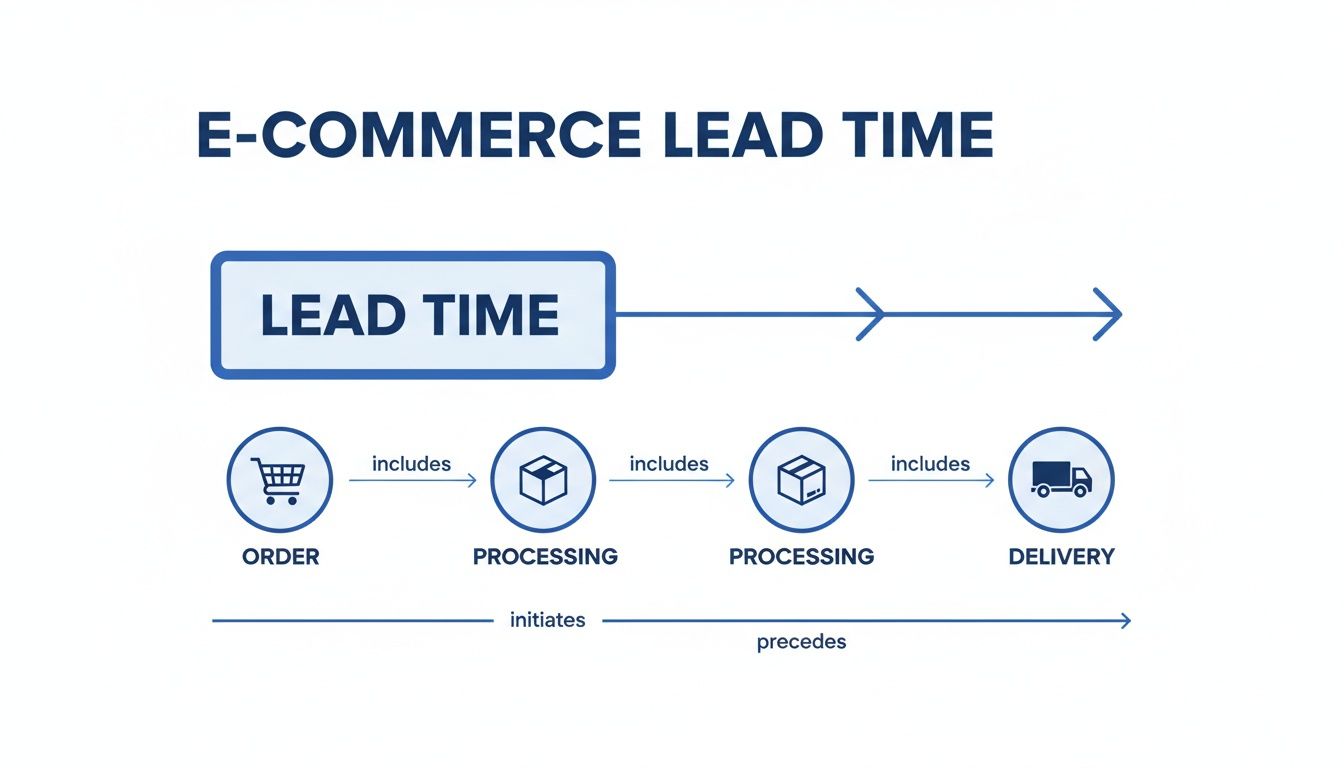
What this really highlights is that while the customer sees a straightforward process—order, processing, delivery—you’re actually juggling several different lead times behind the scenes to make that smooth experience happen.
In Singapore’s fast-paced e-commerce market, quick delivery is the baseline expectation. Customers expect their orders fast, and if you can’t deliver, they’ll find someone who can.
This means managing your lead time is a powerful lever for real business growth. When you shrink the time between a customer’s click and the package arriving at their door, you’re directly upgrading their experience. That improvement pays off in some very tangible ways.
For starters, happier customers leave better seller ratings on platforms like Shopee and Lazada. Those glowing reviews build trust, encourage repeat purchases, and ultimately create a loyal customer base that sticks with you instead of jumping to a competitor.
Beyond making customers happy, getting a handle on your lead time has a direct impact on your bottom line.
By tightening up your processes—from ordering stock to packing boxes—you can operate with less safety stock (use our safety stock calculator to find your optimal level). That’s the ‘just in case’ inventory that ties up your cash and eats up precious warehouse space. Freeing up that capital means you have more money to reinvest into marketing, new products, or other areas to grow your business.
A streamlined operation doesn’t just save you money on storage; it makes your entire business more agile and resilient to shifts in demand. You can respond faster without being weighed down by excess inventory.
Even more critically, consistently hitting the delivery timelines set by marketplaces is vital. These platforms give top billing to sellers who reliably meet their Service Level Agreements (SLAs).
Nailing your SLAs unlocks several key advantages:
In Singapore’s booming e-commerce scene, lead time has become a genuine make-or-break factor. A recent report found that a massive 61% of online shoppers in Singapore will choose one brand over another purely because of better delivery options. This stat alone shows how slashing your lead times can directly fuel customer loyalty.
During peak sales events, the stakes are even higher. Delays can cause cancellation rates to spike—often hitting 5-10% for sellers who can’t keep up with the rush. To get a better sense of the competitive pressure, you can read more about the latest e-commerce trends in Singapore.
You can’t improve what you don’t measure. Before you can shorten your lead times, you need an honest, clear picture of how long things actually take right now. The calculation is simple—it just means breaking down the entire journey, from the moment a customer clicks ‘buy’ to the moment the package arrives.
The basic formula is your starting point.
Lead Time = Order Processing Time + Fulfilment Time + Shipping Time
Want to crunch the numbers quickly? Use our free lead time calculator to get an instant breakdown with delivery date estimates, or jump straight to the reorder point calculator to find when you should place your next order.
This equation tells you exactly how long a customer has to wait. To make it useful, you need to plug in numbers based on real data from your past orders, not just wishful thinking. Averages will give you the most realistic and actionable metric to work with.

Let’s walk through this with a real example. Imagine a Singapore-based seller running both a Shopify store and a Lazada shop. By pulling the data from their last 50 orders, they can figure out a reliable average for each stage of their process.
Here’s how they’d break it down:
Adding these up gives us the full picture: 4 hours (Processing) + 2 hours (Fulfilment) + 36 hours (Shipping) = 42 hours Total Lead Time.
Now we’re getting somewhere. With a clear 42-hour benchmark, this seller can set realistic delivery promises for their customers. More importantly, they can pinpoint which stage offers the biggest opportunity for improvement.
Knowing these numbers is also critical for managing your inventory. You need to have enough stock on hand to cover demand during this entire lead time. If you want to see exactly how this works, a good safety stock calculator can show you how lead time directly impacts your inventory needs.
This data-driven approach is essential, especially as customer expectations continue to soar. Post-pandemic e-commerce growth is being supercharged by urban consumers who now demand lead times under 24 hours for essential items. When peak sales events like 11.11 roll around, having efficient systems is the only way to meet the demands of the 88.9% of Southeast Asian internet users who shop on their phones and expect instant gratification.
Knowing your lead time is one thing; actively shrinking it is what really separates growing businesses from stagnant ones. Cutting down the time from when a customer clicks “buy” to when the package lands on their doorstep means optimising every single step of your operation. The goal here is to hunt down and eliminate wasted minutes, creating a smooth, efficient flow from your warehouse to your customer.

This is about turning theory into action with proven strategies that get products out the door faster. We can break these down into three core areas: improving your internal workflow, strengthening your partnerships, and embracing technology.
Often, the biggest time savings are found right within your own four walls. An organised warehouse is a fast warehouse.
Start by arranging your inventory logically. Your most popular, fastest-selling items should be front and centre, right near your packing station. This one change can drastically cut down the time your team spends walking around searching for products.
Next, get into the habit of batch processing. Instead of picking and packing orders one by one as they trickle in, group similar orders together. For instance, you could process all orders for the same SKU at once. This reduces repetitive tasks and builds a much more rhythmic and efficient workflow.
Your internal efficiency is only half the battle. Delays from your suppliers or logistics partners can undo all your hard work.
It pays to build strong, communicative relationships with your suppliers. Be clear about your needs and negotiate for better terms, especially shorter procurement lead times. A reliable supplier who delivers on schedule is a massive asset. Where you can, consider sourcing from local partners to slash shipping times and sidestep potential customs headaches.
For international e-commerce, a direct way to cut lead time is to streamline your customs clearance process. Nailing these relationships is fundamental to a resilient supply chain, and it’s a key part of effective demand planning and forecasting. You can check out our guide on how to master your supply chain with demand planning and forecasting.
If you’re juggling orders across Shopee, Lazada, and TikTok Shop, manual processing is your biggest lead time killer. Think about it: logging into multiple seller centres to manage orders, update stock, and print labels is incredibly slow and a recipe for errors.
This is where automation becomes a game-changer. Centralising all your marketplace orders into a single dashboard means you no longer have to constantly switch between platforms.
Omnichannel integration demands real-time visibility to cut delays. Platforms that sync Shopee, Lazada, and TikTok Shop enable faster fulfilment, with some third-party logistics providers reducing lead times by 30-50%.
Features like real-time inventory synchronisation are crucial. They stop you from overselling—a primary cause of delays and cancellations—by making sure your stock levels are always accurate across every channel. Plus, being able to bulk print shipping labels from one interface drastically reduces your order handling time.
Take a look at how centralisation transforms the process:
| Fulfillment Stage | Manual Process (High Lead Time) | Centralised Process with OneCart (Low Lead Time) |
|---|---|---|
| Order Management | Log into each marketplace separately to download orders. | All orders from Shopee, Lazada, and TikTok Shop appear in one dashboard. |
| Inventory Sync | Manually update stock levels on each platform after a sale. High risk of overselling. | Inventory syncs automatically across all channels in real time. Overselling is eliminated. |
| Picking & Packing | Print packing slips and shipping labels from different seller centres, one by one. | Generate a consolidated picklist. Bulk print shipping labels for all orders from one interface. |
| Fulfilment | Slower pick/pack process leads to delays in handing over parcels to couriers. | Faster, batched processing means orders are ready for courier pickup much sooner. |
| Error Handling | High chance of manual errors like shipping the wrong item or incorrect address labels. | Automated data transfer minimises human error, reducing returns and reshipments. |
The difference is significant. What was once a slow, error-prone series of manual tasks becomes a fast, automated, and accurate workflow.
With Singapore’s e-commerce gross merchandise value projected to hit S$11 billion by 2025, logistics efficiency is more critical than ever. Warehouse managers have reported 40% error reductions and massive time savings after switching to centralised dashboards, often seeing a return on their investment in just a matter of days.
Even with a great strategy, you’re bound to run into specific questions about lead time. Let’s tackle some of the most common ones we hear from e-commerce sellers in Singapore.
In Singapore’s fast-paced market, a “good” lead time is a moving target that keeps getting shorter. For most products on marketplaces like Shopee and Lazada, you should be aiming for a total lead time of 1-3 days from the moment a customer clicks “buy” to the package landing on their doorstep.
If you’re selling groceries or daily essentials, the bar is even higher—customers now expect same-day or next-day delivery. The moment your total lead time stretches beyond 3-4 days, you may see more abandoned carts and a dip in seller ratings.
The best policy is always transparency. Clearly state the estimated delivery date on your product pages to manage customer expectations right from the start.
Safety stock is the extra inventory you keep on hand just in case. It’s your buffer against a sudden spike in demand or a supplier who takes longer than promised to deliver your goods.
These two concepts are directly related. If your supplier’s lead time is long and unpredictable, you’re forced to hold more safety stock to avoid running out. This means more of your cash is locked up in products sitting in a warehouse.
On the other hand, if you work with reliable suppliers with short, consistent lead times, you can confidently reduce your safety stock. This frees up your cash flow and brings down your warehousing costs. You can use our safety stock calculator to work out exactly how many units of buffer you need, then the reorder point calculator to set your trigger level based on daily demand and supplier lead times. It also means you’re less likely to deal with the headache of what are backorders, where you sell items you don’t actually have in stock.
A practical insight: shorter, more reliable supplier lead times act as a form of insurance, allowing you to run a leaner, more cash-efficient business without disappointing customers.
This is a classic problem for anyone selling on more than one platform. The bottleneck is almost always the manual work of jumping between your Shopee, Lazada, and Shopify dashboards to process orders, update stock levels, and print shipping labels. Every minute you spend toggling between tabs adds to your internal handling time.
The most effective fix is to bring everything under one roof with a centralised e-commerce management platform. It solves the problem by pulling all your orders from every channel into a single, unified dashboard.
The benefits are immediate:
By getting rid of these repetitive manual tasks, you can get orders out the door much faster, no matter how many channels you’re selling on.
Ready to slash your lead time and eliminate the chaos of managing multiple stores? OneCart centralises your orders, syncs your inventory in real-time, and automates your fulfilment workflow so you can ship faster and grow smarter. Schedule your free demo of OneCart today
Automate & Scale Your Online Business with OneCart
Start a Free TrialUsed by hundreds of merchants in Singapore & Southeast Asia