Mastering E-commerce Warehousing and Logistics in Singapore [2025]
Unlock growth for your Singapore e-commerce store. Our guide covers key warehousing and logistics processes, KPIs, and tech to streamline your operations.
Unlock growth for your Singapore e-commerce store. Our guide covers key warehousing and logistics processes, KPIs, and tech to streamline your operations.
Picture your e-commerce business as a popular café. Warehousing is the perfectly organised kitchen pantry where every ingredient is fresh and easy to grab. Logistics is the seamless dance between the cooks and the waiters, making sure every dish gets to the right table, piping hot and right on time.
In Singapore’s bustling e-commerce scene, getting warehousing and logistics right is crucial. When these two parts work together smoothly, you create those five-star customer experiences that keep people coming back. When they don’t, orders get delayed, stock gets misplaced, and frustrated customers hit ‘cancel’. This operational core is the real engine driving your business forward.
This guide will walk you through building a solid operational foundation, whether you’re selling on Shopee, Lazada, or your own Shopify store. We’ll break down how a central system can turn warehousing and logistics from a daily headache into your biggest competitive advantage. For a deeper dive into layout design, WMS selection, and fulfilment workflows, check out our warehouse management for ecommerce guide.
At its heart, warehousing and logistics covers every single physical step your product takes—from the moment it arrives from your supplier to the final handover to your customer. It can be broken down into two key areas:
Think of warehousing as managing everything that’s static—the items sitting on your shelves. Logistics, on the other hand, is about managing everything in motion—the products moving into, through, and out of your facility.
The pressure for fast, reliable logistics is only growing. Singapore’s freight and logistics market was recently valued at around USD 24.53 billion and is expected to climb to USD 33.3 billion in the next few years. What’s driving this? The massive expansion of multi-channel e-commerce, which directly fuels the need for more (and smarter) warehousing space.
This growth puts a huge amount of pressure on sellers to keep up. Looking at how major fulfillment services like Fulfillment by Amazon (FBA) run their operations can give you some great ideas for your own business. Many sellers find that partnering with specialised companies to handle these complex tasks is the smartest move. If you’re weighing your options, our guide on the role of e-commerce enablers can help you understand the landscape.
Ultimately, a strong operational setup is absolutely essential for survival and growth.
To really get a feel for warehousing and logistics, the best way is to follow a product on its journey from the supplier’s truck to your customer’s doorstep.
Let’s use a practical example. Imagine you sell phone cases online. A fresh shipment of 100 new units has just arrived from your supplier. At the same time, your phone buzzes with 20 new orders that have come in from your Shopee and Lazada stores. Getting those 100 new cases onto your shelves and the 20 sold ones out the door is a tightly choreographed process, and it can be broken down into five core stages.
This simple flow is the engine of your e-commerce business: moving goods from your warehouse, through your logistics partners, and finally, into the hands of a happy customer.
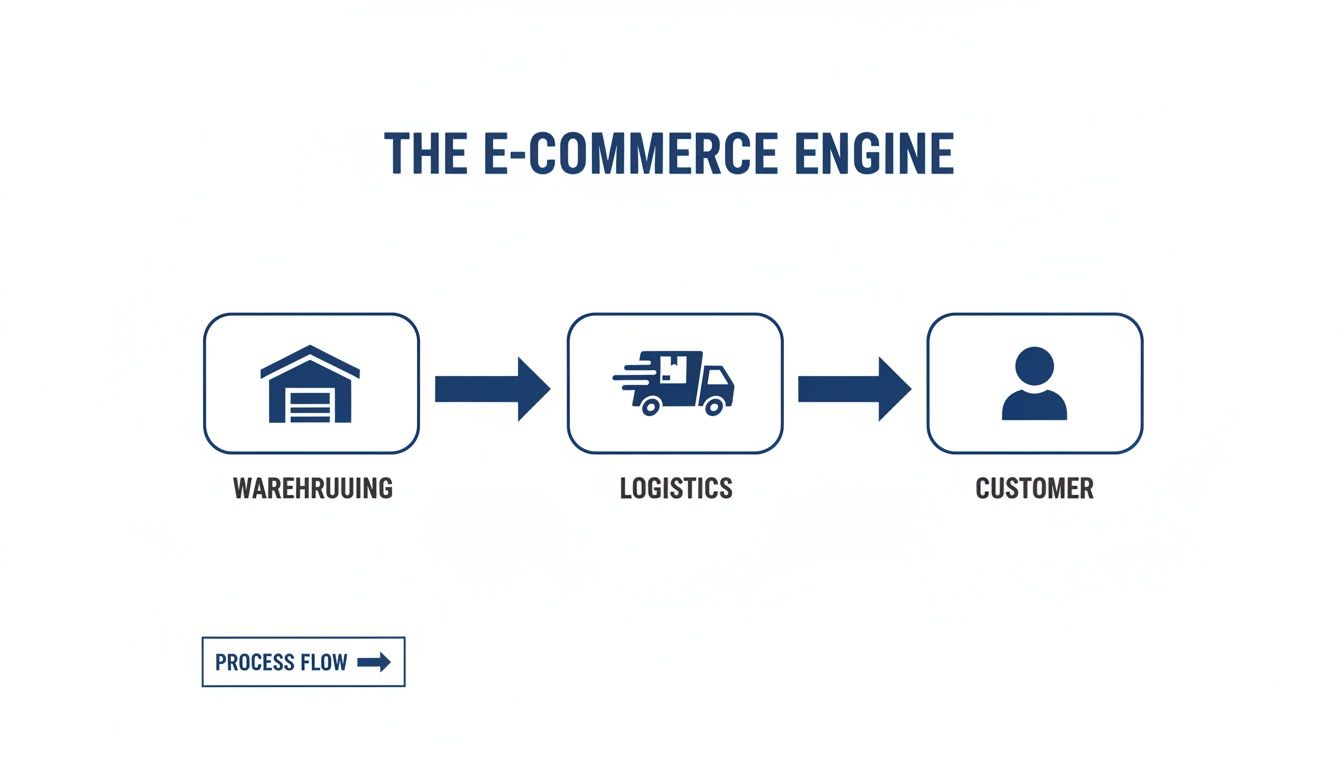
Think of each stage as a link in a chain. If one link breaks, the whole operation grinds to a halt.
To bring this to life, we’ve summarised the key processes in a table. Each step has a clear goal, and getting it right is what separates the pros from the amateurs.
| Process | What It Involves | Why It Matters for Sellers |
|---|---|---|
| 1. Inbound & Receiving | Checking incoming supplier shipments against purchase orders, inspecting for quality, and logging items into the inventory system. | This is your first line of defence against incorrect stock counts and damaged goods. Getting it right prevents future customer complaints. |
| 2. Storage & Inventory | Placing received items into organised, designated locations (slotting) and maintaining accurate stock counts over time. | Smart storage means faster picking. Accurate inventory prevents overselling and disappointing customers. |
| 3. Order Picking | Retrieving the correct products from the shelves to fulfil customer orders that have come in. | This is often the most labour-intensive part of the process. Efficiency here directly cuts down your fulfilment time. |
| 4. Packing & Prep | Placing picked items into the right packaging with protective materials and applying the correct shipping label. | Good packing prevents damage in transit. A streamlined labelling process saves precious minutes on every single order. |
| 5. Outbound & Shipping | Sorting packed orders by courier and handing them off for last-mile delivery. | This is the final handoff. A smooth pickup process ensures your parcels get into the delivery network without delay. |
Now, let’s break down exactly what happens at each of these crucial steps.
This is where it all begins—the first touchpoint. Your 100 new phone cases have arrived, but you can’t just toss them onto a shelf.
The receiving team’s first job is to check the delivery against the purchase order. Did the supplier send exactly 100 units? Are they the right model and colour? Any discrepancies here need to be flagged immediately.
Next up is a quality check. A quick inspection for defects like scratches or cracks is a must. Catching a faulty product now saves you the headache and cost of a customer return later. Once everything is verified, each item is scanned, and the quantity is logged into your inventory system. Only then is it officially available for sale.
A classic bottleneck here is a delay in data entry. If that new stock isn’t logged into your system quickly, you risk overselling on one marketplace while another incorrectly shows it as out of stock.
With the receiving process done, those 100 phone cases need a home. This is where smart storage, or slotting, comes into play. It’s the art of assigning products to specific locations for maximum efficiency.
Your best-selling phone case? That should be stored in a prime, easy-to-reach spot—maybe at waist height and close to the packing station. This simple move minimises the travel time for your pickers, shaving seconds off every order.
This stage is also about keeping your inventory records clean. Techniques like cycle counting—where you count a small section of your inventory every day instead of doing one massive annual stocktake—are brilliant for maintaining accuracy. It ensures the number in your system actually matches what’s physically on the shelf.
Good storage isn’t about filling space; it’s about organising for speed. An organised warehouse directly translates to faster order fulfilment and fewer errors.
Poor slotting is a massive, and often hidden, source of inefficiency. If your team has to walk to the far back corner of the warehouse for a popular item, you’re bleeding time and money on every single order.
Now, let’s tackle those 20 new orders from Shopee and Lazada. Picking is the physical act of grabbing the right items from their storage locations to fulfil what your customers have bought.
Doing this efficiently is key. A few common methods include:
Without a system, pickers are left to wander the aisles with a single order printout. A simple, consolidated pick list that organises items by their location in the warehouse is a game-changer. It cuts down on wasted movement and dramatically speeds up the entire stage. For a detailed breakdown of each picking method and when to use it, see our complete pick, pack, and ship guide.
With the 20 phone cases picked, it’s time to pack. This is more than just putting things in a box. It means selecting the right-sized mailer, adding protective materials like bubble wrap to prevent damage, and sealing it all up securely.
This is also when the shipping label gets generated and stuck on the package. If you’re selling on multiple channels, this can become chaotic. Imagine having to log into the Shopee Seller Centre and then Lazada’s platform just to print labels separately. Centralised systems are a lifesaver here, letting you print every label from a single screen.
This is the final handoff. The packed and labelled parcels are sorted by courier—all the Ninja Van packages in one pile, all the J&T Express in another.
When the couriers arrive for their scheduled pickup, they scan the parcels, and just like that, the packages enter their delivery network. This is the moment your warehousing work ends and the final leg of logistics—getting the order to the customer—takes over. The fulfilment cycle is complete.
To really get a handle on your warehousing and logistics operation, you have to look past the physical boxes and focus on the numbers. Key Performance Indicators (KPIs) are your command centre, showing you exactly where you’re winning and where you need to pay attention. They turn gut feelings into hard, actionable data.

Tracking the right KPIs helps you spot the small cracks before they turn into massive, expensive floods. It gives you a clear, objective view of how efficiently you’re turning inventory into happy, repeat customers.
For any multi-channel e-commerce seller, a handful of core metrics can tell you most of the story. Let’s break down the most critical ones, what they mean, and what you should be aiming for.
1. Order Accuracy Rate This is a simple but powerful one: it measures the percentage of orders you ship out perfectly. No wrong items, no incorrect quantities, no damages.
(Total Orders - Orders with Errors) / Total Orders * 100(500 - 5) / 500 * 100 = 99%.2. On-Time Shipping Rate This one tracks how many orders are packed, labelled, and handed off to the courier within your promised window (like within 24 hours).
(Number of Orders Shipped on Time) / Total Orders Shipped * 100(475 / 500) * 100 = 95%.An order can be 100% accurate but still create a terrible customer experience if it ships late. In a competitive market like Singapore, both accuracy and speed are non-negotiable for building trust and earning repeat business.
Beyond performance, you absolutely need to have a firm grip on your costs. In the world of warehousing and logistics, three main expenses will make or break your profit margins. Knowing them inside and out helps you make much smarter financial moves.
Warehouse Space This is the rent you pay for your physical footprint. In Singapore, these costs are a big deal and they’re not getting any cheaper. Recent data showed the overall Warehousing & Storage Price Index creeping up, with general warehousing costs climbing by 2.6% in a single quarter. This pressure is driven by high industrial rents and the relentless demand for modern, tech-ready facilities.
Labour This is the cost of your team – the people on the floor picking, packing, and managing inventory. It’s often your largest variable expense, but it’s also where small changes can have a huge impact. A simple tweak, like organising your products by how fast they sell (placing best-sellers right next to the packing station), can shave seconds off every single order, which adds up to significant labour savings.
Shipping Fees These are the direct costs you pay to couriers like Ninja Van or J&T Express to get parcels to your customers’ doorsteps. You can get these under control by negotiating rates for bulk shipments, using the most size- and weight-efficient packaging, and using software that automatically finds the cheapest carrier for each order.
Finally, let’s connect your warehouse operations directly to the financial health of your business with two final KPIs.
Inventory Turnover Rate This metric reveals how many times you sell and replace your entire inventory over a period. Generally, a higher number is better. It means your products are flying off the shelves and you aren’t tying up precious cash in stock that’s just gathering dust.
Cost of Goods Sold (COGS) / Average Inventory ValueCost Per Order This is the bottom line: the total cost of running your warehouse divided by the number of orders you ship. It tells you exactly how much it costs to get one single package out the door.
Total Warehouse Costs (Rent + Labour + Supplies) / Total Orders ShippedIn e-commerce, trying to grow your business with manual processes is like trying to win a race with the handbrake on.
Juggling spreadsheets, frantically updating stock levels on Shopee and Lazada, and printing shipping labels one by one might feel manageable when you have ten orders a day. But once you hit one hundred, that “system” crumbles into chaos and becomes a massive bottleneck.
This is where technology steps in. Think of it as the central nervous system for your warehousing and logistics, connecting every moving part into a single, smart operation.
For sellers on multiple channels, the biggest headaches almost always come from disconnected systems. An order comes in on your Shopify store, but it doesn’t automatically update your stock count on Shopee. Before you know it, you’ve sold an item you don’t have, leading to the dreaded oversell.
That’s why a centralised platform like OneCart is essential for growth. It creates a single source of truth for your entire business, putting an end to the operational chaos.
The most immediate win you get from technology is real-time inventory synchronisation. When you sell across platforms like Shopee, Lazada, and your own website, your stock is effectively split into separate pools. Selling your last T-shirt on one channel without instantly updating the others is a guaranteed recipe for angry customers and cancelled orders.
A centralised platform plugs into all of your sales channels. The moment a product sells anywhere, the system instantly deducts the stock and pushes the new, accurate quantity to all your other listings within seconds.
This simple change completely eliminates the risk of human error from manual updates and ensures your inventory is always accurate, everywhere.
Let’s paint a picture. Imagine you’re handling 100 orders a day from three different marketplaces. Here’s how technology completely transforms your day-to-day reality.
Before (The Manual Grind): Your team logs into Shopee, Lazada, and Shopify separately. They download three different spreadsheets, print them out, and then try to stitch them together into a single picking list. It’s slow, messy, and mistakes are inevitable. After that, they have to go back into each seller centre to print out the shipping labels one by one.
After (The Centralised Hub): All 100 orders, regardless of where they came from, flow into a single dashboard. With one click, your team generates a consolidated pick list, neatly organised by warehouse location for maximum efficiency. Another click bulk-prints every single shipping label, already sorted by courier.
The difference is significant. The manual process is chaotic, stressful, and impossible to scale. The tech-driven approach is organised, fast, and could easily handle double the orders without needing more staff.
Here’s a look at the OneCart dashboard, which brings multi-channel order management into one clean view.
This unified interface lets your warehouse team see, process, and fulfil orders from every sales channel without ever needing to jump between different seller centres again.
Generating a single, consolidated pick list is a massive game-changer. Instead of handing your picker three separate lists—one for Shopee, one for Lazada, and one for your website—the system combines everything into one master list.
This master list might tell the picker to grab, say, 15 units of SKU-A and 8 units of SKU-B to fulfil all pending orders in one trip through the warehouse. This method, known as batch picking, dramatically reduces the amount of walking your team has to do, which directly cuts down on labour costs and speeds up fulfilment for every single order.
Technology transforms your fulfilment from a series of disjointed, repetitive tasks into a single, fluid workflow. This shift is fundamental to scaling your warehousing and logistics operations effectively.
The final piece of the puzzle—shipping—is also full of opportunities for automation. For anyone running their operations manually, preparing shipping documents and coordinating with couriers is a huge time sink.
By integrating directly with local couriers, a platform can automate this entire process from start to finish. You can:
This level of automation doesn’t just save you countless hours; it also boosts your On-Time Shipping Rate, a critical metric for keeping customers happy and maintaining your standing on marketplaces. The real power of a dedicated platform is how it pulls all these functions together. If you’d like to dive deeper, our guide explains in detail just what an order management system is and why you need one.
Adopting technology is a major driver of productivity in Singapore’s logistics scene. For example, a warehouse in Jurong that brought in automated guided vehicles (AGVs) reported a massive 35% reduction in fulfilment time. These kinds of automation trends are consistently linked to productivity gains of 30–40% in advanced facilities, allowing businesses to handle peak sales seasons like 11.11 with ease. For marketplace sellers, these gains directly translate to faster order cycles and lower operational costs.
Jumping straight into advanced systems without a solid plan is a recipe for chaos. The best way to sort out your warehousing and logistics is to take it one step at a time, building a strong foundation first before layering on technology and optimisations.
This roadmap breaks the journey down into three manageable phases. It’s designed for steady, impactful improvements rather than an overwhelming overnight change.

Think of it as a practical action plan to get you from basic organisation to a fully streamlined operation. Each phase builds directly on the last, ensuring your growth is sustainable and doesn’t fall apart under pressure.
Before you can even think about automation, you have to bring order to your physical space. This first phase is all about creating a clean, logical, and well-documented environment. It’s the essential groundwork that makes everything else possible.
First things first, organise your physical warehouse. Tidy up, create clear pathways for people to move, and set up dedicated zones for receiving, storage, packing, and dispatch. A cluttered warehouse isn’t just inefficient—it’s unsafe.
Next, define clear SKU locations. Assign every single product variant a specific bin or shelf location and label everything clearly. This simple action is the bedrock of efficient picking; it turns chaotic searches into a quick, predictable process.
Finally, document your current workflows. Map out every single step, from how you receive new stock to how you hand off parcels to the courier. This exercise will immediately shine a light on your biggest bottlenecks and pain points, giving you a clear list of problems to solve.
Once your physical space is in order, the next step is to connect your digital operations. This phase is all about creating a single source of truth for your inventory and orders, wiping out the manual work that leads to costly errors like overselling.
The main job here is to connect all your sales channels to a central platform. Whether you sell on Shopee, Lazada, TikTok Shop, or your own Shopify website, they should all feed into one dashboard. This integration is what makes real-time inventory synchronisation a reality.
When your channels are connected, inventory syncing becomes automatic. When an item sells on Lazada, the stock level is instantly updated across Shopee and Shopify. This completely prevents you from selling an item you no longer have, protecting your seller ratings and customer trust.
True operational control comes when you stop managing individual channels and start managing a single, unified business. Centralisation is the key that unlocks this level of command over your warehousing and logistics.
With a solid physical foundation and integrated digital systems, you can now focus on making everything run faster, cheaper, and smarter. This final phase is about using the data and tools you have to fine-tune every aspect of your fulfilment process.
Start by analysing your product velocity using the data from your system. Identify your fastest-moving products and re-slot them to locations closest to your packing stations. This simple change can dramatically reduce picker travel time, which is one of the biggest labour costs in any warehouse.
Next, use your centralised platform to create highly efficient, consolidated pick lists. Instead of printing separate lists for each channel, generate a single list that combines all orders and sorts items by their warehouse location. This lets your team pick for multiple orders in one go, boosting productivity significantly.
Finally, streamline your shipping. Use your system’s integrations to bulk-print shipping labels and packing slips for all your orders with a single click. This eliminates the tedious process of logging into multiple seller centres and dramatically reduces the chance of labelling errors.
To help you get started, use this simple checklist to audit your current operations and figure out your next concrete step.
This checklist is a great starting point for any seller looking to audit their current setup. Run through these points to identify quick wins and areas that need a bit more attention as you work through the phases.
| Area of Focus | Action Item | Status (To Do / In Progress / Done) |
|---|---|---|
| Physical Space | Are receiving, storage, and packing areas clearly defined and organised? | |
| Inventory | Does every single SKU have a specific, labelled location in the warehouse? | |
| Workflows | Have you documented the entire fulfilment process from receiving to shipping? | |
| Integration | Are all your online sales channels connected to a central management system? | |
| Picking | Are you generating a single, consolidated pick list for all daily orders? | |
| Shipping | Can you bulk-print all your shipping labels from one platform? |
Working through this list will give you a clear picture of where you stand and what needs to be done. Remember, progress is the goal, not perfection overnight.
The whole point of this guide is to drive home one crucial message: getting your warehousing and logistics right is the bedrock of your e-commerce growth. When you master your processes, keep an eye on the right numbers, and use smart technology, you’re building a resilient, profitable backbone for your entire business.
Think about it this way. Your current setup might be humming along nicely, handling 50 orders a day without breaking a sweat. But what happens during the 11.11 mega-sale when 500 orders flood in? A scalable operation is one that can handle a tenfold spike in volume without descending into chaos, shipping delays, and angry customers.
If you’re constantly in reactive mode, you don’t have a scalable operation. You’re just putting out fires. An order gets missed. Stock counts are off. The wrong item gets shipped. Every day is about cleaning up yesterday’s mess instead of building for tomorrow. This isn’t just stressful; it’s a hard cap on your potential.
But when you start implementing the strategies we’ve discussed, you shift from reacting to problems to proactively planning for success. It doesn’t matter if you sell on marketplaces, your own DTC site, or both—these principles are universal.
For example, a seller who manually updates inventory on Shopee and Lazada after every sale is guaranteed to oversell during a flash sale. It’s inevitable. Contrast that with a brand using a centralised system like OneCart, which syncs stock in real-time across all channels. They prevent overselling automatically, letting them capture every single sale without fear.
Building a scalable operation means your logistics no longer hold you back. Instead, they become the engine that powers your growth.
Ultimately, mastering your warehousing and logistics gives you the confidence to chase bigger goals. You can launch aggressive marketing campaigns, expand to new sales channels, and add more products to your lineup, all with the peace of mind that your operational backbone can handle the weight. In Singapore’s fast-paced e-commerce scene, this is what separates a fleeting success from a true market leader.
When you’re deep in the trenches of growing an e-commerce business, it’s natural to have questions about warehousing and logistics. Here are some of the most common ones we hear from sellers in Singapore, along with some practical advice.
This is a big one: should you outsource to a third-party logistics (3PL) provider or run your own warehouse? There’s no single right answer, as it really depends on your stage of growth and business model.
A 3PL takes the entire operational headache off your plate—storage, picking, packing, and shipping—all for a fee. It’s a fantastic option if you want to pour all your energy into sales and marketing. The biggest win here is scalability. You pay for what you use, so handling big seasonal spikes like the 11.11 sale becomes much more manageable without massive upfront investment.
On the flip side, managing your own warehouse gives you complete control. You get to design every process, oversee quality firsthand, and build your own team. But this control comes with hefty fixed costs: rent, utilities, staff salaries, and the mental load of managing every single detail.
A typical journey might look like this: a new brand starts with a 3PL to keep costs low and stay agile. Once they’re consistently hitting hundreds of orders a day and need specialised packaging or faster turnaround, they might decide to bring it all in-house for greater control and, potentially, a lower cost-per-order.
So many sellers ask when it’s time to ditch the spreadsheets for a proper Warehouse Management System (WMS). If you’re still using Excel to track stock, our free inventory spreadsheet template is a good starting point before committing to a full WMS. A good rule of thumb is when you’re consistently processing over 50 orders per day. At that point, trying to track everything manually is just asking for trouble—overselling popular items, picking the wrong products, and shipping delays become constant fires to put out.
But you don’t have to jump straight to a complex, full-scale WMS. That’s a huge investment in both time and money. There are great intermediate tools, often called order or inventory management platforms, that can bridge the gap perfectly.
Think of these platforms as a WMS-lite. They centralise your inventory and orders from all your channels (like Shopee and Lazada), create consolidated pick lists for your team, and print shipping labels automatically. You get the most critical benefits of a WMS without the six-figure price tag or months-long implementation.
Shipping fees can feel like a death by a thousand cuts, slowly eating away at your profit margins. But you’re not powerless here. With a bit of strategy and the right tech, you can definitely bring those costs down.
Here are three simple but effective tips:
Ready to stop the operational chaos and build a scalable foundation for your e-commerce business? OneCart centralises your inventory, orders, and shipping across all your sales channels, preventing overselling and saving your team countless hours. Discover how you can achieve ROI in days at https://www.getonecart.com.
Automate & Scale Your Online Business with OneCart
Start a Free TrialUsed by hundreds of merchants in Singapore & Southeast Asia