A Guide to the Third Party Logistics Industry for E-commerce 2026
Discover how the third party logistics industry operates. Our guide explains 3PL services, tech, and pricing to help you scale your e-commerce business.
Discover how the third party logistics industry operates. Our guide explains 3PL services, tech, and pricing to help you scale your e-commerce business.
Running an e-commerce brand is tough. You’re the marketer, the product designer, the customer service head—and too often, the warehouse packer. The third party logistics industry exists to take that last, most time-consuming job off your plate for good.
A third-party logistics (3PL) partner steps in to become your dedicated operations team. They handle the nitty-gritty of receiving inventory, warehousing it safely, and then picking, packing, and shipping orders straight to your customers. By handing over these physical tasks, you get your time back to focus on what you do best: building your brand.
At its heart, the third party logistics industry provides outsourced supply chain services. Think of it this way: your online store is booming, but now you’re spending your days surrounded by cardboard boxes and bubble wrap instead of planning your next big marketing campaign. This is exactly where a 3PL comes in.
Instead of sinking money into your own warehouse lease, hiring staff, and trying to negotiate decent shipping rates, you partner with a 3PL. They take in your products from suppliers, store them, and the moment an order hits your Shopify or Lazada store, their team gets to work. They pick the right items, pack them up, and get them out the door.
A 3PL becomes the physical engine of your online business. Their main job is to manage your stock and get orders to customers, all without you having to touch a single roll of packing tape. This frees you from the massive upfront costs and daily operational headaches that come with handling logistics yourself.
Practical Example: A fashion brand on TikTok Shop goes viral during a holiday sale. Without a 3PL, the founders would be scrambling to rent extra space and hire temporary workers, probably messing up orders in the chaos. With a 3PL partner, they just keep selling. The 3PL’s existing infrastructure seamlessly handles the surge, ensuring every customer gets the right order, on time.
Actionable Insight: A 3PL partnership is a strategic move that lets you scale your business without getting crushed by the weight of physical fulfilment. It turns a huge fixed cost (like a warehouse) into a variable one that moves in step with your sales.
While the specifics can vary, most players in the third party logistics industry offer a core set of services that are crucial for any e-commerce seller:
To get the full picture, it’s worth understanding how major marketplaces view these services, including the details in Amazon’s drop shipping policy. And while the 3PL model is the most common, you can get a clearer view by comparing 3PL vs 4PL providers in our guide. This knowledge will help you pick the perfect operational setup for where your business is heading.
To really understand what a third-party logistics industry partner does, it helps to break down the actual tasks they take off your plate. These services are the engine room of modern e-commerce, built to solve the physical headaches of selling products online. You can think of them as three key pillars every growing brand needs to stand on.
Each pillar solves a distinct operational bottleneck, from simply storing your products to actually getting them into your customer’s hands. By outsourcing these jobs, you can get back to focusing on marketing and building your brand, instead of getting tangled up in warehouse operations.
The most fundamental service a 3PL offers is a place to keep your stuff. This goes way beyond just renting a corner in a warehouse. A modern 3PL facility is a highly organised, tech-driven environment designed from the ground up for speed and accuracy.
When your products arrive from the factory, the 3PL team receives, inspects, and logs every single item into their Warehouse Management System (WMS). This software is the brain of the whole operation, giving you a live, real-time view of your stock levels.
This live data is a game-changer. For instance, if you sell on both Shopee and Lazada, a good WMS syncs your inventory across both platforms instantly. When a product sells on Shopee, the stock count is immediately updated for your Lazada store. This simple function prevents you from overselling and disappointing customers—a common and costly mistake. For a deeper look at how this works, you can explore more about advanced warehousing and logistics solutions.
As soon as a customer clicks “buy,” the fulfilment process kicks into gear. This is more than just putting an item in a box; it’s a series of precise actions that create the final customer experience. It usually breaks down like this:
Actionable Insight: The real value of a 3PL is their ability to handle complex, value-added services at scale. This turns a logistics function into a strategic growth driver for your brand.
Many 3PLs also offer specialised value-added services that let you customise products before they’re shipped. A popular one is kitting, which is bundling multiple separate items into a single package. For a beauty brand, this could mean putting together a monthly subscription box with five different products. The 3PL handles the entire assembly line, creating a unique product bundle without you ever having to touch the inventory.
The final step is last-mile delivery—that critical journey from the warehouse to your customer’s doorstep. Because 3PLs ship huge volumes, they have strong relationships with multiple courier companies. This allows them to negotiate much better shipping rates and offer more delivery options than a small business could ever get on its own.
Just as important is how they handle reverse logistics, or customer returns. When a customer sends something back, the 3PL receives it, inspects its condition, and decides if it can be put back on the shelf or needs to be set aside. This process alone saves you from the massive headache of managing a pile of returned goods.
These extra services are becoming more and more critical. In Singapore, the Value-Added Warehousing & Distribution market is set to grow at a 7.02% CAGR through 2031, as more brands outsource tricky tasks like kitting and returns management. This shift is being pushed by customers who now expect delivery in under two days, with 53% of 3PLs feeling this pressure. To keep up, top providers are using automation and AI to slash pick-to-ship cycles by 20%, making sure businesses can keep their delivery promises. You can find more insights on 3PL market trends in Singapore on Statista.
The third party logistics industry isn’t just growing; it’s being completely reshaped by the speed and scale of modern e-commerce. To make smart decisions for your own business, you need a clear picture of just how big this market is and, more importantly, where it’s heading—especially in the dynamic Southeast Asian landscape.
The industry’s incredible expansion is directly tied to the explosion of online shopping, where customer expectations for fast, reliable, and cheap delivery are higher than ever.
This rapid evolution means partnering with the right 3PL is no longer just a nice-to-have; it’s a core strategic move to keep up. As marketplaces like Shopee, Lazada, and TikTok Shop generate mind-boggling order volumes, the demand for specialised, tech-savvy logistics partners has surged. These providers aren’t just warehouses anymore; they’re essential growth engines for ambitious e-commerce brands.
The global 3PL market is a behemoth, but the growth happening right here in Southeast Asia is where the real action is. Singapore, as a major logistics hub, gives us a perfect snapshot of this trend.
Here’s a look at the key numbers driving the 3PL industry in Singapore, a crucial hub for e-commerce in the region.
| Metric | Figure | Implication for E-commerce Sellers |
|---|---|---|
| Market Valuation (2025) | USD 4.85 billion | The market is large and mature, offering a wide choice of partners. |
| Projected Growth (by 2029) | USD 6.04 billion | Strong growth signals a competitive, innovative environment benefiting sellers. |
| E-commerce Share | 26.55% of the market | E-commerce is the main driver, so 3PLs are focused on solving seller problems. |
| Key Drivers | Shopee & Lazada Growth | Partners are well-versed in marketplace needs like peak sales and returns. |
These figures tell a clear story: outsourcing logistics has become a standard, powerful strategy for scaling an online business efficiently. For a deeper dive into the numbers, you can check out the full Singapore 3PL market report on Mordor Intelligence.
This visual breaks down the three fundamental services that are the bread and butter of the third party logistics world.
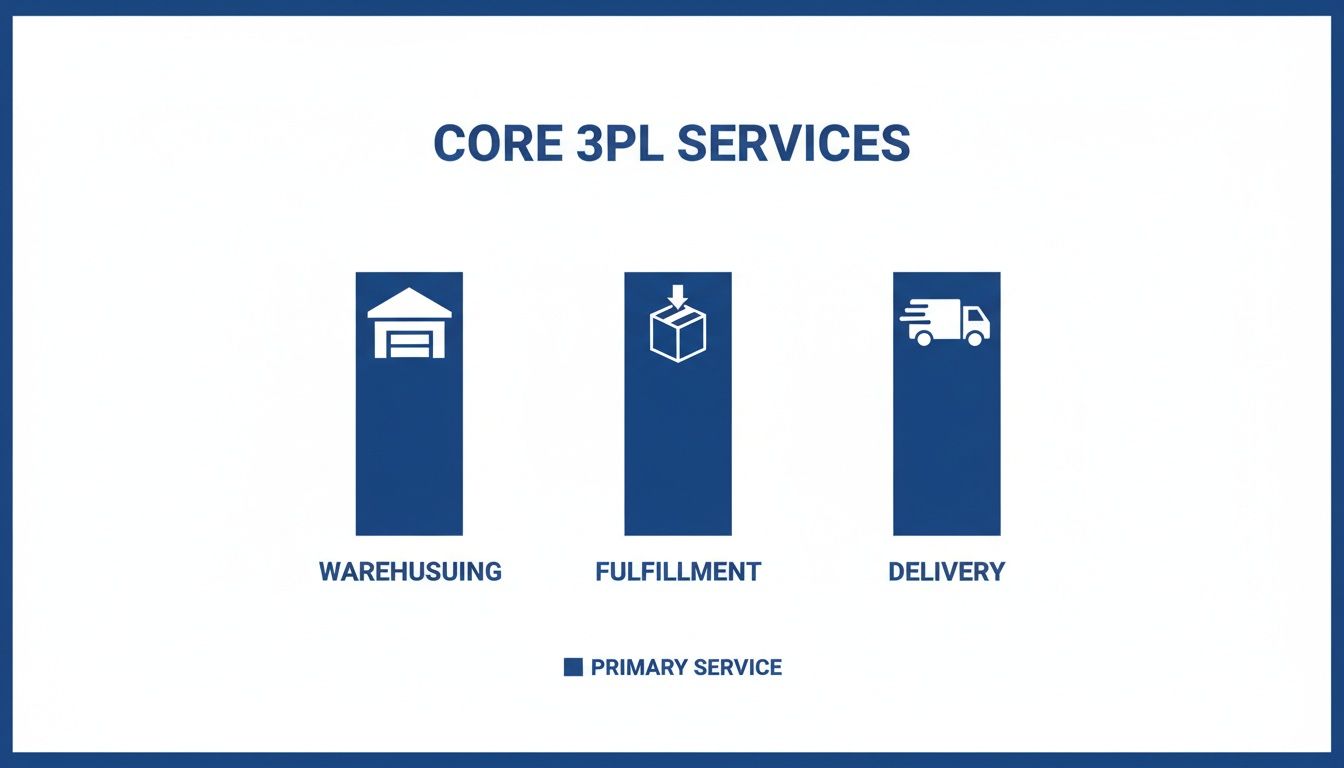
As you can see, these services—warehousing, fulfilment, and delivery—work together to form the complete operational backbone that lets an e-commerce business run smoothly.
To stay competitive, you need to know what’s happening on the ground. The big trends in the third party logistics industry today are all about meeting the modern customer’s demand for speed, accuracy, and transparency.
Actionable Insight: When vetting potential partners, ask them how they are actively investing in these areas. Their commitment to new technology and flexible models is a strong sign they can support your growth for the long haul.
Here are the most significant trends e-commerce sellers need to be watching:
The most important trend is the relentless drive to use technology to improve the customer experience. A 3PL that can ship faster and make fewer mistakes gives your brand a massive competitive advantage in a crowded market.
Ultimately, these trends show that the 3PL industry is becoming smarter, more flexible, and completely data-driven. Aligning your business with a provider that gets this is about building a tough, scalable supply chain that can meet whatever customer demands come next.
Picking a 3PL partner is a make-or-break decision for your e-commerce business. This involves more than just renting warehouse space; it’s about handing over a massive piece of your customer experience. The right partner becomes an extension of your team, a silent engine powering your growth. The wrong one leads to lost stock, late deliveries, and a flood of angry customer emails.
So, how do you find the right one? The process has to be methodical. Every business is different—what works for a massive enterprise is overkill for a growing Shopify store, and vice versa. Let’s walk through how to evaluate your options and find a 3PL that can actually keep up with your ambitions.
Before you even glance at a 3PL’s website, you need to get brutally honest about your own business. A crystal-clear picture of your operational needs is non-negotiable. Without it, you’re just comparing sales pitches.
Get specific about your products. Are you selling cosmetics that melt in the heat? You’ll need climate-controlled storage. Are your items big, bulky, or heavy? That requires special handling capabilities. These details will instantly slash your list of potential partners, filtering out those who can’t handle your inventory.
Next, look at your order volume. How many orders do you ship a month right now? More importantly, what’s your forecast for the next year? And don’t forget your peak seasons. If your sales go through the roof during the 11.11 sale, you need a partner with a proven track record of surviving those spikes without crumbling under the pressure.
In today’s third-party logistics industry, technology is the nervous system connecting everything. A 3PL’s tech capabilities are just as critical as its physical warehouse. You absolutely must have seamless integration between your sales channels and their warehouse management system (WMS).
This means your partner’s system needs to talk directly to your e-commerce platforms, whether you’re on Shopify, WooCommerce, Lazada, or TikTok Shop. The magic behind this connection is usually an Application Programming Interface (API).
Actionable Insight: An effective API connection puts your fulfilment on autopilot. When a customer places an order, it zips over to the 3PL’s system instantly—no manual entry, no copy-paste errors. It just works.
When you’re vetting potential partners, grill them with these tech questions:
A 3PL with a flimsy tech stack will cause constant headaches. One with robust, flexible technology will be a genuine growth partner.
The business you run today isn’t the one you hope to be running in two years. Your 3PL has to be able to scale right alongside you. That means having the physical space for more inventory, the manpower for more daily orders, and the network to support you as you expand into new markets.
Ask them about their capacity for growth. If your inventory doubles, can they find more shelf space for you? If a flash sale brings a tenfold spike in orders, do they have the processes to handle it? The ability to scale both up and down is crucial, ensuring you only pay for what you use while knowing they can handle your biggest wins.
Your geographic goals are also a huge piece of the puzzle. If you’re selling in Singapore today but have your eyes on Malaysia or Indonesia, you need a partner with a regional footprint. A 3PL with warehouses in multiple countries can be a game-changer for cross-border logistics, simplifying customs and getting products closer to your new customers for faster, cheaper shipping.
Practical Example: A Singaporean brand on Shopify wants to break into the Malaysian market. They should look for a 3PL with a warehouse in Johor Bahru or Kuala Lumpur and deep experience with customs clearance between the two countries. Making that strategic choice from day one will dramatically slash their last-mile delivery times and shipping costs for all their Malaysian customers.
Choosing a 3PL is a significant commitment, and a structured evaluation process can help you avoid costly mistakes. This checklist covers the critical areas you need to investigate to ensure you find a partner who aligns with your business goals, operational needs, and customer expectations. Use these questions as a starting point for your conversations.
3PL Partner Evaluation Checklist
| Evaluation Area | Key Questions to Ask | Why It Matters |
|---|---|---|
| Operational Capabilities | Do you handle products like mine (e.g., fragile, oversized, temperature-sensitive)? What are your standard operating procedures for receiving, picking, and packing? | Ensures they have the right infrastructure and processes for your specific inventory, preventing damage and errors. |
| Technology & Integration | Which e-commerce platforms do you integrate with? Do you provide a real-time inventory and order management dashboard? | Seamless tech integration is essential for automating order flow and maintaining visibility over your operations. |
| Scalability & Flexibility | How do you handle sudden spikes in order volume (e.g., during sales)? Can you scale services up or down based on seasonal demand? | Your 3PL must be able to grow with you. A partner that can’t handle your peak season will stunt your growth. |
| Geographic Footprint | Where are your warehouses located? Do you support cross-border fulfilment to my target expansion markets? | The right warehouse locations are key to reducing shipping times and costs, which directly impacts customer satisfaction. |
| Performance & Reliability | What are your documented accuracy rates for order picking and inventory? Can you share references or case studies from similar brands? | You’re trusting them with your reputation. You need proof they can deliver on their promises consistently. |
| Pricing & Contracts | Can you provide a clear, line-item breakdown of all potential fees? What are the contract terms, and is there flexibility? | Hidden fees can destroy your margins. A transparent pricing model and fair contract terms are non-negotiable. |
| Customer Support | Who is my dedicated point of contact? What are your support hours and typical response times for issues? | When problems arise (and they will), you need a responsive and helpful account manager who can resolve them quickly. |
By working through this checklist, you move beyond the sales pitch and get to the core of what each 3PL can actually deliver. Finding the right fit is about deep alignment on technology, operations, and vision for the future.
A solid technology connection is the absolute backbone of a successful 3PL partnership. Without it, you aren’t really automating anything; you’re just swapping one set of manual chores for another. The real magic happens when your systems can talk directly to your 3PL’s systems, creating an automated workflow that runs for you 24/7.
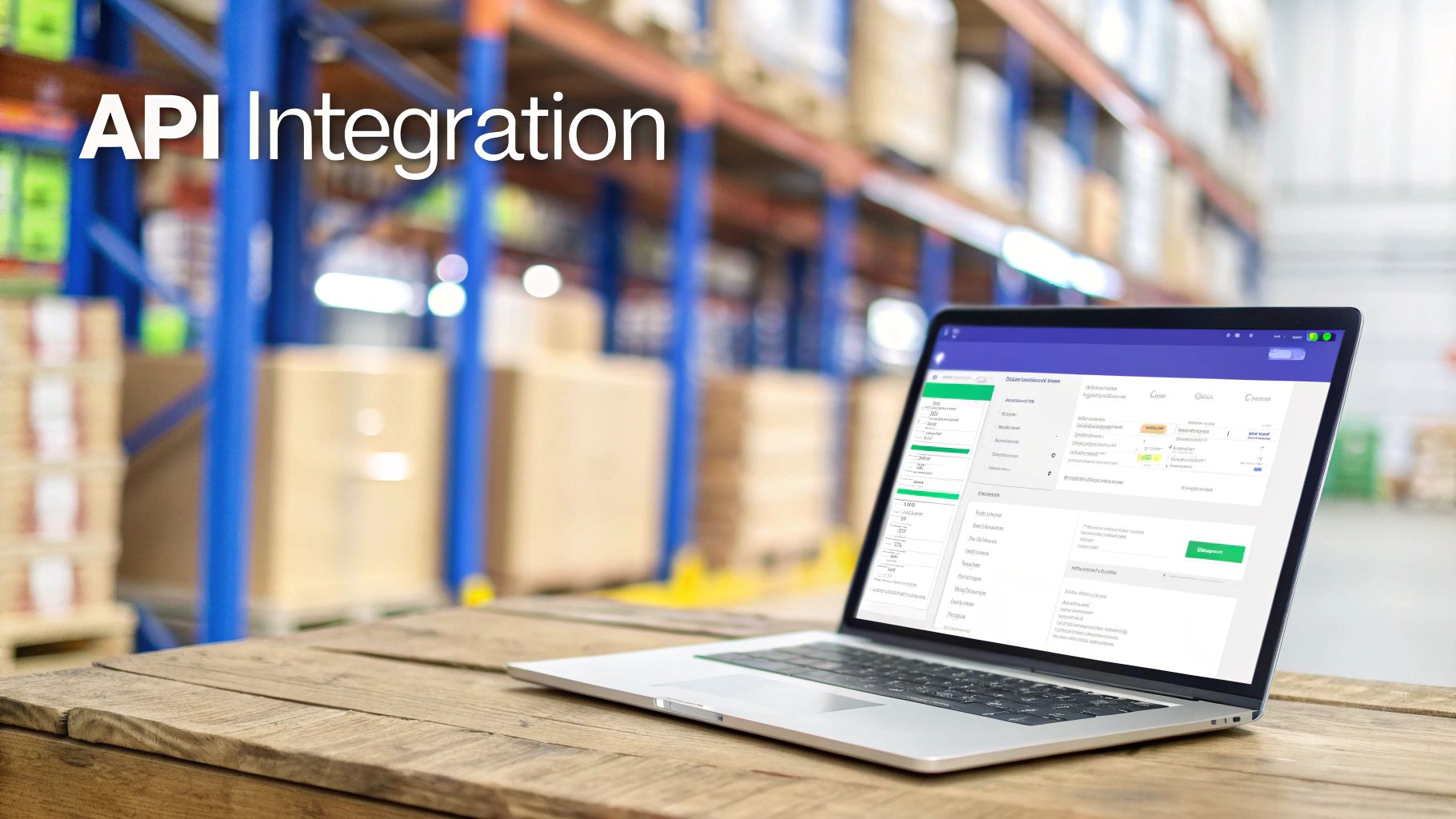
This digital conversation is made possible by an Application Programming Interface (API). The easiest way to think of an API is as a universal translator. It lets your e-commerce store—whether it’s on TikTok Shop or Shopify—speak the same language as your 3PL’s warehouse management software (WMS).
This digital handshake puts your entire fulfilment process on autopilot from the moment a customer clicks “buy.” No more downloading orders, emailing spreadsheets, or manually keying in customer addresses. The API takes care of it all, instantly and without mistakes.
Let’s walk through a real example. A customer finds your product on Shopee and places an order. The second their payment goes through, the API zaps all the order details—what they bought, where it’s going, the shipping method—straight into your 3PL’s system.
From there, your 3PL’s warehouse team sees the order pop up on their scanners, picks the items off the shelf, and packs the box. As soon as the shipping label is printed, the API sends the tracking number right back to your Shopee store. Shopee then automatically pings your customer to let them know their package is on its way.
Actionable Insight: This level of automation is a competitive necessity. It slashes human error, keeps your inventory perfectly synced across all sales channels to stop overselling, and frees up your team to focus on growing the business instead of getting bogged down in data entry.
The impact is huge, especially in fast-moving markets. In Singapore, e-commerce now makes up a massive 26.55% of the entire 3PL market, thanks to over 95% internet penetration. This means sellers on platforms like Shopee and Lazada are leaning heavily on 3PLs that can automate thousands of daily orders and provide real-time tracking. You can learn more about Singapore’s 3PL market dynamics on Mordor Intelligence.
A tightly integrated system does way more than just shuffle order data around. It becomes the central command centre for your entire logistics operation. Here are some of the biggest wins:
Ultimately, a strong tech connection between your storefront and your 3PL is what allows your business to scale. It’s what ensures your operations run just as smoothly whether you’re shipping 50 orders a day or 5,000. For businesses juggling multiple systems, getting these connections right is vital. You might find our guide on mastering ERP integration for optimal system performance helpful.
Figuring out how a 3PL charges you is absolutely critical. It’s the key to setting a budget, protecting your margins, and making sure the partnership actually makes you money.
While third-party logistics pricing can look complicated from the outside, most of it boils down to the specific services you actually use. Good partners are transparent, which helps you forecast your costs and pick a model that fits your business.
Most pricing plans fall into one of two buckets: flexible, pay-as-you-go models or predictable, fixed-rate plans. The right one for you really depends on your sales patterns and where you are in your growth journey.
This is the most common model you’ll see, especially in e-commerce. You get billed for exactly what you use. Think of it like your electricity bill—the more you use, the more you pay. It’s incredibly flexible and perfect for businesses with sales that go up and down.
Practical Example: A new fashion brand that goes viral on TikTok might see orders spike for a few weeks and then quiet down. A pay-as-you-go model is ideal here because they aren’t stuck paying high fixed fees during those slower months. They only pay for the orders that actually get shipped.
This model is usually itemised, so you’ll see specific charges on your invoice. Here are the usual suspects:
For businesses with steady, predictable sales, a fixed-rate (or all-in-one) model offers simplicity and makes budgeting a breeze. You pay a single, recurring monthly fee that covers a specific bundle of services, like a set number of orders and a certain amount of storage.
Practical Example: An established company selling daily supplements is a great fit for this. They know they ship roughly the same number of orders every single month, so a fixed cost makes financial planning completely straightforward. It removes the guesswork from per-order charges and makes accounting much cleaner.
Actionable Insight: The most important thing in any pricing discussion is transparency. A good 3PL partner will give you a clear, itemised quote with no hidden fees. This is the only way you can accurately calculate your real cost of fulfilment for every single order.
Before you sign anything, demand a complete list of every possible charge. Ask about the little things—packaging materials, account setup fees, or the cost of handling customer returns. Getting a clear picture of these costs upfront prevents nasty surprises later on and helps you protect your profit margins as you scale.
Got questions about the 3PL industry? You’re not the only one. Even experienced sellers sometimes need a quick refresher on the specifics.
Let’s clear up some of the most common queries we hear from e-commerce owners when they start looking for a logistics partner.
Onboarding can take anywhere from a few weeks to a couple of months, and the timeline really comes down to the complexity of your business and the 3PL’s tech.
For instance, if you’re running a standard Shopify store, you can often get up and running pretty fast using a pre-built integration. But if you’re a larger company that needs a custom API connection to your ERP system, expect a longer setup process.
The main steps are always the same: integrate your systems, ship your first batch of inventory to their warehouse, and get a quick tutorial on how their platform works.
This is a big one. A fulfilment centre typically does one core job: the pick, pack, and ship process for your customer orders. It’s a very specific, focused service.
A 3PL, on the other hand, offers a much wider range of logistics services. We’re talking warehousing, comprehensive inventory management, freight forwarding, kitting (product bundling), and even reverse logistics (handling all your customer returns).
Think of it this way: a fulfilment centre offers one piece of the puzzle, while a 3PL provides the entire logistics solution.
Actionable Insight: If you just need someone to ship orders, a basic fulfilment centre might be enough. But if you’re looking for a strategic partner to manage your entire supply chain—including inventory planning and returns—a full-service 3PL is the smarter choice.
Absolutely. In fact, many modern 3PLs are built from the ground up to support startups and small businesses. They get that new brands need flexibility to grow.
These 3PLs often use pay-as-you-go pricing. This means you can tap into professional-grade logistics without the massive fixed costs of leasing your own warehouse or hiring a full-time team. It’s the perfect way to scale your operations as your sales grow, letting you compete with bigger brands on delivery speed right from day one.
3PLs manage customer returns through a process called reverse logistics. When a customer sends a product back, it arrives at the 3PL’s warehouse, not your office.
From there, the 3PL’s team inspects the item based on criteria you’ve set. They’ll check its condition, decide if it can be restocked and resold, and then update your inventory levels in the system. This service is a huge time-saver, stopping you from getting buried under a pile of returns so you can focus on actually selling.
Ready to stop juggling multiple seller logins and start scaling your e-commerce operations? With OneCart, you can manage all your orders from Shopee, Lazada, TikTok Shop, and more from a single, powerful dashboard. Prevent overselling with real-time inventory sync and save hours every day with bulk order processing. See how top sellers grow their brands at https://www.getonecart.com.
Automate & Scale Your Online Business with OneCart
Start a Free TrialUsed by hundreds of merchants in Singapore & Southeast Asia