The Ultimate Guide to Third Party Logistics for Ecommerce 2026
Discover how third party logistics (3PL) can scale your ecommerce business. This guide covers benefits, services, pricing, and how to choose the right partner.
Discover how third party logistics (3PL) can scale your ecommerce business. This guide covers benefits, services, pricing, and how to choose the right partner.
What is third-party logistics? Think of it as the expert backstage crew for your online store. They manage all the physical tasks—storing your products, packing boxes, and shipping orders—so you can focus on growing your business.
Let’s look at a common scenario. Your e-commerce business is taking off. Orders are coming in from Shopify, Lazada, and TikTok Shop. It’s exciting, until you realize your living room has become a chaotic warehouse.
Suddenly, your day is no longer about marketing, developing new products, or talking to customers. Instead, it’s a race to print labels, wrestle with packing tape, and spend too much time in line at the post office. This is a classic growing pain for successful online sellers.
This is where a third-party logistics (3PL) provider can help. They are a partner you hire to handle these operational tasks. You send your inventory to their specialized warehouses. When an order comes through your store, their team picks the items, packs them professionally, and ships them directly to your customer. They become a seamless, invisible extension of your brand, managing the entire fulfillment process behind the scenes.
How do you know when it’s time to hire a 3PL? Ask yourself this simple question: Where is your time best spent?
If you find yourself spending more hours packing boxes than on activities that grow your brand—like creating a new marketing campaign or finding your next bestselling product—you have likely reached that tipping point.
Here’s a practical example: A home-based candle business starts receiving 30 orders a day. This is great, but the owner now spends four hours every single day just on fulfillment. That’s four hours they can no longer use to create new scents or engage with their community on social media. This fulfillment bottleneck is now slowing their growth.
Actionable Insight: Track your time for one week. If logistics tasks consistently take up more than 25% of your workday, it’s a strong sign that outsourcing could unlock significant growth. You are not just buying a service; you are buying back your time.
By handing off these repetitive tasks to a third-party logistics expert, the business owner instantly reclaims those valuable hours. This frees them up to think strategically, build their brand, and scale the business, all while knowing their customers’ orders are being handled efficiently and professionally. This shift often separates a small side hustle from a thriving, scalable brand.
Working with a third-party logistics provider is like having a flexible toolkit where you choose the exact services that solve your biggest operational problems. These services fall into two categories: core functions and value-added solutions, all of which can be tailored to your business.
The foundational services are what most people think of when they hear “3PL.” They cover the essential physical journey of your products, from the moment they arrive in a warehouse to when they reach your customer’s doorstep. This includes warehousing, managing your inventory, and distribution.
Beyond these basics, modern 3PLs offer a range of value-added services that can improve your operations and enhance customer satisfaction. These are the solutions that help your brand stand out.
The main benefit is that you can mix and match services to build a logistics strategy that fits your needs perfectly. This means you can address specific pain points without paying for features you don’t need.
Common services include:
This diagram shows you exactly where a 3PL partner fits in—right between your business and the core tasks of getting products to your customers.
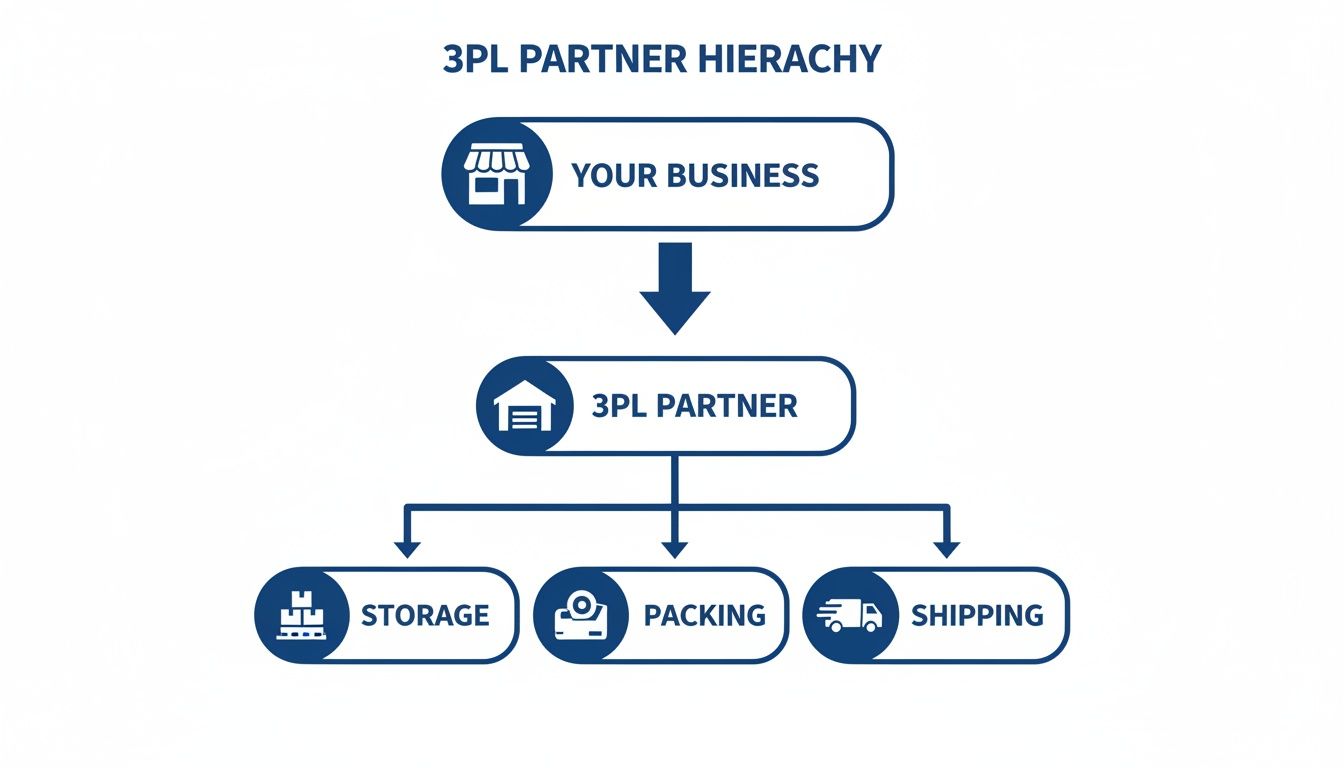
It’s a simple visualization of the fundamental relationship: you outsource the heavy lifting of storage, packing, and shipping to a specialized partner.
This is where a 3PL can become a true strategic partner. A great example is kitting and assembly, a popular service where the 3PL bundles multiple items together to create a new product, like a gift set.
Imagine you’re launching a new skincare product. Your 3PL could bundle it with a best-selling serum and package it as a limited-edition “Holiday Glow Kit”—all without you ever having to touch a single piece of inventory. This kind of service is a major driver of growth in the logistics market.
In Singapore, the third-party logistics market hit a USD 5.59 billion valuation. While transportation is the biggest slice of the pie, the Value-Added Warehousing & Distribution sector is set to grow at a 7.02% CAGR through 2031. This growth is powered by services like kitting and returns processing that are absolutely crucial for e-commerce brands to thrive. You can find more on these market trends in this in-depth report.
Other valuable add-ons could be custom packaging to create a memorable unboxing experience for your customers, or applying special labels for different sales channels.
Actionable Insight: Start by identifying your current operational bottlenecks. Are returns taking too long to process? Match that problem to a 3PL’s reverse logistics service. By directly aligning specific services with your biggest pain points, you ensure you’re only investing in solutions that genuinely boost your efficiency and keep your customers coming back.
Partnering with a third-party logistics (3PL) provider is a strategic move that can bring efficiency, expertise, and scalability to your business. It allows you to get back to focusing on what you do best: building your brand and delighting your customers.
The most immediate benefit is cost savings. A 3PL combines shipping volumes from all its clients, giving them the leverage to negotiate lower courier rates. These are discounts a single small business could rarely get on its own.
You also benefit from their shared overhead costs for warehouse space, staff, and technology. This eliminates the need for you to invest a large amount of capital into building your own fulfillment center. Your logistics costs become a flexible, variable expense instead of a fixed one. You only pay for the space and services you use, which makes your cash flow more predictable.
Beyond cost savings, the biggest benefit might be reclaiming your time. When you’re not busy printing labels, packing boxes, and managing inventory, you can redirect that energy into activities that grow your business, such as marketing, product development, and customer service.
This is about shifting your focus from low-impact operational tasks to high-impact strategic activities. Instead of managing warehouse staff, you could be planning your next product launch or refining your ad campaigns.
Practical Example: An online apparel brand spends three hours a day processing about 50 orders. By outsourcing to a 3PL, the founder instantly reclaims 15 hours every week. They use that newfound time to secure two new wholesale accounts and launch an influencer marketing campaign—both activities that directly drive revenue and grow the brand.
One of the biggest challenges for a growing e-commerce brand is handling fluctuations in order volume. A massive surge during a flash sale or Black Friday can overwhelm an in-house team, leading to shipping delays and unhappy customers.
A good third party logistics partner is designed for this. They have the staff, space, and systems to handle large order spikes efficiently. This means your fulfillment can scale up and down with your marketing efforts. You can launch an ambitious sales campaign with confidence, knowing your operations can handle the increased volume.
Actionable Insight: Calculate the opportunity cost of your time. If you value your time at $50 an hour and you’re spending 10 hours a week on logistics, that’s a $2,000 monthly opportunity cost. Comparing that figure against a 3PL’s quote can provide a clear picture of the potential return on investment.
You also gain immediate access to a team of experienced logistics professionals and their sophisticated technology. They have years of experience optimizing warehouse layouts, managing inventory with powerful software, and navigating complex shipping regulations. Their expertise helps you avoid common mistakes and continuously improve your supply chain without you having to become a logistics expert yourself.
Choosing a third-party logistics provider is a major decision. You are entrusting your entire operations department to an external team. A good choice can accelerate your growth, while a poor one can lead to customer service issues.
To make a smart choice, start by understanding your own business needs clearly. Begin by analyzing your daily order volume—what’s your average, and what does it look like during your busiest season?
Next, be specific about your products. Are you shipping fragile glassware that needs special handling? Or perhaps food items that require temperature-controlled storage? These details are important. For example, a business selling frozen meals needs a 3PL with certified cold storage facilities, which immediately narrows the list of potential partners.
Finally, list all your sales channels. A 3PL that integrates seamlessly with Shopify and Lazada is great, but if a large portion of your sales comes from TikTok Shop, you must ensure they can handle that integration as well.
Once you understand your requirements, you can start evaluating potential 3PLs. Your goal is to find a partner whose skills and systems match your needs. This is where you move beyond sales pitches and conduct a practical, side-by-side comparison.
Focus on these critical areas:
The best way to make an objective decision is to use a structured evaluation process. Create a simple scorecard to rate your top candidates against the criteria that are most important for your business.
Actionable Insight: This structured approach prevents you from being swayed by a flashy sales pitch and helps you focus on operational capability. It transforms a complex decision into a clear, data-driven choice.
Here’s a sample checklist you can adapt. Score each provider on a scale of 1 to 5, where 5 is the best fit. A simple framework like this makes it easy to see which provider is the best match for your needs.
| Evaluation Criteria | Provider A Score (1-5) | Provider B Score (1-5) | Notes |
|---|---|---|---|
| Shopify Integration Quality | 5 | 3 | Provider A has a native, real-time sync. |
| Warehouse Proximity to Customers | 4 | 5 | Provider B is closer to our main market. |
| Transparent Pricing Structure | 4 | 2 | Provider B has many potential surcharges. |
| Custom Packaging Capabilities | 5 | 4 | Both are good, but A offers more options. |
| Returns Processing Efficiency | 3 | 5 | Provider B has a clearer, faster process. |
Adding up the scores gives you a clearer picture, helping you weigh the pros and cons logically.
Choosing and managing a 3PL partner is fundamental to your long-term success. These principles align with general vendor management best practices that are valuable for any external partnership. Ultimately, using a scorecard gives you the confidence to select the best third party logistics partner for your brand’s unique journey.
Understanding the financial side of a third party logistics partnership is key to ensuring it benefits your bottom line. To budget properly and avoid unexpected invoices, you need a clear picture of what you’re paying for and how each fee is calculated.
Most 3PLs base their pricing on the physical journey of your product. Every step, from the moment your stock arrives at their warehouse to when it reaches a customer’s doorstep, has an associated cost.
While every 3PL’s quote will look a bit different, you can expect to see charges for these standard activities. It’s important to get an itemized list so you can understand how the total cost is calculated.
When you receive a quote, it will likely follow one of two main structures.
Some 3PLs use an itemised model, where every service is listed as a separate line item. This provides transparency, allowing you to see exactly what you’re paying for.
The other common approach is an all-in-one fulfillment fee. This bundles several costs, like receiving, storage, and pick-and-pack, into a single rate per order. It simplifies accounting but can sometimes hide inefficiencies. For instance, you might pay the same fulfillment fee for a simple, one-item order as you would for a complex, five-item order.
Actionable Insight: Do not just accept a quote at face value. Ask for a fully itemized breakdown, even if they have offered an all-in-one price. Then, pull your sales data from an average month and run a cost simulation. Calculate what your total 3PL bill would have been with that provider.
This exercise is the most effective way to avoid surprises. By running your real-world order volume against their fee structure, you get an accurate forecast of your monthly logistics spend. It also lets you compare different 3PLs on an apples-to-apples basis, showing you how each pricing model impacts your profit margins. This foresight helps build a healthy, sustainable partnership with your third party logistics provider.
A successful third party logistics partnership relies on solid technology. This connection allows your online store and your 3PL’s warehouse to communicate seamlessly, turning a manual process into an automated workflow that keeps your business running smoothly and your customers happy.
At the core of this is real-time data synchronization. When a customer places an order on your Shopify store, that order needs to appear in your 3PL’s system instantly. When the warehouse team packs and ships that order, your inventory levels must update across all your sales channels—Lazada, TikTok Shop, your own website—in seconds.
This instant communication is essential. It prevents you from selling an item that is out of stock, a mistake that can erode customer trust. It also enables automated shipping notifications that keep your customers informed, from the moment they place their order until the package arrives. These updates significantly improve the customer experience, and you can learn more about setting up an advanced shipping notification process to see its benefits.
Getting your e-commerce stack and your 3PL to communicate typically involves a few key steps.
Check for Pre-Built Integrations: The ideal scenario is a native, one-click integration. Many modern 3PLs offer ready-made connections for major platforms like Shopify and WooCommerce, as well as major marketplaces. These are designed to be plug-and-play, so you don’t need a developer to set them up.
Understand APIs for Custom Connections: If a pre-built option isn’t available, the connection will be made through an Application Programming Interface (API). An API is a set of rules that allows different software to communicate. Your 3PL should provide clear, well-documented APIs that your developer can use to build a custom connection between your systems. For example, your developer could use the 3PL’s API to build a function that automatically sends order information from your custom-built e-commerce site to the 3PL’s fulfillment software.
A solid 3PL integration is also the foundation for more advanced tools that can save you time and prevent costly mistakes.
Actionable Insight: Do not treat technology as an afterthought. Before signing a contract, request a full demo of the 3PL’s software portal. Ensure they have solid, well-documented integrations for the sales channels you use today, and also for the ones you plan to expand to in the future. This foresight will prevent future headaches and ensure a smooth, automated operation.
Considering a partnership with a third party logistics provider is a significant step, and it’s natural to have questions. Here are some of the most common ones we hear from e-commerce merchants, with clear answers to help you decide on your next move.
The tipping point often arrives when you realize you’re spending more time on logistics than on core business activities like marketing, sales, or product development. If you’re consistently processing 50-100+ orders a day, that’s a strong indicator.
Other signs include your storage space (like a spare room or garage) becoming unmanageable, missing shipping deadlines, or making fulfillment errors that lead to unhappy customers. A practical example is a business owner who has to stop taking new orders for a day just to catch up on packing and shipping from the previous day’s sales. The goal is to make the switch before logistics becomes a bottleneck that hinders your growth.
It can feel like you’re giving up control, but a good 3PL provides complete digital control. You’ll get access to their Warehouse Management System (WMS), a software portal that gives you a real-time overview of your inventory.
Think of it as a centralized dashboard for your operations. You can see exact stock levels, track the status of every order, and monitor shipments from your computer, without being in the warehouse. You maintain full visibility and control, without the physical work.
Actionable Insight: Treat the WMS demo as a crucial part of your evaluation. If the software is clunky, slow, or confusing, that is a major red flag. It indicates how easy (or difficult) it will be to manage your inventory and operations remotely. A good WMS should allow you to easily search for orders, view inventory counts for specific SKUs, and generate reports on fulfillment speed.
Yes, most modern third party logistics partners understand the importance of branding. They typically offer value-added services that include using your custom boxes, branded tape, and even inserting promotional materials into packages. Maintaining a special unboxing experience for your customers is vital, and a good 3PL should act as an extension of your brand.
Be sure to discuss your specific packaging needs early in your conversations. Clarify any related costs and confirm that a potential partner can execute your branding vision. This is a non-negotiable step before signing a contract. A memorable unboxing experience can significantly improve customer loyalty.
Managing inventory, orders, and fulfilment across multiple channels is a massive headache. OneCart simplifies everything by unifying your operations into a single, easy-to-use dashboard. Sync your stock in seconds, process orders from any platform, and grow your business without the logistical nightmares. Learn how OneCart can streamline your e-commerce operations.
Automate & Scale Your Online Business with OneCart
Start a Free TrialUsed by hundreds of merchants in Singapore & Southeast Asia