Shopee vs Lazada Singapore Which Is Best for Your Store 2026
Choosing between Shopee vs Lazada? Our guide analyzes fees, logistics, and audiences to help Singapore sellers pick the right platform for real growth.
Choosing between Shopee vs Lazada? Our guide analyzes fees, logistics, and audiences to help Singapore sellers pick the right platform for real growth.
When you’re trying to figure out the Shopee vs Lazada puzzle, the short answer for most Singapore sellers is this: Shopee is where the crowd is. It has a massive lead in user traffic and overall market share, making it the go-to starting point if you want to reach the most people, fast.
But don’t count Lazada out. It holds its own with a more brand-savvy audience, creating some really interesting opportunities for sellers with more premium products.
For anyone setting up shop online in Singapore, choosing between Shopee and Lazada is your first big decision. They are both titans of e-commerce, but they serve slightly different crowds and come with their own unique perks. Getting this right from the start is crucial because it aligns your entire business model with the platform that will give you the best shot at success.
The numbers tell a big part of the story. In 2022, Shopee accounted for a whopping 53% of Singapore’s e-commerce Gross Merchandise Value (GMV), with Lazada following at 35%.
What’s driving that gap? Eyeballs. Shopee pulls in an incredible 13.21 million monthly visitors, which is more than double Lazada’s traffic. This is a huge advantage in a market where nearly 60% of shoppers are buying something online at least once a week. If you want to dig deeper into these trends, Cube Asia’s market analysis is a great resource.
This infographic paints a pretty clear picture of who’s leading the race.
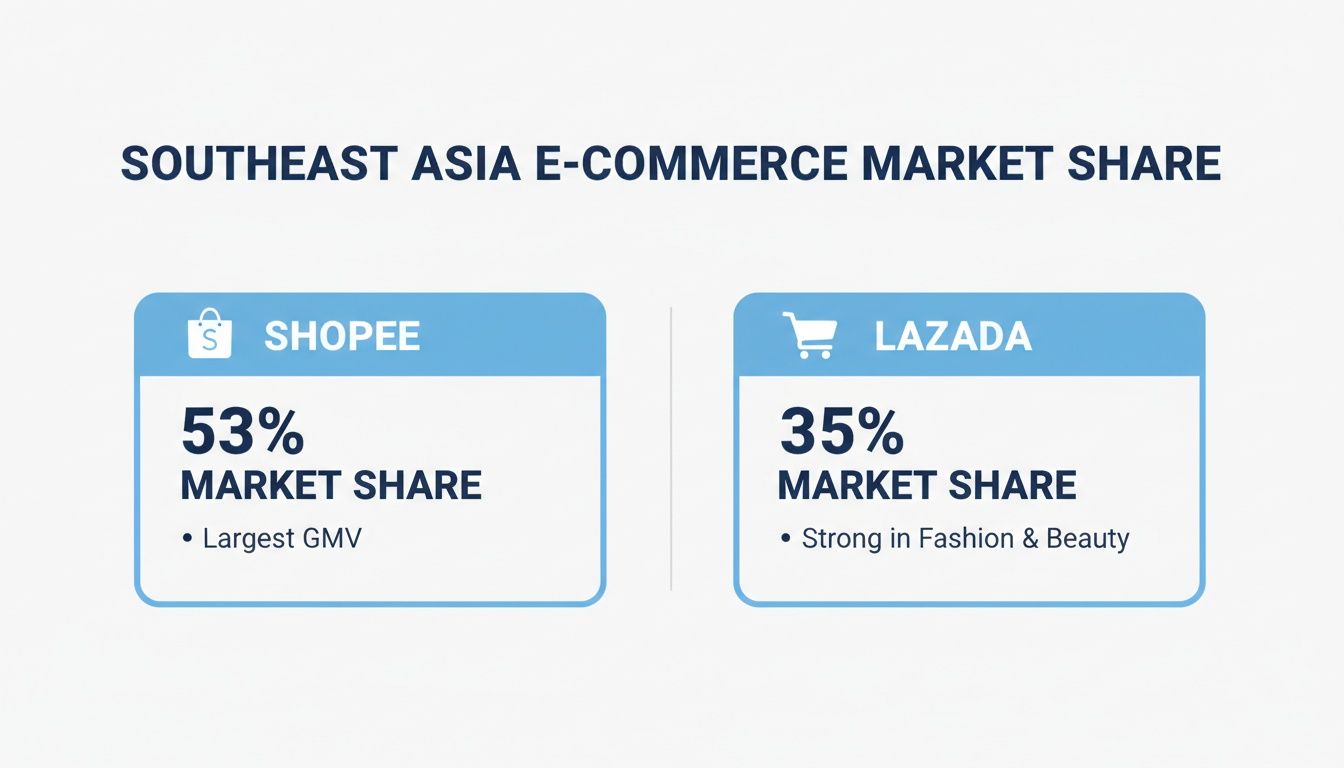
Shopee’s dominance here translates directly into a larger pool of potential customers right out of the gate for any new seller.
To cut through the noise, let’s look at the core differences that really matter when you’re just starting out. Shopee acts like a massive, bustling digital bazaar—it’s all about deals, trends, and high-volume sales. Lazada, on the other hand, feels more like a curated online shopping mall, especially with its LazMall offering.
Here’s a quick table to break down the key distinctions at a high level.
| Factor | Shopee | Lazada |
|---|---|---|
| Primary Audience | Younger, mobile-first, price-sensitive shoppers | Brand-conscious buyers, slightly older demographic |
| Popular Categories | Fast fashion, beauty, mobile accessories | Home appliances, electronics, official brand goods |
| Platform Vibe | Social, gamified, and deal-driven | Structured, premium, and brand-focused |
| Seller Onboarding | Generally faster and simpler for new sellers | More stringent, especially for LazMall verification |
The takeaway here is pretty straightforward: match the platform to your product and business strategy.
Actionable Insight: If your business is built on moving high volumes with competitive prices—think phone cases or the latest trendy apparel—Shopee’s enormous traffic is exactly what you need. But if you’re an authorised distributor for a premium electronics brand, the brand-focused audience on LazMall might be far more valuable, even with lower overall traffic.
This high-level view gives you a strategic starting point. Now, let’s dive deeper into the nitty-gritty details like fees, logistics, and marketing tools to really see where each platform shines.
Choosing between Shopee and Lazada is about finding the right crowd for your products. Each marketplace has its own distinct vibe and attracts a different kind of shopper. If you get this match right from the get-go, you avoid burning cash on ads that don’t convert and get your products in front of people who are actually ready to buy.
Think of Shopee as a massive, bustling digital street market. It’s loud, fast-paced, and built on the thrill of the hunt. It pulls in a younger, mobile-first crowd that lives on deals, follows trends, and loves the social, almost game-like, shopping experience.
Lazada, on the other hand, operates more like a well-organised online department store. Its shoppers are often a bit older, more established, and they really care about brand trust and product quality. They’re usually willing to pay a premium for items they know are the real deal, which is why LazMall is such a huge draw.
Shopee’s entire platform is engineered for engagement. You’re not just shopping; you’re participating. Its audience is hooked on:
This high-energy environment is a goldmine for sellers whose products have mass appeal, are price-sensitive, or can be sold in high volumes. If you’re selling quirky phone cases, fast fashion, or affordable skincare, Shopee’s massive and eager audience is waiting for you.
Lazada offers a more curated and premium shopping journey, which naturally attracts a different type of customer. These buyers are typically on the lookout for:
So, if you’re an authorised distributor for a well-known kitchen appliance brand or you sell high-end home organisation products, Lazada is your spot. Its brand-conscious buyers are less likely to be swayed by a small price difference and more focused on getting a quality, dependable product.
Key Takeaway: The Shopee vs Lazada debate really boils down to your product’s core appeal. If you compete on price, trends, and volume, Shopee’s massive, deal-hungry audience is your best bet. If your strength is brand trust, quality, and a higher price point, Lazada’s more discerning customer base will be a much better fit.
Recent sales figures from Singapore back this up. While Shopee and Lazada together pulled in about $280 million in revenue, their top-performing categories told very different stories. On Shopee, Apparel & Fashion dominated with a 27.3% market share. Over on Lazada, Health & Beauty and Home & Lifestyle Supplies were the powerhouses, making up nearly 40% of its sales.
Getting a handle on buyer behaviour on each platform is crucial. Understanding your customer’s journey from browsing to purchase can give you a massive leg up here. The data clearly shows Shopee’s strength in fast-moving consumer goods and trends, while Lazada excels in more considered purchases for the home and personal wellness.
Let’s talk about the money. Understanding the real cost of selling is absolutely critical if you want to be profitable on either Shopee or Lazada. It’s easy to look at the headline commission rate and think you have it figured out, but your cash flow and bottom line depend on you looking deeper.
Both platforms will take a cut of your sales through a base commission fee. This is a straightforward percentage of your product’s price. But that percentage changes depending on what you’re selling and whether you’re a standard marketplace seller or part of a premium programme like LazMall or Shopee Mall.
For instance, if you’re selling consumer electronics, you might find a 3% commission on Lazada. Shift over to fashion on Shopee, and that rate could jump closer to 5%. While these numbers look small on their own, they add up incredibly fast when you’re processing hundreds of orders a month.
Beyond that base commission, other fees are waiting to chip away at your margins. Both Shopee and Lazada charge a transaction fee (sometimes called a payment gateway fee) of about 2%. This is a non-negotiable cost on every single successful order that covers the expense of processing your customer’s payment.
Where the two platforms really start to show their differences is in their programme fees. Shopee, for example, heavily promotes its Coins Cashback and Free Shipping Special Programmes. These are undeniably powerful for attracting buyers, but they don’t come free. Joining them typically adds another 3-5% to your total fees for that order.
Actionable Insight: Before you click “join” on any of these special programmes, run the numbers. Calculate your product’s break-even point. For items with already slim margins, piling on commission, transaction, and programme fees can easily turn a sale into a loss, even if your sales volume goes up.
To help you visualise how these costs stack up, here’s a clear breakdown of the typical fees you’ll encounter on both platforms.
| Fee Type | Shopee Details | Lazada Details |
|---|---|---|
| Commission Fee | Varies by category (2-6%). Mall sellers pay higher rates. Often a cap for electronics. | Varies by category (2-8%). LazMall sellers are on the higher end of the scale. |
| Transaction Fee | A standard ~2% fee on the final payment amount to cover payment processing. | A standard ~2% payment gateway fee on successful orders. |
| Programme Fees | Optional but highly encouraged. 3-5% extra for Coins Cashback & Free Shipping programmes. | Included for LazMall sellers. Standard sellers can join campaigns with associated costs. |
| Shipping & Logistics | Sellers often subsidise a portion of the shipping cost, even with platform vouchers. | Similar structure where sellers may need to cover the difference between the actual shipping cost and what the buyer pays. |
As you can see, what starts as a simple commission can quickly become a multi-layered cost. Always factor in these additional fees when pricing your products.
How much you get paid is important, but how quickly you get that money is just as crucial for managing your business. Cash flow is king, especially when you need to restock inventory quickly.
Both Shopee and Lazada use an escrow-based system. This means they hold the customer’s payment safely until the order is confirmed as delivered.
The real difference for sellers is in the payout schedule. Shopee gives you a bit more control with its manual withdrawal system from the Seller Wallet. Lazada’s automated weekly payout is reliable and predictable, but it’s less flexible. If you want to get a precise forecast of your potential take-home pay on Lazada, using a good Lazada fee calculator can help you model different sales scenarios.
When you weigh it all up, Shopee might offer slightly lower base commissions in some categories, but the optional (and often essential) programme fees can drive the total cost up. Lazada, especially for LazMall brands, has higher commissions but bundles it into a structured package that builds the kind of trust brand-conscious shoppers look for.
How quickly and reliably you get products to your customers is just as critical as the sale itself. Both Shopee and Lazada have built impressive logistics networks, but they’ve taken different paths. Understanding these differences is key to managing your operational costs and keeping your customers happy.
Shopee runs Shopee Supported Logistics (SSL), which is a curated network of third-party partners, including its own in-house fleet, SPX Express. This setup gives sellers a variety of courier options, often with shipping rates made more competitive by Shopee’s heavy use of voucher subsidies.
Lazada relies more heavily on its own logistics powerhouse, Lazada Express (LEX), while also working with other third-party providers. This gives them much tighter control over the end-to-end delivery journey, which often translates to more consistent service, especially in dense urban centres.
For your daily grind of packing and shipping, your decision boils down to convenience versus cost. Both platforms have you covered with pickup services and a massive network of drop-off points across Singapore.
The practical difference is in how you manage your daily fulfilment. Shopee gives you choice; Lazada offers a more controlled, proprietary system.
For sellers ready to hand over the keys to their warehousing and packing, both platforms offer full-service fulfilment. This is where their strategic differences really shine.
Fulfilled by Shopee (FBS) is built for speed and volume. It’s best suited for sellers with fast-moving, smaller products. The entire system is optimised for rapid processing to leverage Shopee’s logistics network, getting items to buyers in a flash—a must-win for high-volume categories.
Fulfilled by Lazada (FBL) often makes more sense for businesses dealing with larger or bulkier items, like home appliances or furniture. FBL’s warehousing infrastructure and fee structure can be much more cost-effective for products that take up more space and might have a slower sales cycle.
Scenario-Based Insight: Imagine you sell phone cases. FBS would be a no-brainer; its efficiency is designed for high-turnover inventory. Now, picture yourself selling premium office chairs. The storage costs and handling capabilities of FBL would almost certainly be a much better financial and operational match for your business.
Choosing the right logistics partner is a cornerstone of your operational strategy. For a deeper dive into how all these pieces fit together, you can learn more about optimising your warehousing and logistics for selling across multiple channels. Ultimately, the best network depends entirely on your product type, sales volume, and how much control you want over the delivery experience.
Getting your products listed is the easy part. The real challenge is making sure people actually see them. In crowded marketplaces like Shopee and Lazada, your success often hinges on how well you play the advertising game. Both platforms offer some powerful tools to get you noticed, but they’re built for different strategies and play to different seller strengths.
Shopee’s ad ecosystem is all about engagement and discovery, making it super accessible for sellers of any size to jump in and get started. Lazada’s Sponsored Solutions, on the other hand, is a more structured, performance-focused suite of tools. It appeals to brands that want to zero in on high-intent buyers and meticulously track their return on ad spend.
Shopee’s main advertising tools are straightforward and they work. The core of it is Shopee Ads, which covers keyword-based search ads and discovery ads that pop your products in front of users browsing similar items. The real-time bidding system is pretty intuitive, so you can set up campaigns quickly to push traffic to specific products without a steep learning curve.
But where Shopee really changes the game is with Shopee LIVE. This is a way to connect with customers through live streaming in a really dynamic, interactive way. It’s a killer feature for doing product demos, running flash sales, and building a genuine community around your brand.
Think about a new local beauty brand launching a lipstick line.
Lazada’s advertising suite, called Sponsored Solutions, is built for precision. It gives sellers a scalpel to target customers at different points in their buying journey.
It really boils down to two main pillars:
Actionable Insight: If you have a solid grasp of how your customers search, Lazada’s Sponsored Discovery is an absolute goldmine. You can target very specific, long-tail keywords to capture high-intent buyers, making sure your ad budget is spent on shoppers who are literally moments away from clicking “buy.”
Imagine an electronics store selling specific camera models. Using Sponsored Discovery, they could bid on keywords like “Sony A7IV camera body” or “Canon R6 with kit lens.” This puts their product directly in front of someone who knows exactly what they’re looking for. This surgical approach almost always delivers a higher Return on Ad Spend (ROAS) compared to broader, more discovery-focused campaigns.
Ultimately, whether you lean towards Shopee or Lazada’s marketing tools comes down to your business goals. If you want to create buzz, build a community, and reach a massive audience, Shopee’s tools are fantastic. If you’re all about targeting serious buyers and maximising conversions, Lazada provides the structured, performance-driven solutions to get it done.
The real answer is about finding the one that syncs up with your specific business model, your products, and your goals. Think of it less like a competition and more like a strategic partnership.
Picking the right home for your online store from day one is critical. A mismatch can mean burning through your ad budget with little to show for it, while the right fit can feel like putting your business on a rocket ship. Let’s break down the common seller types to see where you’ll most likely thrive.
Shopee is a bustling digital marketplace. It’s fast, loud, and packed with a massive audience hungry for deals. Its entire ecosystem is practically engineered for sellers who win through sheer volume, jumping on trends, and competitive pricing.
You’ll probably feel right at home on Shopee if you’re one of these:
Here’s a real-world example: Imagine you sell custom-printed phone cases. Using Shopee’s flash sales and seller tools, you could easily move hundreds of units in a single day. The platform’s algorithm loves high sales velocity, so a successful promotion can actually boost your organic ranking, creating a self-feeding growth loop.
Lazada, especially with LazMall, has carved out a space that feels more like a premium online shopping mall. This makes it the go-to choice for sellers whose value comes from trust, quality, and authenticity—not just the lowest price tag.
Lazada is likely a better fit for your business if you fall into these camps:
Ultimately, the Shopee vs Lazada choice boils down to a simple question about your own business. Are you built for the fast-paced, high-volume sprint of a digital bazaar, or the curated, trust-driven marathon of an online mall? Figure that out, and you’ll know exactly which platform gives you the best shot at success.
After weighing up Shopee vs Lazada, you’ll likely come to the same conclusion as most experienced sellers: the smartest move isn’t to pick one, but to sell on both. This strategy immediately doubles your reach, putting your products in front of two massive, distinct pools of ready-to-buy customers.
But it also creates a huge operational bottleneck. How do you manage two separate seller centres, two inventories, and two streams of orders without doubling your workload or making costly mistakes?
The key is to stop juggling platforms and start managing your business from a single, unified dashboard. This is where multi-channel management software is no longer a ’nice-to-have’—it’s essential. It turns a potential nightmare into a powerful growth engine.
A centralised system like this means you can see and manage products across all your stores from one screen.
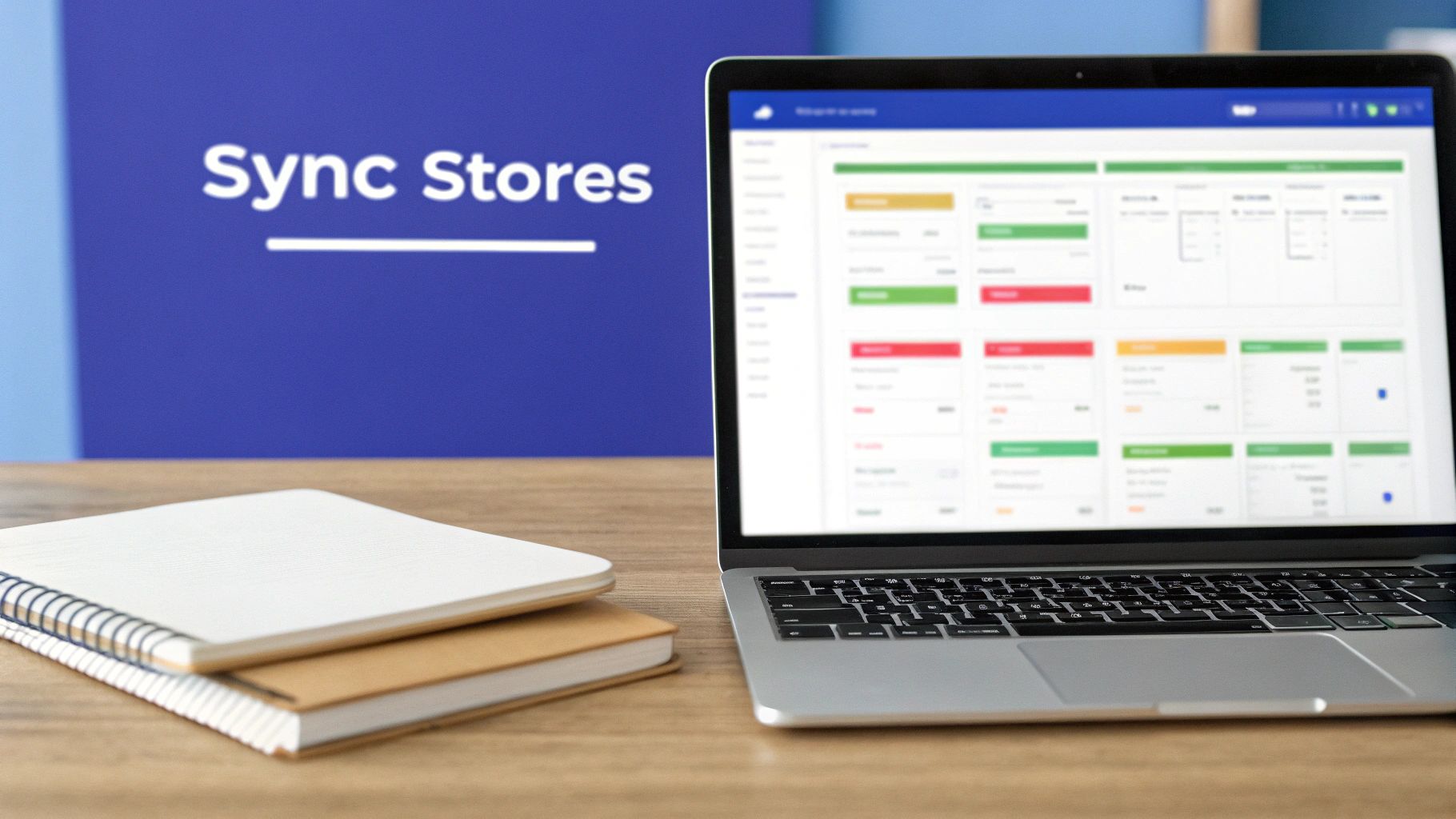
This approach eliminates the constant tab-switching between different seller centres, streamlining your entire workflow from a single command centre.
Trying to run two stores manually always leads to the same predictable, painful problems. These are the issues that can seriously tank your store ratings and eat into your profits. A centralised system tackles these head-on with automation, giving you back precious time and preventing the errors that hurt your bottom line.
Here’s how it works in practice:
Actionable Insight: The single most critical function of any multi-channel tool is inventory synchronisation. During massive sales like 11.11 or 12.12, when orders are flooding in every second, manual updates are simply impossible. Automated syncing is the only way to sell confidently on both platforms without the constant fear of overselling and wrecking your store’s reputation.
By automating the tedious, manual grind of running two stores, you free up yourself and your team to focus on activities that actually grow the business—like marketing, sourcing new products, and delivering stellar customer service. You can learn more about the technical side of how to sync inventory for Shopee and Lazada to see exactly how it works.
This approach lets you scale your sales without scaling your headcount or your stress levels. You can easily add more sales channels down the line, like TikTok Shop or your own Shopify site, without adding complexity.
And let’s be honest, selling online isn’t always smooth sailing. It’s smart to be prepared for common challenges like account suspensions, chargebacks, and brand protection issues. Having a streamlined, automated operation gives you the bandwidth to handle these bigger-picture problems when they arise.
Suddenly, the whole “Shopee vs Lazada” debate becomes irrelevant. The real question is, why choose when you can master both?
When you’re weighing up Shopee and Lazada, a few common questions always pop up. Let’s tackle them head-on so you can make a smarter decision for your business in Singapore.
This is a classic “it depends” situation. Both Shopee and Lazada have their Seller Centres, but the experience feels different on the ground.
Lazada tends to offer more structured, hands-on support, especially for brands on LazMall. It’s not uncommon for these sellers to get a dedicated account manager who can actually help with strategy and troubleshoot tricky problems.
Shopee’s support is built for scale. It’s generally quick and accessible for the massive number of sellers on the platform, but it can feel a bit more automated for routine stuff. For day-to-day queries, it works just fine. But when a critical operational issue hits, response times can be a mixed bag on both platforms. The real lesson here? Build solid internal processes instead of relying completely on platform support to save the day.
For a new seller just dipping their toes in, Shopee is generally the faster route. The onboarding is famously quick and painless. You can get your products listed and be ready to sell in a remarkably short amount of time.
Lazada’s process, particularly if you’re aiming for that official LazMall status, is more thorough. They require more documentation and verification to maintain brand integrity, which is a good thing for buyers but an extra step for you. While both have made their basic sign-up pretty straightforward, Shopee is without a doubt the quickest path from registration to your first potential sale.
Here’s a practical tip: If your main goal is to get to market fast and test out a new product idea, start with Shopee. Its simple setup lets you validate your concept with the least amount of administrative friction.
Yes, and you absolutely should. Selling the same items on both Shopee and Lazada isn’t just allowed—it’s one of the best ways to maximise your reach in Singapore. You’re effectively tapping into two distinct, massive pools of customers at the same time.
The real challenge isn’t listing your products; it’s the day-to-day operational headache, especially managing your inventory. When an item sells on one marketplace, the stock level on the other needs to update instantly. If it doesn’t, you risk overselling, which leads to cancelled orders and a nasty hit to your store’s reputation.
Picture this: You’re running a flash sale. Your last 10 units of a hot-ticket item sell out on Shopee in minutes. You need your Lazada listing to immediately switch to “Out of Stock.” Trying to do that manually is a recipe for disaster. This is exactly why a multi-channel inventory management system is non-negotiable for anyone serious about a dual-platform strategy. It syncs your stock levels automatically, letting you sell aggressively without the constant fear of overselling.
Ready to stop juggling and start growing? OneCart centralises your Shopee and Lazada operations into a single powerful dashboard. Sync inventory in seconds, process orders in bulk, and manage your entire business without the headache. Discover how you can scale smarter at https://www.getonecart.com.
Automate & Scale Your Online Business with OneCart
Start a Free TrialUsed by hundreds of merchants in Singapore & Southeast Asia