How to Start an Online Business in Singapore [2026 Guide] 2026
Start your online business in Singapore — ACRA registration, Shopee vs Shopify, GST rules, and how to scale across marketplaces in 2026.
Start your online business in Singapore — ACRA registration, Shopee vs Shopify, GST rules, and how to scale across marketplaces in 2026.
Singapore’s e-commerce market hit US$9.4 billion in gross merchandise volume (GMV) in 2025, with projections pointing toward US$13 billion by 2028. Whether you are selling on Shopee, building a Shopify store, or listing on TikTok Shop, the opportunity for a new online business in Singapore has never been stronger.
But before your first sale, there is essential groundwork: registering with ACRA, choosing the right legal structure, setting up your finances, and picking your sales channels. This guide walks you through every step — from registration to scaling across multiple marketplaces.
While it is tempting to start selling immediately, skipping these foundational steps can cause significant issues later. Taking the time now to register your business correctly and separate your finances creates a stable base that lets you scale with confidence.
Think of it this way: this initial setup protects your personal assets and shows the government, banks, and future partners that you are a legitimate, serious business.
Your first major decision is how to register your business with ACRA. For most new e-commerce sellers, the choice is between a Sole Proprietorship and a Private Limited Company (Pte Ltd). This decision affects your personal liability, how you are taxed, and your ability to bring in investors.
Sole Proprietorship: This is the simplest and quickest way to get started. You and your business are legally the same entity. The main disadvantage is that you are personally responsible for all business debts. It is a good low-cost option if you are a solo founder testing an idea with minimal risk. For instance, if you sell handmade jewellery from home, this structure is straightforward and affordable.
Private Limited Company (Pte Ltd): This setup creates a separate legal entity, shielding your personal assets from business debts. While it costs more to set up and has stricter annual filing requirements, it is the standard choice for any business planning to scale, hire employees, or seek funding. For example, if you plan to import and sell electronic gadgets, the liability protection offered by a Pte Ltd is crucial.
Here’s a practical way to think about it: If you’re selling handmade crafts from your living room, a Sole Proprietorship is probably fine. But if you’re importing electronics or products with potential safety issues, the protection you get from a Pte Ltd is absolutely essential.
Once you have chosen a business structure, a few more critical tasks need your attention. Use this as your pre-launch checklist. Completing these tasks from the start will prevent major problems as you grow.
Domain Name and Website Policies Your domain name is your online address—make it memorable and relevant to your brand. Once you have secured it, you need to add key legal pages to your website. This is necessary for complying with local laws and building trust with your customers.
Privacy Policy: Singapore’s Personal Data Protection Act (PDPA) requires this. You must clearly state what customer data you collect (e.g., names, addresses, phone numbers), why you collect it, and how you keep it safe. For instance, you must state if you use their data for marketing emails or share it with delivery partners like Ninja Van.
Terms of Service: This page sets the rules for using your site. It should cover your payment terms, shipping details, return and refund policies, and any limits on your liability. An actionable tip is to clearly define your return window, such as “30-day returns for unused products in original packaging.”
Corporate Bank Account and Bookkeeping It is vital to keep your personal and business finances separate. Open a separate corporate bank account as soon as your business is registered. This makes tracking income and expenses simple and is crucial for accurate accounting and tax filing.
Start basic bookkeeping from your very first transaction. A simple spreadsheet is sufficient initially, or you can use accounting software like Xero. This discipline is essential for monitoring your financial health and makes year-end reporting less stressful.
Once your business is legally registered, your next big decision is where to set up your online store. For anyone starting an online business in Singapore, this involves two main paths: selling on large marketplaces like Shopee and Lazada, or building your own direct-to-consumer (DTC) website on a platform like Shopify.
Each option has its advantages and disadvantages. Marketplaces provide immediate access to a large audience ready to shop. A DTC site gives you complete control to build your brand and own your customer relationships. The best choice depends on your product, goals, and how much hands-on control you want.
Joining platforms like Shopee, Lazada, TikTok Shop, or Amazon.sg is the fastest way to get your products in front of millions of potential buyers. Singapore’s e-commerce market reached US$9.4 billion in GMV in 2025, making it one of the most digitally mature markets in Southeast Asia.
These platforms handle many complex tasks for you. Payment processing is built-in, and their extensive logistics networks (including SPX Express for Shopee) simplify shipping. This allows new sellers to focus on sourcing products and making sales rather than building an entire e-commerce infrastructure from scratch.
In 2026, TikTok Shop has emerged as a serious third option alongside Shopee and Lazada. Its built-in social commerce features — live selling, short video product showcases, and affiliate marketing — make it particularly effective for reaching younger consumers. If you are considering this platform, our guide on whether TikTok Shop is safe covers the key considerations for sellers, and our step-by-step TikTok Shop selling guide walks through registration, fees, and strategies for new sellers.
However, this convenience comes with trade-offs:
If you want to get into the nitty-gritty, our guide comparing Lazada vs. Shopee can give you a much clearer picture of Singapore’s two biggest players.
Setting up your own online store using a platform like Shopify or WooCommerce is a long-term strategy. This path is for founders who are serious about building a lasting brand.
The biggest advantage of a DTC site is simple: ownership. You control the website design, the entire customer experience, and, most importantly, the customer data. This is what allows you to build a true community and drive repeat business through your own marketing efforts.
This route requires more effort at the start. You are responsible for everything, from designing the website to driving traffic to your store. Marketing becomes your primary job, as you do not have the built-in traffic that marketplaces provide.
This decision tree can help you visualise some of the early structural choices you’ll face.
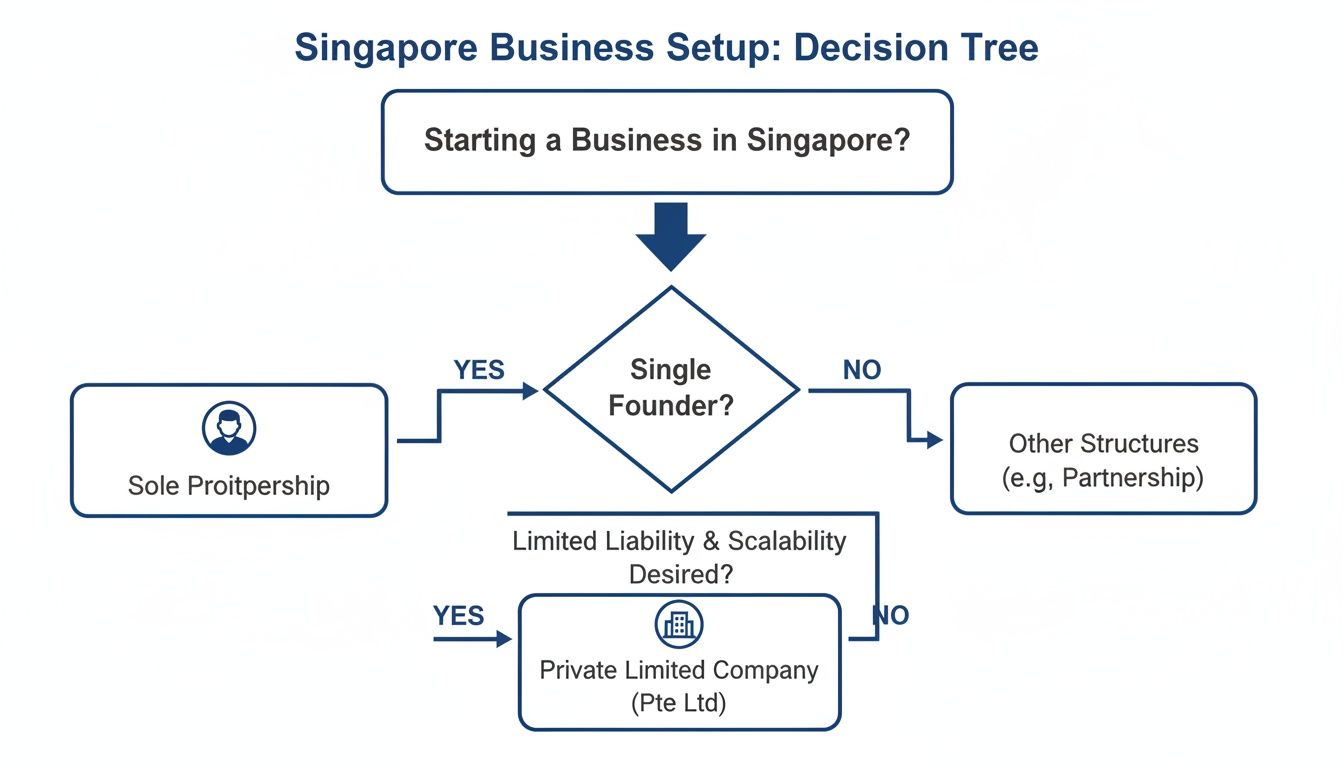
Choosing between a Sole Proprietorship or a Private Limited Company often goes hand-in-hand with your sales channel strategy and your ambitions for growth.
To make the decision clearer, here is a comparison of the key differences between the two approaches.
| Factor | Shopee / Lazada | TikTok Shop | DTC Website (Shopify) |
|---|---|---|---|
| Audience Access | Massive built-in buyer base | Growing fast via social discovery | You must generate your own traffic |
| Setup Speed | Very fast, minimal cost | Fast, requires content creation | Slower; needs design + marketing investment |
| Competition | Extremely high; price wars common | Moderate; content quality matters more | You control the environment |
| Branding | Limited by platform templates | Better — your content IS your brand | Complete control over everything |
| Customer Data | Marketplace owns data | Limited access via affiliate tools | You own all customer data |
| Fees | Commission + transaction fees (Shopee fees, Lazada fees) | Referral fees + affiliate commissions (TikTok fees) | Monthly platform + payment processing fees |
| Best For | Product-led sellers, price-competitive goods | Visual products, younger demographics | Brand-driven products, repeat business |
Neither option is inherently better; it is about which model aligns with your business goals right now.
So, should you choose a marketplace or your own website? There is no single formula, but here is some practical advice.
Many successful sellers use a hybrid approach — and in 2026, the smartest strategy is to sell on multiple channels simultaneously. Start on one marketplace to validate your product, then expand. A seller listing on both Shopee and Lazada, for example, typically sees 30-50% more total sales than single-channel sellers. The challenge is managing inventory and orders across all channels without overselling — which is where multichannel listing software becomes essential. If you are sourcing inventory from overseas suppliers, you will also need a commercial invoice for customs clearance on every international shipment.
You have figured out where you are going to sell. Now it is time for the operational side of your business. Managing your operations effectively—from inventory management to order fulfillment—is what turns online clicks into satisfied, loyal customers. This is what distinguishes professional businesses from hobbyists in Singapore’s e-commerce market.
Getting this right from the beginning will save you from common problems, like overselling popular items during a sale or spending all your time packing boxes instead of planning your next marketing campaign.

How you manage your stock is one of the most significant operational decisions you will make. It affects your startup costs, profit margins, and daily tasks. There are three main options.
1. Dropshipping: The Low-Risk Start
This is a popular model for those wanting to start an online business with minimal financial investment. When you receive an order, you forward it to your supplier, who then ships the product directly to the customer. It is an effective, low-cost way to test a product idea.
The downside is that your profit margins will be smaller, and you have very little control over the customer experience. Shipping times, packaging quality, and stock availability are all managed by your supplier.
2. Holding Your Own Stock: The Control & Margin Model
This is the traditional retail approach: you buy inventory, store it, and ship it yourself. This gives you complete control. You can inspect each item for quality, use your own branded packaging, and ensure faster shipping. This method typically results in higher profit margins since you are buying in bulk.
The disadvantage is the upfront capital required to purchase stock and the need for storage space. You also bear the risk of being left with unsold products.
3. Third-Party Logistics (3PL): The Scalable Approach
A 3PL partner can be a valuable asset as your business grows. These companies handle all your warehousing, picking, packing, and shipping. You purchase the stock and send it to their warehouse, and they manage the rest. This frees you up to focus on growing the business rather than just running it.
This is an ideal middle ground for businesses that have outgrown their initial storage space but are not yet ready to lease a full warehouse. It provides professional-level logistics without the high overhead costs. If you want to dive deeper, you can explore the differences between 3PL and 4PL models.
When you are just starting, fulfilling orders from your home is the standard choice. It costs nothing, and you can add personal touches, like a handwritten thank-you note.
However, once you start receiving 10-15 orders a day, the DIY approach becomes less efficient. The time spent printing labels, packing boxes, and going to the post office is time you are not spending on marketing or product development. At this point, using a Singapore-based 3PL becomes a very attractive option. They often have better shipping rates than you can get on your own, which can save you money in the long run.
By outsourcing your fulfillment, you are not just buying storage space; you are buying back your time. It allows you to transform from a stock packer into a business owner focused on strategy and growth.
For those serious about scaling in Singapore, our guide to last-mile delivery in Singapore covers the key courier options and fulfilment strategies for local sellers.
A complicated checkout process can lead to lost sales. Making it easy for customers to pay is essential for any online business in Singapore.
At a minimum, you should offer these payment options:
Finally, a brief note on the Goods and Services Tax (GST). You only need to register for GST with the Inland Revenue Authority of Singapore (IRAS) once your annual taxable turnover reaches S$1 million.
Until you approach that threshold, you do not need to charge GST. However, once you cross it, registration is mandatory. Keep your financial records organised from the start, and this process will be much smoother when the time comes.
You have a great product and a professional website. This is an excellent start, but it will not generate sales on its own. To make your online business in Singapore successful, you need a smart plan to attract customers.
This requires a focused marketing approach that connects with local shoppers, rather than just posting on social media and hoping for the best.
Let’s look at some practical ways to get your first customers, even with a limited budget. These are the fundamental channels that will build awareness and drive sales.
When people in Singapore want to buy something, they often start with a Google search. If your store does not appear in the search results, you are missing out on potential customers. This is where Search Engine Optimisation (SEO) is important. It helps Google understand what you sell so it can show your site to the right people.
Start with basic local keyword research. Think about what your customers would type into the search bar.
Include these phrases naturally in your product pages, descriptions, and page titles. To build a strong online presence that brings people to your site, understanding the basics of ecommerce SEO is absolutely essential. SEO is a long-term strategy, but getting the fundamentals right from the beginning will yield results for months and even years.
While SEO takes time to show results, paid ads on platforms like Meta (Facebook and Instagram) can bring customers almost immediately. The key advantage is the targeting capability. You can show your ads to specific groups of people based on their interests, age, location, and online shopping habits.
For example, if you sell eco-friendly yoga mats, you could create an ad campaign that targets:
This focused approach ensures your ad budget is not wasted on people who are unlikely to buy your product, leading to a better return on investment. Start with a small daily budget of S$10-S$20 to test which ad images and messages perform best before increasing your spending.
The goal isn’t just to get clicks; it’s to get the right clicks. A well-targeted ad campaign brings qualified buyers to your site, making the path to purchase much smoother. Don’t be afraid to experiment with different audiences to see what works best.
Content marketing is about creating helpful and interesting material that solves problems for your target audience. This helps build trust and positions your brand as an expert. A simple way to start is with blog posts.
Imagine your Singapore-based online business sells skincare for sensitive skin. You could write articles such as:
This type of content attracts people who are looking for solutions, not just products. By providing value, you start building a relationship. When they are ready to buy, your brand will be at the top of their mind.
Your social media channels should not be just a product catalogue. Shoppers in Singapore value authenticity and want to connect with the brands they support. Use platforms like Instagram and TikTok to show the human side of your business.
Share behind-the-scenes content, such as how you pack an order or the story behind a new product. Run polls to ask your followers for their opinions. Most importantly, engage with every comment and message promptly. This is how you build a community and turn one-time buyers into loyal fans who will promote your business for you.
When sales begin to increase, the manual tasks that were manageable at the start can become overwhelming. Juggling orders between your Shopify store and Lazada shop, constantly checking stock levels, and printing shipping labels one by one is not a sustainable way to grow.
At this stage, you need to shift your mindset from simply running the business to strategically scaling it.
For many online sellers, growth involves selling on multiple channels. You might start on a single platform, but expanding to places like Shopee, Lazada, or TikTok Shop can significantly increase your visibility and sales. The challenge is that more channels can lead to more complexity.
Imagine you have a popular product listed on your website and on Shopee. During a flash sale, you receive 20 orders on your site and 30 on Shopee within an hour. However, you only had 40 units in stock. Now you have 10 unhappy customers and risk a penalty from the marketplace for overselling.
This is a common and costly problem. Manual inventory management cannot keep up with high order volumes.
The solution is to centralise your operations. Instead of treating each sales channel as a separate business, you need a single system that connects everything.
Using a centralised commerce platform transforms your operations from reactive to proactive. It automates the tedious tasks that drain your time, prevents critical errors like overselling, and gives you the clear oversight needed to make smart growth decisions.
Technology can be your most valuable employee. A good system syncs your inventory across all channels in real time. When an item sells on Lazada, the stock count is instantly updated on your Shopify store and any other platform where you sell. This eliminates the need for manual spreadsheet updates.
A unified dashboard does more than just sync inventory. It consolidates your entire fulfillment process onto a single screen, allowing you to manage every order—whether from your website or a marketplace—in one place.
Here is what that looks like in practice:
For businesses in Singapore, this level of efficiency is crucial. The local e-commerce market is diverse — Shopee and Lazada dominate marketplace traffic, while Shopify powers thousands of DTC stores and TikTok Shop is growing rapidly. Sellers who can manage operations across all these channels have a significant competitive advantage.
Automating these core operational workflows is fundamental for scalable growth. You can dive deeper into the different ecommerce automation tools and strategies in our detailed guide to see what might fit your setup. By letting technology handle repetitive tasks, you can focus on activities that actually grow the business: marketing, customer engagement, and finding your next bestselling product.
The e-commerce landscape evolves fast. Here are the trends that matter most for new sellers entering the market in 2026.
Social commerce platforms are blurring the line between content and shopping. TikTok Shop’s live selling feature lets sellers demonstrate products in real time and close sales during the stream. In Southeast Asia, live commerce sales grew by over 60% year-on-year through 2025, and Singapore sellers are increasingly using it as a primary sales channel.
If your product is visual or demonstrable — fashion, beauty, food, gadgets — live selling should be part of your strategy from day one.
AI tools are no longer optional extras. In 2026, sellers use AI for:
Selling on a single channel is increasingly risky. Platform algorithm changes, fee increases, or policy updates can devastate a single-channel business overnight. The sellers who thrive in 2026 spread their risk across 3-4 channels — typically Shopee + Lazada + their own website, with TikTok Shop as a fourth channel. Understanding how to manage inventory across these channels is a core skill for any growing business.
Starting an e-commerce business for the first time can be daunting. Here are straightforward answers to some of the most common questions from new entrepreneurs in Singapore.
Yes, you can. The government’s Home-Based Small Scale Business Scheme allows you to use your residential address for business registration, so you do not need to rent an office immediately.
There are a few rules to follow to ensure you do not disturb your neighbours:
This scheme is very helpful for solo founders and small teams, as it keeps overhead costs low while you validate your business idea.
The short answer is yes. According to the Accounting and Corporate Regulatory Authority (ACRA), if you are conducting any activity with the intention of making a profit, you must register your business. This includes selling through social media or a marketplace shop.
Failing to register can result in significant fines. Think of it as the first step to making your business official. It legitimises your brand and builds trust with customers.
Registering your business isn’t optional. It’s your legal foundation. It lets you open a corporate bank account, protects you personally, and shows customers you’re a serious, credible seller.
The amount of starting capital you need depends entirely on your business model. It could range from a few hundred dollars to tens of thousands.
Here is a breakdown:
For most common products like clothing, accessories, or home decor, you do not need a special licence. Registering your business with ACRA is sufficient.
However, if you are selling products in certain regulated categories, you will need the appropriate permits from the relevant authorities. Key examples include:
Always check the specific rules for your product category before you launch. It is better to be safe than sorry.
If you are selling a general consumer product at a competitive price, Shopee is usually the best starting point — it has the largest buyer base in Singapore and the lowest barrier to entry. For higher-ticket or brand-name products, Lazada can work better due to its LazMall programme. TikTok Shop is ideal if your product is visually compelling and you are comfortable creating short video content. Most successful sellers eventually expand to all three — you can compare the fees using our Shopee fee guide, Lazada fee calculator, and TikTok Shop fee calculator.
This is one of the biggest operational challenges for multi-channel sellers. If you sell the same product on Shopee, Lazada, and your own website, a sale on one platform must instantly reduce stock on all others — otherwise you risk overselling and marketplace penalties. Most sellers start with spreadsheets, but this breaks down quickly beyond 50 SKUs or 10 orders per day. A multichannel inventory management tool automates stock synchronisation and centralises order management across all your channels.
Pricing for marketplaces is different from pricing for your own website. On Shopee and Lazada, understanding the fee structure is critical — commission rates, payment processing fees, and shipping subsidies all eat into your margin. Use a markup calculator to work backwards from your desired profit margin. For more advanced pricing approaches, our guide on price segmentation strategies explains how to use different pricing across channels.
Ready to scale your online business in Singapore without the operational headaches? OneCart centralises your orders, inventory, and listings from Shopee, Lazada, TikTok Shop, Shopify, WooCommerce, and more into a single dashboard. Stop overselling and start growing faster — get started at getonecart.com.
Automate & Scale Your Online Business with OneCart
Start a Free TrialUsed by hundreds of merchants in Singapore & Southeast Asia