Your Guide to Omni Channel in Retail Industry Success 2026
Discover how to leverage the omni channel in retail industry for massive growth. Learn the strategies and tech needed to create a seamless customer journey.
Discover how to leverage the omni channel in retail industry for massive growth. Learn the strategies and tech needed to create a seamless customer journey.

Omni channel in the retail industry is all about creating a single, continuous experience for your customer, no matter where they interact with you. It means your website, physical store, social media shops, and marketplace listings all talk to each other. A customer can flow from one to the next without hitting a dead end.
This approach turns a collection of separate platforms into a single, unified system that works together seamlessly.
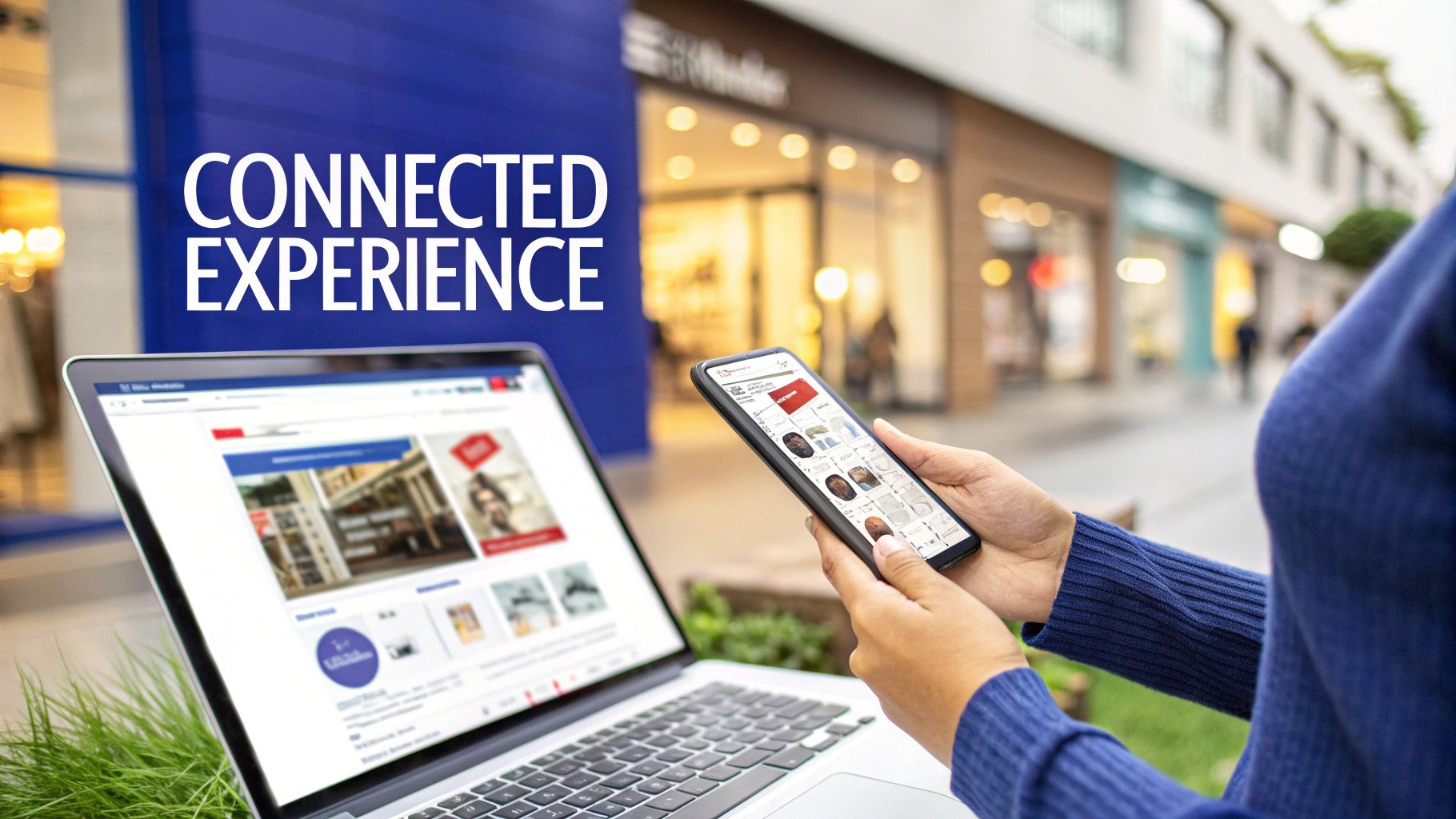
Think of an omnichannel strategy as one long conversation with your customer. The chat might start when they see an ad on TikTok Shop, continue on your Shopify store where they add something to their cart, and finish in your physical store where they pick it up.
Each touchpoint knows what happened before, making the whole journey feel smooth and connected.
This unified approach is what really separates an omnichannel strategy from a multichannel one. Lots of businesses are multichannel—they have a website, a Facebook page, and a store on Lazada. But often, those channels operate in their own little bubbles, creating a disjointed experience for both the customer and the operations team behind the scenes. For example, in a multichannel setup, a customer who bought an item online may be told they cannot return it in a physical store because the two systems are not connected.
An omnichannel approach weaves these channels together so they work in harmony. The customer isn’t dealing with your “Shopify store” or your “TikTok Shop”—they’re just dealing with your brand, and the experience feels the same everywhere.
For sellers feeling the daily headache of managing disconnected platforms, this is a game-changer. Instead of juggling separate inventory pools, manually updating stock levels, and processing orders from five different dashboards, an omnichannel system brings it all together.
This single source of truth for your entire operation helps prevent overselling, slashes human error, and gives you a clear picture of your business. To see a deeper comparison, check out our article on omnichannel vs. multichannel ecommerce.
To help clarify the differences at a glance, here’s a quick breakdown of how the two approaches stack up.
This table highlights the core philosophical and operational differences between running a multichannel setup versus a true omnichannel one.
| Aspect | Multichannel Approach | Omnichannel Approach |
|---|---|---|
| Core Focus | Channel-centric: Each platform is treated as a separate sales opportunity. | Customer-centric: The entire focus is on creating a seamless customer journey. |
| Customer Experience | Fragmented: A customer’s history on one channel isn’t visible on another. | Unified: All interactions are connected, providing a consistent experience. |
| Inventory & Orders | Siloed: Inventory and orders are managed separately for each channel. | Centralized: A single system manages stock and orders across all channels. |
| Business Operations | Complex: Requires manual work to reconcile data between different systems. | Streamlined: Automation reduces errors and frees up operational resources. |
As you can see, the shift from multichannel to omnichannel is less about adding more sales channels and more about integrating the ones you already have.
Getting a true omnichannel model up and running isn’t just about making things easier for customers; it directly hits your bottom line. In today’s fast-moving retail world, businesses that fully embrace omnichannel strategies are pulling way ahead of the pack.
Companies with strong omnichannel customer engagement see a 9.5% year-over-year increase in annual revenue. In contrast, those with weaker strategies barely manage 3.4% growth. This isn’t a small difference—it’s the gap between thriving and just surviving.
Putting an omnichannel strategy in place directly tackles the biggest headaches in modern retail. When you get it right, it leads to real, measurable growth in three places that matter: customer loyalty, revenue, and the efficiency of your own operations. When your sales channels stop fighting each other and start working together, you build a much stronger, more resilient business.
The first thing you’ll notice is the impact on the customer experience. Think about it: when a shopper can buy something online and then return it to your physical store without any fuss, you build trust. This kind of flexibility removes the friction and doubt from the buying process, making it much easier for customers to shop with confidence.
Those smooth, positive experiences are what create deep loyalty. Brands that offer this kind of integrated experience retain an average of 89% of their customers. Compare that to just 33% for companies with disconnected, weaker strategies. A loyal customer base isn’t just a nice-to-have; it’s the foundation of sustainable growth.
A unified experience doesn’t just make customers happier—it makes them spend more. It turns out that shoppers who interact with a brand across multiple channels have a 30% higher lifetime value than those who stick to just one. This means they don’t just come back more often; they spend more money over the long haul.
This revenue lift happens because an omnichannel setup gives you more chances to connect with customers in a meaningful way. You can use data from their in-store visit to send a personalized offer to their email or show them a relevant ad on TikTok. It all comes together to create one cohesive journey that gently guides them toward their next purchase.
By making every interaction count, an omni channel in retail industry approach transforms your separate sales platforms into a powerful, interconnected revenue engine.
Beyond all the customer-facing benefits, a proper omnichannel model brings huge efficiency gains to your back-end operations. The heart of this transformation is a centralized commerce platform, which gets rid of the soul-crushing, error-prone task of manual data entry.
Instead of your team logging into Shopify, Lazada, and TikTok Shop separately to update inventory, a single system syncs your stock levels in real time across every single platform.
This has a massive impact during peak sales events like 11.11.
A practical example is a DTC brand on Shopify expanding to marketplaces. By using a unified dashboard to manage every order, they can process a surge of 11.11 sales from Lazada and Shopify using a single picklist. This means no more manually reconciling sales data, which drastically reduces the risk of human error and allows them to scale their operations without having to hire more staff.
To really get what makes an omnichannel approach so powerful, let’s walk through a modern shopping journey from the customer’s point of view. It’s a great way to see how a bunch of seemingly separate touchpoints can—and should—feel like one smooth, connected experience.
Meet Sarah. Her journey starts where so many do these days: scrolling through TikTok. She sees a sharp-looking ad for a new skincare product from your brand. It catches her eye, she taps the ad, and lands directly on the product page of your Shopify store.
But she doesn’t buy right away. Instead, she does what 72% of shoppers do—she dives into the reviews and checks out other options on the page. She adds the product to her cart… and then life happens. She gets a notification, gets distracted, and leaves your site.
In a clunky, multichannel setup, this is where the story would probably end. A lost sale. But in a true omnichannel world, the conversation just keeps going.
A few hours later, an automated abandoned cart email lands in her inbox. It’s a friendly reminder about the product she left behind, sweetened with a small discount code to nudge her over the finish line.
This time, she’s ready to buy. But then she remembers she has a voucher sitting in her Lazada app. So, she hops over to the Lazada app, searches for your brand, and instantly finds the exact same product. She applies her voucher, completes the purchase for faster shipping, and gets an order confirmation on the spot. Every channel worked together, letting her buy wherever it was most convenient for her.
The experience doesn’t stop once the payment goes through. Over the next couple of days, Sarah gets timely shipping updates via SMS, keeping her in the loop and building excitement. When the product arrives, she has a quick question about how to use it. She heads back to your website and opens up the live chat widget.
An agent replies almost immediately. They already have her order history right in front of them, so Sarah doesn’t have to waste time explaining what she bought or where she bought it from. The whole chat is quick, contextual, and makes her feel like a valued customer, not just another order number.
This story is a practical, real-world look at how an effective omnichannel retail strategy really works in practice. The process of connecting these dots is what fuels serious business growth, as the diagram below shows.
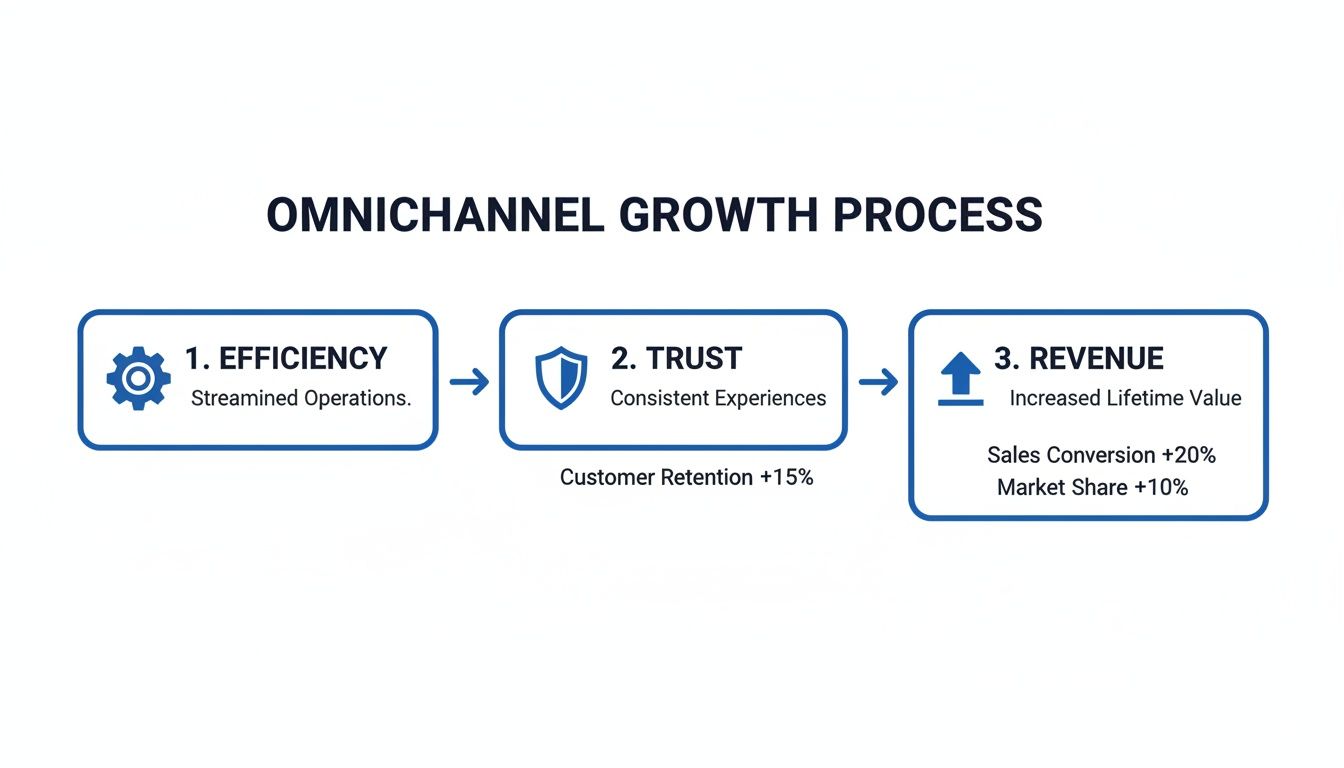
It all builds on itself. Better operational efficiency creates a more trustworthy customer experience, which in turn drives real, sustainable revenue. By gathering data from every single interaction—from that first TikTok ad click to the final live chat—you get the insights needed to personalize future marketing and build a lasting relationship with customers just like Sarah.
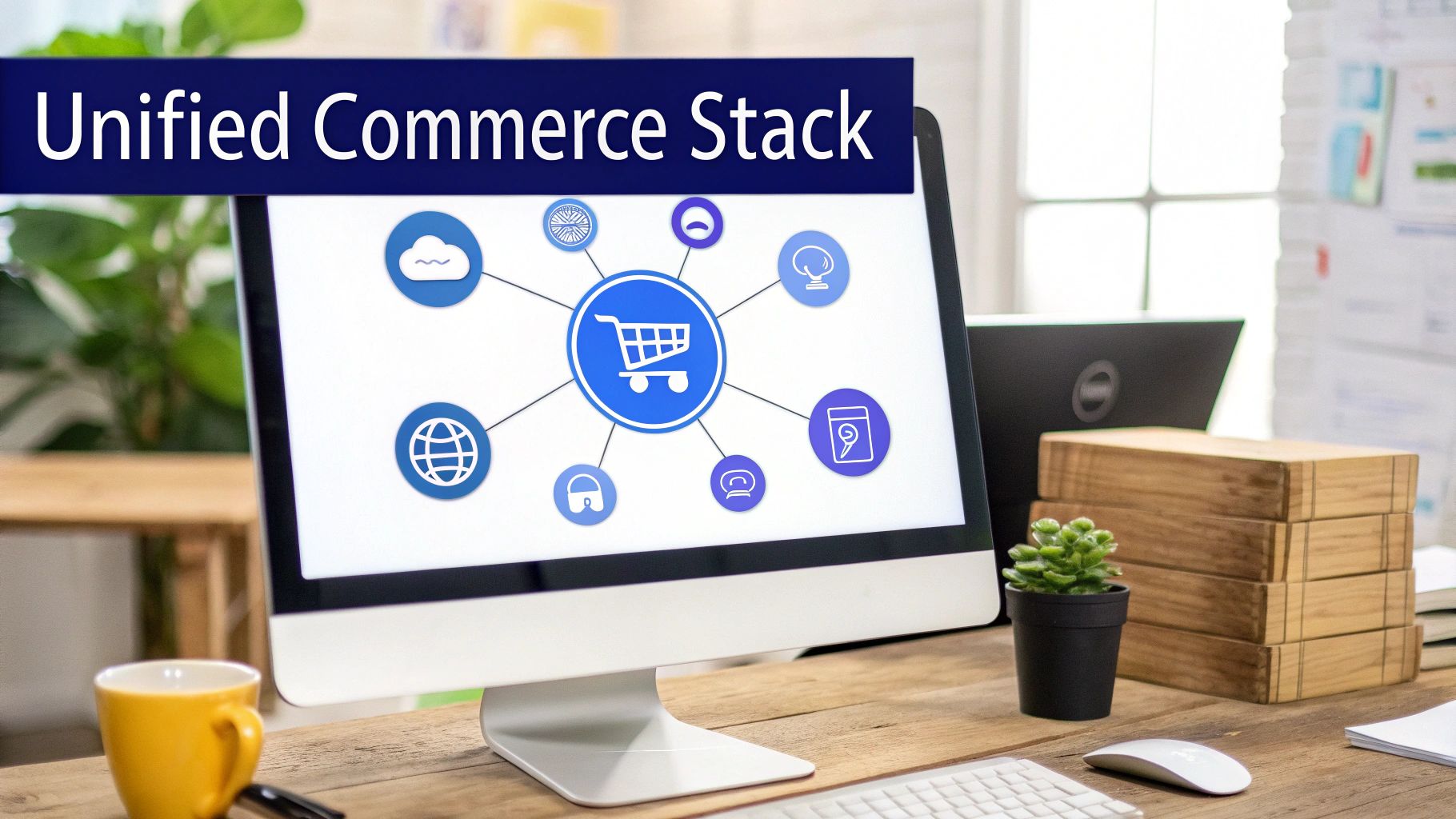
A great omnichannel strategy isn’t just a marketing idea; it’s powered by a set of interconnected tools humming away behind the scenes. Think of this tech stack as the central nervous system for your entire retail operation. It’s what ensures information flows smoothly between every single sales channel and customer touchpoint.
For marketplace sellers and direct-to-consumer (DTC) brands, getting this foundation right isn’t just important—it’s critical for growth.
The heart of any modern omni channel in retail industry setup is a centralized commerce platform. This is your single source of truth, the hub that connects your Shopee, Lazada, Amazon, and Shopify stores into one cohesive unit. Its most important job? Syncing inventory, orders, and product data in real time.
This real-time sync is non-negotiable. When an item sells on one channel, the stock level must update everywhere else within seconds. This prevents the costly mistake of overselling, which can wreck your seller ratings and instantly break customer trust.
While a central platform is the foundation, a few other key pieces of tech complete the puzzle. Each one plays a distinct role in creating a seamless experience for both your customers and your team.
These systems talk to each other through modern Application Programming Interfaces (APIs), which act as bridges between different software. This connectivity is what automates workflows, cuts down on manual data entry, and eliminates human error.
The goal of your tech stack is simple: create a single, unified view of your customers, inventory, and orders. This operational clarity is the engine that powers a truly customer-centric retail experience.
The need for this integrated approach is exploding. The global omnichannel retailing market is projected to rocket from USD 10.13 billion in 2025 to USD 25.35 billion by 2032. This growth is being driven by the 73% of shoppers who now use multiple channels during their buying journey.
This is a fundamental shift in how people shop, and it underscores the importance of building a robust technology stack to keep up.
For a comprehensive look at the kinds of technologies shaping modern retail, exploring how AI is transforming ecommerce can offer some powerful ideas for your tech stack. And of course, integrating a modern POS system for your retail stores is a crucial step in bridging the gap between your online and offline operations.
Making the switch to an omnichannel model can feel like a massive project, but you don’t have to boil the ocean. Breaking it down into a clear, step-by-step plan turns it into something you can actually manage. Think of it less as a total overhaul and more as a series of smart, deliberate upgrades to your operation.
The journey starts with a hard look at where you are right now. From there, we’ll build a solid foundation by getting your data and tech to play nicely together. The final steps are all about getting your team on board and using data to keep getting better.
Before you change a single thing, you need a brutally honest picture of how customers interact with your brand today. Get a whiteboard and map out every possible touchpoint, from the moment they see a TikTok ad to the post-purchase email that lands in their inbox.
Your mission here is to find the friction. Where do customers get stuck or frustrated? Maybe your website promises an item is in stock, but the physical store has no idea what they’re talking about. Or perhaps a customer has to repeat their order number three times just to get a simple update from your support team.
These pain points are gold. By circling them in red, you’re creating a practical to-do list for your omni channel in retail industry strategy. This ensures every move you make is focused on fixing real problems that have the biggest impact on the customer experience.
This is the non-negotiable, most critical step of the entire process. Right now, your data—inventory counts, order details, and customer info—is probably scattered across a dozen different platforms. The goal is to create a single source of truth that every part of your business can trust.
A single source of truth isn’t just a technical term; it’s the operational backbone of your entire omnichannel strategy. Without it, you’re just running a more complicated, more frustrating multichannel business.
Once your data is centralized, the next job is to make sure your core technologies can actually talk to each other. This is about connecting the dots between your e-commerce platform, marketplace accounts, and your internal systems, like your warehouse management software.
Modern platforms do this using APIs, which act as bridges between different systems. For example, your central commerce platform should integrate seamlessly with your Shopify store and your TikTok Shop account. This ensures data flows automatically, eliminating manual data entry and the human errors that come with it.
Technology is only half the battle. Your teams—from customer service reps and marketers to the people picking and packing in the warehouse—need to know how to use the new, unified system. Don’t skip this part.
Run thorough, hands-on training sessions. Show your customer service reps how to pull up a unified customer profile to solve issues in minutes, not hours. Train your warehouse team on processing orders from a single, consolidated pick list that combines orders from every channel.
When everyone feels confident, it’s time to go live. But don’t flip the switch on everything at once. Start small by integrating two of your main channels first. Measure the results, get feedback from your team, and then gradually roll out the changes to your other platforms. Using the data from this initial launch to fine-tune your process minimizes risk and makes the transition much smoother for everyone involved.
Once your omnichannel strategy is live, how do you know if it’s actually working? Just looking at your overall sales numbers won’t cut it. You need to track specific Key Performance Indicators (KPIs) that show you exactly how your integrated channels are changing customer behavior and making your operations sharper. These metrics are the hard data you need to prove your investment is paying off.
Moving beyond basic sales figures is crucial. The right KPIs will tell you whether your unified experience is creating more valuable, long-term customers and making your business more efficient.
Ultimately, the goal of an omni channel in retail industry strategy is to create happier, more loyal customers who stick around and spend more over time. The single best metric for this is Customer Lifetime Value (CLV).
CLV calculates the total amount of money you can expect to earn from a single customer throughout their entire relationship with your brand. If your CLV is climbing, it’s a strong signal that your seamless experiences are encouraging repeat purchases and building real loyalty.
Another powerful metric is the Channel Crossover Rate. This tells you what percentage of your customers are shopping on more than one of your channels—for instance, someone who discovers a product on your TikTok Shop and later buys it from your Shopify store. A high crossover rate is direct proof that your channels are working together.
A customer who buys online and uses your in-store pickup service is a perfect omnichannel success story. Tracking how often this happens shows you which integrated services your shoppers find most valuable.
A solid omnichannel setup doesn’t just make customers happy; it makes your entire operation run smoother. A critical KPI here is your Inventory Turnover Ratio. This metric shows how many times you sell and replace your entire inventory over a set period.
A healthy, rising turnover ratio means your unified stock management is working as it should. It shows that products are moving efficiently from your warehouse to the customer, no matter which channel they used to buy, which helps prevent dead stock and frees up your cash flow.
Here are a few other essential metrics to add to your dashboard:
By focusing on these KPIs, you can move from guessing to knowing. The data tells a clear story about what’s working, what needs a tune-up, and how your investment is paying off. To go even deeper, check out our guide on the top ecommerce metrics and KPIs to track for business success.
Jumping into an omnichannel strategy always brings up a few questions. It’s smart to think about the common roadblocks, what this all costs, and how long it takes to see a real difference. Here are some straight answers to the questions we hear most often from retailers.
The single biggest hurdle, without a doubt, is getting all your data in one place. Most businesses start out with disconnected systems for their website, marketplace stores, and maybe even a physical shop. This creates data silos.
Inventory numbers live in one system, customer details in another, and order information is trapped somewhere else. This setup makes a seamless customer experience impossible. Your first, most critical job is to pull all that core data into a single platform. This creates one “source of truth” that every part of your business can trust. Without it, you’re not building an omnichannel strategy; you’re just running a more complicated multichannel operation.
You don’t need a massive, upfront investment to get started. The key is to be strategic. Tackle the highest-impact, lowest-cost projects first and then build from there. For most sellers, this means starting by unifying their existing online channels.
If you’re already selling on platforms like Shopify, Lazada, and TikTok Shop, bringing them together with a system that syncs your inventory and orders will give you an immediate payback. It cuts down on the hours spent doing manual updates and stops those painful overselling mistakes in their tracks.
Once that’s sorted, you can gradually plug in other touchpoints as your budget allows, like a unified customer service tool or a central marketing platform. The idea is to solve your biggest operational headaches first—which often frees up the cash to fund the next step.
Operationally, you can see a difference almost right away. Within the first few weeks of using a central management system, businesses often report a huge drop in packing errors and find they’re getting daily orders out the door much faster.
Just preventing one overselling incident on a major marketplace during a big 11.11 sale can often pay for the software investment on its own.
Bigger picture benefits, like a real jump in Customer Lifetime Value (CLV), take a bit more time to show up in the numbers. You’ll typically see these results emerge after three to six months, once customers have had a chance to experience your smoother shopping journey and reward you with their loyalty and repeat purchases.
Ready to unify your sales channels and eliminate operational chaos? OneCart centralizes your inventory, orders, and listings from Shopee, Lazada, TikTok Shop, Shopify, and more into a single, powerful dashboard. Stop overselling, reduce errors, and scale your business with confidence. Explore how OneCart can transform your retail operations at https://www.getonecart.com.
Automate & Scale Your Online Business with OneCart
Start a Free TrialUsed by hundreds of merchants in Singapore & Southeast Asia