Your Guide to Net Sales Margin in Ecommerce [2025]
Unlock true profitability. This guide breaks down the net sales margin formula with practical examples to help you measure and improve your ecommerce profits.
Unlock true profitability. This guide breaks down the net sales margin formula with practical examples to help you measure and improve your ecommerce profits.

For any e-commerce business, your net sales margin is the single most honest number you can look at. It tells you, in simple terms, how much actual profit you pocket from every dollar of sales after every single cost—from the product itself to marketing, salaries, and pesky platform fees—has been paid.
Think about running a pop-up stall selling artisanal coffee. You sell each cup for $5. That $5 is your revenue. It’s easy to stop there, look at the long queue of customers, and feel pretty successful based on the day’s total sales. But that’s a dangerously incomplete picture.
True business health is about how much of that money stays. Net sales margin cuts through the noise and gives you that clarity. It forces you to look at all the little expenses that take a bite out of that initial $5.
To give you a clearer picture, here’s a quick summary of what net sales margin is all about.
| Concept | Definition | Importance |
|---|---|---|
| Net Sales Margin | The percentage of revenue left after all operating expenses, interest, and taxes are deducted. | It’s the ultimate indicator of your business’s overall profitability and operational efficiency. |
| Core Components | Revenue minus Cost of Goods Sold (COGS), Operating Expenses, Interest, and Taxes. | Accounts for every cost, providing a complete and honest view of financial health. |
| Business Health Check | Measures how effectively you turn sales into actual, spendable profit. | A strong margin means you have the resources to grow, while a weak one signals operational issues. |
This table shows why focusing just on sales is a mistake. Let’s dig deeper into what this metric really tells you.
Fixating on total sales is like judging your coffee stall’s success by the length of the customer queue. A long line looks fantastic, but what if your costs are so high that you’re barely breaking even on each cup? To know if you’re actually winning, you need to count what’s left in the cash register at the end of the day.
This is where net sales margin really shines. It makes you account for everything:
Once you subtract all these expenses from your revenue, you’re left with your net profit. The net sales margin simply turns that profit figure into a percentage, giving you a crystal-clear indicator of how much you’re truly making per dollar sold.
A business with high sales volume but a low net sales margin is working hard, not smart. It’s a huge red flag that costs are out of control or prices are too low, slowly bleeding the business dry with every sale.
If revenue is your business’s pulse—a sign of activity—then net sales margin is the full blood test. It reveals the underlying health of your entire operation and tells you if your business model is actually sustainable in the long run.
A healthy margin means you have enough cash leftover to reinvest in new products, run bigger marketing campaigns, and grow your business.
On the other hand, a weak margin, even with impressive sales figures, is a warning sign. It might mean your marketing spend isn’t paying off, your shipping is too expensive, or those marketplace commission fees are eating up your bottom line.
By consistently tracking your net sales margin, you shift your mindset from just making sales to building a genuinely profitable and resilient e-commerce business. It’s the truest measure of success you have. If you’re unsure what sales volume you need to reach profitability, our break-even calculator shows your break-even point with platform fees factored in.
Knowing that net sales margin is important is the first step, but the real magic happens when you start calculating it for your own business. The formula itself looks simple enough on paper, but you have to know exactly which numbers to use.
Here’s the core formula we’ll be working with:
Net Sales Margin = (Net Profit / Net Sales) x 100
To get there, we first need to figure out your Net Profit and Net Sales. This means we have to break down three key parts of your e-commerce finances: Gross Sales, Cost of Goods Sold (COGS), and all your Operating Expenses. Let’s walk through it, one step at a time.
Your Net Sales figure is the money you actually pocketed after dealing with customer returns, refunds, and discounts. It’s a much more honest look at your sales performance than gross revenue, which can be misleadingly high.
First, you start with your Gross Sales—the total value of every single product you sold before any deductions. Then, you subtract all the take-backs:
Practical Example: Imagine your online store’s dashboard shows $20,000 in gross sales for the month. But your records show you processed $1,500 in returns and customers used discount codes totalling $500. Your Net Sales would be calculated as $20,000 - $1,500 - $500 = $18,000. This is the number you should use for an accurate margin calculation.
Next up, we need to nail down your Cost of Goods Sold (COGS). This is a big one. It covers all the direct costs of acquiring or making the products you sold in a given period. Getting this number right is absolutely critical for an accurate margin — use our free COGS calculator if you need help running the numbers.
For most e-commerce sellers, COGS usually includes:
Practical Example: For that period where you had $18,000 in Net Sales, let’s say your total COGS was $7,000. That covers the cost of the products, the freight to get them to you, and the materials to pack them up.
The final piece of this puzzle is your Operating Expenses (OpEx). Think of these as all the costs needed to keep the lights on—everything that isn’t directly part of the product itself. This is often where hidden costs sneak in and quietly eat away at your profits.
Common operating expenses to track are:
Practical Example: To make sure your margin reflects reality, you have to be meticulous here. For instance, you need to understand how platform fees work on your marketplaces. Let’s say your total OpEx for the period was $6,000. This includes $2,500 for ads, $1,500 for salaries, $1,000 for shipping to customers, $500 for platform fees, and $500 for software. Now we have all the numbers we need to see the full picture.
This flow chart gives you a great visual of how revenue moves through your business, gets chipped away by various costs, and finally leaves you with your true profit.
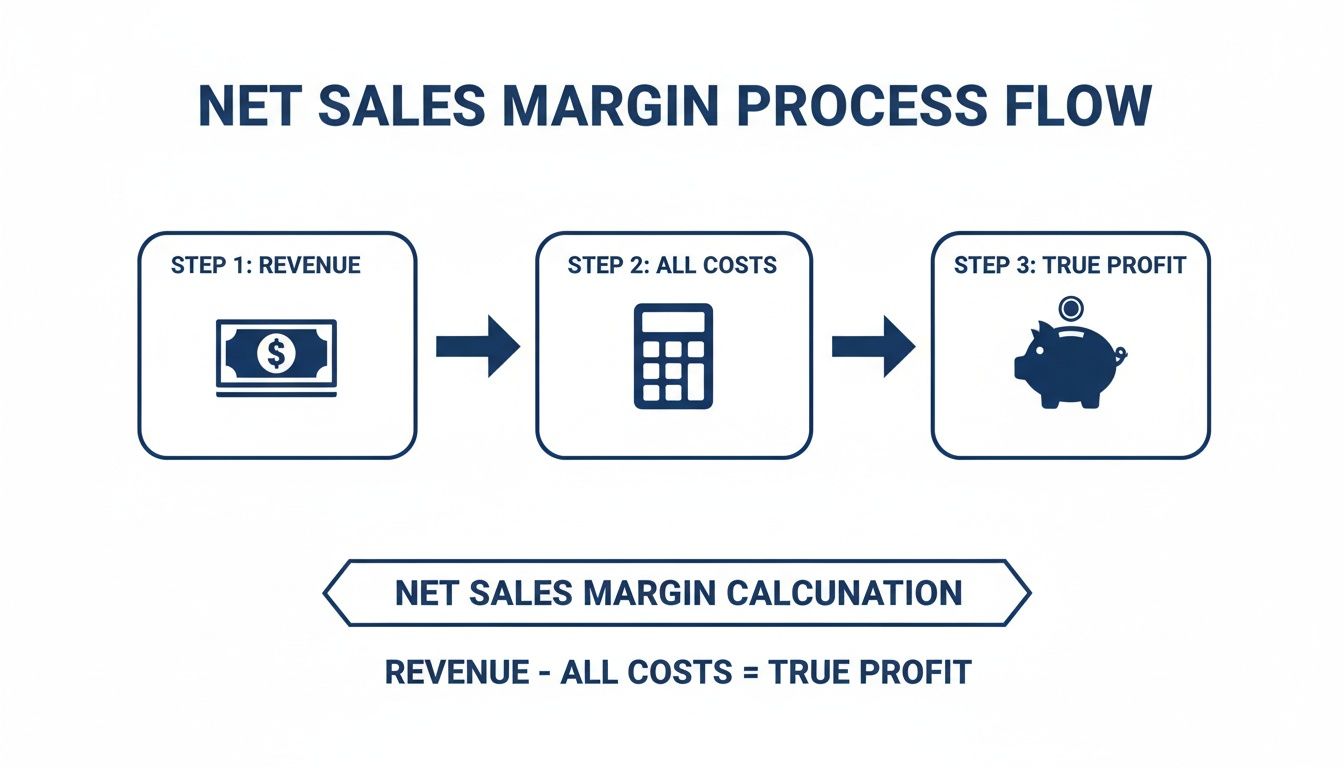
As you can see, true profit is only what’s left after every single cost has been paid. It’s the ultimate health check for your business.
Okay, let’s plug in all our numbers from the example and see where we land.
Calculate Net Profit: Net Sales - COGS - Operating Expenses
Calculate Net Sales Margin: (Net Profit / Net Sales) x 100
In this scenario, your net sales margin is 27.8%. This means that for every dollar of net sales you generated, you kept 27.8 cents as pure profit.
Want to run these numbers for your own store without fiddling with spreadsheets? You can use a free ecommerce profit margin calculator to speed things up.
A single, store-wide net sales margin is a great starting point. It’s like taking your business’s temperature—a quick health check. But to truly understand what’s happening under the hood, what’s making you money and what’s draining it, you have to dig deeper.
The real power comes from breaking down that one big number into smaller, more focused pieces. This is how you move from just knowing your profitability to actively improving it. It helps you answer critical questions like, “Which of my products are actually worth the effort?” or “Is selling on Lazada really more profitable for me than on Shopify?”
Without this level of detail, you might be making big decisions based on revenue alone, which, as we’ve seen, can be a recipe for disaster. Let’s explore how to dissect your net sales margin by product, channel, and time period to uncover the real engines of your business.

Not all sales are created equal. It’s a hard truth. Some of your bestsellers might look fantastic on paper but are actually costing you money once every little expense is factored in. These are your ‘margin killers’. On the flip side, you could have quieter, less popular items that are incredibly profitable.
The only way to know for sure is to analyse your margin by Stock Keeping Unit (SKU).
To pull this off, you need to allocate all relevant costs to each individual product. This includes:
Imagine you sell two types of water bottles: a simple plastic one and a premium insulated flask.
At first glance, the plastic bottle looks like the champion, bringing in $5,000 in revenue versus the flask’s $3,000. But let’s look at the margins. The plastic bottle sits in a competitive niche, requiring higher marketing costs, and it also has a higher return rate. After you allocate all those costs, you discover its net sales margin is a measly 8%.
In contrast, the insulated flask, with its higher price and lower marketing spend per unit, boasts a very healthy 35% margin.
Actionable Insight: This analysis is huge. You’re actually making more net profit from the flask ($1,050) than the plastic bottle ($400), despite the massive difference in sales volume. Now you can make smarter decisions, like shifting your ad budget to promote the more profitable flask. Understanding these calculations is fundamental, and you can learn more about how to calculate profit percentage to really get a handle on these concepts.
Where you sell matters just as much as what you sell. Every sales channel—whether it’s Shopee, Lazada, TikTok Shop, or your own Shopify website—comes with its own unique cost structure. Marketplace commissions, transaction fees, and advertising costs can vary wildly between platforms.
Analysing your net sales margin by channel reveals the true profitability of each one.
You might discover that your highest-revenue channel is actually your least profitable one after accounting for steep commission fees and mandatory participation in platform-wide sales campaigns that force you to offer deep discounts.
To do this right, you have to track expenses on a per-channel basis. This means knowing exactly how much you spend on Lazada’s sponsored ads versus your Google Ads for your Shopify store.
Let’s say you sell on both Lazada and your own Shopify store.
Actionable Insight: The conclusion is crystal clear: even with lower revenue, your Shopify store is more than twice as profitable. This doesn’t mean you should ditch Lazada, but it certainly means you should adjust your strategy. Perhaps you raise prices slightly on that channel to offset the higher fees or focus more of your inventory on your more profitable DTC channel.
Finally, remember that profitability isn’t static. It ebbs and flows with seasonality, marketing campaigns, and changes in supplier costs. Analysing your net sales margin over different periods—monthly, quarterly, or during huge sales events like 11.11—helps you spot trends and plan more effectively.
For example, tracking your margin during a major sales campaign is crucial. You might see a massive spike in sales, but did your margin hold up? Often, the deep discounts required to compete during these events can absolutely crush your profitability, leaving you with a lot of work for very little reward.
Actionable Insight: By comparing your margin during the sale to a normal period, you can determine if the campaign was a true financial success. If your margin dropped from 25% to 5% during the sale, you might decide next year to offer a smaller discount or focus on a product bundle to protect your profit. This allows you to plan future promotions with profitability, not just revenue, as the main goal.
In the world of ecommerce, it’s easy to get tangled in metrics that sound similar but tell completely different stories about your business’s health. Two of the most common culprits are gross margin and net sales margin.
Getting them straight isn’t just about semantics; it’s about knowing exactly which levers to pull to make your business more profitable.
Think of gross margin as your first, quick profitability check. It zones in on how efficiently you’re producing and selling your products, looking only at your revenue versus the direct costs of those products.
Net sales margin, on the other hand, gives you the unfiltered, complete truth. It factors in every single expense your business has, from the cost of the item itself all the way to marketplace fees and your marketing spend.
A great way to visualise this is to think of your profitability as an iceberg.
Gross margin is the tip of the iceberg—the part you see floating above the water. It looks impressive and is pretty straightforward to measure. It’s simply your revenue minus the Cost of Goods Sold (COGS). This number tells you if your core operation of buying (or making) and selling products is fundamentally sound.
Gross Margin = (Net Sales - Cost of Goods Sold) / Net Sales x 100
Net sales margin is the entire iceberg, especially the massive, hidden part lurking beneath the surface. This submerged part represents all your other operating expenses: marketing campaigns, platform commissions, salaries, software subscriptions, and warehouse rent. A business can have a fantastic gross margin but still be sinking fast if its operational costs are out of control.
To make this distinction crystal clear, let’s break down what each metric includes and what it really measures for your online store.
| Metric | Formula | What It Measures | Key Use Case |
|---|---|---|---|
| Gross Margin | (Net Sales - COGS) / Net Sales | The profitability of your products before any other business expenses are considered. | Assessing pricing strategies and the efficiency of your supply chain and production. |
| Net Sales Margin | (Net Sales - COGS - Operating Expenses) / Net Sales | The overall, bottom-line profitability of your business after all expenses have been paid. | Evaluating the total financial health and long-term sustainability of your operations. |
As you can see, both are crucial. One tells you if your products make money on their own, while the other tells you if your business as a whole is making money.
Let’s put this into practice. Imagine you sell custom-printed t-shirts online. You sell a shirt for $30. The blank shirt plus the printing costs you a total of $10.
Based on this, your gross profit is $20 (that’s $30 - $10).
Your gross margin is a very healthy 66.7% ($20 / $30 x 100).
Seeing that 66.7% feels great, right? You might be tempted to double down on production. But this number doesn’t tell the whole story. To find your real profit, we need to calculate the net sales margin.
Let’s factor in all the other costs tied to selling that single shirt:
The total operating expenses for that one t-shirt come out to $14. Now we can see the real picture.
Suddenly, things look very different. While your production is efficient (that high gross margin proves it), your operational costs are eating up a huge slice of your profit. You’re left with a much leaner 20% net sales margin. This is a classic scenario many online sellers face.
For a deeper dive, check out our guide on the key differences between gross margin and gross profit.
So, when should you focus on each metric? The truth is, they’re most powerful when used together as a diagnostic toolkit for your business.
Use Gross Margin to: Analyse your pricing strategy and production efficiency. If your gross margin is low, you have two primary levers: raise your prices or find ways to lower your product costs (COGS). It answers the question, “Am I pricing my products correctly relative to what they cost me?”
Use Net Sales Margin to: Assess the overall health and sustainability of your business. If your net sales margin is low even with a healthy gross margin, it’s a bright red flag. Your operating expenses are too high, and it’s time to dig into your marketing spend, platform fees, and fulfilment costs. It answers the question, “Is my entire business model actually profitable?”
Alright, so you’ve got a handle on what your net sales margin is. That’s the first step—the diagnosis. Now comes the fun part: making it better. Improving this metric is where you start building a tougher, more resilient business that can weather the ups and downs of e-commerce.
Think of it this way: a higher margin isn’t just a number on a spreadsheet. It’s more cash in your pocket to reinvest in new products, handle a slow sales month without panicking, and ultimately, grow your brand. It’s about making smart, targeted adjustments across your entire operation, not just finding one magic bullet.
Let’s dive into five key areas where you can make a real difference to your bottom line.

If you’re just adding a standard markup to your product cost and calling it a day, you’re almost certainly leaving money on the table. A more thoughtful pricing strategy can directly boost your net sales margin without scaring off customers.
Instead of cost-plus pricing, try a value-based approach. Price your products based on the perceived value they bring to your customers, not just what it cost you to acquire them. If your product is unique, solves a specific pain point, or is just plain better quality than the competition, you can often charge more.
A couple of other powerful tactics are bundling and tiered pricing.
This is where a tool like OneCart really shines. It lets you set different prices for the same SKU across different channels. You can price a little higher on marketplaces that take a bigger commission cut, while keeping prices competitive on your own Shopify store to protect your margin everywhere.
Those small, recurring operating expenses? They’re like tiny leaks in a boat, slowly but surely sinking your profits. Actively hunting down and managing these costs is a surprisingly effective way to reclaim your margin.
A great place to start is with your platform and payment processing fees. Some are unavoidable, sure, but different payment gateways have different rates. Even knocking 0.5% off your transaction fees can translate into thousands of dollars in savings by the end of the year.
Next, get ruthless with your software subscriptions. Are you paying for five different tools when you only really use two? Do a quarterly audit of your SaaS stack and cancel anything that isn’t giving you a clear, positive return.
A key part of improving your net sales margin is plugging the small leaks. Many businesses focus on big costs like inventory but ignore the cumulative impact of dozens of smaller fees that drain profitability every month.
Promotions are a must for driving sales, but poorly planned discounts can absolutely demolish your net sales margin. The goal is to create urgency and move products without just giving away your profit.
Instead of running a generic, store-wide percentage discount, get a bit more strategic:
And don’t forget email marketing. For Shopify stores especially, well-targeted campaigns to your existing customers are way more cost-effective than constantly trying to find new ones. A good email strategy drives repeat purchases and builds loyalty. For a deeper dive, check out this guide on Automated Email Campaigns for Maximizing Shopify Profits.
Every product return is a direct punch to your net sales margin. You don’t just lose the revenue from the sale; you also have to eat the costs of return shipping, staff time for processing, and potentially end up with inventory you can’t even resell. When a return is approved, you will need to issue a credit note to formally document the refund and keep your accounting records clean. Reducing your return rate is pure profit protection.
The single best way to cut down on returns is to make sure your customers know exactly what they’re getting. Invest in high-quality product photos from every conceivable angle. Write product descriptions that are painfully detailed and accurate—include sizing charts, materials, dimensions, everything.
Customer reviews are your other secret weapon here. They provide social proof and often answer the specific questions that other shoppers have, helping them make a more confident purchase and reducing the chance of a return because of mismatched expectations.
Finally, take a hard look at your shipping and fulfilment operations. This is often one of the biggest variable costs for any e-commerce business, which means it’s also a huge opportunity for savings.
Don’t just stick with one courier out of habit. Get into the routine of comparing rates between different providers. Prices change all the time, and you might find a much better deal for certain package weights or destinations.
Using a central platform like OneCart can also make a huge difference. When you process all your orders from a single dashboard, you can bulk-print shipping labels and arrange pickups for multiple couriers at once. This cuts down on manual work, reduces packing errors, and ultimately lowers your cost per order—a direct boost to your net sales margin.
You’ve got the formula down and some strategies in mind, but a few practical questions always pop up when you start to really dig into your net sales margin. Here are some of the most common ones we hear from sellers, along with our straight-up answers.
Honestly, there’s no magic number here. What’s “good” is all over the map and depends heavily on what you’re selling. For most ecommerce businesses, landing somewhere between 5% and 10% is a healthy sign.
But context is everything. A high-volume store slinging everyday essentials might do just fine on a lean 3% margin. On the other hand, if you’re a niche brand selling unique, handcrafted goods, you might be aiming for 20% or even higher.
The most important benchmark is your own trend line. Are you improving month over month? A consistent or growing net sales margin is the goal. If you see it dipping, that’s your cue to start digging into your costs and pricing.
You should make calculating your net sales margin a regular financial habit. Checking in on it monthly is a great rhythm. It’s frequent enough to spot problems before they snowball into something serious.
Beyond that, a deeper quarterly review is perfect for analysing trends and comparing your performance against previous periods. It’s also absolutely critical to run the numbers after a huge sales event like 11.11 or Black Friday. That’s the only way to know if your big promotion was actually profitable.
Yes, absolutely. In fact, this is a super common trap for online sellers. Seeing this pattern means you’re doing a great job with your product sourcing and pricing, but your operating expenses are eating you alive.
Think of it like this: you’re fantastic at buying a widget for $10 and selling it for $30—that’s a solid gross margin. But once you subtract platform commissions, marketing spend, shipping fees, and software subscriptions, you’re left with pennies. That’s a low net sales margin, and it’s a clear signal to audit your operational spending, pronto.
Ready to stop guessing and start managing your profitability with real data? OneCart centralises all your sales channels, giving you the clear, unified view you need to track costs and improve your net sales margin. Find out how OneCart can help you grow smarter.
Automate & Scale Your Online Business with OneCart
Start a Free TrialUsed by hundreds of merchants in Singapore & Southeast Asia