A Guide to Multi Channel Order Management Systems 2026
Tired of juggling orders from multiple stores? This guide explains how a multi channel order management system centralizes your entire ecommerce operation.
Tired of juggling orders from multiple stores? This guide explains how a multi channel order management system centralizes your entire ecommerce operation.
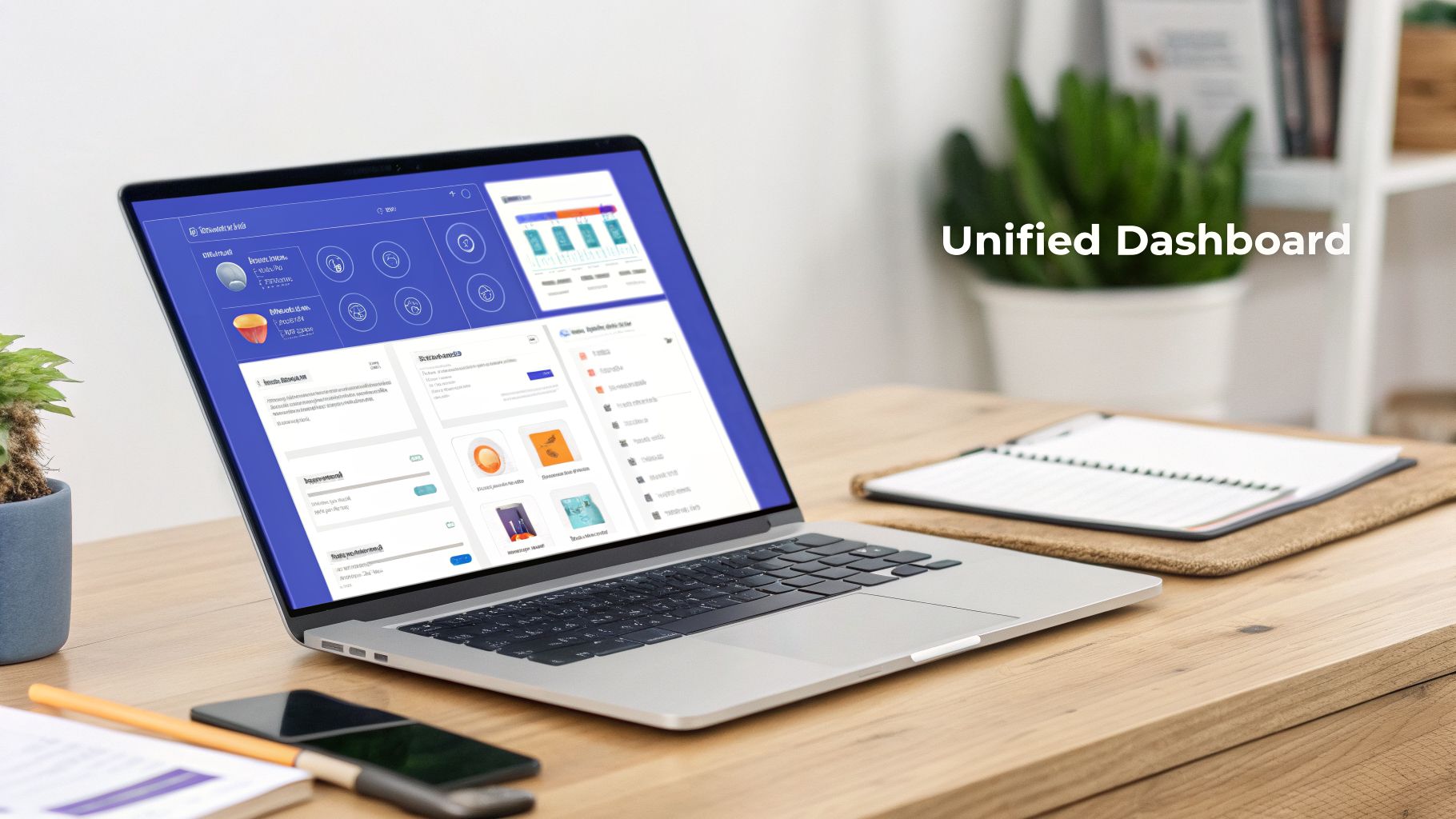
A multi-channel order management system is software that pulls all your orders, inventory, and customer data into a single, unified dashboard. For businesses selling across multiple platforms like Shopee, Lazada, and their own Shopify store, this centralization is a game-changer. It becomes your command center, preventing overselling and making fulfillment a smooth, repeatable process.
Imagine trying to run your e-commerce business across multiple channels without the right tools. You’re constantly jumping between your Shopee Seller Centre, Lazada Seller Center, and Shopify admin, desperately trying to keep track of everything. It’s like conducting an orchestra where each musician is reading from different sheet music.
A multi-channel order management system (OMS) is the conductor that gets everyone on the same page. It pulls all the critical data from every sales channel into one platform. This immediately puts an end to the daily chaos of manual data entry, the risk of overselling your most popular products, and the fulfillment delays that tank your customer ratings.
Without a centralized system, even simple tasks become tedious and prone to human error. You find yourself downloading orders into spreadsheets, frantically updating stock levels on each site after a sale, and copy-pasting tracking numbers one by one. This fragmented workflow creates operational friction that holds you back.
An OMS automates these repetitive chores, completely transforming your workflow. Instead of just reacting to problems as they pop up, you can proactively manage your entire operation. This shift is crucial for growth because manual processes simply can’t keep up when order volumes start to climb. If you want to dive deeper into the fundamentals, check out our guide on what an OMS is and why your business needs it.
There’s a reason the market for these platforms is expanding so quickly. Projections show the multi-channel order management market is set to grow from USD 3.82 billion in 2025 to an impressive USD 8.85 billion by 2033. This boom is fueled by sellers needing real-time inventory sync to avoid stockouts. In fact, 78% of retailers had already adopted these platforms by 2025, slashing stockouts by 35% and significantly improving on-time deliveries—a vital edge for handling peak sales events like 11.11.
To truly grasp the impact, let’s contrast the daily grind of managing orders manually with the streamlined process an OMS provides. This comparison is about more than just saving time; it’s about building a more resilient and scalable business from the ground up.
An effective multi-channel order management system gives you a single source of truth. This empowers your team to make faster, more accurate decisions, from picking orders in the warehouse to analyzing channel profitability.
The table below paints a clear picture of how your day-to-day operations will change. On one side, you have the constant, stressful juggle. On the other, a smooth, automated workflow.
Manual Order Processing vs. Automated OMS Workflow
| Task | The Manual Juggle (Without an OMS) | The Automated Workflow (With an OMS) |
|---|---|---|
| Order Processing | Log into each channel (Shopee, Lazada, Shopify) separately to view and download new orders. | All new orders from every channel appear automatically in one unified dashboard. |
| Inventory Update | After a sale on Lazada, manually reduce stock count on Shopee and Shopify to prevent overselling. | A sale on any channel instantly updates inventory levels across all other integrated platforms in real time. |
| Fulfillment | Copy and paste customer shipping details to create labels individually for each order. | Select hundreds of orders and bulk-print shipping labels and packing lists in a single click. |
| Customer Service | Switch between multiple tabs and accounts to find a customer’s order history or tracking status. | Search for a customer’s name once to see their complete order history across all channels. |
| Reporting | Export sales data from each platform into spreadsheets to manually calculate total revenue and channel performance. | Access built-in reports that automatically track sales, inventory, and profitability by channel. |
As you can see, the contrast is stark. An OMS takes the repetitive, error-prone tasks off your plate, freeing you and your team to focus on strategic activities that actually grow the business—like marketing, customer engagement, and sourcing new products.
While the idea of a central command center sounds great, its real power is in the specific features that eliminate daily operational headaches. A solid multi-channel order management system is built on a few core functions, each designed to save time, slash errors, and set you up for growth.
Let’s move from theory to what this looks like in the real world. These are the engines that drive an efficient multi-channel business. Knowing what they are helps you build a checklist of non-negotiables when you’re comparing different platforms.
This is the beating heart of any good OMS. Instead of logging into Shopee, then Lazada, then your Shopify store just to see what sold, everything is automatically pulled into one dashboard. It allows your team to handle all orders in a single, clean workflow.
Practical Example: Picture this—it’s Monday morning. You’ve got 50 new orders from Shopee and 30 from your Shopify site. With a centralized system, you can select all 80 orders at once and batch-process them to the “Ready to Ship” stage, all without leaving the platform.
Overselling is one of the fastest ways to get bad reviews and even marketplace penalties. This feature prevents it. Real-time inventory syncing automatically updates your stock levels across every channel the instant a sale happens anywhere. It’s a critical piece of any multi channel order management system.
When a single item sells, your OMS instantly tells all your other channels that one less unit is available. This happens in seconds, protecting you from selling phantom stock during a flash sale.
A powerful OMS depends on smart systems to keep stock levels accurate. If you’re curious about how this works in practice, see our guide on how to sync inventory for Shopee and Lazada.
Practical Example: You launch a flash sale for a popular Bluetooth speaker on Lazada, and a customer buys the very last one. Instantly, the system updates your inventory count to zero on TikTok Shop and your own website, making it impossible for anyone else to buy that out-of-stock item.
Printing shipping labels and packing slips one by one is a massive time-waster for any growing seller. An OMS automates this entire process, letting you prep huge batches of orders for shipment with just a few clicks.
This feature almost always includes:
How do you know which sales channel is actually your most profitable? Without an OMS, answering that means hours spent mashing together data in spreadsheets. Advanced reporting gives you clear, actionable insights into your business performance at a glance.
Practical Example: At the end of the month, you generate a report showing your total revenue, order count, and average order value for Shopee, Lazada, and Shopify—all on one screen. You might see that while Shopee brings in more orders, your Shopify customers have a 25% higher average order value. That’s a powerful insight that helps you decide where to focus your marketing budget next.
Deciding when to implement a multi-channel order management system can feel like a huge commitment. Many sellers ask if they’re “big enough” or if the timing is right. The tipping point is not about company size—it’s about the operational complexity you face every day.
If your operations feel more like a frantic scramble than a smooth process, you’re probably ready. Let’s walk through two common scenarios. See if either of these stories feels familiar, as they are classic signs that it’s time for a real solution.
First, let’s look at a seller we’ll call “The Marketplace Pro.” This person is doing well on platforms like Shopee and Lazada, consistently hitting 50 or more orders a day. Sales are great, but behind the scenes, it’s a mess. Their daily routine is a stressful juggling act, bouncing between different seller dashboards to manually update inventory every time something sells.
The goal? To stop overselling.
During a peak sales event like 11.11, the manual system completely falls apart. Inventory counts go out of sync, leading to cancelled orders, angry customers, and the risk of getting penalized by the marketplaces. The warehouse team is just as lost, working off outdated spreadsheets and unsure which orders to pick first. The Marketplace Pro knows they can’t grow any further without the whole operation collapsing.
For a seller like this, a multi-channel OMS provides a single source of truth.
Next up is “The Brand Builder.” This entrepreneur has poured their heart into building a loyal following through their Shopify store. Now, they’re ready to expand their reach by selling on marketplaces like TikTok Shop and Shopee. The problem? They’re terrified that operational chaos will destroy the brand reputation they’ve worked so hard to build.
Their biggest fear is a poor customer experience. How will they manage inventory across their website and two new channels? How can they guarantee fast, accurate fulfillment when orders are flying in from three different directions? The risk of overselling, shipping delays, and simple human error feels overwhelming, and it’s putting their expansion plans on hold.
A multi-channel OMS gives The Brand Builder the confidence to grow without compromising their brand. It’s the operational backbone that ensures every customer gets the same fantastic service, no matter where they found you. Exploring broader multi-channel e-commerce solutions can offer a complete roadmap for managing this kind of growth successfully.
This isn’t a problem reserved for giant corporations anymore. While large enterprises have traditionally used these systems, there’s been a major shift. Small and Medium Enterprises (SMEs) are now driving market growth, with the highest CAGR of 12.18%. This surge is all thanks to affordable, cloud-based solutions designed for multi-store sellers on platforms like Shopee and Lazada who need to get organized without a massive upfront investment. You can find more on this trend in the full market report.
An OMS protects your brand by turning the promise of fast, reliable shipping into a reality. This builds customer trust and encourages repeat business across all your sales channels.
If you saw your own business in either of these stories, you’ve likely hit the point where the cost of not having an OMS—in lost time, costly mistakes, and stunted growth—is much higher than the investment in one.
Picking the right multi-channel order management system is one of the most important decisions you’ll make for your e-commerce business. This is about choosing the operational backbone that will support your growth for years to come. A simple feature list won’t tell you the whole story.
To make a confident choice, you need an actionable framework. This means looking beyond marketing claims and asking tough questions that reveal how a platform will perform when it truly matters—during a massive sales event or when you’re expanding to a new marketplace.
Let’s break down the key things you need to look at to guide your decision.
The first, most basic test for any OMS is whether it actually connects to all your sales channels. A “multi-channel” system is pointless if it doesn’t support the specific platforms where you make your money, like Shopee, Lazada, TikTok Shop, and Shopify.
But don’t stop there; think about where you’re headed. Are you eyeing an expansion to Amazon or planning to build a WooCommerce site next year? A good OMS shouldn’t just meet your needs today—it needs to support your ambitions for tomorrow.
Ask potential providers these direct questions:
Your business isn’t static, so your OMS can’t be either. A system that works fine with 50 orders a day might completely fall apart under the pressure of 5,000 orders during a major sales event like 11.11. System crashes and slowdowns during peak times mean lost sales and angry customers.
Scalability is about flawlessly executing on your busiest day of the year, not just an average Tuesday. Your OMS must be built to withstand the intense pressure of your most successful sales campaigns.
Practical Example: Picture this. It’s the first hour of the 11.11 flash sale. You have hundreds of orders pouring in every minute. A scalable multi-channel order management system will process every single one without lag, update inventory across all channels instantly, and let your team print shipping labels in massive batches. An unscalable one will freeze, and your warehouse will descend into chaos.
In multi-channel e-commerce, a few seconds can be the difference between a happy customer and a costly oversell. When you have one item left in stock and it sells on your Shopify store, how fast does that information get to your Lazada and Shopee listings? If the sync takes minutes instead of seconds, you’re wide open to problems.
A slow sync creates “phantom inventory”—stock that looks available but has already been sold elsewhere. This leads directly to cancelled orders, which tanks your marketplace ratings and makes your brand look unreliable.
Actionable Insight: When you’re in a demo with a potential OMS provider, ask them to show you a live sync. Get them to process a test order on one channel and time how long it takes for the stock level to update on another. The gold standard is near-instant, well under 10 seconds.
A powerful system is only useful if your team can actually use it. The implementation, from migrating your product data to training your staff, is a make-or-break factor. A complicated setup can lead to months of frustration and lost productivity, wiping out any potential benefits.
You need to know what the onboarding journey looks like and what kind of support you get. You’re looking for a partner, not just a software vendor.
Here are the key questions to ask about the setup process:
By focusing on these four pillars—integrations, scalability, sync speed, and implementation—you can confidently choose a multi-channel order management system that doesn’t just solve today’s headaches but becomes a powerful engine for your future growth.
A powerful tool is only as good as its setup. Choosing the right multi-channel order management system is a huge first step, but implementing it correctly is what turns all that potential into actual profit.
Getting this part right means you start reaping the rewards of automation and accuracy from day one, without throwing your daily sales into chaos. To make it feel less like boiling the ocean, let’s break the process down into four clear, manageable phases.
Before you can centralize anything, you have to get your data in order. This is, without a doubt, the single most critical step for making sure your new system works as advertised. The main focus here? Your SKUs (Stock Keeping Units).
If you have different SKUs for the same exact product on Shopee, Lazada, and Shopify, your new system won’t have a clue how to track inventory. It will see them as three different items.
Your first job is to create a “master SKU list” where one unique SKU is assigned to each product variant. This is your single source of truth. It ensures that when a t-shirt sells on any channel, the system knows exactly which item’s stock level to reduce across the board.
Once your SKUs are sorted, it’s time to plug your stores into the OMS. Modern platforms have made this surprisingly painless. It usually just involves going into your OMS settings and authorizing secure access to each of your seller accounts.
You’ll typically be redirected to your Shopee, Lazada, or Shopify login page to grant permission. This whole process uses secure tokens, which means you never have to share your actual passwords with the OMS provider. In just a few clicks, your new command center will begin pulling in your products, inventory levels, and live orders.
The factors you weighed when choosing the system—integrations, scalability, and speed—are now put to the test.
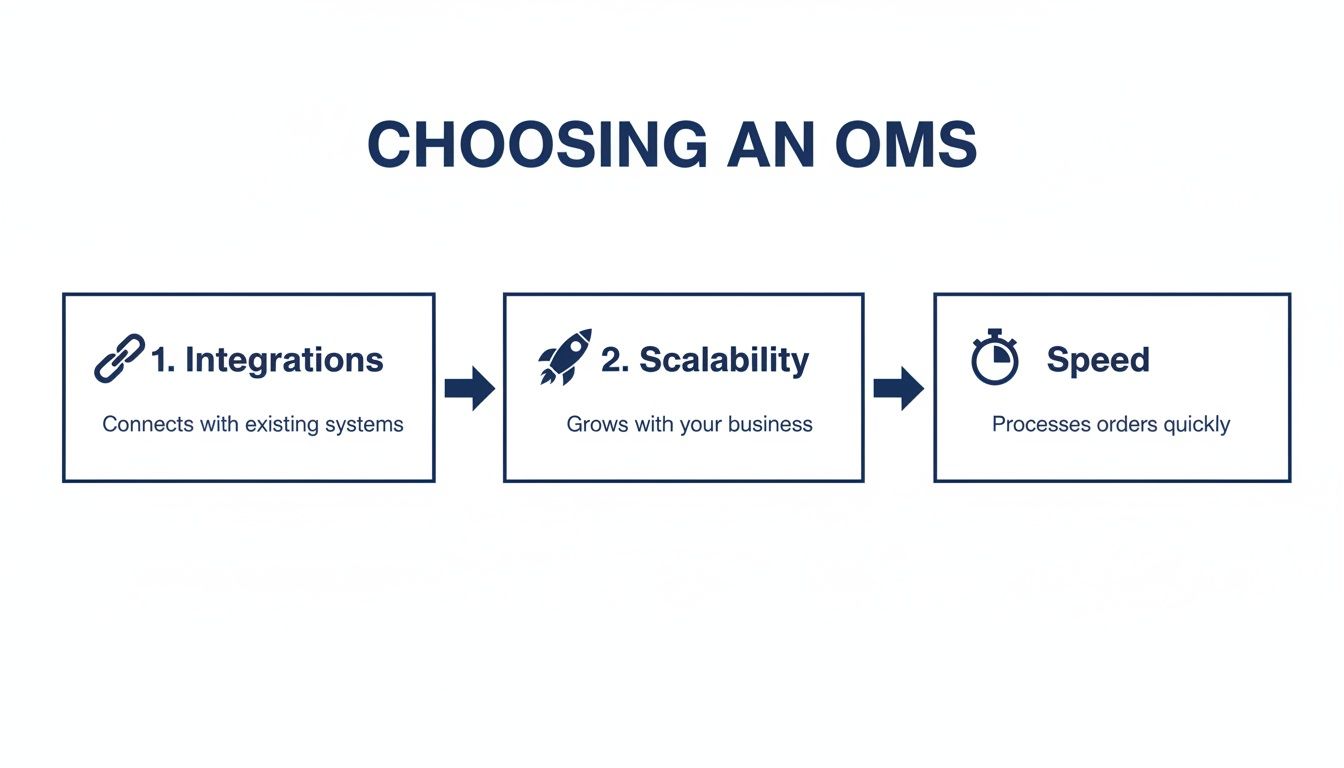
This is where the rubber meets the road. A system with seamless integrations will connect to your stores in minutes, not days.
With your data clean and channels connected, you can now teach the system how you want to pick, pack, and ship orders. This is where you essentially digitize your current warehouse process, but with added intelligence.
Think of it like setting the preferences on a new phone. Key steps include:
The final phase is all about getting your team on board and ready to use the new system. Don’t just give them a login and a manual; that’s a recipe for failure. Effective training is what makes or breaks adoption.
Explain the why behind the change. It’s not just new software; it’s a tool to get rid of tedious work, slash packing errors, and ultimately make their jobs easier and less stressful, especially during big sales events.
Actionable Insight: On launch day, I always recommend running your old and new systems in parallel for a bit. Process a small, manageable batch of orders (say, 10-20) through the new OMS while your team also does it the old way. This lets you compare the outputs in real-time, catch any small configuration mistakes, and build confidence before you flip the switch completely.
Following these structured steps helps you dodge the common pitfalls that can derail an OMS rollout. A methodical implementation ensures your new system starts adding value from the get-go, transforming from a line on an expense sheet into a genuine engine for growth.

Implementing a multi-channel order management system is a real investment, but its true value goes far beyond the monthly subscription fee. To understand the real return on your investment (ROI), you have to connect the software to your bottom line. It’s all about tying it to measurable business results you can see right away.
The most concrete returns show up in reclaimed resources—both time and money. By automating manual work and eliminating expensive mistakes, a solid OMS can quickly pay for itself and become a profit-generating tool for your brand. Let’s break down how to calculate this value in practical terms.
The first and most obvious return is getting back all those hours your team sinks into repetitive tasks. Manually pushing orders through, updating inventory on every channel, and copy-pasting tracking numbers isn’t just mind-numbing; it’s expensive. You’re paying your team for low-value admin work instead of focusing on activities that actually grow the business.
To put a number on it, start by tracking the hours.
Here’s a practical example: If your team spends 5 minutes per order and you process 60 orders a day, that’s 300 minutes (5 hours) spent just on manual processing every single day. An OMS can shrink that down to 30 minutes, saving you 4.5 hours per day. That’s over 22 hours a week.
Mistakes in e-commerce are never free. Overselling leads to cancelled orders and angry customers. Shipping the wrong item means you’re on the hook for costly returns. And inaccurate inventory causes stockouts that kill sales momentum. A multi-channel OMS directly plugs these financial leaks with automation and real-time data syncs.
The true cost of an error isn’t just the return shipping label. It’s the lost customer lifetime value, the negative review that deters future buyers, and the damage to your marketplace rating.
Gauging the ROI of your OMS often means looking at its knock-on effects in your warehouse. Exploring warehouse management for ecommerce can show how a well-integrated OMS boosts overall efficiency and savings, which is a huge part of your investment’s payback.
Finally, a powerful OMS lets you handle a much higher volume of orders without having to hire more people. When your team isn’t buried in manual tasks, they have the bandwidth to manage massive sales spikes and expand to new channels without the usual chaos. This is scalability you can actually measure.
Track these metrics to see the difference:
By focusing on these three areas—time saved, fewer errors, and more capacity—you can build a clear, data-driven case for your investment. You’ll quickly find that a robust multi-channel order management system isn’t a cost. It’s an engine for profitable growth.
Even with a clear guide, you probably still have a few questions bouncing around in your head about how an OMS works in the real world. This section tackles the most common uncertainties we hear from business owners just like you. The goal is to give you straight answers and practical info so you can feel confident about your next move.
This is a common question, and the honest answer is: it varies. But a modern, cloud-based OMS is built for speed. If you have clean product data (meaning your SKUs are already organized), you could be up and running in less than a week.
The setup usually involves connecting your sales channels, setting your shipping rules, and a quick training session for your team. The biggest bottleneck is almost always your own data. If your SKUs are a mess—inconsistent across Shopee, Lazada, and your website—you’ll need to clean that up first. That’s what adds time.
Actionable Insight: Before you even sign up for a demo, do this: create a master spreadsheet of all your products with a single, unified SKU for each one. Seriously. This one step can cut your implementation time in half and save you from massive headaches later.
No, not at all. A multi-channel order management system is a central hub that plugs into your existing seller accounts. It pulls all the important data from them, but it doesn’t replace them.
You will absolutely still need your Shopee Seller Centre and Lazada Seller Center accounts. You’ll use them for things like managing your storefront listings, running marketing campaigns, and handling direct customer messages.
Think of it like this: your seller accounts are the customer-facing storefronts. Your OMS is the engine room that runs the whole operation behind the scenes. It handles the nitty-gritty operational work:
Yes, and this is where things get really powerful. Many modern OMS platforms are specifically designed for this “omnichannel” model. They can sync inventory not just between your online marketplaces, but also with your brick-and-mortar retail locations. This creates a “unified stock pool.”
Here’s a practical example: A customer in Jurong buys a pair of shoes from your Shopify website. Your OMS can be set up to automatically route that order to your physical store in Orchard Road for fulfillment, since it has the stock and is closer to the customer. The moment that order is processed, the system deducts that pair of shoes from the store’s inventory, ensuring the stock levels are perfectly accurate for both your in-store staff and your online shoppers. No more telling a walk-in customer an item is out of stock because it was just sold online a minute ago.
This one is easy: failing to train the team. We see it all the time. A business invests in a powerful new system, hands over the login details, and just expects everyone to figure it out.
This approach is a recipe for disaster. It almost always leads to frustration, low adoption, and a complete failure to see any of the benefits you paid for. Your team—especially the folks in the warehouse and customer service—needs to understand why you’re making this change and, more importantly, how it will make their jobs easier, not harder.
Without their buy-in, they’ll just slide back into their old, inefficient habits. A good OMS provider knows this and should offer structured training and ongoing support to make sure your entire team is confident and ready from day one.
Ready to stop overselling, slash your fulfillment time, and finally get a single, clear view of your entire e-commerce business?
OneCart is the multi-channel order management system built from the ground up to handle the chaos of selling across Shopee, Lazada, TikTok Shop, and your own website. Stop drowning in spreadsheets and start scaling your business with confidence.
Automate & Scale Your Online Business with OneCart
Start a Free TrialUsed by hundreds of merchants in Singapore & Southeast Asia