Boost Growth with multi channel ecommerce solutions for 2026 2026
Discover how multi channel ecommerce solutions centralize inventory and orders for scalable growth and fewer oversells in 2026.
Discover how multi channel ecommerce solutions centralize inventory and orders for scalable growth and fewer oversells in 2026.

If you’re selling on more than one online channel, you’ve probably felt the chaos. You jump between seller dashboards—Shopee, Lazada, TikTok Shop, maybe your own Shopify store—just trying to keep up. A sale happens on one, and you’re racing to update stock levels on the others before you oversell.
This frantic, manual juggling act is a huge drag on your operations. It’s slow, stressful, and a recipe for costly mistakes. This is the exact problem multi-channel ecommerce solutions were built to solve.
Think of a multi-channel solution as a central command center for your entire ecommerce operation. It’s a software platform that plugs into all your different sales channels and pulls all your critical data—orders, inventory, and product info—into a single dashboard.
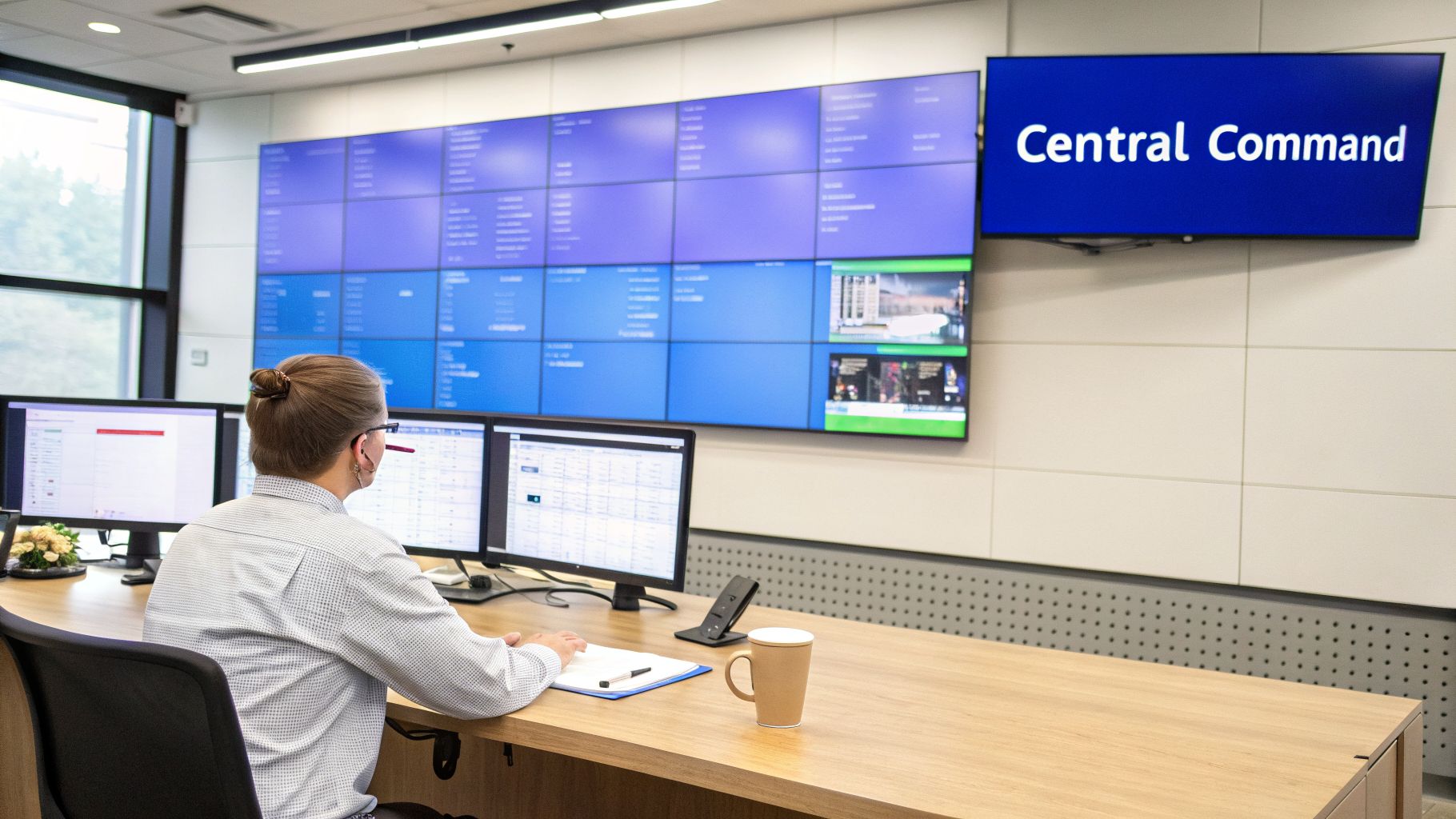
From this one spot, you can manage everything automatically, without ever needing to log in and out of different seller accounts again.
Without a central system, your team is probably drowning in repetitive tasks that feel like a never-ending fire drill.
This manual approach is a bottleneck. It might work when you’re small, but as you scale, the risk of errors and team burnout skyrockets.
Now, imagine that command center is fully operational. An item sells anywhere—it doesn’t matter where—and the system instantly updates your inventory count across all other channels within seconds. No human intervention needed.
Actionable Insight: A multi-channel solution transforms your operations from a reactive, chaotic scramble into a proactive, automated workflow. For example, instead of manually directing traffic at a busy intersection, you install an intelligent, synchronized traffic light system.
The table below shows the direct operational shift when you adopt a multi-channel solution, highlighting concrete gains in efficiency and accuracy.
| Operational Task | Manual Process (Without a Solution) | Automated Process (With a Solution) |
|---|---|---|
| Inventory Sync | Manually updating stock counts on each channel after every sale. High risk of overselling during sales. | Stock levels are automatically synced in real-time across all channels the moment an order is placed. |
| Order Management | Logging into multiple seller centers to download, process, and track orders individually. | All orders from every channel appear in one centralized dashboard, ready for unified processing. |
| Product Listing | Creating or updating product listings one by one on each marketplace. A simple price change can take hours. | Create a product once and publish it to multiple channels with a few clicks. Bulk updates are instant. |
| Reporting | Manually downloading CSV files from each platform and combining them in a spreadsheet to see total sales. | A unified dashboard provides a real-time, at-a-glance view of total sales, top products, and channel performance. |
The move to a centralized system is about survival and growth in a competitive market.
This need for efficiency is why the multi-channel software market is projected to hit USD 15 billion by 2025. For any merchant handling over 50 orders a day, juggling marketplaces like Shopee and Lazada without a unified system is simply unsustainable. Platforms like OneCart are essential for syncing stock in real-time, which is a lifesaver for preventing overselling during peak campaigns. You can explore more market growth data to see the full scope of this trend.
A laundry list of software features is just noise. To understand what multi channel ecommerce solutions can do, you need to see how they perform in day-to-day operations. Let’s break down the core components and show how they fix real problems, buy back your time, and fuel your brand’s growth.
For any multi-channel seller, this is the single most important feature. Think of it as a vigilant, always-on accountant for your stock levels.
Let’s say you have 10 units of a best-selling handbag. You list them on Shopee, Lazada, and your own Shopify store. A customer buys one from Lazada. Without a proper system, you’d have to scramble to manually log into Shopee and Shopify to update the quantity to nine.
With real-time inventory sync, the moment that Lazada sale is confirmed, the system automatically deducts one unit. It then pushes the updated stock count of nine to all your other channels in seconds.
This is what stops the dreaded overselling nightmare, especially during massive sales events like 11.11 or Black Friday. It makes sure the stock number your customers see is the real number, protecting your seller ratings and avoiding the operational chaos of cancelling orders.
Jumping between multiple seller dashboards to process orders is a huge time-waster and a recipe for mistakes. A centralized order management system pulls all your orders from every channel into a single, unified command center.
Your ops manager can log in and see a complete list of new orders from Shopee, TikTok Shop, and WooCommerce, all in one place. Instead of dealing with them one by one, they can take action in bulk.
Here’s a practical example of how this works:
This turns a chaotic, hours-long process into a streamlined workflow that’s done in minutes. It also slashes human error because manual data entry is almost completely gone. For a deeper dive, see how a multi-channel order management system can overhaul your entire fulfillment process.
Managing product information across multiple marketplaces is painfully repetitive. A simple price change could mean logging into three, four, or even five different platforms.
Product listing management tools fix this by creating a single source of truth for all your product data. A brand manager can update a product’s price, description, or images once in the central system, then push those changes to all connected channels at the same time.
For instance, if you want to run a weekend flash sale, you can schedule a price drop to go live on Friday evening and revert on Monday morning across all marketplaces—all from one dashboard.
At its core, a solid multi-channel strategy depends on smart data management, often powered by a Product Information Management (PIM) system. These systems are the backbone that makes consistent and accurate product listings possible.
Actionable Insight: When you centralize your product data, you ensure brand consistency. For example, every customer sees the same correct price, product details, and branding, no matter if they shop on your website, a marketplace, or a social media shop.
By adopting these core features, brands consistently free up valuable time—often 15-20 hours per week—and dramatically reduce operational mistakes. This is about giving your team the freedom to focus on what actually grows the business: marketing, customer service, and strategy.
Picking the right multi channel ecommerce solution is a make-or-break decision that will ripple across your entire operation. Get it right, and you unlock efficiency and scale. Get it wrong, and you’re stuck with a system that creates more fires than it puts out.
Think of it like choosing a new car. You wouldn’t buy a two-seater sports car to haul construction gear, and you wouldn’t use a dump truck for a family road trip. The best vehicle depends entirely on what you need it to do. You’re looking for a platform that solves today’s problems and can also handle where you’re headed tomorrow.
Before you even sit through a single demo, you need to be crystal clear on your non-negotiables. These are the absolute must-haves. If a platform can’t deliver on these basics, it’s an instant “no,” saving you a ton of time.
Focus on these three pillars first:
Treat these checks as your first filter. They’ll help you quickly cut through the marketing noise and narrow your options down to only the serious contenders.
Once you have a shortlist, it’s time to go deeper. When you get into demos and trials, use a structured checklist to compare each platform apples-to-apples. Don’t just sit back and watch the sales pitch—come prepared with tough, specific questions that reveal how the system actually works under pressure.
Actionable Insight: A provider’s willingness to give direct, transparent answers to challenging questions is often a strong indicator of their product’s quality and their commitment to customer success. Be wary of vague answers.
To help you get started, we’ve put together a checklist of critical features and questions. Use this to guide your conversations and make sure you’re not just buying a list of features, but a solution that actually works for a growing ecommerce brand.
Here is a checklist to guide your evaluation process.
Your Multi-Channel Solution Evaluation Checklist
| Evaluation Criteria | Key Questions to Ask | Why It Matters for Your Growth |
|---|---|---|
| Order Processing Workflow | “Can you demonstrate how to bulk process 500 orders, from generating pick lists to printing all the shipping labels in one go?” | This reveals the platform’s real-world efficiency. It shows if it will genuinely reduce manual work or just move the bottleneck somewhere else. |
| Inventory Audit Trail | “Show me the full audit trail for a single SKU. I need to see every stock movement, who made the change, and an exact timestamp.” | This is non-negotiable for accountability. It’s how you diagnose stock discrepancies in minutes instead of days of guesswork. |
| API and Integration Support | “What’s your process when a marketplace like Lazada pushes a major API update? How do you ensure my connection doesn’t break?” | A great partner manages these technical headaches for you, preventing downtime and ensuring your sales never stop. You shouldn’t have to worry about this. |
| Guaranteed Uptime | “What is your guaranteed uptime percentage during peak sales season? And what are the service credits if you fail to meet that SLA?” | This holds your provider accountable for performance when it matters most. It protects your revenue during your most critical sales events. |
Taking the time to ask pointed questions like these helps you see past the marketing fluff and get to the core of what a platform can actually do for your business. The right multi channel ecommerce solutions don’t just connect your channels; they provide a rock-solid foundation for you to build on.
The data backs this up. Retailers who unify their platforms see a 287% higher purchase rate compared to single-channel sellers. With mobile commerce now making up over 60% of all e-commerce, today’s customers expect a perfect experience every time, and a robust, integrated system is the only way to deliver it.
Picking the right multi-channel e-commerce solution is a big win, but the real work starts now: implementation. A smart approach to migration and scaling is what lets you tap into the platform’s full power without blowing up your current operations.
Think of it as your roadmap for a smooth transition, covering everything from cleaning up your data to crushing massive sales events.
This simple, three-step journey shows how to evaluate and roll out a new system, zeroing in on channel support, scalability, and sync.
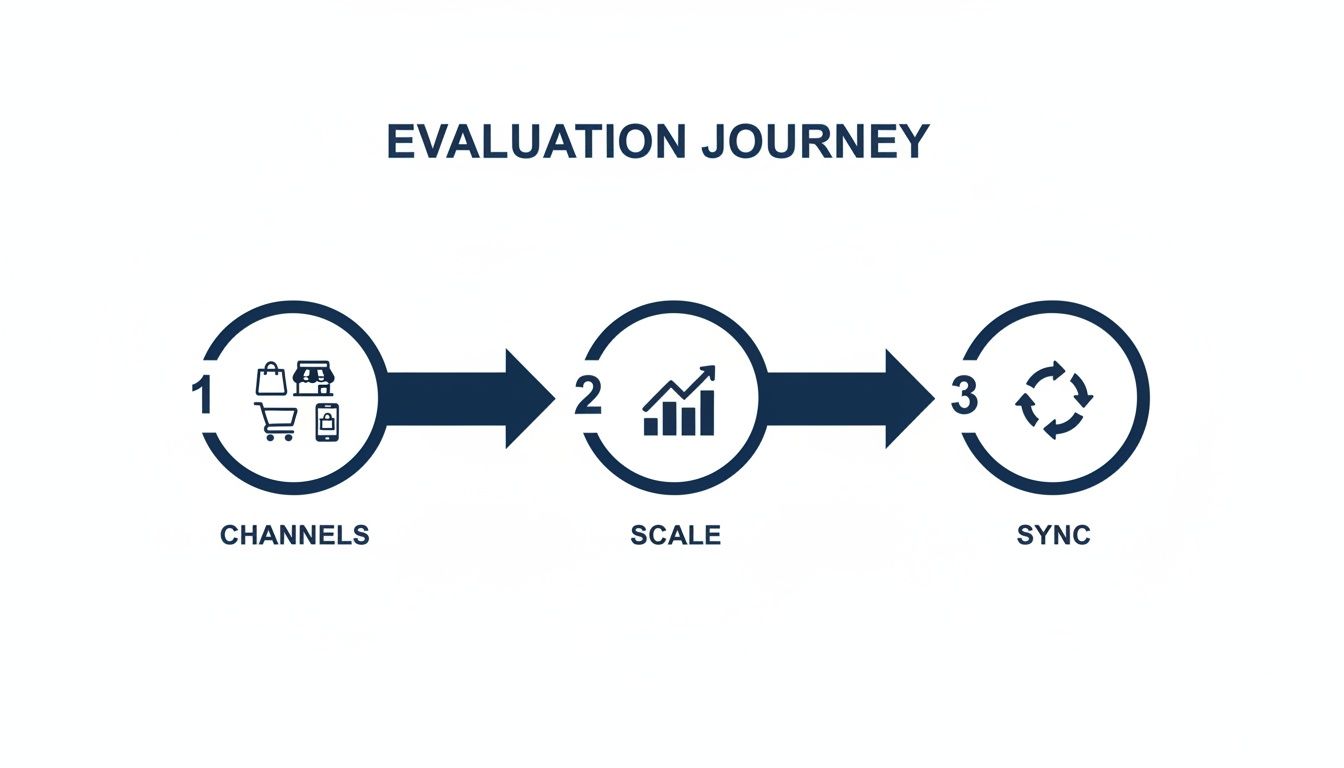
The core idea is that a successful setup balances your current needs (your channels) with future growth (your scale), all held together by lightning-fast, reliable data synchronization (your sync).
Migrating to a new system feels like a huge project, but breaking it down into clear steps makes it far less intimidating. If you rush this part, you’re just setting yourself up for sync errors and operational headaches later.
Follow this checklist for a clean and effective launch:
Actionable Insight: Remember to prepare your warehouse team. They need to understand the new, unified pick lists and packing processes to avoid fulfillment delays. A quick training session showing them how a single list now contains orders from all channels can prevent confusion on day one.
Your new system manages day-to-day orders and is also a weapon for handling massive growth and sales spikes. With e-commerce revenue projected to hit $3.89 trillion globally by 2026, handling more channels and peak demand is what separates the brands that thrive from those that just get by.
Smart retailers are even blending online and physical stores, with 77% now offering options like buy-online-pick-up-in-store (BOPIS) to meet customer expectations. A system with strong API integrations is essential for this kind of scalable growth, delivering a fast ROI by slashing errors.
Here are a few proven strategies for managing huge order volumes:
For a deeper dive into optimizing these processes, our guide on warehouse management for ecommerce offers advanced strategies for streamlining your entire fulfillment operation.
By building these scaling tactics into your operational plan, you ensure your business can grow without the risk of breaking. Your multi-channel ecommerce solution should give you the confidence to chase bigger sales, knowing your backend can handle the success.
Adopting a new system is a big investment, and you’ll need to prove it pays for itself. Justifying the cost of a multi-channel ecommerce solution means moving beyond feelings like “we’re more efficient now” and into hard, cold numbers. By measuring the right things before and after you make the switch, you can build a solid business case and see a clear return on your investment.
To see the real impact of automation, you need a baseline. Start tracking these key performance indicators (KPIs) right now so you have a “before” snapshot to compare against your “after” results.
Tracking these metrics gives you concrete data to show real improvement. If you’re hunting for more ideas, check out our guide on the top ecommerce metrics and KPIs to track for business success.
Calculating your return on investment doesn’t have to be a complex, MBA-level exercise. Often, the biggest and most immediate gain comes from all the time your team gets back.
Let’s walk through a practical example. Say your operations team spends 20 hours per week just manually updating inventory across channels, downloading orders from different seller centers, and creating shipping labels.
If your staff’s average hourly rate is $20, the math is surprisingly simple:
20 hours/week x $20/hour = $400 in labor costs saved per week $400/week x 4 weeks = $1,600 in monthly savings
If your multi-channel software costs $400 a month, you are achieving a 4x return on your money from labor savings alone. This kind of quick math often proves the software pays for itself in the very first month.
Not every return shows up neatly on a spreadsheet. Some of the most powerful benefits of a centralized system are the “hidden” ones, but they have a very real impact on your brand’s long-term health and profitability.
These intangible wins are just as important:
You’ve seen the problems, you know the features, and you get the ROI behind a proper multi channel ecommerce solution. Now it’s time to stop learning and start doing. This is how you build real momentum and carve out a clear path for your business.
The right first step really depends on who you are in the company. Below are three simple, practical mini-plans to help you take that next logical step—today.
As the owner, you feel every single operational headache. Your time is your most precious resource. Use this quick self-audit to figure out where a central system will give you the biggest, fastest win.
Grab a pen and actually write down the answers to these three questions:
Your answers are your top three bottlenecks. A multi-channel solution is built to solve exactly these problems, giving you a perfect checklist for when you start evaluating different platforms.
You see the daily chaos up close, but you need the boss to sign off on the budget for a fix. The key is to build your case with hard data, not just feelings.
Actionable Insight: A strong business case connects the operational fires you put out every day to the financial metrics leadership actually cares about: cost savings, revenue protection, and growth.
Frame your argument using these simple points:
You’ve got a successful direct-to-consumer brand on Shopify or WooCommerce, and now you’re ready to tap into the massive audiences on marketplaces like Shopee, Lazada, or TikTok Shop. The smart move is a low-risk, controlled launch.
Follow this mini-plan to expand without the chaos:
Jumping into a multi-channel ecommerce solution can bring up a lot of real-world questions. Here are some no-nonsense answers to the most common things merchants ask when they’re thinking about making the switch.
One of the biggest fears is that getting started will be a months-long headache that kills your sales momentum. Modern platforms are built to get you live in a matter of days, not weeks.
The whole process breaks down into a few simple stages:
Actionable Insight: The most time-consuming part isn’t the software—it’s cleaning up your data. If your SKUs are a mess, take a day to get them straight before you start. That one day of prep will save you weeks of frustration down the line.
Absolutely. This is a core function, often called price segmentation. Any good multi-channel platform will let you set unique prices for the same SKU across different channels, all from one central dashboard.
For instance, you could have a standard price on your Shopify store but run a flash sale with a lower price on TikTok Shop to capture a different audience. It’s also perfect for managing regional pricing, letting you adjust for different currencies or markets without having to log in and manually update every single channel.
This is one of the biggest reasons to use a dedicated provider. Marketplaces like Shopee and Lazada are constantly updating their APIs—the tech that lets different software talk to each other. When an API changes, it can instantly break the connection for anyone using a custom-built tool or a poorly maintained system.
With a quality multi-channel ecommerce solution, this problem disappears. The provider’s tech team is on the hook for keeping those connections stable. They work behind the scenes to update their software whenever a marketplace makes a change, so your operations keep running without a single hiccup. You’re effectively outsourcing all that technical complexity, freeing you up to just focus on selling.
Ready to stop juggling dashboards and start scaling your business? OneCart centralizes your inventory, orders, and listings into a single command center, preventing oversells and saving your team hours every day. Book a demo today and see how you can achieve ROI in just days.
Automate & Scale Your Online Business with OneCart
Start a Free TrialUsed by hundreds of merchants in Singapore & Southeast Asia