
MOQ Meaning: Minimum Order Quantity, Formula & Alibaba Guide 2026
MOQ (Minimum Order Quantity) is the fewest units a supplier will sell. Learn the MOQ formula, typical Alibaba ranges, and 5 ways to negotiate lower.

MOQ (Minimum Order Quantity) is the fewest units a supplier will sell. Learn the MOQ formula, typical Alibaba ranges, and 5 ways to negotiate lower.
MOQ stands for Minimum Order Quantity, the smallest number of units a supplier will sell in a single order. Typical MOQs are 100–1,000 units on Alibaba, 10–100 units from suppliers offering low MOQs, and as few as 1 unit from no-MOQ suppliers (at a higher per-unit cost). If a supplier’s MOQ is 500, you must buy at least 500 units per purchase.
You’ll encounter MOQs when sourcing products from Alibaba, negotiating with local manufacturers, or restocking inventory for platforms like Shopee, Lazada, and Amazon. Understanding MOQs is essential for controlling costs and avoiding dead stock that ties up capital.
In this guide, we cover what MOQ means (including on Alibaba and in supply chain contexts), the MOQ formula suppliers use to set their minimums, real-world examples from ecommerce and manufacturing, and 5 proven strategies to negotiate lower minimums, even if you’re a small business.
MOQ is an abbreviation for Minimum Order Quantity, the minimum number of items required for a transaction, especially in business-to-business (B2B) dealings. You will encounter MOQs when sourcing from manufacturers, wholesalers, and suppliers on platforms like Alibaba, 1688, and Global Sources.
| Term | Definition |
|---|---|
| MOQ | Minimum Order Quantity, the fewest units a supplier will sell per order |
| Low MOQ | Supplier willing to sell 10–100 units (ideal for testing) |
| No MOQ | Any quantity accepted, even 1 unit (higher per-unit cost) |
| MOQ on Alibaba | Typically 100–1,000 units per product, shown on every listing page |
Minimum Order Quantity (MOQ) refers to the smallest number of units a supplier is willing to sell in a single order. Suppliers set MOQs to ensure that production and distribution costs are covered, making the transaction viable for their business.
For example, if a manufacturer tells you that the MOQ is 500 units, you must order at least 500 units per transaction. This is common when sourcing products for resale on marketplaces like Shopee, Lazada, Amazon, and TikTok Shop.
Actionable Insight: Before committing to a supplier’s MOQ, calculate your break-even point to ensure the order volume makes financial sense for your business.
MOQs exist because suppliers need to cover the cost of production, materials, and logistics. They also:
Businesses use MOQs to balance production and distribution needs with profitability. Understanding the supplier’s perspective helps you negotiate better terms.
Suppliers need assurance that the effort and costs of production are worthwhile. MOQs help them achieve consistent revenue while managing raw materials effectively.
For example, a T-shirt supplier has fixed costs like setting up a machine and preparing designs. If someone orders just 50 shirts, these costs are spread over too few items, making it expensive and unprofitable. By setting an MOQ of 500 shirts, the supplier can:
Actionable Insight: When sourcing products for your ecommerce store, always ask suppliers to break down their cost structure. Understanding their fixed vs. variable costs gives you leverage to negotiate the MOQ downward.
Without MOQs, suppliers risk producing items that might not sell, leading to wasted resources. With MOQs, only items with guaranteed demand are manufactured. This is particularly important for custom or private-label products popular on marketplaces like Amazon and Shopee.
MOQ calculations align production costs with profitability. The calculation takes into account factors like raw material costs, labour, and overheads. For example:
| Industry | Typical MOQ | Why |
|---|---|---|
| Textiles & Apparel | 500–1,000 units | Fabric dyeing and cutting have high fixed setup costs |
| Electronics | 1,000+ units | Expensive tooling, PCB assembly, and testing |
| Handmade Jewellery | 10–50 units | Labour-intensive, not machine-dependent |
| Cosmetics & Beauty | 500–5,000 units | Regulatory testing and packaging minimums |
| Food & Beverage | 100–1,000 units | Shelf life constraints and batch production |
If you’re sourcing products to sell on Shopee, Lazada, or Amazon, here’s what to expect:
| Platform | Typical MOQ | Best For |
|---|---|---|
| Alibaba | 100–1,000 units | Private label, bulk sourcing |
| 1688 (China domestic) | 50–200 units | Budget sourcing (needs agent) |
| Global Sources | 500+ units | Verified manufacturers |
| Local wholesalers (SG, MY) | 10–50 units | Testing, small batches |
On Alibaba, MOQ appears on every product listing, usually displayed next to the price tiers. For example, a listing might show:
This means you must order at least 100 units. The per-unit price drops as your order quantity increases. This is why understanding MOQs is critical for your profit margins.
Actionable Insight: When messaging Alibaba suppliers, mention your monthly sales volume across all channels. A supplier is more likely to drop MOQ from 500 to 200 if they know you sell on Shopee, Lazada, AND Amazon, because repeat orders are almost guaranteed.
| Product Category | Typical Alibaba MOQ | Negotiable To |
|---|---|---|
| Apparel & Fashion | 200–500 units | 50–100 |
| Electronics & Accessories | 500–1,000 units | 100–200 |
| Home & Kitchen | 100–500 units | 50–100 |
| Beauty & Personal Care | 500–2,000 units | 200–500 |
| Packaging & Supplies | 1,000–5,000 units | 500–1,000 |
In supply chain management, MOQ has broader implications beyond just the price negotiation with a single supplier. It affects your entire logistics and inventory planning cycle:
Actionable Insight: Map your supply chain’s MOQ constraints alongside your reorder points. If your supplier’s MOQ is 500 units and your reorder point triggers at 200 units of remaining stock, you’ll always hold at least 200 + 500 = 700 units. Make sure your warehouse and cash flow can support that.
MOQs allow suppliers to take advantage of economies of scale, reducing per-unit production costs. For buyers, this translates to lower prices: the more you order, the better your margins.
Structured ordering through MOQs helps businesses maintain optimal inventory levels. Instead of ad-hoc purchasing, you can plan stock replenishment cycles that align with your sales velocity across platforms, tracking everything in an inventory spreadsheet or using tools like safety stock calculators to determine the right buffer quantities. For sellers using a FIFO approach, consistent MOQ ordering also simplifies batch tracking and costing.
When buyers consistently meet MOQ requirements, they gain leverage to negotiate better payment terms, such as Net 30 or Net 60, which improves cash flow and working capital management. Before confirming a bulk order, ask your supplier for a formal quotation or proforma invoice that locks in pricing, payment terms, and delivery estimates. Size those bulk commitments against an open-to-buy budget so every purchase order fits the cash and stock you have allocated for the period.
Running out of stock costs more than many sellers realise: backorder handling, expedited shipping, and lost sales. Preventing overselling starts with consistent supply, and MOQs help ensure that.
While MOQs benefit suppliers, they can pose real challenges for buyers, especially smaller ecommerce businesses.
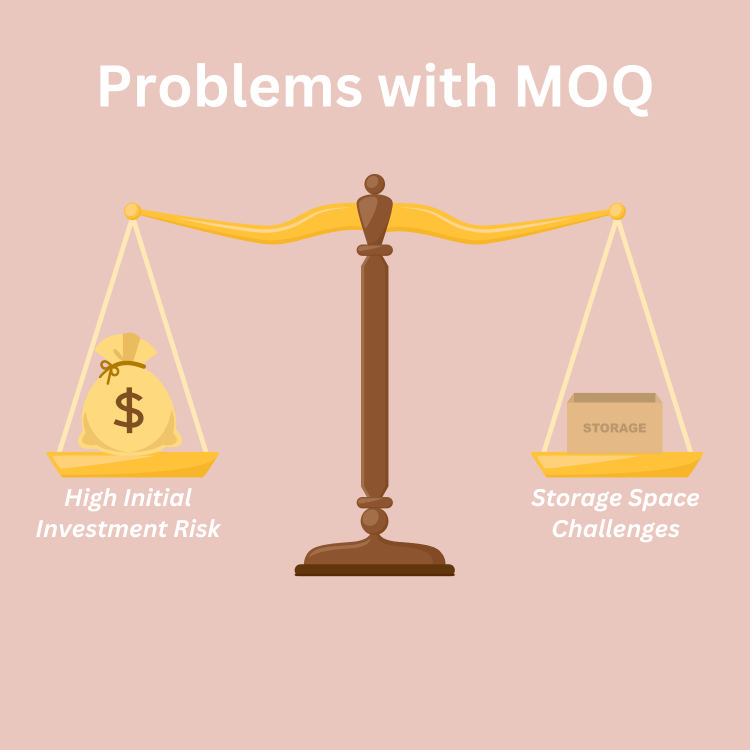
Small businesses often struggle to meet high MOQs due to limited capital or storage space. Meeting them can lead to overcommitment and inventory management headaches.
According to a survey by Software Advice, 42% of small and medium-sized businesses struggle with their inability to meet minimum order sizes set by vendors, hindering their ability to compete with larger companies.
Actionable Insight: If you sell across multiple channels (Shopee, Lazada, Shopify, Amazon), consolidate your demand forecasting across all platforms to justify higher order quantities to suppliers.
For businesses with fluctuating or seasonal demand, committing to a large upfront order is risky. If products don’t sell as expected, you’re left with dead stock tying up capital. This is especially common for sellers testing new products on marketplaces, where trends can shift quickly.
A “low MOQ” headline is sometimes a hook for hidden costs that lift the all-in per-unit price well above what a supplier with a higher MOQ would have charged. Run every quotation through this checklist before you sign anything.
The trap: A pristine 5-unit sample arrives by air, but the 500-unit production run uses thinner fabric, looser tolerances, or substitute components. By the time you’ve inspected the bulk shipment in your 3PL, the supplier has been paid in full.
How to avoid it: Pay for a pre-shipment golden sample from the same production batch as your order, not a separate factory sample. Insist on a third-party inspection (SGS, Bureau Veritas, or QIMA cost ~US$300–500 per inspection) before the 70% balance is wired. Reference the break-even calculator. A single rejected shipment usually wipes out 6 months of profit.
The trap: Your “1,000-unit MOQ at $4.50/unit” suddenly carries a US$1,800 tooling fee, a US$400 logo plate fee, and a US$250 packaging mockup fee, none of which appeared on the proforma. Effective per-unit cost rises from $4.50 to $6.95 (+54%).
How to avoid it: Always request a written all-in quotation that explicitly lists tooling, mold, mockup, label, packaging artwork, photography, and any one-off NRE (non-recurring engineering) charges. Ask whether tooling is amortised or remains property of the supplier. If you’ve paid, it should be yours.
The trap: The Alibaba listing shows MOQ: 100 units at $8.00/unit. After two weeks of negotiation, the supplier “discovers” that 100 units falls below their actual production minimum of 300 units, and the only way to honour the lower MOQ is to pay $13.00/unit for a partial run.
How to avoid it: Lock the price in writing before negotiating MOQ down. If a supplier won’t put pricing for the small-MOQ tier on a stamped proforma, walk away. There are usually 5–10 alternate suppliers for the same SKU.
The trap: Master cartons are charged separately at US$0.80–$2.00 each, polybags at US$0.05–$0.15 each, and “export-grade” packaging adds another US$1.20 per unit on top of the unit price. None of these line items appeared on the original quote.
How to avoid it: Ask: “Is the price FOB US$8.00 per unit, fully packaged, with master carton, polybag, barcode label, and warning sticker included?” Get a yes-or-no answer in writing. Then double-check on receipt that the packing slip and commercial invoice match the line items on the proforma.
The trap: Your supplier quotes in USD but their domestic bank requires settlement in CNY. Between the quotation date and the wire date, the USD/CNY rate moves 2–4%, and an additional 1.5% disappears in correspondent bank fees and forex spreads.
How to avoid it: Lock the exchange rate at the proforma stage with a forward FX or pay through a marketplace escrow (Alibaba Trade Assurance, PayPal, or Pingpong) that pegs the conversion. Build a 2% FX buffer into your margin calculations.
The trap: Your first 500-unit order at $5.20/unit goes smoothly. Order #2 quietly comes in at $5.45, order #3 at $5.65, and by order #6 you’re paying 9% more without any commodity-cost or FX justification.
How to avoid it: Insist on a 12-month price-lock clause once your first three orders settle, with a transparent escalation formula tied to a public commodity index (LME copper, Brent crude, cotton futures). If the supplier refuses, treat them as a single-order vendor and start parallel-sourcing the SKU immediately.
Actionable Insight: Build a one-page “MOQ Quote Checklist” with these 6 traps as line-item fields, and require every supplier proforma to address each one before you wire the 30% deposit. Most red-flag suppliers self-eliminate when they see the checklist.
A high MOQ requirement is not the end of the world. Here are proven strategies that ecommerce sellers use to bring minimums down.
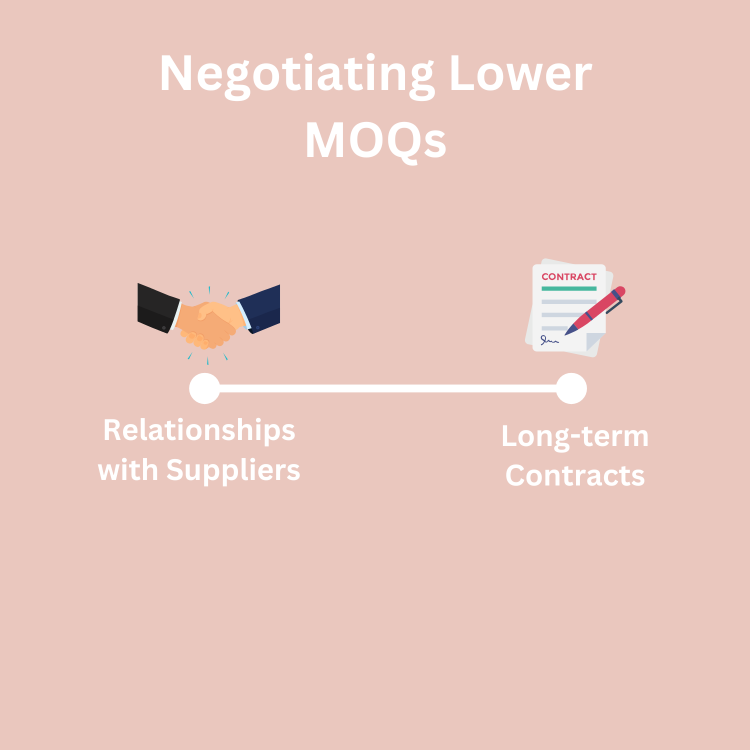
Establish trust through consistent business and clear communication. Over time, suppliers become more flexible with MOQ requirements for loyal clients. Start with their minimum, deliver repeat orders, and then negotiate downward.
Commit to regular orders over a defined period (e.g., quarterly). Suppliers are more likely to lower the MOQ for buyers offering predictable revenue, even if each individual order is smaller.
Many suppliers will reduce MOQs if you accept a slightly higher price per unit. This is often worth it for testing new products before committing to large volumes.
Instead of ordering small quantities of many different products, consolidate your order into fewer SKUs at higher quantities. This is especially relevant if you manage a large Item Master across multiple platforms.
Sourcing agents on platforms like Alibaba can aggregate orders from multiple buyers to meet supplier MOQs. Some ecommerce communities also organise group buys for exactly this purpose.
Most ecommerce buyers underperform at MOQ negotiation because they ask suppliers a single closed question, “Can you lower the MOQ?”, which almost always returns a flat “no, sorry”. The scripts below open the conversation with concrete commercial value, which is what suppliers actually trade against. Adapt the tone for your supplier’s region (more formal for Japan/Korea, more direct for mainland China).
Hi [Supplier Name], I’m sourcing for a multichannel ecommerce brand selling on Shopee, Lazada, TikTok Shop, and Shopify across Singapore and Malaysia. We’re starting with 3 SKUs and want to validate quality and shipping before scaling.
Could you accept a trial order of 150 units (vs your listed MOQ of 500) at your tier pricing for 500+ ($X.XX/unit), in exchange for a written commitment to a 500-unit repeat order within 60 days if quality matches the sample? I’m happy to pay a 25% deposit upfront and the balance against the third-party inspection report.
Why it works: You name the channels (signals genuine seller, not a hobbyist), commit a forward order in writing, accept the supplier’s higher-tier pricing, and offer escrow-style payment. Suppliers say yes to about 40–50% of well-structured trial orders.
Hi [Supplier Name], we’ve now placed 3 orders totalling 1,800 units over the past 4 months with on-time payments and no quality issues. Sales velocity on our marketplace stores has stabilised at around 120 units/week, so we’d like to move to monthly orders of 500 units instead of quarterly orders of 1,500.
Same per-unit price, same packaging, same delivery terms. The only change is order frequency. This gives you predictable monthly revenue and lets us hold less safety stock. Can we agree on this from order #4 onwards?
Why it works: You’re not actually asking for a lower MOQ; you’re asking for the same total volume across more frequent orders. Suppliers love predictable revenue and almost always agree. This is the script that genuinely reduces your working-capital lock-up. Pair it with the reorder point calculator.
Hi [Supplier Name], we’ve identified 5 SKUs in your catalog (listed below) that fit our portfolio. Each has an MOQ of 300 units, totalling 1,500 units if we order one MOQ each.
Would you accept a consolidated PO of 1,500 units spread across the 5 SKUs in any quantity allocation we choose (e.g., 500/300/300/200/200), keeping the 300-unit per-SKU pricing? Your production line stays full, we get to test multiple SKUs at once, and we ship as one container.
Why it works: Suppliers care about total volume and production-line utilisation, not per-SKU minimums. SKU consolidation is the single most effective MOQ negotiation tactic for diversified sellers. It lets you run 5 product tests for the cost of 1 “all-in” SKU bet. Use the wholesale price calculator to model unit economics across mixed allocations.
Hi [Supplier Name], I’m coordinating a group buy on behalf of 4 ecommerce sellers in Southeast Asia (each running their own brand). Combined first order would be 1,200 units delivered in one container to a consolidator in Yiwu, then split into 4 separate sub-shipments of 300 units each.
We’d handle all the in-China consolidation. Your invoice and proforma would be a single document for 1,200 units, but we need 4 separately labelled cartons / pallets at no extra charge. Per-unit price as per your 1,000+ tier.
Why it works: Suppliers see one customer, one wire, one production run. The buyer cohort gets per-unit pricing none of them could justify alone. This is how Yiwu-based sourcing agents operate and is the easiest way to attack high-MOQ categories like cosmetics and electronics packaging.
Hi [Supplier Name], in exchange for accepting a 150-unit order against your standard 500-unit MOQ, I’m offering 100% payment upfront via T/T instead of the usual 30/70 split. Funds wired the day you confirm the order, no Letter of Credit, no escrow.
Production turnaround at your discretion, and I cover the international shipping. The cash certainty should offset the higher per-unit production cost on a smaller run.
Why it works: Smaller suppliers are often cash-flow-constrained. Full upfront payment removes their working-capital risk and lets them buy raw materials immediately. Use this only with verified suppliers (Alibaba Verified Supplier badge, 3+ years of trade history, video factory tour completed), never on a first-time relationship.
Actionable Insight: Track which scripts work for which categories. Across our SEA seller community, Script 2 (frequency reduction) has the highest hit rate for established suppliers, Script 3 (SKU consolidation) is the strongest opener for first-time orders above US$5,000, and Script 5 (upfront payment) unlocks the smallest factories where everyone else has been refused.
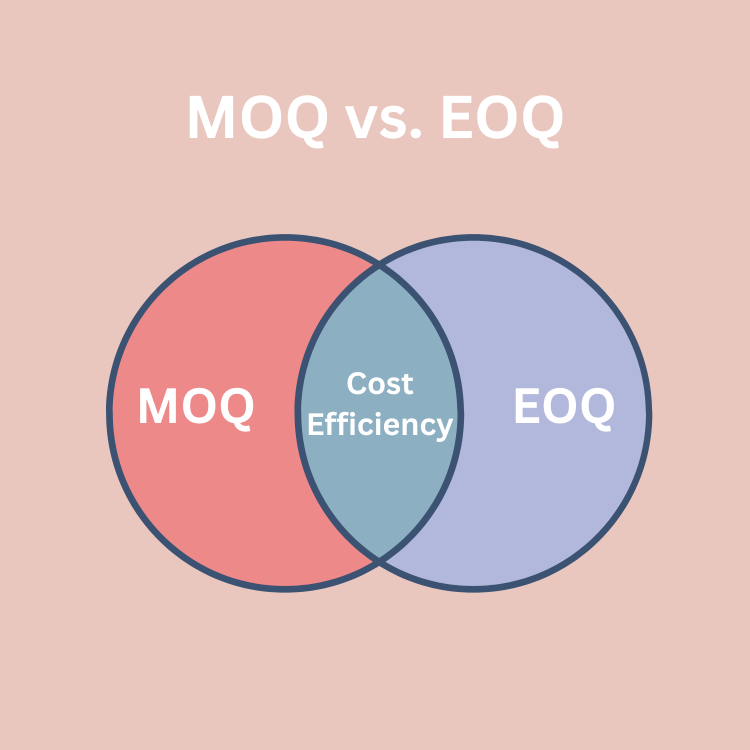
EOQ, or Economic Order Quantity, is the optimal number of units a business should order to minimise total costs related to purchasing and storage. It balances order frequency against holding costs.
| Factor | MOQ | EOQ |
|---|---|---|
| Set by | Supplier | Buyer (calculated) |
| Purpose | Ensure production viability | Minimise total ordering + holding costs |
| Focus | Minimum threshold | Optimal quantity |
| Flexibility | Fixed per supplier | Changes with demand and costs |
The challenge for ecommerce sellers is balancing both: your EOQ might suggest ordering 200 units, but the supplier’s MOQ is 500. In this case, you need to assess whether the excess 300 units can be sold within a reasonable timeframe, or if the holding costs make the order unprofitable.
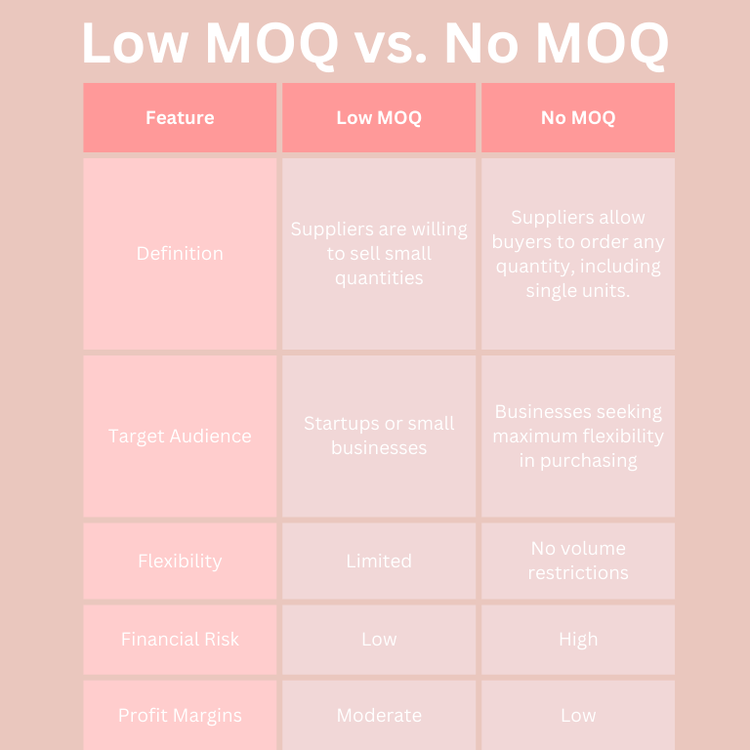
Low MOQ means suppliers are willing to sell small quantities, typically 10–100 units. This caters to startups, small businesses, and sellers testing new products on platforms like Shopee or TikTok Shop. Low MOQ suppliers are common on:
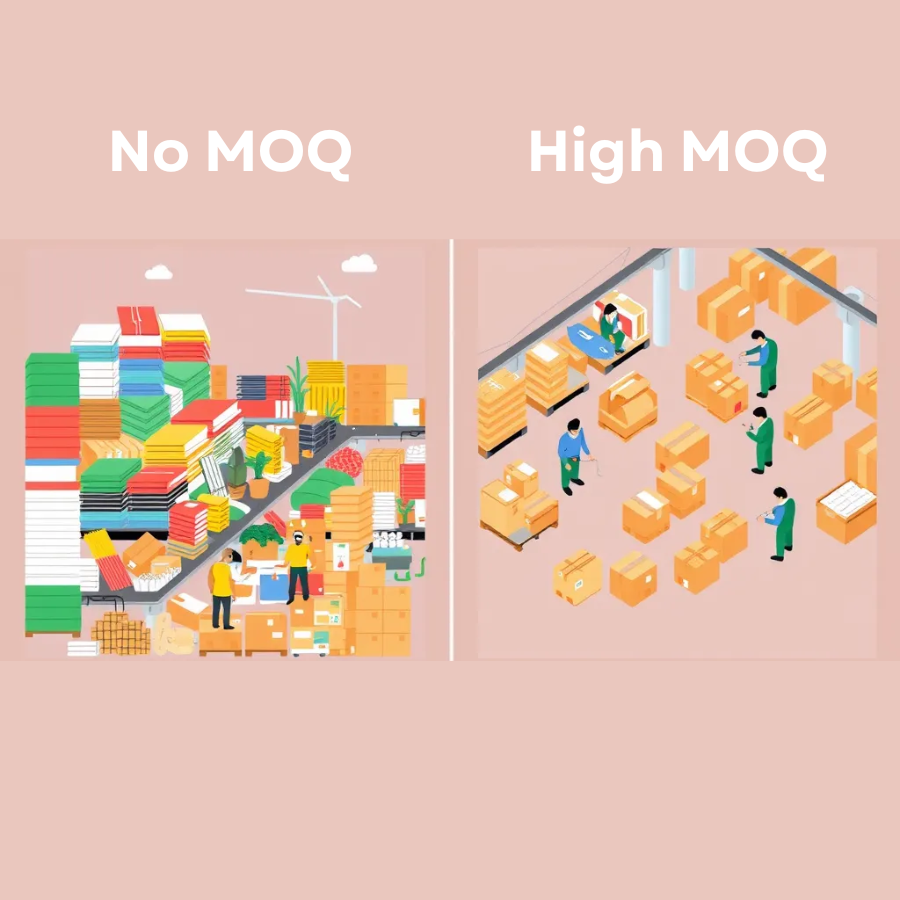
No MOQ provides maximum flexibility: order exactly what you need. However, this comes at a cost:
| Low/No MOQ | High MOQ | |
|---|---|---|
| Per-unit cost | Higher | Lower |
| Risk | Lower (less capital tied up) | Higher (more inventory to sell through) |
| Best for | Testing, small volumes, seasonal items | Proven sellers, high-velocity SKUs |
If you’re setting MOQs as a supplier or wholesale seller, here’s how to determine the right number. Use our wholesale price calculator to model pricing at different order quantities.
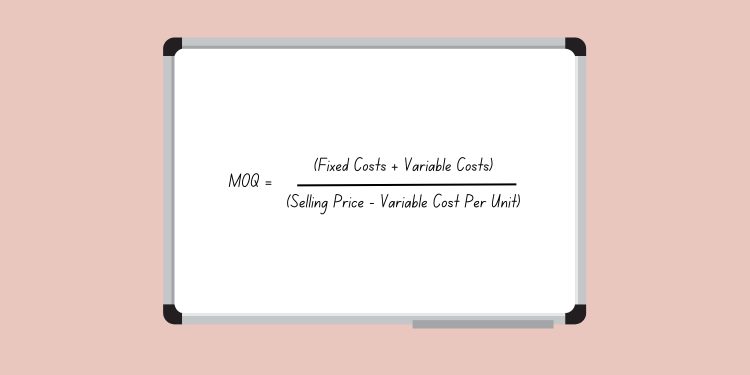
MOQ = (Fixed Costs + Variable Costs) / (Selling Price − Variable Cost Per Unit)
Example:
| Input | Value |
|---|---|
| Fixed costs | $2,000 (equipment setup, overhead) |
| Variable costs | $500 (labour and materials for entire order) |
| Selling price | $50 per unit |
| Variable cost per unit | $20 |
Calculation:
To recover all costs and ensure profitability, you need to sell at least 84 units. Use our break-even calculator to run your own numbers.
In ecommerce, MOQ primarily appears in B2B transactions and wholesale sourcing. Wholesalers may require retailers to purchase 500 units of a product to ensure production costs are covered while offering competitive per-unit pricing.
For multichannel sellers managing inventory across Shopee, Lazada, Amazon, and Shopify simultaneously, MOQ decisions become more complex. You need to factor in demand across all channels, not just one, which often justifies meeting higher MOQs because total sales velocity is higher.
| Model | Typical MOQ | Notes |
|---|---|---|
| Dropshipping | No MOQ | Zero inventory risk, but lowest margins (10–20%) |
| Private label | 500–1,000 units | Higher margins (40–60%) but requires upfront investment |
| Wholesale resale | 100–500 units | Moderate margins, established brands |
| Print-on-demand | No MOQ | Good for testing designs, low margins |
Multichannel inventory tools like OneCart help sellers track stock levels across all platforms from a single dashboard, making it easier to plan orders against supplier MOQs without risking overselling on any single channel. When you’re ready to place an order, use a purchase order template to formalise the agreed quantities, pricing, and delivery terms with your supplier.
Most MOQ guides stop at “calculate your break-even” and move on. In practice, MOQ decisions live or die on cash flow, how much working capital is locked up, how long it stays locked up, and whether your bank account can survive the payback window. Here’s a worked example you can adapt.
You’re a SEA-based seller listing on Shopee SG, Lazada SG, TikTok Shop SG, and Shopify. You’ve validated demand for a phone-accessory SKU at 80 sales/month combined across the four channels. Your supplier in Shenzhen quotes:
| Tier | MOQ | Per-unit FOB | Lead time |
|---|---|---|---|
| Trial | 100 units | US$5.40 | 14 days |
| Standard | 500 units | US$3.80 | 21 days |
| Bulk | 2,000 units | US$3.10 | 30 days |
Add 15% for sea freight, duty, and last-mile to your 3PL in Singapore. Landed cost per unit:
Average sell price across channels: S$24.90 (~US$18.40) after promotional discounts. Marketplace fees average 15% (Shopee + Lazada commission + payment + shipping subsidy), payment-platform fees on Shopify add 3.5%, and you spend 8% on ads. Net contribution after channel costs:
At 80 sales/month:
| Tier | Units | Sell-through time |
|---|---|---|
| Trial (100) | 100 | 1.25 months |
| Standard (500) | 500 | 6.25 months |
| Bulk (2,000) | 2,000 | 25 months (over 2 years) |
Working capital tied up the moment you wire the deposit:
| Tier | Order cost (landed) | Cash locked at peak | Days to recover |
|---|---|---|---|
| Trial | US$621 | US$621 | ~38 days |
| Standard | US$2,185 | US$2,185 | ~190 days |
| Bulk | US$7,140 | US$7,140 | ~750 days |
The “best price” tier (bulk) ties up nearly US$7,140 for over 2 years, a brutal hit if you’re running a multichannel store on a thin cash buffer.
The standard tier looks attractive on per-unit cost (US$4.37 landed vs US$6.21 trial), but it locks up 3.5× more cash for 5× longer. If your monthly free cash is US$3,000, the bulk tier alone consumes 2.4 months of free cash, leaving nothing for ads, returns reserves, or a parallel SKU test.
Decision rule:
Actionable Insight: Run this exact model for every SKU before you sign a PO. Pair it with the break-even calculator and your inventory turnover ratio. The trap most multichannel sellers fall into is locking 60–80% of working capital into “cheaper per-unit” bulk MOQs, then having no liquidity to test the next 5 SKUs that might be 10× winners.
Collaborate with other businesses to collectively meet MOQs and share costs. Joint purchasing groups are common in niches like fashion, beauty, and consumer electronics. Facebook groups and trade associations in your niche often coordinate these group buys.
Local suppliers often provide more flexible MOQ terms compared to overseas manufacturers. Benefits include:
In Southeast Asia, countries like Malaysia, Thailand, and Vietnam have growing manufacturing bases that cater to smaller ecommerce sellers with competitive MOQs.
Many suppliers, especially on Alibaba, offer a “sample order” or “trial order” at a higher per-unit cost but well below their standard MOQ. Use this to validate product quality and market demand before committing to larger volumes.
The 2024–2026 tariff cycle has redrawn the MOQ math for any seller importing from China, particularly into the US, where Section 301 tariffs and the de minimis review pushed effective duty rates on many ecommerce SKUs from 0% to 30%+ almost overnight. SEA sellers facing the same suppliers but exporting outward now have to factor jurisdiction-specific duty differently from a year ago.
A 20% import duty applied to a US$3.80/unit standard-tier landed cost adds US$0.76 per unit. Over a 500-unit MOQ, that’s US$380 straight off your gross profit. Over a 2,000-unit bulk MOQ, it’s US$1,520, and crucially, you wired this duty cost upfront alongside the goods, deepening your working-capital hole.
Tariff exposure also shrinks the “cheaper per-unit at higher MOQ” wedge: if the bulk-tier saving is US$0.80/unit but tariffs add US$0.76/unit uniformly, the per-unit advantage of bulk collapses to US$0.04, well below the threshold that justifies tying up extra cash for 2 years of sell-through.
These thresholds change frequently, always cross-check with trade.gov or your customs broker before a PO.
| Lane | De minimis threshold | Typical effective duty (consumer goods) | Notes |
|---|---|---|---|
| China → US (Section 321) | Eliminated for most categories in 2025 | 20–35% depending on HTS code | Section 301 + reciprocal tariffs layered on top of MFN duty |
| China → Singapore | None for commercial imports | GST 9% on CIF + duty (most consumer goods 0%) | Singapore is duty-free for most ecommerce SKUs; GST applies on landed value |
| China → Malaysia | RM 500 (~US$110) | Duty 5–30% + SST 5–10% | LMW or FCZ structures can defer; check with MIDA |
| China → Indonesia | US$3 (parcel) | Duty 7.5% + VAT 11% on most consumer goods | Bea Cukai enforcement tightened 2025 |
| China → Philippines | PHP 10,000 (~US$180) | Duty 0–15% + VAT 12% | De minimis raised in 2024 budget |
Actionable Insight: Build a single spreadsheet with one row per SKU and columns for FOB unit cost, freight, duty rate, GST/VAT, marketplace commission, and net contribution. Re-run the model on the 1st of every month. Tariff turbulence is the single biggest reason 2026 MOQ decisions are different from 2024 MOQ decisions, and most sellers are still using a 2023 cost model.
Modern ecommerce inventory management software enables smarter MOQ decisions by providing:
Multichannel sellers using tools like OneCart can aggregate demand data from all platforms to make MOQ decisions based on total velocity rather than per-channel guesswork.
As sustainability becomes a priority, businesses are rethinking MOQ strategies to minimise environmental impact. Smaller, more frequent orders reduce waste from overproduction, though they increase shipping emissions. Use a volumetric weight calculator to optimise shipping costs when splitting larger MOQs into smaller shipments.
In 2026, AI-powered sourcing tools are making MOQ negotiation easier by analysing supplier pricing patterns, predicting optimal order timing, and identifying low-MOQ alternatives automatically. Platforms like Alibaba are also rolling out dynamic MOQ adjustments based on buyer history and seasonality.
MOQ stands for Minimum Order Quantity, the smallest number of units a supplier will sell in a single order. It’s a standard term in manufacturing, wholesale, and B2B ecommerce.
On Alibaba, MOQ is displayed on every product listing and indicates the minimum number of units you must order. Typical Alibaba MOQs range from 100–1,000 units, but many suppliers will negotiate lower quantities for first-time buyers. Use the “Min. Order” filter and check “Ready to Ship” listings for suppliers offering MOQs as low as 1–50 units.
Use this formula: MOQ = (Fixed Costs + Variable Costs) / (Selling Price − Variable Cost Per Unit). Factor in production costs, labour, materials, and your target profit margin. Our break-even calculator can help you run the numbers.
Low MOQ means a supplier is willing to sell small quantities, typically 10–100 units. This is ideal for startups, businesses testing new products, or sellers with limited capital.
No MOQ means buyers can order any quantity, even a single unit. This offers maximum flexibility but usually comes with higher per-unit costs, reducing profit margins.
In supply chain management, MOQ refers to the minimum purchase quantity set by suppliers that directly affects inventory planning, lead times, safety stock levels, warehouse capacity, and cash flow cycles. Higher MOQs require more sophisticated demand forecasting and larger working capital buffers.
MOQ is set by the supplier (the minimum they’ll sell), while EOQ is calculated by the buyer (the optimal order quantity to minimise total costs). A good purchasing strategy considers both.
Start by building a relationship with the supplier through consistent orders. Offer long-term contracts, accept a slightly higher per-unit price, consolidate SKUs, or use sourcing agents to aggregate orders with other buyers. On Alibaba specifically, try the Request for Quotation (RFQ) feature to attract suppliers willing to accommodate smaller orders.
Multichannel sellers can often justify higher MOQs because they sell across multiple platforms simultaneously (e.g., Shopee + Lazada + Shopify + Amazon). Higher total sales velocity means larger orders are easier to sell through, and multichannel inventory tools help prevent overselling.
Yes, and it’s the single most effective MOQ-reduction tactic. Most suppliers care about total production-run volume, not per-SKU minimums. Use Script 3 above to propose a consolidated PO across 3–5 related SKUs, keeping the per-SKU price tier identical. Suppliers say yes most of the time because their line stays full and they ship a single container. This is how you can run 5 product tests for the cost of one full-MOQ commitment.
Three outcomes are typical: (1) the supplier refuses outright; (2) the supplier accepts but charges a per-unit premium of 15–40%; or (3) the supplier accepts at standard pricing but inserts hidden tooling, packaging, or “small-order” surcharges (see the 6 supplier traps section). If a supplier suddenly offers below-MOQ pricing without justification, treat it as a quality risk signal and pay for a third-party inspection before the balance wire.
Trade Assurance is Alibaba’s escrow product, funds are released to the supplier only after you confirm receipt and quality. It de-risks low-MOQ trial orders for the buyer and lowers the stakes on the supplier side, which is why Verified Suppliers with Trade Assurance enabled are typically more flexible on MOQ for first-time orders. It does not, however, replace a third-party pre-shipment inspection on production runs, Trade Assurance covers contract terms, not sub-spec materials.
MPQ (Minimum Production Quantity) is the smallest production run a factory can economically execute, usually driven by tooling setup time, materials waste, and machine changeover cost. MOQ is the smallest commercial order the supplier will accept. MPQ is a hard physical floor; MOQ is a commercial decision sitting on top of MPQ. If a supplier quotes MOQ 500 but reveals MPQ is 1,500, they’re aggregating multiple buyers into single production runs. Your 500-unit order may share a production run with another buyer, which can affect lead time and quality consistency.
Every 6–12 months, or whenever your sales velocity changes by ±30%. After 3 clean orders, suppliers expect their best customers to push for better terms. Use Script 2 above to renegotiate frequency and total volume rather than the headline MOQ. That delivers cash-flow benefit without forcing the supplier to defend their floor pricing. Re-check terms after every duty or commodity-price step-change.
Managing MOQs effectively is one of the foundations of a profitable ecommerce business. Whether you’re negotiating with suppliers on Alibaba, sourcing locally in Southeast Asia, or scaling across multiple marketplaces, the right approach to MOQs can significantly impact your margins and cash flow.
Ready to streamline your multichannel inventory? OneCart connects your Shopee, Lazada, Amazon, TikTok Shop, and Shopify stores into a single dashboard, helping you track stock, prevent overselling, and make smarter purchasing decisions. Start your free trial →
OneCart's Item Master keeps stock levels in sync across every marketplace you sell on, automatically.
Try OneCart freeUsed by hundreds of merchants in Singapore & Southeast Asia