Lazada vs Shopee for Sellers: Fees & Verdict [2026] 2026
Real seller fee comparison: Shopee 2–8% vs Lazada 2–6%. Plus TikTok Shop & Temu — how the competitive landscape has changed for SEA sellers in 2026.
Real seller fee comparison: Shopee 2–8% vs Lazada 2–6%. Plus TikTok Shop & Temu — how the competitive landscape has changed for SEA sellers in 2026.
Lazada vs Shopee for sellers in 2026 comes down to fees, traffic, and your product type. Shopee charges 2–8% in seller fees and pulls 8M monthly visits; Lazada charges 2–6.5% with 6M visits but attracts higher-value buyers. With TikTok Shop now processing over $30 billion in GMV across Southeast Asia and Temu aggressively expanding, the competitive landscape has shifted — but Shopee and Lazada remain the two core marketplaces for serious sellers. Here’s our data-backed comparison to help you choose the right platform — or sell on both.
Jumping into Singapore’s e-commerce scene means making a big call right from the start: Lazada or Shopee? Both are giants, but they play the game differently and attract different kinds of shoppers. Making a smart choice before you list your first item can make all the difference.
Shopee has cemented its position as the traffic king. It’s built for mobile, buzzing with constant flash sales, and packed with features like Shopee Coins. This creates a fast-paced, social atmosphere that pulls in a massive audience looking for variety and, most importantly, a great deal.
Then you have Lazada. With the might of Alibaba behind it, Lazada positions itself as a more premium, brand-focused marketplace. Its LazMall feature is a huge draw for shoppers who prioritise authenticity and are willing to pay for the peace of mind that comes with buying from official brands. The platform feels less like a busy market and more like a digital shopping centre.
Let’s talk numbers, because that’s where the biggest difference lies. In Singapore, the web traffic data tells a clear story: Shopee is way out in front. As of early 2026, Shopee.sg pulls in roughly 8 million monthly visits, with Lazada at around 6 million. More eyeballs on Shopee can mean more organic views for your products, especially if they’re price-sensitive.
But more traffic doesn’t automatically mean better sales. Lazada’s audience, while smaller, often consists of more deliberate buyers searching for specific brands. This can actually lead to higher conversion rates for sellers with the right kind of products. It’s why so many successful sellers don’t choose—they sell on both. If that sounds like a smart move, you might want to check out our guide on why you must be on all e-commerce platforms.
Actionable Insight: If you’re selling trendy phone cases or fast-fashion accessories, Shopee’s massive, deal-seeking crowd is your best bet. If you’re an authorised reseller for a premium electronics brand, Lazada’s LazMall gives you the credibility you need to attract serious buyers who won’t flinch at a higher price tag.
To kick things off before we dive deeper, here’s a quick side-by-side look at how the two platforms stack up for sellers in Singapore.
This table gives you a high-level summary of what to expect from each marketplace.
| Attribute | Shopee Singapore | Lazada Singapore |
|---|---|---|
| Primary Audience | Mass-market, younger, mobile-first, and deal-focused shoppers. | Brand-conscious, slightly older demographic, and deliberate buyers. |
| Platform Feel | Fun, social, and interactive with gamification and live streams. | Professional, structured, and feels more like a digital shopping centre. |
| Key Strength | Unmatched user traffic and a vibrant, high-volume sales environment. | Strong brand trust, LazMall for authenticity, and robust logistics. |
| Ideal Seller Profile | Sellers with high-volume, low-margin products or trendy items. | Authorised brand distributors and sellers of higher-value goods. |
Think of this as your starting point. The real magic is in understanding the smaller details, which we’ll get into next.
To figure out which platform is actually better for your wallet in the Lazada vs Shopee showdown, you have to look past the headline commission rates. The final payout you get is a mix of standard fees, optional programme costs, and transaction charges that are quite different between the two. Understanding this calculation is everything for your profitability.
Both platforms will take a base commission fee, which is a percentage of your item’s selling price. On top of that, you’ll get hit with a transaction fee (usually around 2%) on every single successful order to cover payment processing. These two are non-negotiable for all sellers.
Where the numbers really start to drift apart is in the optional marketing and service programmes. Joining these is often the only way to get noticed and stay competitive, but they tack on another layer of costs.
Shopee heavily promotes its Coins Cashback and Free Shipping Special programmes. When you enrol your shop, you agree to pay an extra service fee on all your orders. In return, your listings get those special tags that shoppers love. For most sellers, these programmes are a necessary cost of doing business on the platform.
Lazada’s equivalent programmes are its Free Shipping Max and Everyday Cashback. The deal is similar: you pay another percentage-based fee, and in exchange, you offer customers valuable shipping discounts and cashback rewards. One thing to note is that Lazada’s fee caps on these programmes can sometimes make it a cheaper option, especially if you’re selling higher-priced goods.
Actionable Insight: Before you join any programme, run the numbers based on your average order value (AOV). For example, if you sell cheap items like stationery, a cashback offer might pull in more buyers than a flat-rate shipping discount. But if you’re selling something expensive like a coffee machine, a significant shipping discount can be the final push a customer needs to click “Buy Now.”
The headline “2–8%” and “2–6.5%” ranges hide big differences by product type. Here’s how the actual commission rates compare for popular seller categories in Singapore:
| Product Category | Shopee Commission | Lazada Commission |
|---|---|---|
| Fashion & Accessories | 5.24% | 5.24% |
| Electronics & Gadgets | 3.15% | 3.15% |
| Home & Living | 5.24% | 5.24% |
| Health & Beauty | 5.24% | 6.54% |
| Groceries & FMCG | 2.10% | 2.10% |
| Mobile Phones | 2.10% | 2.10% |
| Baby & Toys | 5.24% | 5.24% |
| Sports & Outdoors | 5.24% | 5.24% |
| Transaction Fee | 2.18% flat | 2.00% flat |
On top of these, both platforms add programme fees for Free Shipping and Cashback (typically 3–6% combined). The total take rate usually lands between 8–15% of the selling price.
Actionable Insight: Don’t estimate — calculate your exact costs using a dedicated Lazada fee calculator or check our Shopee seller fees breakdown for the full category-by-category list. Even a 1% difference compounds significantly at scale.
Let’s run the numbers for a S$50 fashion item on both platforms, assuming you’re enrolled in their Free Shipping and Cashback programmes:
| Cost Component | Shopee | Lazada |
|---|---|---|
| Selling Price | S$50.00 | S$50.00 |
| Commission (5.24%) | - S$2.62 | - S$2.62 |
| Transaction Fee | - S$1.09 (2.18%) | - S$1.00 (2.00%) |
| Programme Fees (~5%) | - S$2.50 | - S$2.50 |
| Total Fees | S$6.21 (12.4%) | S$6.12 (12.2%) |
| Net Payout | S$43.79 | S$43.88 |
The difference is tiny for a single item. At 500 orders/month, it adds up to about S$45/month — not enough to choose one platform over the other on fees alone. Your decision should be driven by where your audience shops, not marginal fee differences.
Beyond platform fees, consider your total cost of doing business. Price monitoring tools can help you track competitor pricing and adjust your strategy. If you’re importing products, a landed cost calculator helps you factor in shipping, duties, and taxes before you even set your selling price. And if you need to calculate your true profitability per item, our COGS calculator and markup calculator can help.
The bigger picture matters, too. Shopee holds roughly 50% of Southeast Asian e-commerce GMV as of 2025, with Lazada at around 20% and TikTok Shop rapidly growing to claim about 15%. Singapore’s e-commerce market is projected to exceed US$12 billion in 2026. Shopee’s sheer size gives sellers access to a staggering number of potential buyers, while Lazada attracts buyers making higher-value purchases.
Choosing between Lazada and Shopee goes way beyond just comparing fees and website traffic. It’s about knowing who you’re selling to. Each platform has built a unique shopping world that pulls in a different kind of customer, and if you want to get traction fast, you need to align your brand with the right one.
Think of Shopee as a digital bazaar. It’s lively, a bit chaotic, and totally built around the thrill of discovery and entertainment. This vibe clicks perfectly with a younger, mobile-first crowd who loves hunting for deals, jumping on flash sales, and engaging with interactive stuff like Shopee Live streams.
Lazada, on the other hand, feels more like a structured, premium department store. Its crown jewel, LazMall, is a trusted space for official brands. This attracts shoppers who care about authenticity and are often looking for specific, higher-value items. These buyers tend to be more deliberate and show stronger loyalty to brands they trust.
The real difference is in the shopper’s mindset. A Shopee user is often scrolling for fun or chasing the high of a great bargain, making them prime candidates for impulse buys and trendy, low-cost products. A Lazada shopper, more often than not, lands on the site with a specific purchase already in mind, seeking reliability and quality from brands they recognise.
Actionable Insight: The platform’s atmosphere directly shapes how people see your products. For example, a S$15 novelty phone case feels like a fun, spontaneous find during a Shopee flash sale. That same case on Lazada, placed next to premium electronic accessories, might look out of place, making shoppers question its quality.
This distinction creates clear lanes for different types of sellers. Your brand’s personality and products should feel like they belong on whichever platform you choose as your main battlefield.
To see how this plays out, let’s look at two hypothetical Singapore-based sellers.
Seller A: “K-Pop Style SG” This brand sells affordable, trendy K-pop inspired apparel and accessories, with most items priced between S$10 and S$40. Their audience is young, glued to social media, and rides every new trend wave.
Seller B: “Pro-Grade Camera Gear” This seller is an authorised reseller of professional camera lenses and lighting equipment. Their average product sells for around S$600. Their customers are serious hobbyists and professional photographers who sweat the details and demand authenticity.
At the end of the day, winning the Lazada vs. Shopee debate isn’t about which platform is “better.” It’s about deeply understanding these customer differences and picking the platform where your ideal shopper is already hanging out. That’s how you give your business a massive head start.
Getting your products to customers quickly and reliably is the absolute backbone of any e-commerce business. When we look at Lazada versus Shopee, their logistics and fulfilment networks are where some of the biggest operational differences pop up, and these directly impact your daily workflow and, ultimately, your customer’s happiness. The choice here isn’t just about shipping fees; it’s about control, scale, and day-to-day efficiency.
Shopee’s model is built around Shopee Supported Logistics (SSL). Think of it as an integrated system connecting you to a network of third-party partners like J&T Express and Ninja Van. This approach is straightforward and accessible, which makes it perfect for new sellers or anyone running their business from home.
Lazada, on the other hand, runs a more controlled, in-house logistics arm called Lazada eLogistics (LEL). This gives them much tighter oversight of the entire delivery process. For sellers who want a premium, hands-off solution, Lazada offers Fulfilled by Lazada (FBL). This is a service where you store your products in their warehouses, and they handle everything—packing, shipping, and even returns.
The best way to really get the practical differences is to look at two common seller profiles. The right choice really depends on your operational scale and business model.
Scenario 1: The Home-Based Seller (15 daily orders)
For a seller managing a small inventory from their living room, Shopee’s SSL system is incredibly convenient. The process is simple: print an Air Waybill (AWB) from the Seller Centre, pack the order, and drop it off at a nearby collection point or schedule a pickup. The whole thing is seamless, tracking is automatic, and the costs are clear.
Lazada’s standard shipping works in a similar way for this seller. However, the sheer density of Shopee’s drop-off network often gives it a slight edge in pure convenience for smaller operations. Using a premium service like FBL at this stage would be total overkill and not cost-effective.
Scenario 2: The Warehouse Operation (200+ daily orders)
Now, for a larger business pushing out hundreds of orders daily, efficiency is everything. While Shopee’s SSL can still work, managing bulk pickups and coordinating with different third-party couriers can start to become a real logistical headache. The system is designed for ease of use, not necessarily for high-volume, industrial-scale operations.
This is where Fulfilled by Lazada (FBL) becomes a seriously powerful tool. By outsourcing storage, picking, packing, and shipping to Lazada, the business can free up its team to focus on sourcing, marketing, and growth. FBL also gives products that coveted “Fulfilled by Lazada” badge, which helps build customer trust and can improve your listing’s visibility. This service essentially turns Lazada into your own third-party logistics (3PL) partner. Understanding this is key to scaling, and you can learn more about the distinctions between 3PL and 4PL providers in our detailed guide. If you’re shipping across borders, our CBM calculator helps you estimate container space and our pallet calculator optimises packing for palletised shipments.
Actionable Insight: Re-evaluate your fulfilment strategy every six months. If your daily order volume on Shopee starts creeping past 50-100 orders and packing becomes a major time sink, that’s a strong signal. It’s time to either hire dedicated packing staff or start exploring a warehousing solution like FBL on Lazada, at least for your best-selling products.
How each platform handles returns can really affect your seller rating and your bottom line. Both have structured processes, but your role as a seller and the protections you have can differ.
On Shopee, returns are typically managed right through the Seller Centre. When a buyer requests a return, you get a window to review their reason and any evidence they’ve provided. If you want to dispute it, Shopee steps in to mediate. The process is generally straightforward, but you have to be proactive in responding to claims to protect your interests.
Lazada’s return process, especially if you’re a LazMall or FBL seller, is often more automated. Lazada might handle the initial customer service chat and the logistics for the return itself. While this is certainly convenient, it can sometimes feel like you have less direct control over the outcome. That said, their seller protection policies are quite robust, particularly against fraudulent claims.
No matter which platform you’re on, clear product photos, detailed descriptions, and careful packing are your best defence against disputes. Always maintain meticulous records and respond to all return requests promptly to keep your seller metrics in good standing.
Getting your shop live is just the first step. If you just sit back and wait for sales to roll in, you’ll be waiting a long time. Both Lazada and Shopee offer a powerful set of advertising and promotional tools to get your products in front of buyers. Knowing how to use them is the key to turning your ad spend into actual profit.
Shopee’s ad platform, simply called Shopee Ads, is generally seen as the more beginner-friendly of the two. It’s built around two core ad types: Search Ads for when a buyer knows what they’re looking for, and Discovery Ads to get your products noticed by browsing shoppers. The simplicity here is a huge plus; you can get a campaign up and running in just a few minutes.
Lazada’s equivalent, Lazada Sponsored Solutions, offers similar tools but gives you a bit more control under the hood. Their Sponsored Discovery and Sponsored Search tools work much like Shopee’s, but Lazada also provides more advanced options for brand-building, like Sponsored Media, which lets you target shoppers even when they’re off the Lazada platform.
Let’s say you’re launching a new model of wireless earbuds. Your goal is to create a big initial splash, drive those crucial first sales, and keep your return on ad spend (ROAS) looking healthy.
How you’d tackle this on Shopee:
The best approach here is a one-two punch. Kick things off with Search Ads, targeting very specific, high-intent keywords like “wireless earbuds Singapore,” “Bluetooth earphones,” and maybe even some competitor brand names if you’re feeling bold. Simultaneously, run a Discovery Ads campaign to get your new earbuds featured on related product pages and in the “Daily Discover” feed.
How you’d handle it on Lazada:
The strategy is similar, but you have more levers to pull. You’ll use Sponsored Search for your keyword targeting and Sponsored Discovery to pop up in those valuable “Recommendations” sections. The key difference is that Lazada’s campaign setup lets you refine your target audience in more detail right from the start.
Actionable Insight: For any new product launch, commit to a fixed daily budget for the first two weeks on both platforms. On Shopee, let the auto-bidding do its thing for a few days to collect data, then take the reins and switch to manual bidding for your top-performing keywords. On Lazada, start with slightly more cautious manual bids and slowly increase them for keywords that show a strong ROAS.
Beyond just paid ads, both platforms give you a whole toolbox for creating special offers. These promotions are absolutely critical for increasing your average order value (AOV) and moving stock.
Shopee is legendary for its Bundle Deals and Add-on Deals. They are incredibly effective at getting shoppers to buy more than one thing. A classic tactic is to create a “Buy 3, get 10% off” bundle for related items like phone cases, screen protectors, and charging cables. It just works.
Lazada’s answer to this is Flexi Combo. It offers similar features, letting you set up tiered discounts like “Buy 2 get 5% off, Buy 3 get 8% off.” Sellers on Lazada often use this for more expensive items to encourage a larger purchase, like pairing a new camera with a discounted lens.
To make things clearer, let’s break down how their marketing tools stack up side-by-side.
Here’s a look at the key marketing and advertising tools available to sellers on both platforms, and the best situations to use them in.
| Marketing Tool | Shopee Availability & Use Case | Lazada Availability & Use Case |
|---|---|---|
| Search Ads | Excellent for capturing high-intent buyers with specific keywords. The setup is extremely user-friendly, great for getting started quickly. | Offers more granular bidding controls, making it ideal for experienced sellers focused on optimising cost-per-acquisition (CPA). |
| Discovery Ads | A fantastic tool for new product launches. It helps you get broad visibility across the platform when shoppers are in a browsing mood. | Very strong for retargeting shoppers who have already viewed similar items or have visited your store before, helping to close the sale. |
| Bundle Promotions | The Bundle Deal feature is perfect for increasing the number of units per transaction, especially for low-to-mid priced items. | Flexi Combo is highly effective for creating tiered offers on higher-value products, giving a clear incentive to increase the AOV. |
| Vouchers | It’s incredibly easy to create store-wide or product-specific vouchers to drive urgency and boost conversion rates, especially during campaigns. | Offers similar voucher capabilities, but with better integration into its “Seller Picks” feature, which can give your promotion extra visibility. |
At the end of the day, Shopee’s tools feel designed for speed and driving volume. It’s easy to run multiple promotions at once to appeal to its famously deal-hungry audience. Lazada, on the other hand, provides the tools you need for a more calculated, brand-focused promotional strategy where you have a bit more control.
The Lazada vs Shopee debate no longer happens in a vacuum. Two newer players have reshaped how sellers think about marketplace strategy in Southeast Asia.
TikTok Shop crossed $30 billion in GMV across Southeast Asia by 2025 and is now the third-largest marketplace in the region. Unlike Shopee and Lazada where buyers search for products, TikTok Shop drives sales through short-form video and livestreaming — sellers who create engaging content can generate massive bursts of orders.
Commission rates are 2–8% (similar to Shopee), but the selling model is fundamentally different. Success on TikTok Shop depends on content creation ability, not just listing optimisation. For sellers already strong on Shopee and Lazada, TikTok Shop works best as a third channel that captures a different buyer journey. Read our full guide to selling on TikTok Shop and check the TikTok Shop fee calculator to model your costs.
Temu has expanded aggressively into Southeast Asia with a consignment model that handles shipping and fulfilment for sellers. Fees range from 2–5% for consignment sellers, making it one of the cheapest platforms to sell on — but sellers give up control over pricing and customer experience.
Temu is best suited for manufacturers and wholesalers who want to move volume without managing individual customer relationships. For brand-building sellers, Shopee and Lazada remain far superior. See our complete guide to selling on Temu for the full breakdown.
| Platform | Best For | Commission Range | Key Differentiator |
|---|---|---|---|
| Shopee | Volume sellers, beginners, deal-driven products | 2–8% | Highest traffic, deal culture |
| Lazada | Brand sellers, premium products, FBL users | 2–6.5% | LazMall trust, FBL fulfilment |
| TikTok Shop | Content creators, trend-driven products | 2–8% | Video-driven discovery |
| Temu | Manufacturers, bulk/low-cost products | 2–5% | Consignment, no marketing needed |
The smartest sellers in 2026 aren’t choosing one platform — they’re on Shopee, Lazada, and TikTok Shop simultaneously, using a tool like OneCart to keep inventory synced across all channels. The question isn’t which marketplace to pick, but how many you can manage efficiently.
So, after digging into the costs, audiences, logistics, and ad tools, the big Lazada vs. Shopee debate doesn’t really have a clear winner. The truth is, the “best” platform is simply the one that fits your business model like a glove. Instead of giving you a one-size-fits-all answer, let’s walk through a practical framework based on common seller profiles.
This decision tree gives you a visual on how your main goal—be it building brand awareness or driving direct sales—should shape your advertising strategy from the get-go.
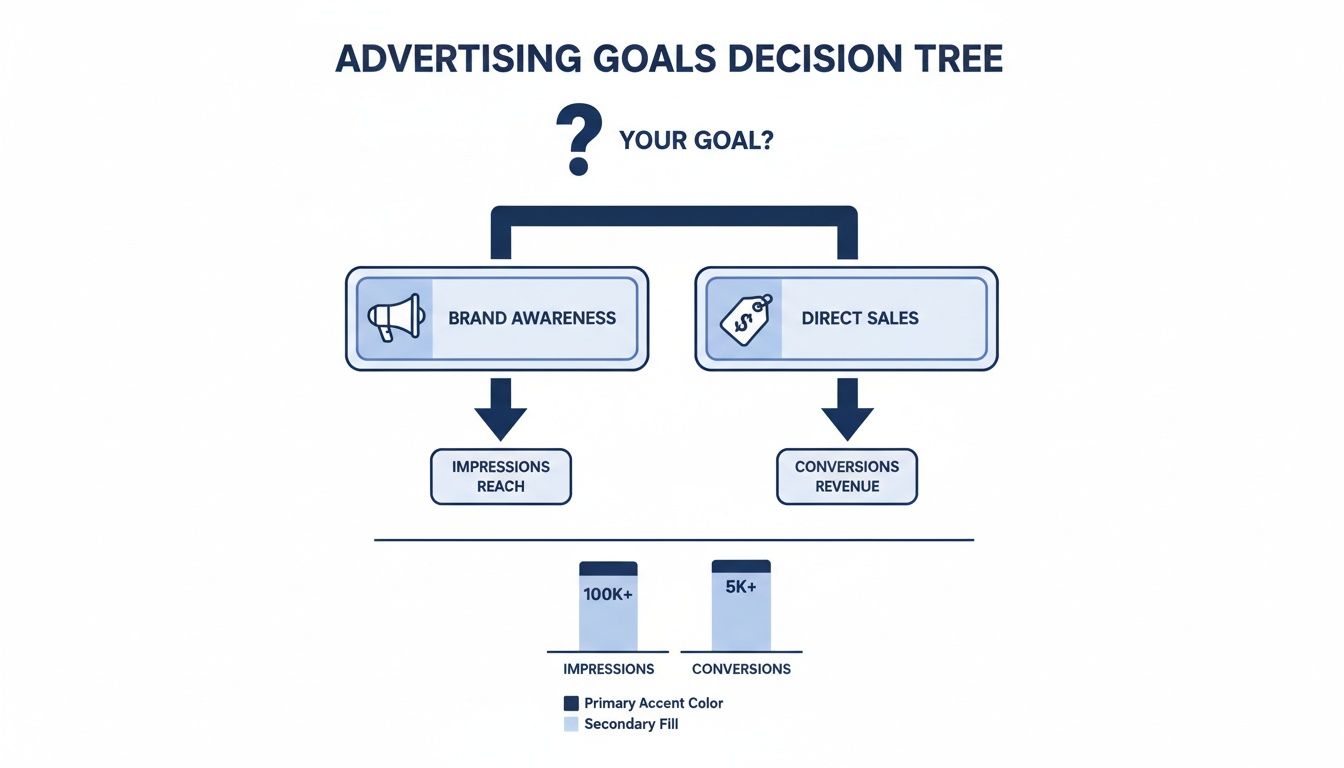
As you can see, a campaign focused on brand awareness is all about racking up impressions. But if your goal is pure sales, then conversions and ROAS are the only metrics that matter.
Your product type and available capital are the two biggest signposts pointing you to the right starting line. Use these real-world recommendations to figure out where you fit.
Best for New Sellers with Limited Capital: Shopee is the obvious choice here. Its absolutely massive organic traffic and beginner-friendly interface give you the best shot at making those crucial first sales without needing a hefty ad budget. The platform’s high-energy, deal-hunting crowd is the perfect environment to gain early traction.
Best for Authorised Distributors of Brands: Head straight to Lazada. The credibility that comes with a LazMall store is priceless when you need to justify premium pricing and earn customer trust. Shoppers on Lazada often arrive looking for authentic, high-value goods, which is a perfect match for this profile.
Best for High-Volume, Low-Margin Goods: Shopee is practically built for this model. Its whole suite of promotional tools, like Bundle Deals and non-stop flash sales, is engineered to move a large number of products, fast. The sheer scale of its user base means there’s a constant appetite for affordable, fast-moving items.
Picking where to start is one thing, but the real path to growth in Singapore’s e-commerce scene is to be on both platforms. A multichannel strategy means you can capture the bargain hunters on Shopee and the brand-loyal shoppers on Lazada, effectively doubling your market reach.
But selling on multiple channels brings its own headaches. Manually tracking inventory across two platforms is a recipe for overselling, and logging into separate seller centres to process orders eats up your day. This is the point where a dedicated management platform becomes a necessity, not a luxury. Ultimately, the Lazada vs Shopee decision is just one part of a bigger multichannel strategy. For a full breakdown of platform options, check our ecommerce platforms Singapore guide or our comparison of the best multichannel listing software.
Actionable Insight: The moment you find yourself spending more than an hour a day just reconciling orders and updating stock levels between Shopee and Lazada, it’s a clear signal that you’ve outgrown manual processes. This is the point where investing in a multichannel solution like OneCart delivers an immediate return on investment.
A solution like OneCart cuts through this complexity by pulling all your operations into a single, clean dashboard. This centralised view stops the constant tab-switching, saves you time, and slashes the risk of human error.
With a platform like OneCart, you can:
Even after a side-by-side comparison, you’ll probably have a few specific questions running through your mind. It’s a big decision. Here are some direct answers to the most common queries we hear from sellers in Singapore.
On the surface, Shopee often looks cheaper, especially if you’re just starting out. Their commission rates are competitive, and they’re always running subsidies and programmes that can lower your initial costs. With its massive organic traffic, you might also find you spend less on ads to get those first few sales.
However, the “cheaper” platform really depends on what you sell and how you sell it. For higher-priced items, Lazada’s fee structure—especially with its fee caps on certain programmes—can sometimes work out to be more cost-effective.
Actionable Insight: Forget the base commission rates. To get the real picture, you need to do the maths. Take your top three best-selling products and calculate the total projected cost on both platforms. Factor in everything: commission, transaction fees, and any mandatory campaign or programme fees. If you’re importing goods, use a landed cost calculator to factor in shipping, duties, and taxes. Then run your numbers through a profit margin calculator to see your true net profit per item. This is the only way to make an accurate financial call.
Most sellers will tell you that Shopee is more beginner-friendly. The seller interface is just more intuitive, and listing a new product is generally a much faster and less complicated affair than on Lazada. Plus, the platform’s heavy focus on organic traffic gives new shops a fighting chance to get discovered without needing a massive ad budget from day one.
Shopee’s Seller Centre is also packed with genuinely useful guides and tutorials. They’ve put a lot of effort into helping new entrepreneurs get the hang of setting up a shop, managing their first orders, and launching promo campaigns. This support system really does make the initial learning curve a lot smoother if you’re new to e-commerce.
Absolutely, yes. For almost every seller in Singapore, being on both platforms is the smartest move. If you stick to just one, you’re willingly ignoring a massive chunk of potential customers. The audiences on Lazada and Shopee are just different enough that a bestseller on one might not even move on the other, and vice versa.
The real challenge with a multi-channel strategy isn’t the why, it’s the how. Juggling the operational side of things — keeping inventory synced, processing orders from two separate backends, and updating listings — can become a nightmare pretty quickly. If you haven’t started yet, read our guides on how to sell on Lazada, how to sell on Shopee, and how to sell on TikTok Shop to get set up. Once you’re live on multiple platforms, a central management tool becomes non-negotiable.
A platform like OneCart was built specifically to solve this problem. It pulls all your orders into a single, clean dashboard. More importantly, it syncs your stock levels across every channel in real-time. This is what stops you from overselling during huge sales like 11.11 and cuts down the hours you’d otherwise spend on manual admin. It frees you up to focus on what actually matters: growing your business across the entire Singaporean market.
Ready to stop juggling Shopee, Lazada, and TikTok Shop from separate tabs? Let OneCart centralise your inventory, orders, and listings across every marketplace in one dashboard. Start your free trial today.
Automate & Scale Your Online Business with OneCart
Start a Free TrialUsed by hundreds of merchants in Singapore & Southeast Asia