Mastering the Last Mile of Delivery for Ecommerce Success [2026]
Optimize your last mile of delivery to reduce shipping costs and delight customers. Our guide offers actionable strategies and KPIs for ecommerce sellers.
Optimize your last mile of delivery to reduce shipping costs and delight customers. Our guide offers actionable strategies and KPIs for ecommerce sellers.
The last mile of delivery is the final, critical step in the supply chain where a package moves from a local distribution hub to your customer’s front door. It’s often the most expensive and complicated part of the entire shipping journey, and it has a massive impact on whether a customer is happy enough to buy from you again.
Think of your entire fulfillment process like a long-distance relay race. The first few legs are all about efficiency—moving thousands of items in bulk between massive warehouses. But the last mile is the final, individual sprint to dozens of different finish lines. It’s where the race is won or lost.
This single stage is notoriously inefficient. Instead of one truck moving a full pallet to one location, you have multiple drivers making countless unique stops. They’re navigating unpredictable city traffic, confusing apartment complexes, and remote rural roads. Each one of those stops adds serious cost and complexity.
The financial impact from the last mile is significant. For most e-commerce sellers, this final leg of the journey consumes a large portion of total shipping expenses, turning it into a major operational challenge.
Last-mile delivery now accounts for 53% of total shipping costs, a figure that has climbed sharply in recent years. This spike is driven by a combination of factors:
This is also the moment your brand’s promise meets reality. A smooth, on-time delivery builds customer trust, but a bad one can undo all the great work you put into your marketing and products. To see how this fits into the bigger picture, it helps to understand the full journey of first mile last mile transportation.
The last mile is a complex puzzle for any e-commerce business. Below is a quick breakdown of the core challenges and how they directly affect your bottom line.
| Challenge | Primary Cause | Business Impact |
|---|---|---|
| High Operational Costs | Fuel, labor, and vehicle maintenance for individual deliveries. | Squeezed profit margins; difficulty offering competitive shipping rates. |
| Route Inefficiency | Unpredictable traffic, remote locations, and dense urban drop-offs. | Increased fuel consumption, longer delivery times, and higher labor costs. |
| Failed Delivery Attempts | Customer not home, incorrect address, or inaccessible location. | Added redelivery costs, increased customer support workload, and customer frustration. |
| Poor Customer Experience | Late deliveries, damaged packages, or lack of tracking visibility. | Negative reviews, loss of repeat customers, and damage to brand reputation. |
As you can see, these are not just logistical hurdles; they’re direct threats to your profitability and brand loyalty.
For today’s online shopper, the delivery experience is the brand experience. The second a customer clicks “buy,” their focus shifts from your product to the package’s journey. They expect speed, transparency, and total reliability.
The final delivery is the most memorable and tangible interaction a customer has with an online brand. It’s the moment of truth that determines whether they become a repeat buyer or a one-time shopper. A sloppy last-mile experience almost always leads to frustrated customers and bad reviews. When a package is delayed without any communication or left in an unsafe spot, the customer doesn’t blame the courier—they blame the brand they bought from.
This is exactly why getting your fulfillment right is a critical part of customer retention. Nailing this final step is non-negotiable, and a great place to start is by finding the right last mile delivery service that fits your business needs.
The final sprint from your warehouse to the customer’s doorstep—the last mile of delivery—is where even the sharpest e-commerce businesses can stumble. While customers see a simple, one-click purchase, sellers on the front lines are fighting a daily battle with logistics. During peak sales seasons like 11.11 or Black Friday, this battle can quickly turn a record-breaking day into a chaotic mess.
Picture a warehouse manager during a flash sale. They are looking at hundreds of packages that need to be picked, packed, and handed off to different couriers. Each one, whether it’s Shopee Xpress or Lazada Logistics, has its own system and specific label requirements.
This manual juggling act is a recipe for human error. A tired employee might slap the wrong label on a box, sending a package meant for one city to a customer in another. Every mistake costs you money in returns and redelivery fees, but more importantly, it chips away at the customer relationship you’ve worked so hard to build.
One of the most damaging—and common—challenges is managing inventory across multiple sales channels. Many sellers operate with separate stock pools for their website, their Shopee store, and their TikTok Shop. This creates information silos where none of the systems talk to each other.
During a sales rush, a popular item might sell out on your Shopify store, but the system doesn’t automatically update your Lazada listing. The result is overselling—you end up taking payments for products you don’t actually have. This leads directly to cancelled orders and deeply frustrated customers who might never shop with you again.
The real cost of overselling is the permanent loss of customer trust. A single stockout can undo months of marketing efforts and positive brand building. Fixing these mistakes is a painful, manual process. You have to contact the customer, apologize, issue a refund, and hope they understand. This not only frustrates buyers but also eats up valuable team hours that should have been spent growing the business. Without a single source of truth for your inventory, scaling is next to impossible.
When you rely on multiple third-party logistics (3PL) partners, you’re placing your brand’s reputation in their hands. The problem is that each courier offers a different level of service and a completely separate tracking experience. This creates an inconsistent and often confusing journey for your customers.
For example:
To the customer, this fragmented experience feels disjointed. They don’t draw a line between your brand and the delivery company; to them, it’s all one and the same. A poor performance from a single courier reflects directly on you, making it incredibly difficult to deliver the reliable, high-quality experience that builds true brand loyalty.
This is exactly why having a unified system—one that lets you manage and track different partners from a single dashboard—is so critical. It gives you back control over the final, and most important, step of fulfillment.
You can’t fix what you can’t see. To get a real handle on your last mile delivery, you have to move past guesswork and start tracking the right data. By focusing on a few key performance indicators (KPIs), you can get a clear, objective picture of what’s working, what isn’t, and where to focus your energy for the biggest impact.
This is all about turning raw numbers into actionable insights. Measuring these metrics lets you spot expensive inefficiencies, identify patterns in delivery failures, and make informed decisions that boost both customer satisfaction and your bottom line.
This infographic breaks down the common operational headaches for sellers, from order chaos to delivery issues.
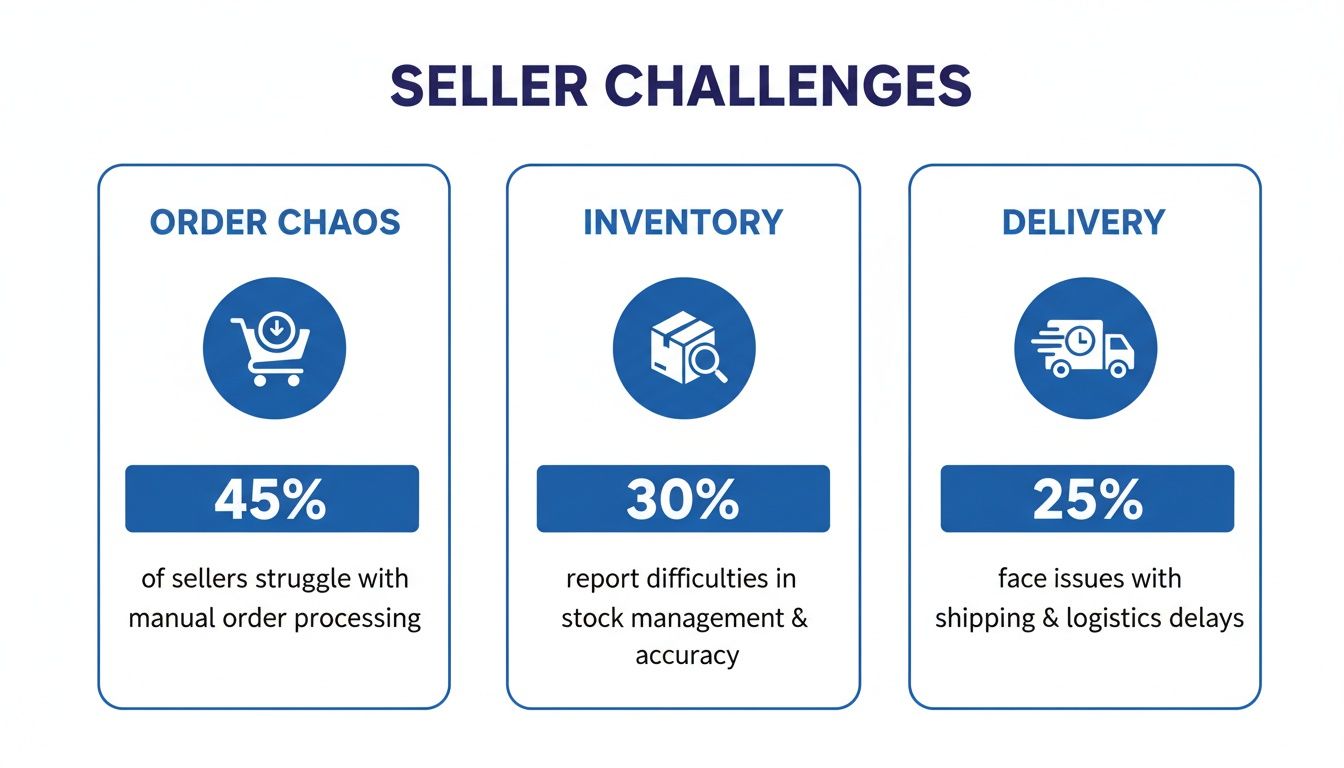
As the data shows, delivery is a massive piece of the fulfillment puzzle that sellers absolutely have to solve to succeed.
To help you get started, we’ve put together a table of the most essential KPIs for measuring your last mile.
This table breaks down the key performance indicators, how to calculate them, and what they reveal about your operations.
| KPI | How to Measure | Why It Matters |
|---|---|---|
| Cost Per Delivery | (Total Last Mile Costs) / (Total Successful Deliveries) | Reveals the true cost of getting one package to a customer. A high number signals inefficiency. |
| On-Time Delivery Rate | (Number of On-Time Deliveries / Total Deliveries) x 100 | Directly measures your reliability and impact on customer experience. The goal is 95% or higher. |
| First-Attempt Success Rate | (Successful First-Attempt Deliveries / Total Attempts) x 100 | Exposes the hidden costs of failed deliveries. Every re-delivery doubles your cost for that order. |
| Order Accuracy Rate | (Correct Orders Delivered / Total Orders Delivered) x 100 | Tracks how often the right products reach the right customer, preventing costly returns. |
Let’s unpack each of these metrics to see how you can use them to make real, practical improvements to your operations.
The most fundamental KPI is your Cost Per Delivery. This metric tells you exactly how much you spend, on average, to get a single package to a customer’s doorstep. It rolls up all your variable and fixed costs into one simple, powerful number.
Your total last mile costs should include everything—driver wages, fuel, vehicle maintenance, software fees, and even the cost of failed delivery attempts. A high Cost Per Delivery often signals inefficient routes or too many failed deliveries, both of which eat directly into your profits.
An actionable way to lower this number is by batching orders geographically. Instead of sending drivers on scattered routes, group deliveries by neighborhood. This simple strategy reduces both fuel consumption and driver time per package.
Your On-Time Delivery Rate is a direct measure of your reliability and your customer’s experience. It calculates the percentage of orders that arrive within the promised delivery window. Customers expect their packages to arrive when you say they will, making this a critical metric for building trust.
An industry benchmark to aim for is 95% or higher. If your rate is dipping below this, it’s a red flag. Start by digging into where the delays are happening. Are they concentrated in specific neighborhoods with heavy traffic? Or with a particular courier service?
To improve this rate, provide proactive delivery notifications. Sending customers an SMS or email with a clear ETA and a tracking link manages their expectations and cuts down on “where is my order?” inquiries.
Failed deliveries are a huge drain on resources. The First-Attempt Delivery Success Rate measures how many packages are successfully delivered on the very first try. Every failed attempt means a second trip, which doubles your delivery cost for that order and delays the customer’s gratification.
A low rate often points to issues like incorrect addresses, inaccessible buildings, or customers simply not being home. One practical solution is to offer flexible delivery options at checkout. Giving customers the choice to have their package sent to a secure local pickup point or left in a safe place can dramatically increase first-attempt success.
For a deeper look at how this fits into your overall business health, you can learn more about the top e-commerce metrics and KPIs to track for sustainable growth.
Finally, Order Accuracy measures whether the right products were delivered to the right customer. While this might seem like a warehouse issue, inaccuracies discovered during the last mile result in costly returns and seriously frustrated customers. A driver arriving with the wrong item creates a terrible experience that can damage your brand’s reputation.
Even a rate of 99% means that 1 out of every 100 orders is wrong—a number that adds up quickly as you scale. To boost accuracy, implement a scan-based verification system during the packing process. Requiring staff to scan each item’s barcode before sealing the box nearly eliminates picking errors before they ever leave the building.
Knowing the challenges and tracking your performance is a great start. Now, it’s time to turn that knowledge into action. Fixing your last mile of delivery doesn’t require a massive budget or a complete teardown of your current process. It starts with smart, practical moves that cut costs, save time, and leave customers feeling good about their purchase.
These strategies are all about boosting efficiency and regaining control. They’re designed to get you ahead of the common headaches that burn through your cash and hurt your brand’s reputation.
If there’s one move that delivers the biggest impact, it’s centralization. Instead of juggling a dozen browser tabs for Shopee, Lazada, and your own website, a centralized platform pulls everything into a single, unified dashboard.
This single change immediately attacks the root causes of manual errors and wasted time. A platform like OneCart lets you see every order from every channel in one place, updated in real-time. This means you can finally ditch the messy spreadsheets and start making quick, informed decisions.
Centralizing your fulfillment process is like trading a pile of messy, handwritten notes for a clear, organized digital planner. It eliminates chaos and gives you the visibility needed to scale your operations without breaking a sweat. With a centralized system, tasks that used to eat up your morning can be done in minutes. You can bulk-print hundreds of shipping labels formatted perfectly for each courier, generate one master picklist for your warehouse team, and schedule pickups without ever leaving the platform.
Two simple tactics can make a huge difference in your delivery speed and success rate. The first is batching orders by location. Instead of sending a driver on a random, zigzagging route across the city, group all the orders for a specific neighborhood together. This one change creates a logical, efficient delivery route that saves a ton of time and fuel.
The second is offering more flexible delivery options at checkout. Not every customer is home during business hours. By giving them alternatives like click-and-collect at a local partner shop or a secure parcel locker, you let them choose what actually works for them. This move drastically cuts down on failed first-attempt deliveries, which are a major cost sink in the last mile.
Picture a small online apparel brand selling on both Shopify and TikTok Shop. Before they centralized, their team spent nearly four hours every morning manually downloading orders, cross-checking inventory to avoid overselling, and printing labels one by one from different courier portals. Shipping errors were a regular problem, affecting about 5% of all orders.
After bringing in a centralized management system, their entire workflow changed. All orders flowed into a single dashboard, and inventory levels synced automatically across all channels. The team could now print 100+ shipping labels in under five minutes.
The results were immediate. They slashed their daily packing and processing time by 40%, and shipping mistakes dropped to nearly zero. This freed up their staff to work on marketing and customer service, which directly helped them achieve a 20% increase in sales the very next quarter. It’s a perfect example of the direct line between smart operations and business growth. To truly optimize your last mile operations, it’s essential to understand the broader context of effective ecommerce supply chain management.
Technology is the engine that drives modern fulfillment. It’s what connects all the moving parts of your last mile—from your sales channels to your warehouse and, finally, to your third-party logistics partners. The goal is to create a seamless flow of information that gets rid of friction at every point.
This is more important than ever. The last-mile delivery market has exploded, becoming the most expensive and critical part of the entire supply chain. In 2024, the global market was valued between $160 and $180 billion, with forecasts showing it could soar past $260 billion by 2030. This incredible growth highlights why centralized systems are no longer a nice-to-have but a must-have for managing last-mile complexity, especially for sellers handling thousands of orders.
By integrating your systems, you unlock a few key advantages:
These tech-driven strategies transform your last mile from a reactive, chaotic scramble into a proactive, controlled operation.
The world of last-mile delivery is always in motion, and it’s being pulled forward by one powerful force: customer expectations. Shoppers today want more than just their package. They expect speed, constant updates, and, increasingly, a sense of responsibility from the brands they buy from. This pressure is pushing the entire industry toward smarter, more efficient ways of getting things done.
When we talk about the future, flashy ideas like delivery drones and sidewalk robots always steal the show. And while that’s exciting stuff, the most impactful changes for sellers right now are far more practical and within reach. They’re the tools that solve today’s problems, cut real costs, and make the customer experience better now.
The real engine behind all this tech is the modern shopper’s need for visibility and control. People expect to know where their package is at every single moment, from the warehouse shelf all the way to their front door. This has turned real-time tracking from a nice-to-have feature into a basic requirement for any e-commerce business that wants to compete.
You don’t need a fleet of drones to level up your delivery game. The most effective technologies are the ones that make your existing processes faster, cheaper, and more reliable.
Here are a few areas where tech is making a huge difference right now:
When these tools work together, they create a last-mile experience that’s far more controlled and predictable for everyone involved.
Customer demands are reshaping every corner of the last mile. The data tells a clear story: 91% of consumers now actively track their packages, while a huge 70% say sustainable delivery options are important to them. At the same time, the demand for delivery ‘within 2 days’ dominates the market with a 64.68% share.
But there’s a major disconnect. Urban traffic continues to stall 30-50% of all deliveries, showing a huge gap between what customers want and what’s actually happening on the ground. You can see more data on last-mile delivery statistics and trends on smartroutes.io.
The future of last mile delivery is about using technology to achieve speed, cost-effectiveness, and sustainability. Platforms that provide a centralized view are best positioned to meet these complex demands. This is where sustainability stops being a buzzword and becomes a real competitive edge. Shoppers are more aware than ever of e-commerce’s environmental footprint, and they’re putting their money with brands that show a real commitment to greener practices.
This includes practical steps like:
By adopting these accessible technologies and sustainable practices, you can build a last-mile operation that isn’t just efficient, but also lines up with what modern customers truly value. That’s how you turn your delivery experience into one of your biggest strengths.
Navigating the last mile can feel complicated, but it doesn’t have to be. Let’s clear up some of the most common questions we hear from ecommerce sellers to give you some practical clarity on what really matters.
Hands down, it’s labor. This covers everything from driver wages to the time spent at each individual delivery stop. Fuel is a very close second.
Think about it: every minute a driver spends stuck in traffic or circling the block looking for an address directly inflates your labor hours per package. That hits your operational costs hard. This is exactly why efficient route planning and getting a high first-attempt success rate are so critical. The fastest way to protect your profit margins is to cut down drive time and eliminate redelivery trips.
The best first step is to get all your orders in one place. Instead of jumping between Shopee, Lazada, and your own website’s admin panels, use a platform that pulls everything into a single dashboard. This one change can slash manual errors and save you countless hours right off the bat.
Next, start looking at your delivery data for patterns. Are you seeing high failure rates in a specific neighborhood? Is one courier service consistently underperforming? Finally, give your customers more flexible options, like local pickup points. This boosts their convenience while lowering your own fulfillment expenses.
A poor delivery experience—like a late or damaged package—is one of the fastest ways to lose a customer for good. Conversely, a fast, reliable, and transparent delivery process builds immense trust and encourages repeat purchases.
Absolutely. The last mile of delivery is your final, and often most memorable, interaction with a customer. A smooth, on-time delivery powerfully reinforces their decision to buy from you. It builds the kind of trust that turns a one-time purchase into repeat business.
When you remember that the cost of acquiring a new customer is so much higher than retaining an existing one, investing in a great last-mile experience delivers a massive return. It’s how you turn casual buyers into loyal advocates for your brand.
The two stages handle logistics on completely different scales. It’s all about bulk versus precision.
In short, the middle mile moves inventory between your facilities, while the last mile moves a product to your customer.
Ready to take control of your last mile and eliminate the chaos of multi-channel selling? OneCart centralizes your orders, inventory, and shipping into a single, powerful platform. Stop overselling, cut processing time, and give your customers the seamless experience they deserve. Discover how you can scale your business with confidence at https://www.getonecart.com.
Automate & Scale Your Online Business with OneCart
Start a Free TrialUsed by hundreds of merchants in Singapore & Southeast Asia