A Guide to Last Mile Delivery Solutions for Singapore Sellers 2026
Optimize your e-commerce fulfilment with our guide to last mile delivery solutions. Learn to cut costs and improve speed for Shopee and Lazada sellers.
Optimize your e-commerce fulfilment with our guide to last mile delivery solutions. Learn to cut costs and improve speed for Shopee and Lazada sellers.

Last mile delivery is the final step of getting goods from a warehouse or transport hub to your customer’s front door. For marketplace sellers here in Singapore, this is the final, most critical moment of the entire customer experience. It’s the part that directly shapes their satisfaction and your store ratings.
Think of your customer’s journey as a relay race. A great product, a smooth checkout, and efficient packing are the first three legs. Last mile delivery is that final, make-or-break sprint to the finish line—the moment that decides if you win or lose that customer’s loyalty for good.
In Singapore’s crowded and demanding e-commerce scene, this last leg is everything. Shoppers on platforms like Shopee, Lazada, and TikTok Shop have sky-high expectations. They want their orders fast, reliably, and with total transparency. A two-day delay or a single missed delivery slot can easily turn into a one-star review.
For any Small and Medium-sized Enterprise (SME), getting your last mile delivery solutions right provides a massive competitive advantage. It’s a core part of your brand’s promise. The experience you deliver at this final stage has a real impact on several key areas of your business.
The final delivery is often the only physical interaction a customer has with your online brand. Getting it right proves they made a good choice buying from you. Getting it wrong can undo all the positive experiences that came before it.
With so many online sellers packed into one island, the delivery experience has become a key way to stand out. Businesses now have to compete on the quality and speed of their fulfilment.
For instance, if a customer is choosing between two shops selling the same phone case at a similar price, they’ll almost always pick the one promising next-day delivery over the one with a vague three-to-five-day window. This turns your choice of last mile delivery solutions into a strategic decision that directly shapes how customers see your brand and whether they decide to click “buy”.
Picking the right last-mile delivery approach involves mixing and matching the right last mile delivery solutions to fit your specific products, your budget, and the promise you make to your customers. For sellers in Singapore, there are a few tried-and-tested models to choose from, each with its own pros and cons.
Get this wrong, and you could be looking at sky-high costs or unhappy customers tanking your store ratings. Get it right, and it can become a massive competitive advantage.
For most sellers on platforms like Shopee or Lazada, tying up with established courier networks is the natural starting point. Think of giants like Ninja Van, J&T Express, and SingPost. These companies have massive, island-wide infrastructure already in place, built to handle huge parcel volumes day in and day out.
This is basically an outsourced model. You get the orders packed and ready, and their drivers take over the complicated job of sorting and delivering everything. It lets you tap into their scale and expertise without having to buy a single van or hire a driver. This setup is a classic example of how a 3PL works, which is a core concept to grasp when you’re deciding between 3PL vs 4PL logistics providers.
Running your own delivery fleet gives you ultimate control. Every single detail is up to you—from the delivery standards and driver training right down to branded uniforms and vehicles. You own the entire customer experience from checkout to their doorstep.
This approach really shines for businesses with very specific needs:
The trade-off, however, is a big one. You’re looking at major upfront costs for vehicles, insurance, and salaries, not to mention the ongoing bills for fuel and maintenance. This model really only makes financial sense once you’re dealing with a consistently high volume of orders.
Crowdsourced delivery platforms are a game-changer. They connect you to a flexible network of independent drivers using their own cars and bikes. This model gives you incredible speed and agility, making it perfect for on-demand or same-day delivery promises.
Imagine you run a fast-fashion brand. You could use crowdsourcing to offer a “three-hour delivery” option within certain postal codes. Suddenly, you have a premium service that your competitors, stuck on standard next-day shipping, can’t match. It’s a fantastic way to satisfy that customer need for instant gratification without the heavy costs of an in-house team.
Actionable Insight: The smartest play is often a hybrid one. Use a reliable courier network for your standard, island-wide orders. Then, bring in a crowdsourced service for those urgent, local deliveries to offer premium speed where it really makes an impact.
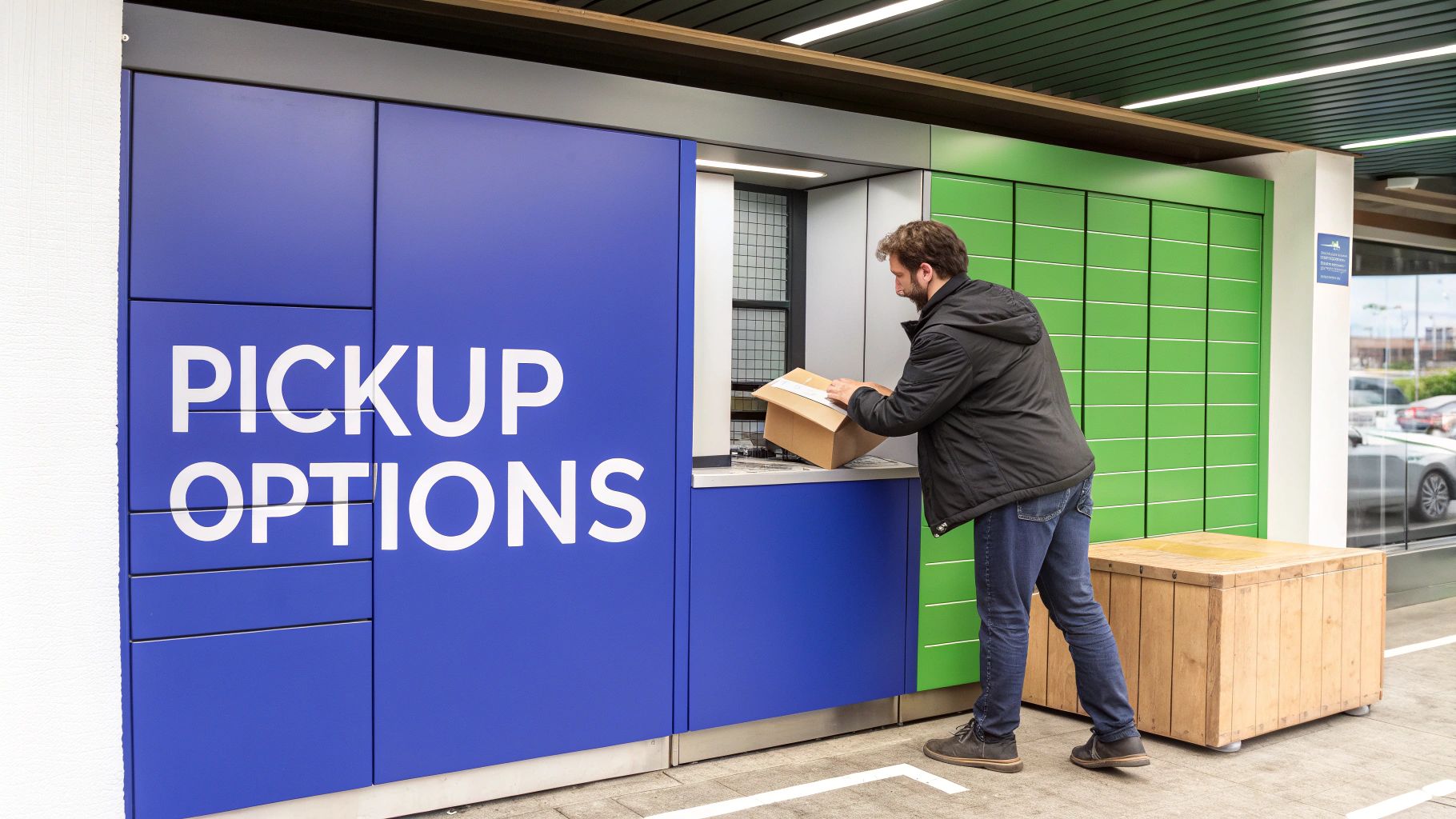
Sometimes, the best delivery isn’t to a customer’s home at all. Automated parcel lockers and designated pickup points—think MRT stations or your neighbourhood 7-Eleven—offer a super convenient and often cheaper alternative. Customers can just swing by and grab their orders whenever it suits them.
To help you figure out if your current delivery strategy is hitting the mark, this simple flowchart can guide your thinking.
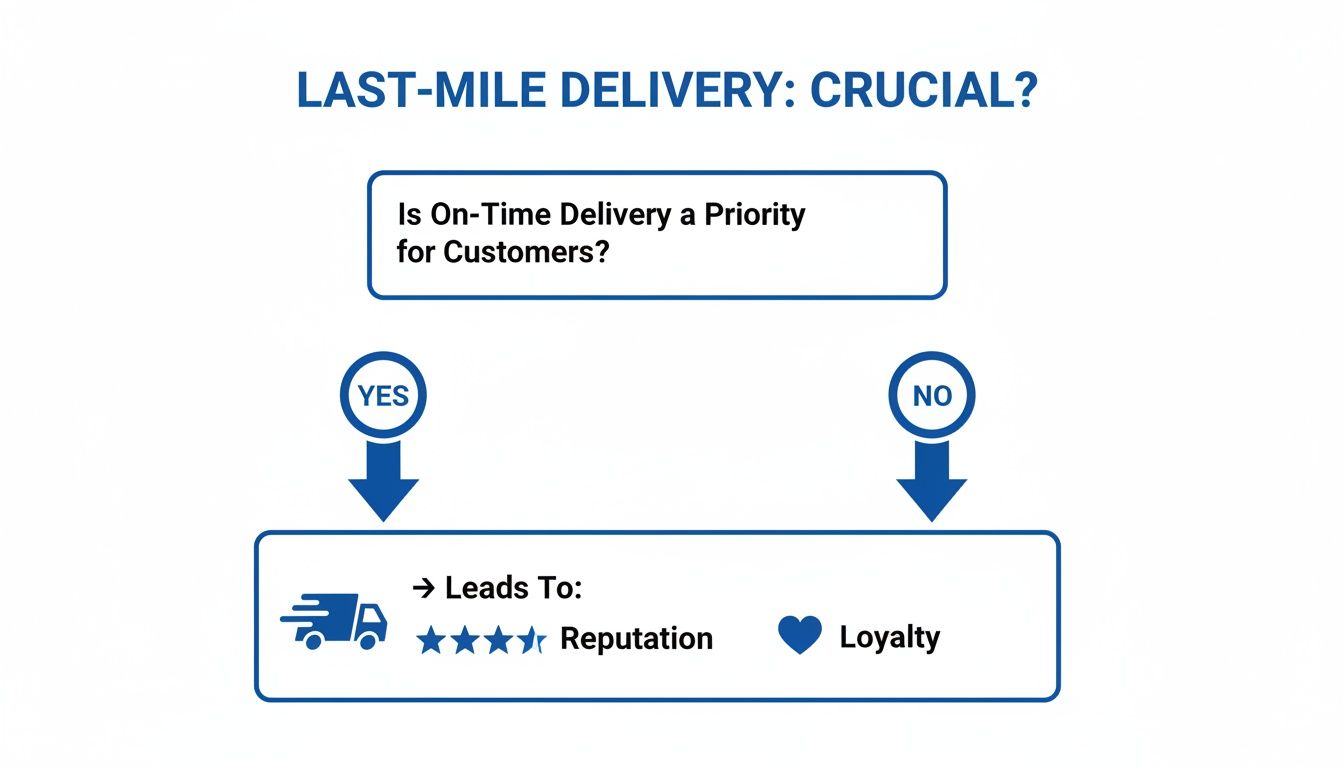
The main takeaway is simple: if your store ratings aren’t where you want them, it’s time to differentiate your delivery experience. Adding options like parcel lockers can be a huge win for customers who are rarely home, cutting down on failed delivery attempts and boosting overall satisfaction.
To make the choice clearer, here’s a quick comparison of the models we’ve discussed.
This table breaks down the different models to help you see at a glance which might be the best fit for your business right now.
| Delivery Model | Best For | Key Advantage | Key Disadvantage |
|---|---|---|---|
| Courier Networks | Most marketplace sellers; businesses needing scalable, nationwide coverage. | Cost-effective and reliable for standard deliveries without upfront investment. | Less control over branding and the final customer interaction. |
| In-House Fleet | Businesses with high-value, fragile, or specialised installation needs. | Complete control over the delivery experience, ensuring quality and service. | Very high initial and ongoing costs; needs high volume to be viable. |
| Crowdsourcing | Businesses needing on-demand, same-day, or hyper-local speed. | Extreme flexibility and speed, ideal for offering premium delivery options. | Variable driver quality and less suitable for nationwide standard shipping. |
| Parcel Lockers/Pickup | Sellers whose customers value flexibility and are often not at home. | Reduces failed deliveries and offers customer convenience; often lower cost. | Not suitable for large items or customers who expect doorstep delivery. |
Ultimately, the goal is to build a delivery system that feels like a natural extension of your brand—one that is reliable, cost-effective, and leaves your customers happy.
Modern last-mile delivery runs on a powerful engine of smart technology working behind the scenes. This tech is what turns a potentially chaotic process into a smooth, predictable experience for both you and your customer. It’s the invisible framework that makes efficient, large-scale delivery possible.
Without this technological backbone, you’re left with manual guesswork—a slow, expensive, and error-prone way to operate. The right tools automate the complexity, letting you focus on growing your business instead of constantly putting out operational fires.
Imagine your driver has 50 different parcels to drop off across Singapore. Manually planning the best sequence would be a logistical nightmare. Route optimisation software acts like an advanced GPS, automatically calculating the most efficient path in seconds.
This software weighs multiple factors to find the absolute best route:
The result? A direct impact on your bottom line. By finding the shortest and fastest routes, you significantly slash fuel costs and reduce driver overtime, making every single delivery more profitable.
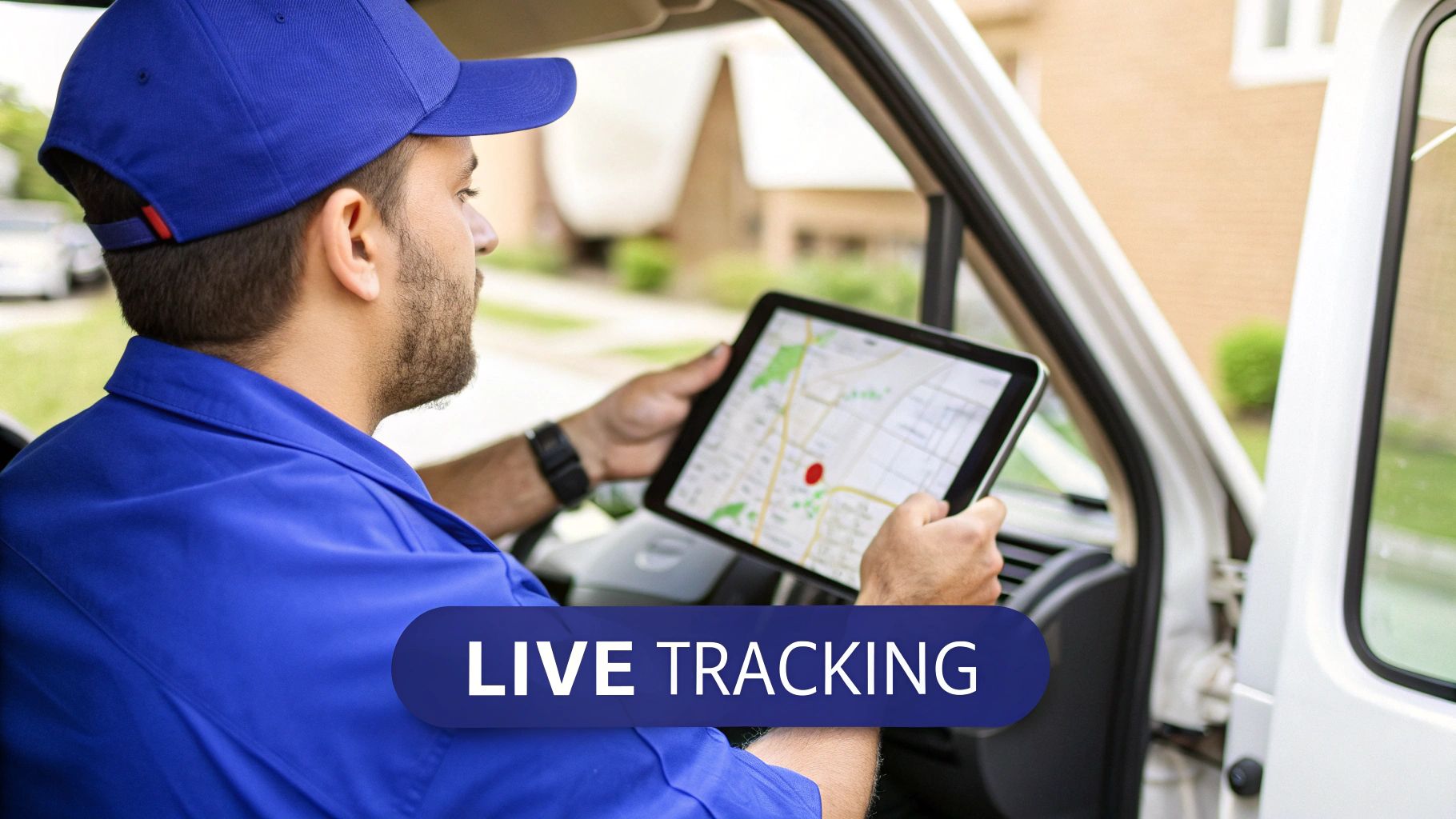
Think about the last time you booked a Grab. Watching the car’s icon creep towards you on the map gives you a sense of control and peace of mind. Real-time tracking brings this exact same experience to parcel delivery.
When customers get a tracking link, they can see exactly where their package is and get an accurate estimated time of arrival (ETA). This simple feature has massive benefits. It reduces customer anxiety and dramatically cuts down on “Where is my order?” calls, freeing up your customer service team. Proactive communication like this is a cornerstone of a great delivery experience.
Gone are the days of paper slips and unreadable signatures. Electronic Proof of Delivery (ePOD) systems let drivers capture delivery confirmation right on their smartphones.
An ePOD serves as undeniable evidence that a parcel was delivered correctly. It can include a digital signature, a photo of the parcel at the doorstep, or even GPS coordinates and a timestamp.
This digital record is uploaded instantly and becomes your best defence against disputes or false claims of non-delivery. If a customer says a package never arrived, you can immediately pull up a photo showing it placed securely at their front door. This protects your business from unnecessary losses and builds trust.
All these technologies are powerful on their own, but they create the most value when they work together. This is where an Order Management System (OMS) comes into the picture. An OMS acts as the central hub, connecting your marketplace stores directly to your logistics operations.
When an order comes in from Shopee or Lazada, the OMS pulls it into a single dashboard. From there, it can automatically assign the order to the best courier and push the delivery details into the route optimisation software. This level of integration, often powered by robust APIs, is essential for automation. To scale effectively, it helps to understand how e-commerce APIs are essential for connecting these systems.
The future of efficient deliveries is increasingly shaped by advancements in artificial intelligence and automation in logistics, offering new ways to optimise routes and processes even further. For sellers, this means less manual work, fewer human errors, and a delivery workflow that can easily handle hundreds of orders a day without breaking a sweat.
You can’t improve what you don’t measure. To really get a grip on your last-mile delivery, you have to track the right Key Performance Indicators (KPIs). Think of these metrics as your dashboard—they give you a clear, data-backed view of what’s working, what’s costing you too much, and where you can make changes that actually matter to your bottom line and customer happiness.
Focusing on a handful of core KPIs keeps you from getting lost in a sea of data. They act as your compass, guiding your day-to-day decisions and helping you spot problems before they turn into one-star reviews on your marketplace listings.
This is probably the most fundamental metric for any e-commerce business. It answers a simple question: How much does it cost, on average, to get one parcel from your warehouse to a customer’s doorstep? It’s a straightforward but powerful indicator of your overall logistical health.
Calculating it is easy. Just add up all your last-mile costs for a specific period (say, a month) and divide that total by the number of successful deliveries you made in that same timeframe.
Actionable Insight: If your Cost Per Delivery is creeping up, that’s a red flag. Dig into your courier invoices to see if fuel surcharges have increased or if you’re being charged for failed delivery re-attempts. Keeping a close eye on this number helps you clamp down on expenses and protect your profit margins.
In Singapore’s hyper-competitive market, speed and reliability are everything. The On-Time Delivery (OTD) rate measures the percentage of your orders that actually arrive within the promised delivery window. A high OTD rate is a direct measure of your reliability and a huge driver of customer satisfaction.
Marketplaces like Shopee and Lazada track this metric religiously, and consistently missing your targets can seriously ding your seller rating. You should be aiming for an OTD rate of 95% or higher—that’s the benchmark for keeping customers happy and staying in the marketplace’s good graces.
A consistently high on-time delivery rate isn’t just an operational goal; it’s a promise you make to your customer. When you keep that promise, you build the kind of trust that turns a one-time buyer into a loyal, repeat customer.
A failed delivery is a lose-lose situation. It means a second trip for the driver, which instantly doubles your delivery cost for that order. Worse, it creates a frustrating experience for the customer who was waiting for their package. The First-Attempt Delivery Success Rate (FADR) tracks the percentage of deliveries that get it right on the very first try.
If your FADR is low, it usually points to one of several common issues:
Improving your FADR often comes down to simple fixes, like sending customers delivery notifications with real-time tracking links or offering flexible drop-off options like parcel lockers. Even a small bump in this rate can lead to significant cost savings and much happier customers.
The real challenge is finding the right balance between these metrics. It’s a constant strategic trade-off. For instance, you could chase a 100% on-time, next-day delivery rate. While that sounds amazing for the customer, the operational costs would probably eat up all your profits.
The key is to use data to make smart decisions. This is where a unified dashboard, like the one you’d find in an Order Management System, becomes invaluable. It pulls all this performance data from your different couriers and sales channels into one central place. With that kind of visibility, you can see the whole picture, track your KPIs in real-time, and make adjustments that keep both your customers and your finance team smiling.
Picking a delivery partner is a huge decision for your business, and it goes way beyond just comparing prices. Think of it this way: your courier is the final, physical touchpoint your brand has with a customer. They’re the ones showing up at the door. Get this choice right, and you’ve got a partner who upholds your reputation and can scale with you.
The real goal is to find a reliable partner who delivers genuine value and reinforces the promise you make to your customers. A low-cost service that consistently misses delivery slots or delivers damaged goods will end up costing you a fortune in angry customers and bad reviews.
When you’re sizing up potential partners, you have to dig deeper than the cost sheet. A solid courier partnership is built on a foundation of reliability, comprehensive coverage, and good tech. As you explore different options, it’s also helpful to understand where 3PL vs 4PL logistics providers fit in the bigger picture.
Here are the non-negotiables you need to investigate:
Actionable Insight: Put them on the spot. Ask a potential partner for their performance metrics from the last 11.11 or Black Friday sale. How they held up during a massive sales peak will tell you everything you need to know about their real capabilities.
Any courier can look good on a quiet Tuesday afternoon. The true test of a partner’s metal is how they handle the chaos of a major sales campaign when order volumes can easily spike by 10x or more. A partner that crumbles under pressure will leave you drowning in unfulfilled orders and fielding calls from unhappy customers.
Before you even think about signing a contract, drill down on their peak season strategy. How do they scale up their fleet and manpower? What are their backup plans for unexpected surges? A partner worth their salt will have confident, detailed answers ready to go.
In today’s e-commerce world, manual work is the enemy of growth. Your courier absolutely must have a robust API that lets your systems and theirs talk to each other automatically. This is the bedrock of efficient last mile delivery solutions.
With a proper integration, you can:
For instance, ask them for a live demo. Get them to show you exactly how their system plugs into your Shopify store or an OMS like OneCart. Seeing the workflow with your own eyes is the only way to be sure their tech is as slick as they claim. A partner with a proven, easy-to-use integration will save you countless hours and prevent the kind of shipping mistakes that cost you money and customers.
If you’re selling across multiple channels, you know the headache. Your team is constantly jumping between Shopee Seller Centre, Lazada’s portal, and your own Shopify dashboard just trying to keep up. This manual juggling act is slow, riddled with errors, and simply won’t work once your order volume really starts to climb.
The answer is to bring everything together under one roof. Centralised management uses a single system to unify your entire fulfilment workflow, from the second an order is placed to the moment it’s handed off to the courier. It’s how you turn operational chaos into a smooth, predictable process.
The first and most powerful step is to pull all your incoming orders into one unified view. Just imagine seeing an order from your Lazada store pop up right next to one from your website, all on the same screen. This is the core function of an Order Management System (OMS).
An OMS is basically the command centre for your business. It plugs directly into all your sales channels and courier partners, funnelling data into one central hub. This instantly gets rid of the need for your team to log in and out of different platforms, saving a huge amount of time and cutting down the risk of a missed order.
To learn more, check out our complete guide on what an Order Management System is and why your business needs one.
Once all your orders are in one place, you can finally create a single, standard workflow for your warehouse team. Instead of having different processes for each marketplace, your team follows the exact same steps for every order, no matter where it came from.
This unified process looks something like this:
Standardising your workflow like this drastically boosts both speed and accuracy. Your team gets faster and makes fewer mistakes because they’re simply repeating the same proven process over and over again.
A standardised workflow is the bedrock of a scalable operation. It ensures your fulfilment stays smooth and error-free, whether you’re processing 50 orders a day or 5,000 during the 11.11 sale.
The final piece of the puzzle is automating the most repetitive part of the job—shipping. A centralised system that’s integrated with multiple couriers can automate the entire documentation workflow, a critical part of modern last mile delivery solutions.
For example, once an order is packed and scanned, the system can automatically:
Here’s how it works in the real world: Your team needs to process a batch of 100 orders from Shopee, Lazada, and your website. With a single click, the system prints all 100 shipping labels in the correct format for each specific courier—no manual data entry required. This simple action turns hours of tedious work into a task that takes seconds, freeing up your team to focus on getting more orders out the door.
Got some lingering questions? Let’s tackle some of the most common ones we hear from Singaporean e-commerce sellers trying to get their delivery operations sorted out.
The secret is to use a smart mix of services, not find one magical cheap courier. Think of it as a hybrid strategy.
For your urgent, nearby orders, lean on on-demand delivery services. For everything else that’s standard and island-wide, stick with traditional couriers. You get the best of both worlds.
The key is to set a hard cut-off time each day—say, 2 PM. This lets you batch all your same-day orders together. Then, with good route optimisation software, you can plan the most efficient delivery route, which brings the cost per parcel way down. A good system can even automatically pick the cheapest courier for each order based on its destination and urgency, so you don’t have to think about it.
By far, the biggest mistake is sticking with manual processes for too long. When you only have a few orders, printing labels from different seller centres and messaging drivers feels manageable. But as your sales grow, this approach quickly turns into a massive bottleneck.
You start seeing shipping mistakes pile up, and suddenly you’re at risk of breaching your service level agreements (SLAs) on marketplaces like Shopee and Lazada.
Actionable Insight: Put an order management system in place before you think you need it. It creates a scalable foundation for your business. When you can automate label printing and courier bookings, you’ll breeze through peak seasons like 11.11 without breaking a sweat.
Yes, absolutely. In fact, we highly recommend it for any serious seller looking to optimise their last mile delivery solutions. Relying on just one courier is like putting all your eggs in one basket.
A multi-courier approach gives you flexibility. You can choose the perfect partner for every type of delivery—balancing cost, speed, and service quality.
For example, you might use NinjaVan for standard nationwide shipping but tap into Lalamove for those super-urgent, three-hour deliveries within the CBD. The trick is to manage them all without creating more headaches for yourself. This is where an order management platform is a game-changer. It pulls all your couriers into one place, letting you compare rates, print the right labels, and track every single parcel from one dashboard.
Ready to stop juggling multiple seller portals and automate your shipping workflow? OneCart centralises your orders from Shopee, Lazada, TikTok Shop, and more, so you can bulk-print shipping labels and manage all your last mile delivery solutions from one place. Book a demo with OneCart today to see how you can scale your operations.
Automate & Scale Your Online Business with OneCart
Start a Free TrialUsed by hundreds of merchants in Singapore & Southeast Asia