Last-Mile Delivery Singapore: Costs & Couriers [2026] 2026
Compare J&T Express, Ninja Van, DHL and more. Real costs, delivery speeds, and how to pick the right courier for your Shopee or Lazada e-commerce orders.
Compare J&T Express, Ninja Van, DHL and more. Real costs, delivery speeds, and how to pick the right courier for your Shopee or Lazada e-commerce orders.
Last-mile delivery in Singapore accounts for up to 53% of total shipping costs — and it’s where your customer experience is won or lost. Whether you’re shipping 10 or 10,000 parcels a month through Shopee, Lazada, or Shopify, choosing the right courier partner and fulfilment strategy directly impacts your margins and seller ratings. This guide compares Singapore’s top couriers (J&T Express, Ninja Van, DHL, and more), breaks down real delivery costs, and shows you how to turn last-mile logistics from a daily headache into a competitive advantage.
The e-commerce scene in Singapore is its own unique beast. Once your business starts scaling past 50 orders a day, that final leg of the delivery journey is where you either forge a massive competitive advantage or get bogged down by a serious operational bottleneck. Understanding this environment is the first step toward building a delivery strategy that works and wins.
Singapore’s last-mile market has absolutely exploded, piggybacking on the growth of platforms like Shopee and Lazada. It was valued at around $500 million in 2025 and is set to grow at a compound annual growth rate (CAGR) of over 8% through 2033. This growth is fuelled by tech-savvy Singaporean consumers who increasingly expect same-day delivery as standard.
For marketplace sellers, this means dealing with a dense urban landscape where the high population density in central Singapore—over 8,000 people per square kilometre—means huge delivery volumes but also brutal challenges like traffic. To get a better sense of these trends, you can explore more data on the Singaporean last-mile market.
Today’s shoppers want their orders immediately. This relentless demand for speed often clashes with the on-the-ground reality of a bustling city. The hurdles are real and can trip up even the most organised sellers.
A few of the biggest headaches include:
This flow chart breaks down the core stages of getting a package from your warehouse to your customer’s hands in Singapore.
Each of these steps is a potential friction point where a small mistake or delay can ripple through the entire customer experience.
Actionable Insight: Start thinking of last-mile delivery as a direct, tangible extension of your brand. A single late or damaged package can undo months of hard work building customer trust. By viewing delivery as a key part of your customer experience, you can justify investing in better partners and technology.
Ultimately, you need to shift your mindset. Last-mile delivery is a strategic asset. With the right strategies, partners, and technology, you can turn this operational headache into a powerful engine for customer retention and growth. The following sections will give you an actionable playbook to do just that.
Think of your courier as the final handshake with your customer. The delivery experience—whether the parcel arrives on time, in good condition, and with clear communication—is a direct reflection of your brand. The goal is picking a partner who delivers on the promise you made to your customer.
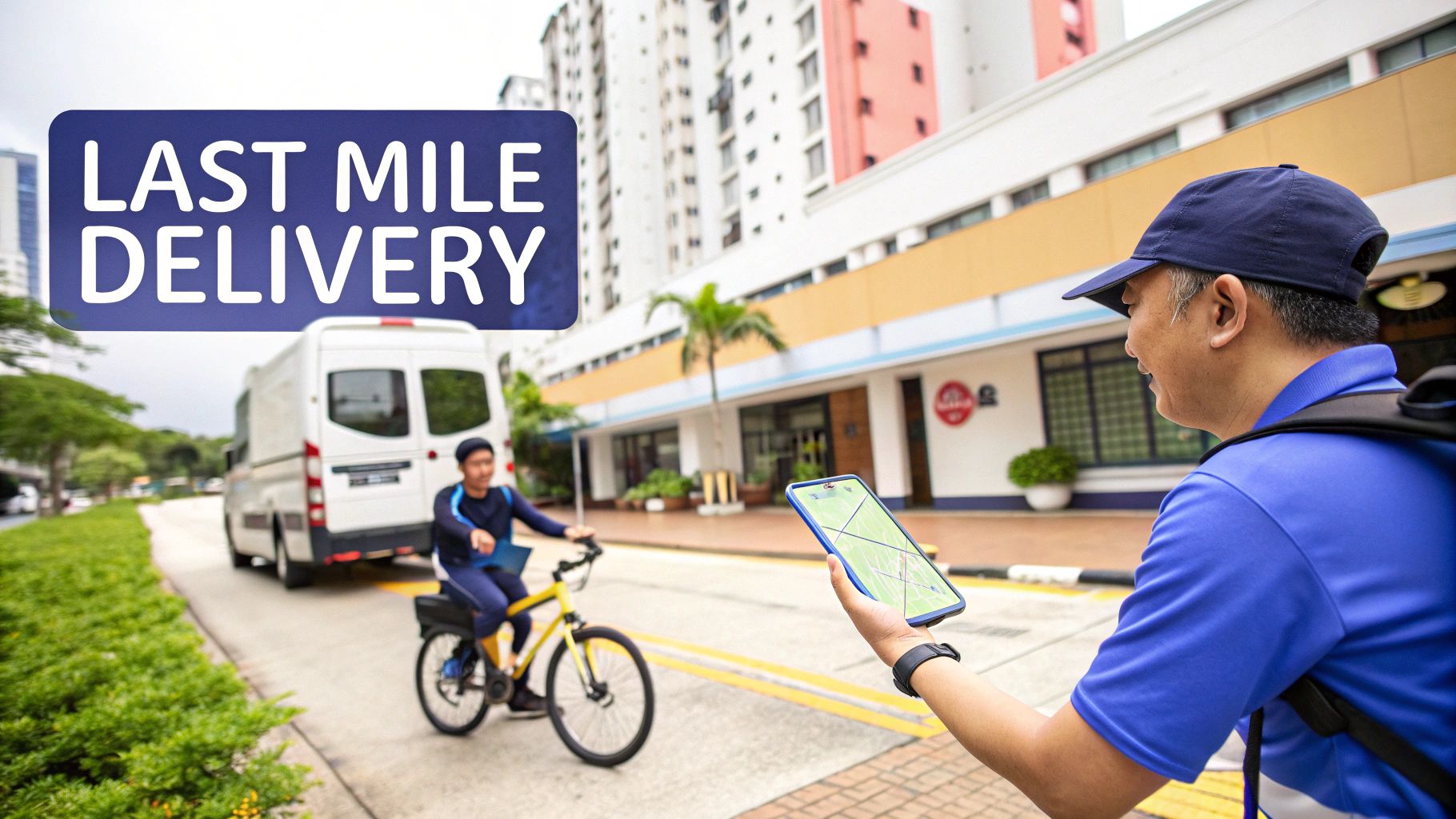
In Singapore, you’re spoiled for choice with strong contenders like Ninja Van, J&T Express, and the ever-reliable SingPost. Each brings a different mix of speed, cost, and service features to the table. Making the right call starts with a crystal-clear understanding of what your business needs and what your customers expect.
Choosing a courier can feel overwhelming, so we’ve put together this table to give you a quick, side-by-side look at some of the key players in Singapore. This isn’t an exhaustive list, but it covers the main options you’ll likely be considering.
| Courier | Best For | Key Services | Integration with Marketplaces | Average Cost (Standard) |
|---|---|---|---|---|
| Ninja Van | E-commerce startups needing flexible pickups and broad coverage | Next-day delivery, real-time tracking, COD, easy returns | Excellent (Shopee, Lazada, Shopify) | S$3.50 - S$5.00 |
| J&T Express | Businesses with high daily volume, especially during sale seasons | 365-day operations, express & standard services, international shipping | Strong (Shopee, Lazada) | S$3.20 - S$4.80 |
| SingPost | Reliability and access to post offices/POPStations for returns | Standard & express parcels, registered mail, SmartPac letterbox delivery | Good (Most major platforms) | S$3.00 - S$6.00 |
| Qxpress | Sellers on Qoo10 and those needing integrated warehousing | Same-day & next-day delivery, Q-storage fulfilment, cross-border | Deep integration with Qoo10 | S$4.00 - S$5.50 |
| GrabExpress | Urgent, on-demand deliveries for high-value or perishable items | 4-hour, same-day, and instant delivery within Singapore | API available for custom integrations | S$6.00 upwards (distance-based) |
This table should help you shortlist potential partners. Once you have a couple in mind, it’s time to dig deeper into the details that truly matter for your day-to-day operations.
When you’re assessing partners for your last mile delivery in Singapore, you have to look beyond the headline price. Get into the nitty-gritty operational details that directly affect your customers and your own workflow.
Here’s what you should be asking them:
Your Service Level Agreement (SLA) is the rulebook for your partnership. It translates vague sales pitches into concrete, measurable promises, protecting your business when things don’t go according to plan.
A solid SLA needs to spell out:
A clear SLA is about building a transparent partnership. When things go wrong—and they sometimes will—it means you have a pre-agreed plan to fix it fast.
Putting all your eggs in one courier’s basket is a huge risk, especially when mega-sales like 11.11 or Black Friday roll around. When one provider gets swamped with parcels, your entire operation can screech to a halt.
This is why a multi-courier strategy is essential for resilience.
By partnering with two or more couriers, you can:
Of course, managing multiple couriers requires a central system that can automatically route orders based on rules you set. This is similar to how businesses choose between logistics models. For a deeper look at this, our guide on 3PL vs 4PL logistics is a great resource for understanding different operational setups. By diversifying your courier partners, you’re building a tougher, more scalable fulfilment machine that can handle the pressures of Singapore’s e-commerce market.
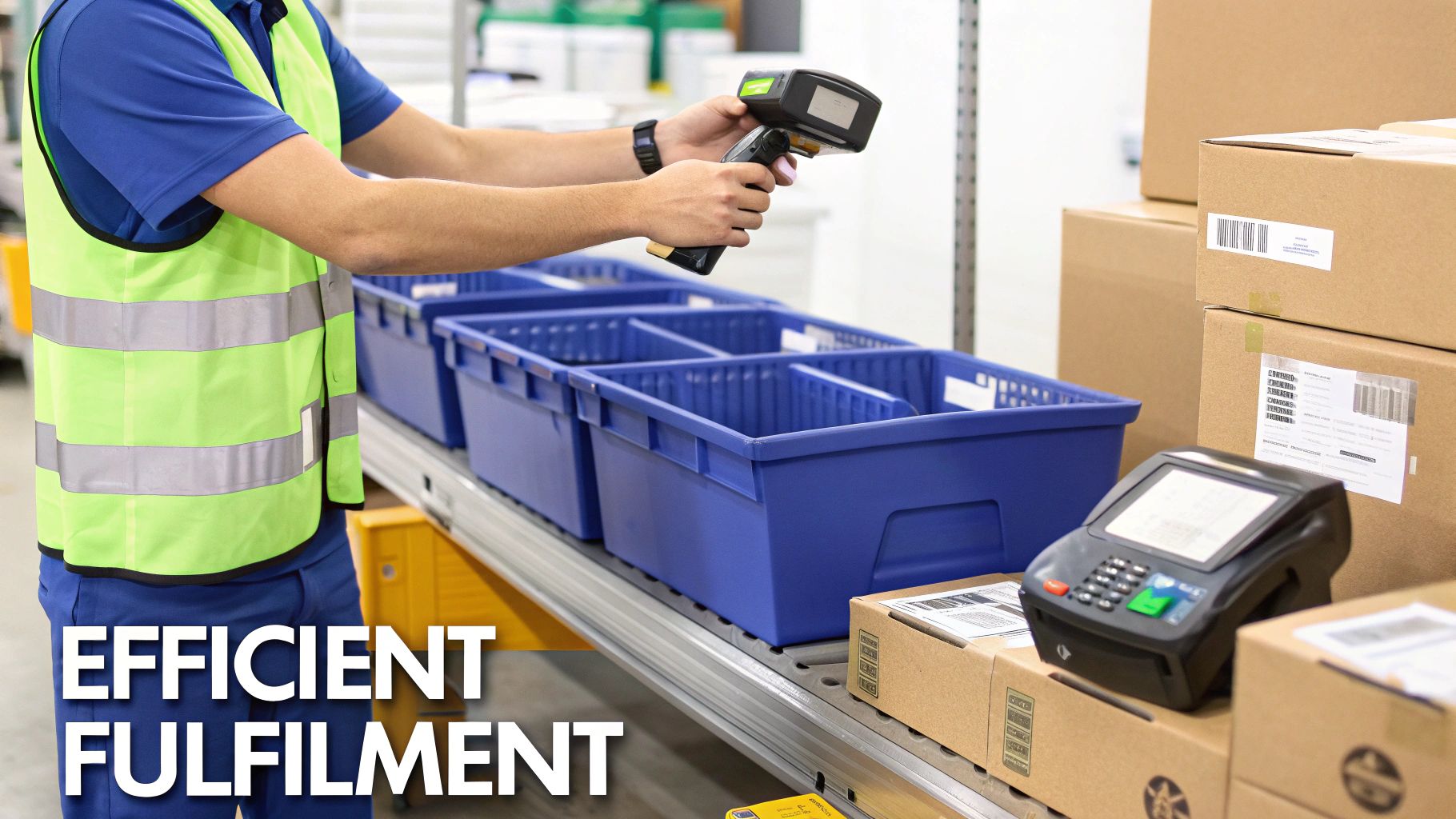
A fast, accurate delivery experience starts long before a package ever reaches a courier. The real speed is gained—or lost—within your own four walls. An optimised warehouse fulfilment process is the engine that powers your last mile delivery in Singapore, slashing errors and getting orders out the door faster than you thought possible.
Every single minute you save in the warehouse translates directly into a happier customer. On the flip side, a disorganised workflow is a recipe for picking errors, shipping delays, and frustrated buyers. The goal here is to create a seamless flow from the moment an order hits your system to the second it’s ready for pickup.
The physical layout of your warehouse and the logic behind how you pick items are absolutely critical. Many growing businesses make the mistake of sticking with a chaotic system where staff just wander around searching for products. To scale, you need a structured approach.
Start by organising your inventory logically. This is about strategic placement.
When a system like this is in place, an order from Lazada for a popular item doesn’t cause a frantic search. Your team knows exactly where to go, without a moment’s hesitation. This process is a cornerstone of effective warehousing and logistics management, and it’s the foundation for any scalable operation.
For sellers juggling multiple platforms like Shopee, Lazada, and TikTok Shop, trying to process orders manually is a nightmare waiting to happen. Constantly switching between different seller centres, copying and pasting customer details, and printing labels one by one isn’t just slow—it’s incredibly prone to human error.
This is exactly where a centralised system becomes a game-changer. Imagine all your orders, from every single channel, flowing into one unified dashboard.
An integrated platform like OneCart automatically pulls these orders together, letting you generate a single, combined picklist for your team. For example, instead of printing separate lists for 10 Shopee orders and 5 Lazada orders, you get one master list that guides your picker through the warehouse in the most efficient path to grab all 15 items.
This automation also takes care of the paperwork. With just a few clicks, you can bulk-generate and print hundreds of correctly formatted shipping labels and packing slips. This completely eliminates manual data entry, which is one of the biggest sources of costly mistakes like sending the wrong product or shipping to an old address.
Your choice of packaging has a direct and immediate impact on your bottom line. You need to protect the product, but you also have to avoid getting hit with unnecessary shipping costs—especially with the volumetric weight calculations that couriers in Singapore rely on.
Volumetric weight is based on a parcel’s size, not its actual weight. That means a large, light item can easily cost more to ship than a small, heavy one.
Actionable Insight: Run a packaging audit this week. For every product you sell, figure out the smallest possible box or poly mailer that still provides adequate protection. Using oversized boxes doesn’t just inflate your shipping fees; it also drives up your material costs and your environmental footprint.
Think about it: shipping a lightweight t-shirt in a big box simply because it’s the only size you have on hand could easily double your shipping cost. By stocking a variety of appropriately sized mailers, you ensure you’re only paying for the space you actually need. It’s a simple change that can lead to massive savings across thousands of orders.
For any business running its own delivery fleet or working hand-in-glove with a 3PL partner, smart route planning is where you wrestle back control over your operational costs and actually hit your delivery promises. A poorly planned route torches fuel, wastes your driver’s time, and is the number one cause of late deliveries.
It is the single most effective lever you can pull to improve the efficiency of your last mile delivery in Singapore.
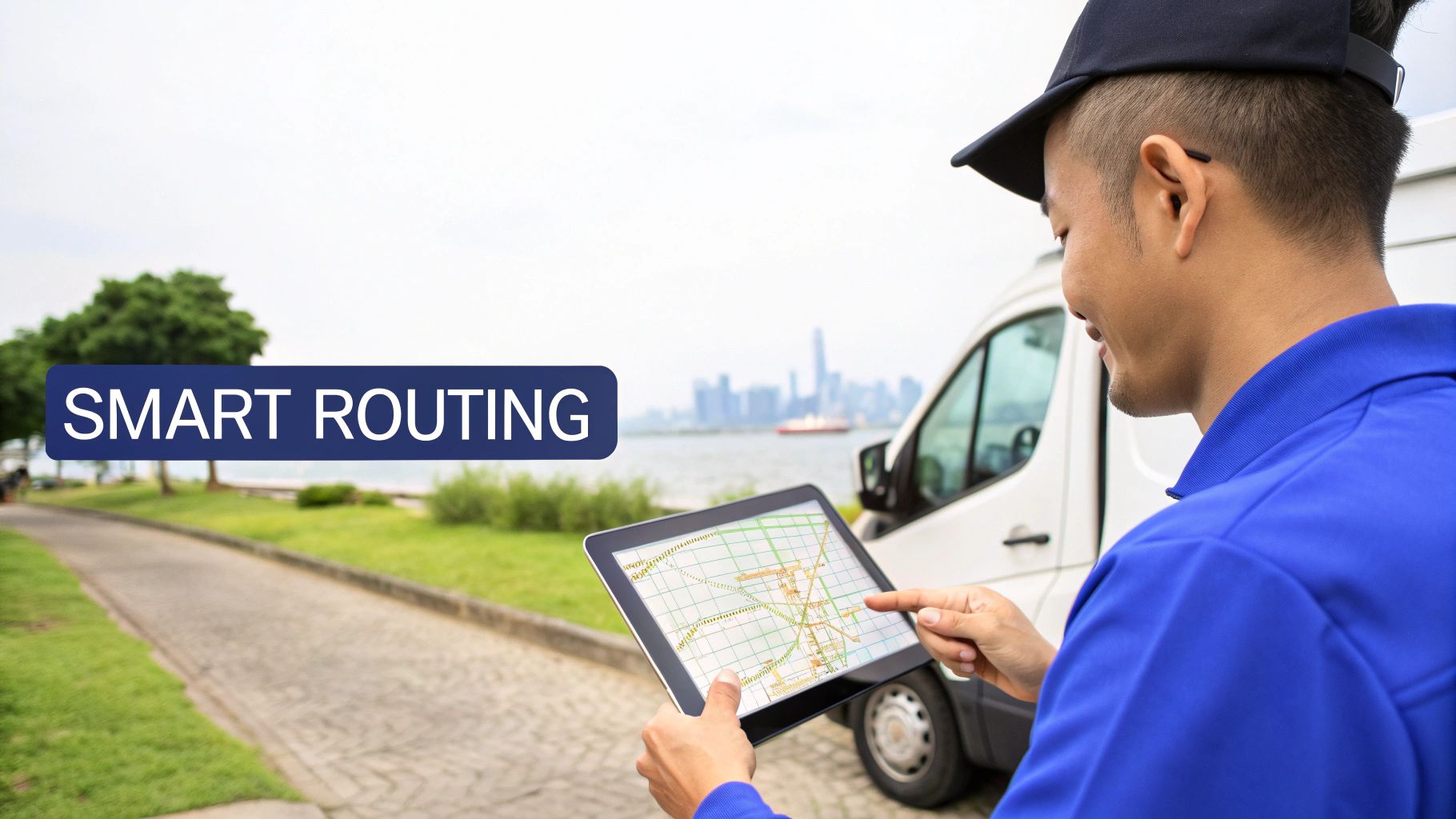
The old way of just handing a driver a stack of addresses and wishing them luck doesn’t work anymore. Singapore’s dense urban grid, with its maze of one-way streets and notoriously unpredictable traffic, demands a much more calculated approach. This is about moving beyond guesswork and using data to build the most efficient delivery sequence possible.
The golden rule of efficient routing is delivery density. You want your drivers to complete as many drops as possible within a tight geographic area before they even think about moving on. This strategy, known as batching or zoning, is your first line of defence against wasted time and money.
Instead of sending out orders on a first-come, first-served basis, start by grouping your daily orders by postal code or pre-defined delivery zones. For example, all orders heading to the Tampines area (postal codes starting with 52) should be bundled and assigned to one driver for a single, focused run.
This simple step prevents the classic, costly mistake: one driver heading from Jurong to Tampines while another is going from Tampines back to Jurong, crossing paths and burning double the resources.
Actionable Insight: Draw up a simple zoning map of Singapore. Group adjacent postal codes into logical delivery zones (e.g., East, West, Central, North). As you process daily orders, sort them into these zones before you even think about assigning them to a driver. It’s a low-tech change with a high-impact result.
While manual zoning is a fantastic start, modern routing software takes this concept to a whole new level. These platforms are built to solve what’s known in logistics as the “Travelling Salesperson Problem” on a massive scale, calculating the absolute optimal path for hundreds of stops in a matter of seconds.
This kind of software doesn’t just look at a list of addresses. It crunches multiple variables in real-time to build hyper-efficient routes that a human planner, no matter how experienced, simply couldn’t create.
Key capabilities to look for include:
This technology shifts your delivery operations from a reactive, fire-fighting process into a proactive, data-driven system.
The true test of any routing strategy isn’t a quiet Tuesday; it’s the chaos of a major sales event like 11.11. A static plan that works perfectly fine on a normal day will completely collapse under a fivefold increase in order volume. This is where dynamic planning becomes non-negotiable.
Let’s contrast two scenarios:
This ensures that even with a massive spike in volume, each driver’s journey remains efficient. It prevents bottlenecks at the warehouse and makes sure you can still meet your delivery SLAs, even under extreme pressure.
By embracing smart routing, you’re not just saving a bit on fuel. You’re building a resilient, scalable delivery operation that performs reliably whether you have 50 orders or 500. In Singapore’s demanding e-commerce market, that is essential for survival.
The customer experience doesn’t end when a parcel is delivered. In fact, what happens after the drop-off—especially when things go wrong—is often what cements lasting loyalty or sends a customer running to your competitors.
Your approach to returns and communication is a critical piece of your last-mile strategy in Singapore. Get it right, and you’ll build incredible trust while cutting the strain on your support team. A positive experience here turns a potential frustration into a moment of brilliant customer service, showing you’re a reliable brand that stands by its customers long after the sale.
Nobody likes dealing with returns, but making the process transparent and painless for your customers is a massive competitive advantage. A clunky, confusing returns policy is a major deterrent for shoppers.
Your goal should be to make returning an item as easy as buying it in the first place. This means offering convenient options that fit into your customers’ busy lives.
Beyond just processing returns, every piece of feedback is a chance to get better. Learn to turn complaints into assets by treating every return as a data point that can help you improve your products or fix a flaw in your process.
The best way to handle a customer service issue is to prevent it from ever happening. Proactive, automated communication keeps customers in the loop, reduces their anxiety, and drastically cuts down on those “Where is my order?” enquiries.
A simple SMS or email at key delivery milestones provides huge value and reassurance. Your communication workflow should fire off automated updates for:
These small touchpoints build a transparent and trustworthy delivery experience, managing customer expectations every step of the way.
Actionable Insight: Don’t view customer communication as a cost. See it as an investment in retention. Each automated update reinforces the customer’s decision to buy from you and reduces the manual workload on your team. For example, a single “out for delivery” SMS can prevent dozens of customer service emails.
Failed deliveries are a huge hidden cost in Singapore’s last-mile landscape. First-attempt failure rates can hit as high as 20% in some zones due to dense urban traffic and incomplete addresses.
With each failed attempt costing around S$17.78, a modest 5% failure rate on 140,000 annual orders can drain nearly S$200,000 straight from your bottom line. How you handle these situations is crucial.
A blunt “delivery failed” notification without clear next steps is a recipe for frustration. Instead, turn it into a moment of control for the customer. Your communication needs to be immediate, clear, and actionable.
An automated SMS or email should explain why the delivery failed (e.g., “Our driver was unable to reach you”) and provide a simple, one-click link to a self-service page. From there, the customer should be able to:
This approach empowers the customer and solves the problem efficiently, preventing a minor hiccup from escalating into a negative review. It shows you respect their time and are committed to getting their order to them, solidifying their trust in your brand.
Growing from 50 orders a day to 5,000 makes your old manual processes impossible to sustain. Trying to manage that kind of scale with spreadsheets is like directing city traffic with a whistle—it just leads to chaos, errors, and a burnt-out team. This is the exact moment technology stops being a nice-to-have and becomes essential for last mile delivery in Singapore.
The daily headaches of juggling multiple sales channels, printing stacks of shipping labels, and keeping your inventory accurate are exactly what an Order Management System (OMS) is built to solve. Think of it as the central brain for your entire e-commerce operation, turning all those disjointed, manual tasks into a smooth, automated workflow.
If you’re selling on Shopee, Lazada, and Shopify, you know the daily grind. It’s a constant cycle of logging in and out of different platforms. This wastes time and is a huge source of operational friction and the kind of simple human error that costs you money.
An OMS like OneCart cuts through that chaos. It funnels all your orders—from every channel—into a single, unified dashboard. Instead of your team having to check three different seller centres, they see every single order in one place, in real-time. This is the first and most critical step you can take to scale your business without having to scale your headcount.
Actionable Insight: Centralising your orders creates a single source of truth for your business. This simple shift drastically reduces mistakes, speeds up fulfilment, and gives you a crystal-clear view of your daily performance. For instance, you can see total sales for a specific SKU across all platforms instantly, without needing to manually add numbers from three different reports.
Let’s be honest, the most time-sucking parts of fulfilment are usually the most mind-numbingly repetitive. Manually creating picklists, printing out shipping labels one by one, and arranging courier pickups can burn through hundreds of operational hours every single month.
This is where technology gives you that time back by automating the critical but low-value tasks. For example, a good OMS can:
As your business grows, so do your customers’ expectations. They want to know where their order is, and they want to know now. For e-commerce businesses, a comprehensive guide to e-commerce customer service can provide invaluable strategies for managing these growing demands effectively. An OMS directly supports this by giving you the data you need for proactive communication and better decision-making.
When you embrace automation, you free up your team to focus on activities that actually grow the business, instead of getting stuck in the weeds of daily operations. It slashes human error, keeps your inventory accurate, and gives you the clear visibility you need to compete and win in Singapore’s demanding market.
We get a lot of questions from merchants trying to get their heads around last-mile delivery. It’s a complex piece of the puzzle, so let’s tackle some of the most common ones we hear.
Honestly, it all comes down to managing sky-high customer expectations for speed against the tough reality of a dense city. You’ve got traffic congestion, customers who aren’t home for the drop-off, and rising costs for fuel and labour. It’s a perfect storm.
Without a really tight, efficient system, these operational headaches can cause your costs to spiral, eating directly into your profits on every single order.
Trying to offer same-day delivery when you’re a smaller outfit can feel impossible without deep pockets, but it’s more about strategy than brute force. You don’t have to build an entire fleet overnight.
Think of an Order Management System (OMS) as the brain of your entire operation. It automates the tedious, manual tasks that, if done wrong, kill your delivery speed and accuracy.
An OMS is your central hub. It pulls in all your orders from Shopee, Lazada, Shopify—wherever you sell—into one clean dashboard. This lets you bulk print shipping labels, create smart picklists, and keep your inventory synced in real-time. Getting these first steps right is absolutely essential for a fast and error-free last mile delivery Singapore process.
Relying on a single courier is a risky game. We strongly recommend a multi-courier strategy for any serious e-commerce business in Singapore. A great starting point is working with two to three different partners.
This setup gives you flexibility. You can use a budget-friendly courier for your standard, non-urgent deliveries, and have an express partner on standby for same-day requests or to handle overflow during peak seasons like 11.11. It builds resilience so your entire operation doesn’t grind to a halt if one provider has a bad day.
Ready to stop juggling spreadsheets and scale your operations with confidence? OneCart centralises your orders, automates your fulfilment workflows, and gives you the control you need to master your last-mile delivery. See how OneCart can help.
Automate & Scale Your Online Business with OneCart
Start a Free TrialUsed by hundreds of merchants in Singapore & Southeast Asia