A Practical Guide to Last Mile Delivery Services [2025]
Explore how last mile delivery services can cut delivery times, improve reliability, and boost customer satisfaction for your e-commerce.
Explore how last mile delivery services can cut delivery times, improve reliability, and boost customer satisfaction for your e-commerce.
Last-mile delivery is the final, crucial step in getting an order to your customer. It’s the journey a package takes from a local distribution hub to a customer’s front door, and it’s often the most expensive and complex part of the entire shipping process.
Think of it as the home stretch of a relay race. Your business can do everything right—sourcing, warehousing, and bulk shipping—but if the final runner stumbles just before the finish line, the whole effort is wasted. That’s the last mile, and it’s where you either win or lose a customer.
Let’s use a practical example: ordering food on an app.
The restaurant kitchen (your warehouse) prepares the order perfectly. The ingredients arrived at the restaurant efficiently in bulk. But the part that defines your experience is the delivery driver. They have to navigate busy streets, find your exact apartment, and get the food to you while it’s still hot. That final leg of the journey is what matters most.
This is exactly what last-mile delivery services do for e-commerce. It’s that short but incredibly complex trip from a local hub to an individual customer’s address. Unlike shipping pallets of goods from one warehouse to another, this stage involves dozens of smaller vehicles making countless unique stops, each with its own potential for delay.
The last mile is the final interaction between your brand and your customer. A speedy, seamless, and transparent delivery builds loyalty and trust. A single delay, a damaged box, or a lost package can sour a customer’s opinion of your brand forever.
In a competitive market like Singapore where expectations are sky-high, a great delivery experience is a core part of your product.
It’s also, by far, the most expensive piece of the logistics puzzle. Last-mile costs can easily account for over 50% of your total shipping budget. Here’s a breakdown of where that money goes:
The pressure for top-notch last-mile services is only getting more intense. The last-mile delivery market in Singapore was valued at $11.57 billion in 2024 and is expected to more than double to $23.07 billion by 2032. This explosive growth is fuelled by increasing urbanisation and customers who now expect—and demand—faster, more flexible delivery options.
To get the full picture, it’s helpful to see how this fits into bigger concepts like door-to-door shipping solutions, which cover the entire journey from sender to receiver. Nailing this final step is a non-negotiable part of modern supply chain and logistics management.
How you get your products into your customers’ hands is just as important as the products themselves. The right approach to your last mile delivery services can build incredible customer loyalty, while the wrong one will create friction and inflate your costs.
There’s no single best solution. The best model depends on your business needs, your order volume, and what your customers expect.
The final leg of a package’s journey often looks simple from the outside, but it’s a massively complex operational challenge. This is the basic flow from the warehouse, through transit, and finally landing on the customer’s doorstep.
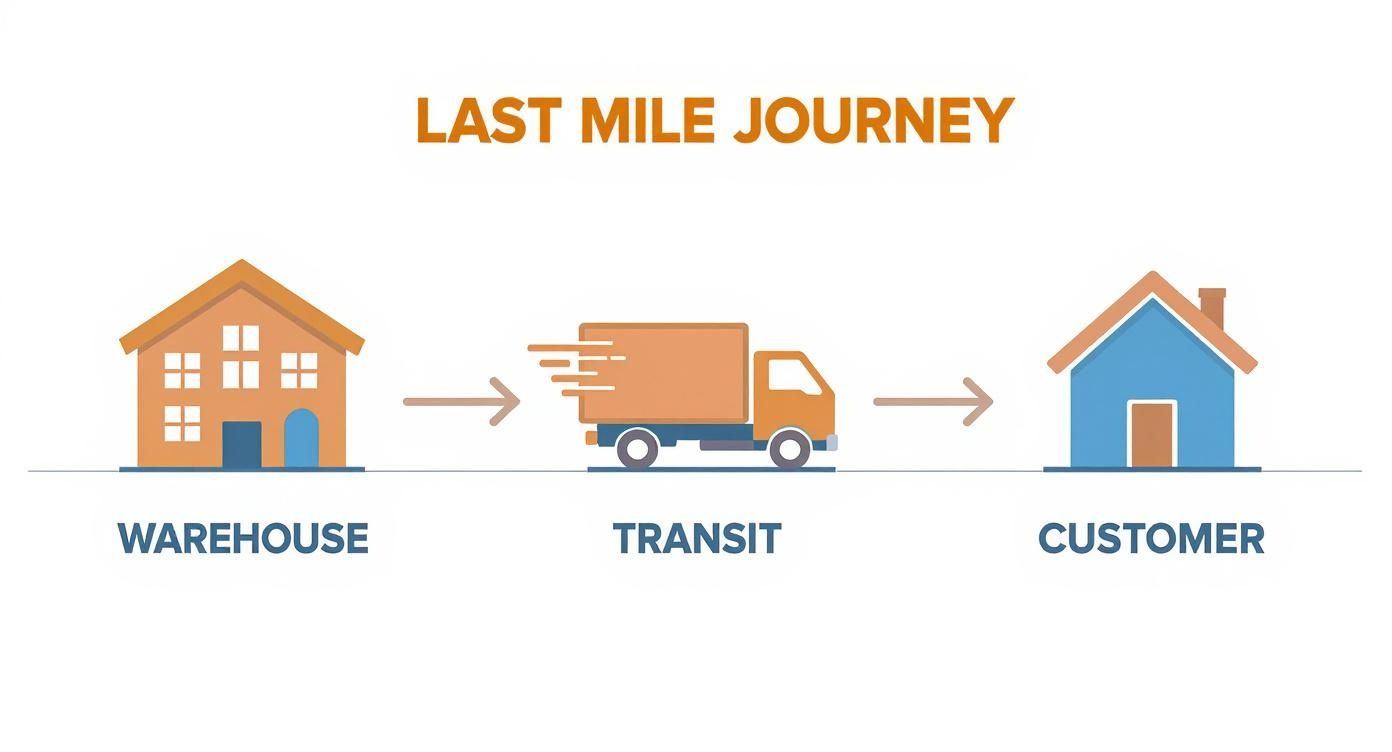
While the path seems straightforward, picking the right strategy for that “transit” step is where businesses either succeed or struggle. Let’s break down the main delivery models you can choose from.
To help you decide, here’s a quick comparison of the different models. Each one has its place, and understanding the trade-offs is the first step to making a smart choice for your brand.
| Delivery Model | Best For | Key Advantage | Main Challenge |
|---|---|---|---|
| In-House Fleet | Businesses with high, stable local volume needing total brand control (e.g., large grocers). | Complete control over the customer experience and branding. | Extremely high capital investment and ongoing operational costs. |
| Third-Party Couriers | Brands that ship nationwide and prioritise reliability and scale without upfront costs. | Access to established, large-scale delivery networks and technology. | Less direct control over the final delivery experience and branding. |
| Crowdsourced | Urgent, same-day, or hyperlocal deliveries; businesses with fluctuating demand. | Incredible speed and flexibility; scales up or down instantly. | Maintaining consistent service quality and professionalism. |
| Parcel Lockers | Urban-focused brands with non-perishable goods; customers who value security and flexibility. | Eliminates failed deliveries and reduces last-mile costs significantly. | Requires customers to travel to a pickup point. |
| Hybrid Model | Most businesses; allows for a mix-and-match approach based on order type and location. | Optimises both cost and customer experience by using the best tool for each job. | Requires more complex operational management and integration. |
As you can see, the best option depends on the specific situation. A hybrid approach often gives businesses the most flexibility to meet diverse customer needs effectively.
Running an in-house delivery model means you own and manage everything: the vans, the drivers, the software, and the entire process from start to finish. You have absolute control over the customer experience, from the driver’s uniform to the exact moment a package is handed over. This allows you to create a premium, branded experience that’s tough to replicate with outside partners.
But all that control comes at a steep price. You’re responsible for vehicle maintenance, fuel, driver salaries, insurance, and route planning software. It’s a huge capital investment that typically only makes sense for businesses with a very high and consistent stream of local deliveries, like a major grocery chain offering two-hour delivery slots.
For most e-commerce brands, partnering with established third-party logistics (3PL) providers or traditional couriers is the most practical choice. Companies like Ninja Van or J&T Express have massive networks, sophisticated tech, and the scale to handle huge volumes of packages efficiently. You can plug into their existing infrastructure without any heavy upfront investment.
This model is a fantastic fit for businesses that ship nationwide and need a reliable, professional service. The main trade-off? You give up some direct control over that final delivery moment. Your brand’s reputation is in another company’s hands, so it’s critical to pick a partner whose service quality matches your own high standards.
Crowdsourced delivery services, often called on-demand platforms, tap into a network of independent contractors who deliver packages using their own vehicles. Think of it as the Grab for parcels. This model delivers incredible flexibility and speed, making it perfect for urgent, same-day, or hyperlocal deliveries.
This model is especially powerful for businesses with unpredictable demand. You can scale your delivery capacity up or down instantly without the fixed costs of an in-house fleet or the rigid contracts of some larger couriers.
For instance, a small florist in Singapore can use a crowdsourced service to handle a massive surge of orders on Valentine’s Day without having to hire extra staff. The biggest challenge here is maintaining consistent service quality, since the driver pool isn’t directly employed by your business.
Automated parcel lockers are secure, self-service kiosks where customers can grab their packages whenever it’s convenient for them. This model is quickly gaining ground in dense urban areas like Singapore because it completely solves the problem of failed deliveries when a customer isn’t home.
This method is highly efficient and cost-effective for delivery providers, and those savings can be passed on to you. It gives customers flexibility, but it does mean they have to travel to a specific location. It works best for non-perishable goods and is a great option for businesses like electronics retailers whose customers value security and flexible pickup times more than doorstep delivery.
In reality, many businesses find that a hybrid model combining two or more of these options is the most effective strategy.
A national retailer might use a 3PL for standard nationwide shipping, an in-house fleet for premium white-glove service in major cities, and automated lockers as a convenient pickup option for customers near MRT stations. This approach lets a business match the delivery method to the specific needs of the customer and the order, optimising for both cost and experience.
Picking the right delivery model is a great start, but the real test comes in the daily execution of getting packages to doorsteps. Executing a flawless last mile is riddled with daily hurdles. These are serious challenges that can reduce your profits, tarnish your brand, and leave you with unhappy customers. Getting this right is what separates the e-commerce brands that thrive from those that get left behind.
The heart of the problem is that the final leg of the delivery journey is inefficient. You’re not moving a large shipment from one warehouse to another. Instead, you have many small vehicles making dozens of unique stops scattered across a wide area. This setup naturally creates bottlenecks that every business has to tackle.
Today’s customers want their orders fast, and their definition of “fast” keeps getting shorter. The days of waiting a week for a package are long gone. Now, the expectation is often same-day or next-day delivery, putting a huge strain on logistics networks built for a slower world.
Consumer expectations for last mile delivery services in Singapore have completely shifted, with an explosion in demand for instant options. Same-day delivery services now dominate the market, all driven by this powerful consumer desire for instant gratification. This trend, pushed hard by retail giants, has set a new, incredibly high bar for speed and reliability that everyone is now measured against. You can find more insights in the Asia-Pacific last mile delivery market report.
Trying to meet these demands means you need a highly responsive and agile operation, which is both tricky and expensive to run, especially during peak shopping seasons like 11.11 or Christmas.
The challenge isn’t just about speed; it’s about precision and communication. Customers now expect real-time tracking, accurate delivery windows, and proactive notifications. A failure to provide this transparency can be just as damaging as a late delivery.
The last mile is, without a doubt, the most expensive part of the entire shipping journey. It often accounts for more than half of your total logistics costs. A few key things drive this high price tag:
Even worse, a single failed delivery attempt can completely wipe out the profit margin on an order. If a customer isn’t home, the package has to go back to the hub, get stored, and be rescheduled for a second try—doubling the cost and effort for that one sale.
Handling returns, or “reverse logistics,” is another significant challenge. A smooth returns process is absolutely critical for customer satisfaction, but it adds another layer of operational complexity. You need a system to schedule pickups, inspect returned items, and process refunds or exchanges without delay.
This whole process has to be just as efficient as your outbound deliveries. A clunky or slow returns experience will frustrate customers and make them think twice before buying from you again.
Finally, there’s growing pressure from both shoppers and regulators to be more environmentally friendly. Customers are becoming more eco-conscious and are starting to choose brands that use electric vehicles (EVs) or sustainable packaging.
Making the switch to a greener fleet or optimising routes to cut down on carbon emissions is not only good for the planet; it’s becoming a key way to make your brand stand out. This change requires investment and careful planning, adding yet another strategic puzzle piece to the already complicated world of last mile delivery.
Knowing the challenges of last-mile delivery is one thing; actually fixing them is another. This is where you need practical, on-the-ground strategies that directly tackle your costs, efficiency, and—most importantly—your customer’s happiness.
By getting smarter with your tactics, you can turn this notoriously expensive final step from a major cost into a real competitive advantage. It’s all about working smarter, not just harder, to get those packages onto doorsteps.
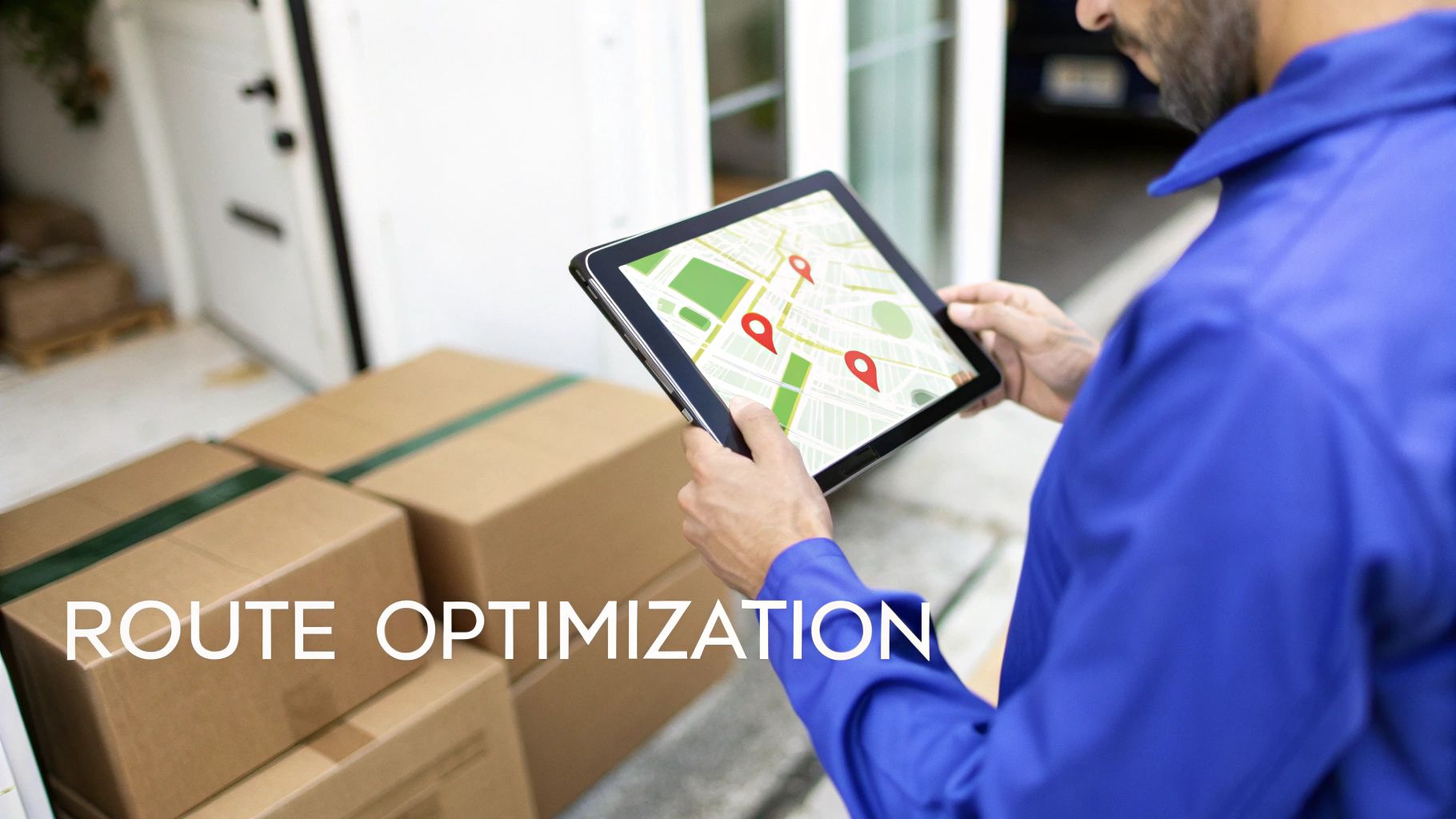
The goal here is to smooth out every part of the journey, from the moment a customer clicks “buy” to when they get that satisfying “delivered” notification. This means using tech to make better decisions, grouping orders logically, and keeping your customers in the loop from start to finish.
Think of modern route optimisation software as an intelligent GPS for your entire fleet. It doesn’t just find the shortest path from A to B. It crunches dozens of variables in real-time—like traffic, delivery windows, vehicle capacity, and driver availability—to map out the most efficient multi-stop route.
This is dynamic planning. If a sudden jam clogs up the PIE, the software can instantly reroute a driver to dodge the delay, saving precious time and fuel. That kind of agility is impossible with manual planning.
Actionable Insight: Start by using a free tool like Google Maps’ route planner for up to 10 stops to see the basic benefits. As you scale, invest in a dedicated software solution that integrates with your order system to automate the entire process, saving hours of manual work each day.
One of the simplest yet most powerful strategies is order batching. This is the practice of grouping multiple orders that are geographically close into a single delivery run. Instead of sending a driver out to one neighbourhood for one package, you hold off until a few more orders for that area come in and send them all out together.
This tactic dramatically increases drop density, meaning your driver gets more deliveries done in less time and with less driving. For instance, a driver heading to a large condo complex could drop off five packages in one stop instead of making five separate trips. This significantly reduces the per-parcel delivery cost.
To do this well, a solid order management system is your best friend, helping you spot and group these orders automatically.
When you’re working with third-party delivery partners, you need a clear rulebook. That’s where a Service Level Agreement (SLA) comes in. It’s a formal contract that lays out specific, measurable standards for performance.
An effective SLA doesn’t just say “deliver on time.” It gets specific. For example: “98% of all deliveries must be completed within the promised 2-hour window” or “Failed delivery attempts must not exceed 2% of total volume.”
This document should cover all the crucial parts of your last mile delivery services:
An SLA removes ambiguity. It holds your partners accountable and makes sure their service quality lines up with the promise you’ve made to your customers.
One of the biggest sources of customer anxiety is the lack of information after checkout. Proactive communication is the solution. Instead of making your customer ask, “Where is my order?”, you should be pushing updates to them at every key milestone.
This means sending automated notifications through SMS or email for:
This constant stream of information creates a better customer experience and also drastically cuts down on failed deliveries. When a customer knows their package is arriving between 2 PM and 3 PM, they’re much more likely to be home to receive it.
Choosing your last-mile delivery partner is one of the most critical decisions you’ll make. You’re handing over a huge part of your customer experience to another company, and that directly shapes your brand reputation.
A great partner feels like a seamless extension of your own team. A poor one can create headaches, frustrate your customers, and ultimately drive them away. To get it right, you need to look beyond the cost per parcel and dig into how they operate, the technology they use, and if they can truly deliver on their promises.
In today’s world, a delivery partner is only as good as its technology. Their tech stack is the brain of their entire operation, and it must integrate with your systems. The last thing you need is a partner that forces you into manual spreadsheets and phone calls.
The non-negotiable here is a solid, well-documented API. This is what allows your e-commerce platform or order management system to talk directly to theirs, automating everything from booking a delivery to getting live tracking updates. Ask them directly: can your system integrate with ours? If the connection isn’t seamless, your operations will suffer.
Your customers crave choice. A one-size-fits-all delivery timeline no longer works. A good partner will understand this and offer a menu of options that match what your customers expect.
Look for a clear range of services:
This kind of flexibility is a game-changer. It lets you offer premium shipping tiers at checkout, which is a proven way to boost conversions and satisfy customers.
A partner’s ability to scale is just as critical as their speed. Question them about their capacity during peak seasons like 11.11 or Christmas. A provider that performs well in August but collapses under pressure in November is a significant liability to your business.
A delivery partner might promise the world, but they’re useless if they can’t actually get to your customers. Always verify their geographic coverage. Make sure they can deliver to all the areas your customers live in, not just the easy-to-reach city centres. Ask for detailed maps or postal code lists to see exactly where their network extends.
Just as important is their reputation. Don’t be swayed by glossy marketing brochures. Do your homework. Look for online reviews, ask for case studies from businesses like yours, and request references you can actually talk to. A solid track record of reliability and positive feedback is the best proof you’ll get.
For more tips on vetting potential partners, check out our resources on 3PL services. And remember, transparent pricing without hidden surcharges is another massive sign of a partner you can trust.
Diving into the world of last mile delivery services can feel overwhelming. You’re trying to manage costs, keep up with the big players, and figure out which tech is actually worth the investment. It’s a lot to juggle.
Let’s clear the air and tackle some of the most common questions we hear from businesses just like yours.
Hands down, it’s labour.
Warehouses have robots and automation, but that final stretch to the customer’s doorstep still needs a real person in a real vehicle. That person—your driver—has wages, benefits, and a limited amount of time in their day.
Every minute a driver spends sitting in traffic, hunting for a parking spot, or buzzing multiple units to find the right recipient is a direct cost to your business.
While you definitely need to budget for fuel, vehicle upkeep, and software, they are all secondary. For most last mile operations, labour easily makes up over 60% of the total cost for each delivery. This makes your drivers’ efficiency the most critical thing to get right.
This is also why failed deliveries are so damaging to your bottom line. You pay the driver for their time, only for them to bring the package back. Then you have to pay them again to re-deliver it, instantly doubling your labour cost for that one order.
It’s easy to feel like you can’t compete with the free, same-day shipping promises from e-commerce giants. The trick is to be smarter and more strategic with your approach.
Your biggest advantage is flexibility. Instead of sinking cash into your own fleet, you can mix and match services to create a great experience for your customers.
Actionable Insight: Be upfront about your shipping fees. Most customers are willing to pay for delivery if the service is reliable and the costs are clear at checkout. You can also set a free shipping threshold (e.g., “Free shipping on orders over $50”) to encourage customers toward a larger basket size, which helps you absorb the delivery cost.
Technology is the brain of any modern delivery operation. It’s what transforms last mile logistics from a chaotic process into a smooth, efficient machine. It’s about using data to make better decisions every step of the way.
Take route optimisation software, for example. This calculates the most efficient route by factoring in live traffic, specific delivery time windows, vehicle capacity, and even things like avoiding left turns in heavy traffic. This alone can slash fuel costs and drive time by up to 30%.
Beyond just planning the route, technology provides crucial visibility for everyone.
Essentially, technology is the glue that holds everything together, ensuring information flows seamlessly from your inventory system right to the customer’s front door.
Returns, or “reverse logistics,” are just as crucial as getting the package out the door. A difficult or slow returns process can discourage a customer from ever buying from you again. Your goal should be to make it completely painless.
First, have a simple, clear returns policy that’s easy to find on your website. Avoid jargon, confusing rules, and short return windows.
Next, give customers convenient ways to send things back.
Actionable Insight: Use the return as a data-gathering opportunity. When a customer starts a return on your website, ask them to select a reason from a simple dropdown menu (e.g., “Wrong size,” “Item not as expected”). This feedback is pure gold for improving your products and making your online descriptions more accurate.
Managing all these moving parts—from orders pouring in across multiple sales channels to coordinating different delivery partners—can be a real headache. OneCart brings your entire e-commerce operation into a single, powerful platform, centralising your orders, inventory, and shipping workflows. Stop juggling dozens of browser tabs and start scaling your business with clarity and confidence.
Learn more and see how OneCart can transform your operations at https://www.getonecart.com.
Automate & Scale Your Online Business with OneCart
Start a Free TrialUsed by hundreds of merchants in Singapore & Southeast Asia