Mastering Inventory Management Techniques for Ecommerce Growth 2026
Discover essential inventory management techniques to prevent overselling, boost profits, and scale your ecommerce business. Get actionable tips for 2026.
Discover essential inventory management techniques to prevent overselling, boost profits, and scale your ecommerce business. Get actionable tips for 2026.
Inventory management techniques are the different methods you can use to organize, track, and control your stock. These range from straightforward approaches like First-In, First-Out (FIFO) to more complex systems like Just-In-Time (JIT). The goal is always the same: find that balance between holding costs, meeting customer demand, and maximizing your profit.
For any ecommerce business, managing inventory is a critical function. This is especially true if you’re juggling sales across multiple channels like Shopee, Lazada, and your own Shopify store. Without a solid system, you’re inviting common but costly mistakes: overselling during a flash sale, tying up cash in products that just won’t move, or running out of a bestseller.
Good inventory management techniques stop these problems before they start. They turn your stock from a potential headache into one of your most powerful assets for growth.
The market proves how crucial this is. The global inventory management software market is expected to jump from USD 2.76 billion in 2025 to USD 4.14 billion by 2031. A huge driver of this growth is cloud-based systems, which now hold a 61.20% market share. They offer the real-time syncing needed to prevent overselling across multiple channels.
Think of your inventory like water in a reservoir. Too little, and you can’t meet demand. Too much, and it gets stagnant and expensive to maintain. The right techniques ensure the flow is just right.
Putting a structured approach in place moves you out of reactive firefighting mode and into proactive, strategic decision-making. The advantages are almost immediate.
Here are the key benefits you’ll see:
Our comprehensive guide on retail inventory management offers more high-level strategies to get your stock under control. This article builds on those concepts, breaking down the most essential techniques you can start using today.
Getting a grip on inventory management means understanding the real-world methods that keep your stock moving and your cash flow healthy. These are practical tools you can use every day to boost your profits and keep customers coming back.
Let’s walk through the core techniques every ecommerce seller should have in their toolkit.
This flowchart gives you a quick way to think about which technique fits your business best.
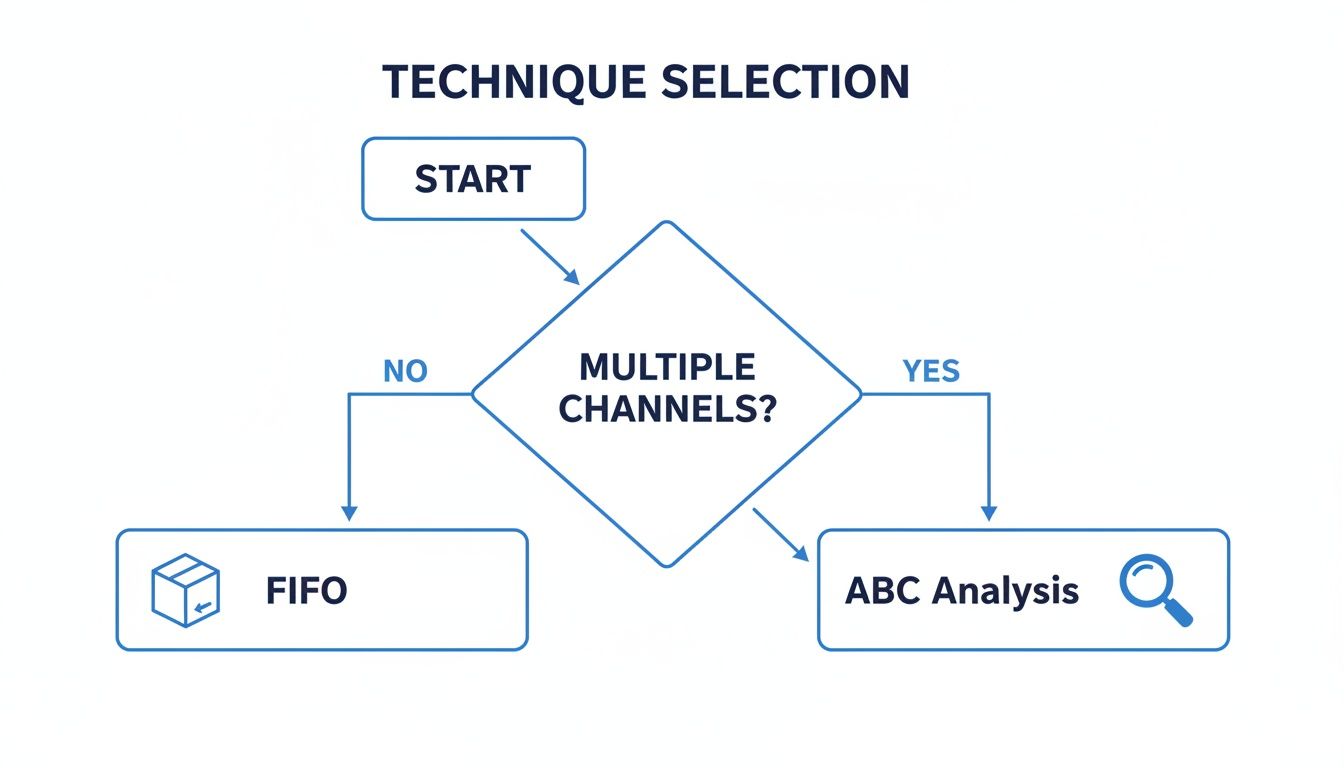
As you can see, if you’re juggling multiple sales channels, ABC Analysis is often the smartest move. For single-channel sellers, FIFO is a powerful and straightforward place to start.
The First-In, First-Out (FIFO) method is intuitive. Picture a grocery store stocking milk. The oldest cartons always go to the front so they sell first, cutting down on spoilage and waste.
For an ecommerce store, this just means you sell the inventory that arrived in your warehouse first. This approach is essential for any business dealing with products that have a shelf life or follow seasonal trends.
Practical Example: A cosmetics brand selling face creams with a two-year expiry date lives by FIFO. By shipping the oldest batches first, they make sure customers get products with the longest possible shelf life. This simple habit prevents them from having to write off a ton of expired, unsellable stock.
Actionable Insight: Organize your warehouse shelves so new stock goes in the back and old stock is pulled from the front. If you use bins, label them with the “received date” so your pickers always grab the oldest items first.
On the flip side, the Last-In, First-Out (LIFO) method works by selling the most recently acquired inventory first. It’s far less common in ecommerce because it’s a poor choice for perishable goods; it guarantees your oldest stock will just sit there.
So, when would you ever use LIFO? It’s mainly a tool for businesses with non-perishable goods, especially when inflation is high. By selling the newest—and likely most expensive—stock first, the cost of goods sold (COGS) reported is higher. In some regions, this can lead to a lower stated profit and a smaller tax bill.
Practical Example: A hardware store selling bulk items like nails or screws could find LIFO useful. These products don’t expire, and their costs tend to creep up over time. Selling the newest stock first matches today’s revenue with today’s costs, giving a more accurate snapshot of current profit margins.
Once your business starts growing and your product catalog gets bigger, you’ll quickly realize that not all products are created equal. This is where ABC Analysis comes in—it’s a game-changer for prioritizing your inventory.
Think of ABC Analysis like organizing your toolbox. You keep the tools you use all the time—your hammer and screwdriver—in the top tray for easy access. These are your ‘A’ items. The less-used tools go in the middle (‘B’ items), and those specialty tools you touch once a year are at the very bottom (‘C’ items).
This method helps you pour your time, money, and energy where they’ll make the biggest difference. The categories usually break down like this:
‘A’ Items: These are your rockstars. They represent a small slice of your total inventory (around 20%) but pull in the lion’s share of your revenue (about 80%). These products need your full attention with tight monitoring and frequent reordering.
‘B’ Items: These are your solid, middle-of-the-road products. They make up roughly 30% of your inventory and contribute around 15% of your revenue. They need regular check-ins, but not the obsessive watchfulness of your ‘A’ items.
‘C’ Items: These are the slow-movers. They often make up the bulk of your physical inventory count (around 50%) but only generate about 5% of your total revenue. These items require the least amount of management.
Actionable Insight: Run a sales report for the last 12 months. Sort your products by total revenue generated. The top 20% are your ‘A’ items. Apply stricter reorder rules and more frequent stock counts to them immediately. For ‘C’ items, consider bundling them or running a clearance sale to free up cash and space.
Once you’ve got the basics down, you can layer in more advanced strategies. These methods protect your business from sudden market shifts and help you stay agile and profitable.
One of the most well-known advanced methods is Just-In-Time (JIT) inventory. This approach involves ordering and receiving products from suppliers only as you need them to fulfill customer orders.
The main upside is a massive drop in holding costs. You aren’t paying to store, insure, and manage products that are just sitting on a shelf. But JIT is demanding. It requires an exceptionally reliable and speedy supply chain. If your supplier is even a day late, you’re looking at stockouts and unhappy customers.
Practical Example: A print-on-demand t-shirt business is a perfect JIT model. They hold zero finished shirts. When a customer orders a specific design and size, the order gets sent to a printing partner, who produces and ships the item directly. This completely wipes out the risk of getting stuck with a mountain of unsold, unpopular designs.
While JIT is powerful, it’s not for every business. For most e-commerce sellers, a more balanced approach involves using Safety Stock and Reorder Points. This is one of the most effective inventory management techniques for preventing lost sales.
Safety stock is that small, extra buffer of inventory you keep on hand to protect you from an unexpected surge in demand or a supplier delay. It’s your emergency reserve.
The reorder point is the specific stock level that triggers a new purchase order. Once your inventory for an item hits this number, you know it’s time to restock—before you have to start dipping into your safety buffer.
Practical Example: Let’s say you sell an average of 10 units of a product per day, and your supplier’s lead time is 7 days. Your reorder point would be 70 units (10 units x 7 days). To be safe, you decide to hold 3 days’ worth of sales as safety stock, which is 30 units. So, you place a new order when you have 100 units left (70 for lead time + 30 for safety). This ensures you can handle a small sales spike or a 3-day shipping delay without stocking out.
Figuring out these levels involves looking at your average daily sales and your supplier’s lead time. To go deeper into the specific formulas for preventing stockouts, you can explore our safety stock formula guide and safety stock calculator to fine-tune the whole process.
The most forward-thinking inventory management technique is Demand Forecasting. This is where you use historical data and market trends to make educated predictions about what your customers will want in the future. Instead of just reacting to sales, you start anticipating them.
Practical Example: If you sell outdoor gear, you can analyze last year’s sales data. You might find that sales of hiking boots spiked by 40% in April. Based on this, you can plan to increase your stock of hiking boots in March of this year to meet the anticipated demand, preventing stockouts during your peak season.
This is where technology, especially artificial intelligence, is making a huge difference. AI-powered tools can analyze complex patterns that are impossible for a human to spot. They look at historical sales, current market trends, competitor pricing, and even outside factors like weather patterns or upcoming holidays to generate shockingly accurate forecasts.
The adoption of this tech is exploding. AI use in inventory management shot up from 23% in 2024 to 48% in 2025 among small and medium-sized businesses. These same businesses are now nearly doubling their investment plans in AI, with 49% planning future adoption. AI helps slash forecast errors and gives you the real-time visibility needed to prevent overselling, especially during massive sales events. As a result, the global inventory optimization market is projected to hit USD 12.42 billion by 2032.

Picking the right inventory techniques is a great start, but you can’t know if your strategies are actually working unless you measure their impact with data. Key Performance Indicators (KPIs) give you a real-time read on the health and efficiency of your entire inventory operation.
Tracking these numbers helps you catch problems before they spiral, pinpoint your most profitable products, and make smart, data-driven decisions that fuel real growth.
One of the first metrics you need to get a handle on is your Inventory Turnover Rate. This KPI tells you how many times you sell through and replace your entire inventory over a set period, usually a year. It’s a direct gauge of how quickly your products are moving.
A high turnover rate usually feels good—it means strong sales and fresh stock. But if it gets too high, it might be a warning sign that you’re constantly under-stocking and selling out. On the flip side, a low rate is a red flag that you have too much cash stuck in products that are just sitting there.
Actionable Insight: Calculate your turnover by dividing your Cost of Goods Sold (COGS) by your average inventory value. If your annual COGS is $500,000 and your average inventory is valued at $100,000, your turnover rate is 5. That means you sold through your entire stock five times last year. Compare this rate across different products to see which ones are moving fastest and which are lagging.
To get an even more practical view, you can translate this into days. Check out our guide on the inventory turnover ratio in days to see exactly how long your stock typically sits around before it sells.
While turnover tells you about speed, Gross Margin Return on Investment (GMROI) tells you about profitability. This powerful KPI answers one crucial question: for every dollar you tie up in inventory, how many dollars in gross profit are you getting back?
If your GMROI is above 1.0, you’re making money on that inventory investment. If it’s below 1.0, you’re losing money. This metric is essential for figuring out the true financial performance of your product lines.
Practical Example: Let’s say you sell a specific line of sneakers.
$40,000 (Gross Profit) / $10,000 (Average Inventory Cost) = 4.0A GMROI of 4.0 is fantastic. It means for every single dollar you invested in sneaker inventory, you made $4.00 in gross profit. That’s a product line worth doubling down on. If another product has a GMROI of 0.8, it’s time to consider discontinuing it or finding a way to improve its margin.
The Stock-to-Sales Ratio helps you find the balance between the inventory you’re holding and the sales you’re making. It’s calculated monthly by comparing the value of your inventory at the start of the month to the sales you generated during that same month.
This KPI is particularly helpful for managing cash flow and avoiding overstocking. A ratio that’s climbing too high is a clear signal that you have excess inventory that isn’t moving nearly fast enough.
This is becoming more critical as e-commerce explodes. Retail and e-commerce are expected to dominate inventory optimization with a 27.3% market share in 2025, all driven by the massive need for flawless multi-channel inventory sync. With the overall inventory management software market projected to grow from USD 3.85 billion in 2025 to USD 8.94 billion by 2033, keeping a close eye on metrics like this is a requirement for survival. You can dive deeper into these inventory optimization market trends on coherentmarketinsights.com.
Trying to manually apply techniques like ABC analysis and demand forecasting across multiple channels is a recipe for disaster. As your business grows, the sheer volume of data and the speed needed to prevent overselling quickly become overwhelming. This is where a centralized automation platform becomes essential for multi-channel e-commerce.
Imagine a single, unified dashboard where your inventory syncs in real-time across all your online stores. When a customer buys a product on Lazada, the stock level is instantly updated on Shopify and TikTok Shop. This immediate synchronization crushes the risk of overselling, protecting your brand’s reputation and your bottom line during flash sales and peak seasons.
Automation does more than just pool your stock together; it actively helps you execute your inventory management techniques with greater accuracy and less manual effort. Smart analytics tools crunch massive amounts of sales data, giving you the precise numbers you need for effective demand forecasting and ABC analysis without ever touching a spreadsheet.
A centralized platform also completely transforms your warehouse operations. Instead of logging into five different seller centers to download orders, you can generate a single, unified picking and packing list for every order across all channels. This simple change drastically reduces errors and speeds up fulfillment. You can learn more about how this impacts your entire process by exploring our guide to a multi-channel order management system.
Here’s what a unified inventory dashboard looks like in action, giving you a complete overview of your stock across all sales platforms.
This single screen provides at-a-glance visibility, turning complex data from multiple sources into actionable intelligence you can use to make quick decisions.
Beyond just syncing inventory, automation brings powerful efficiencies to your entire fulfillment workflow. When you centralize inventory, improving your ecommerce order processing is the key to maximizing those gains and getting orders out the door faster.
Centralized automation acts as the central nervous system for your e-commerce operation. It takes in signals from all your channels and coordinates a fast, accurate response without you having to manually direct every action.
Think about all the time spent on repetitive tasks. With the right platform, you can bulk print hundreds of shipping documents—like airway bills and invoices—with a single click. This frees up your team to focus on packing orders and helping customers instead of getting bogged down in administrative work.
Finally, automation provides the accountability you need to maintain control as your business scales. Key features to look for include:
Even with the best inventory management techniques, a few simple mistakes can unravel all your hard work. Avoiding these common traps is just as critical as picking the right strategy. Think of this as a checklist for building a more resilient and efficient inventory system.
One of the most frequent—and damaging—errors is plain old inaccurate data entry. A single typo when you’re receiving a new shipment or pulling an order can throw your entire stock count into chaos. This one mistake creates a ripple effect, leading to phantom stock, accidental overselling, and frustrated customers.
Actionable Insight: The most effective fix is to use barcode scanners for receiving, picking, and packing. Every scan updates your central system instantly, which drastically cuts down on human error and ensures your data is reliable. If you can’t implement scanners yet, institute a two-person verification process for receiving new shipments.
Another huge pitfall is failing to account for seasonality and shifting trends. Many businesses get stuck with a warehouse full of unsold goods because they overstocked just as demand was about to fall off a cliff. All that does is tie up your cash in dead stock and waste valuable shelf space.
Actionable Insight: Use demand forecasting tools to stay ahead of the curve. Analyze your historical sales data to spot predictable seasonal spikes and dips. This lets you stock up before a busy period and start trimming down inventory as the season winds down, keeping your stock lean and profitable.
Your inventory system is only as strong as your supply chain. Poor communication and a lack of real collaboration with your suppliers can lead to unexpected delays, sudden price hikes, and inconsistent product quality. A supplier who doesn’t give you a heads-up about a production issue can leave you completely unable to fulfill orders.
Strengthening these relationships is absolutely crucial. You need to keep your suppliers in the loop with your forecasts and promotional plans. This helps them prepare on their end and gives you a much better chance of getting priority service when issues arise.
Actionable Insight: Schedule regular check-ins with your key suppliers. Go beyond just placing orders; talk to them about performance, potential challenges, and opportunities to improve. A strong partnership is built on consistent communication, and that can be a real lifesaver during unexpected disruptions.
When you start digging into inventory management, a lot of questions pop up. Here are some of the most common queries.
For most small ecommerce businesses, a combination of ABC Analysis with Safety Stock and Reorder Points provides the most value without being overly complex.
Start with ABC analysis to figure out which products are your money-makers (your ‘A’ items). Then, set up a safety stock level and a reorder point just for those key items. This helps prevent stockouts of your bestsellers and gives you a clear trigger for when to order more, protecting you from both unexpected sales spikes and supplier delays.
Instead of a massive, disruptive annual count, a much better practice is to use cycle counting. This just means checking small, manageable portions of your inventory on a daily or weekly basis.
Practical Example: You could count your high-value ‘A’ items every month, your mid-tier ‘B’ items quarterly, and your slow-moving ‘C’ items just twice a year. This method is far less disruptive, improves your stock accuracy over time, and helps you spot and fix discrepancies way faster.
Absolutely. The most resilient businesses build a hybrid system that’s tailored to their specific products.
A great way to do this is to layer them:
The goal is to create a flexible system that matches the unique demands of your products and supply chain.
Ready to stop overselling and get your inventory under control? OneCart centralizes your inventory across Shopee, Lazada, TikTok Shop, and Shopify, syncing stock in seconds. Process all your orders from one dashboard and reclaim hours of your day. See how it works at https://www.getonecart.com.
Automate & Scale Your Online Business with OneCart
Start a Free TrialUsed by hundreds of merchants in Singapore & Southeast Asia