Inventory Management System Singapore: Centralize Stock & Prevent Overselling 2026
inventory management system singapore centralizes stock across marketplaces like Shopee and Lazada, prevents overselling, and helps you grow.
inventory management system singapore centralizes stock across marketplaces like Shopee and Lazada, prevents overselling, and helps you grow.
It’s 11.11, the biggest sale of the year. Your Shopee, Lazada, and TikTok Shop accounts are lighting up with orders. It’s the dream, right?
For too many Singapore sellers, this dream quickly turns into a logistical nightmare. Without a single, central hub to track your stock, you’re stuck frantically jumping between seller centres, manually updating spreadsheets. This is how overselling happens, leading to angry customers, platform penalties, and a real hit to your bottom line.
Selling across multiple online marketplaces is a brilliant way to reach more customers in Singapore. But as your business scales, the simple methods that worked when you had 10 orders a day completely fall apart at 100 orders a day, creating absolute chaos behind the scenes.
This chaos isn’t just stressful—it costs you real money. Every time you oversell an item, you’re dealing with negative reviews and the operational headache of cancelling orders. Every typo in your spreadsheet could mean shipping the wrong product, leading to costly returns and a damaged reputation.
When you’re starting out, a spreadsheet feels like the logical choice for tracking inventory. It’s free and everyone knows how to use one. But it doesn’t take long for that simple tool to become your biggest liability.
Spreadsheets are completely disconnected from the real-time world of e-commerce. They need constant manual updates, making them a breeding ground for human error.
Practical Example: A spreadsheet can’t tell you that the last piece of an item just sold on Lazada a split second before another customer adds it to their cart on Shopee. That tiny delay is where the most expensive mistakes are made, especially during a flash sale.
Singapore’s e-commerce market is set to hit US$11 billion by 2025, and the pressure on sellers is immense. During massive sales events like 11.11, where Shopee alone grabbed a 48% market share, businesses relying on manual tracking can see error rates as high as 15-20%. This is exactly why a proper inventory management system for Singapore sellers is a necessity for growth.
The damage goes far beyond the direct financial loss from mistakes. Think about the sheer number of hours your team wastes on repetitive, mind-numbing tasks:
This is all time that could be invested in marketing, improving customer service, or finding your next bestselling product.
Actionable Insight: An inventory management system automates all of it. It turns your frantic, error-prone fulfilment process into a smooth, efficient, and profitable operation—giving you the solid foundation you need to scale your business.
Think of an inventory management system as the central nervous system for your entire e-commerce business. It’s the single, intelligent hub that connects all your separate sales channels—like your Shopee, Lazada, and Shopify stores—so they can finally talk to each other. This central system becomes your single source of truth for stock, getting rid of the guesswork and frantic manual updates that cause so much trouble.
So, when an item sells on one platform, the system gets a signal and instantly tells every other channel to update their stock levels. It’s this real-time communication that stops you from accidentally selling that last T-shirt to two different customers on two different marketplaces.
This diagram shows you exactly how a central system stops the chaos of multi-channel selling by linking up marketplaces like Shopee, Lazada, and TikTok.
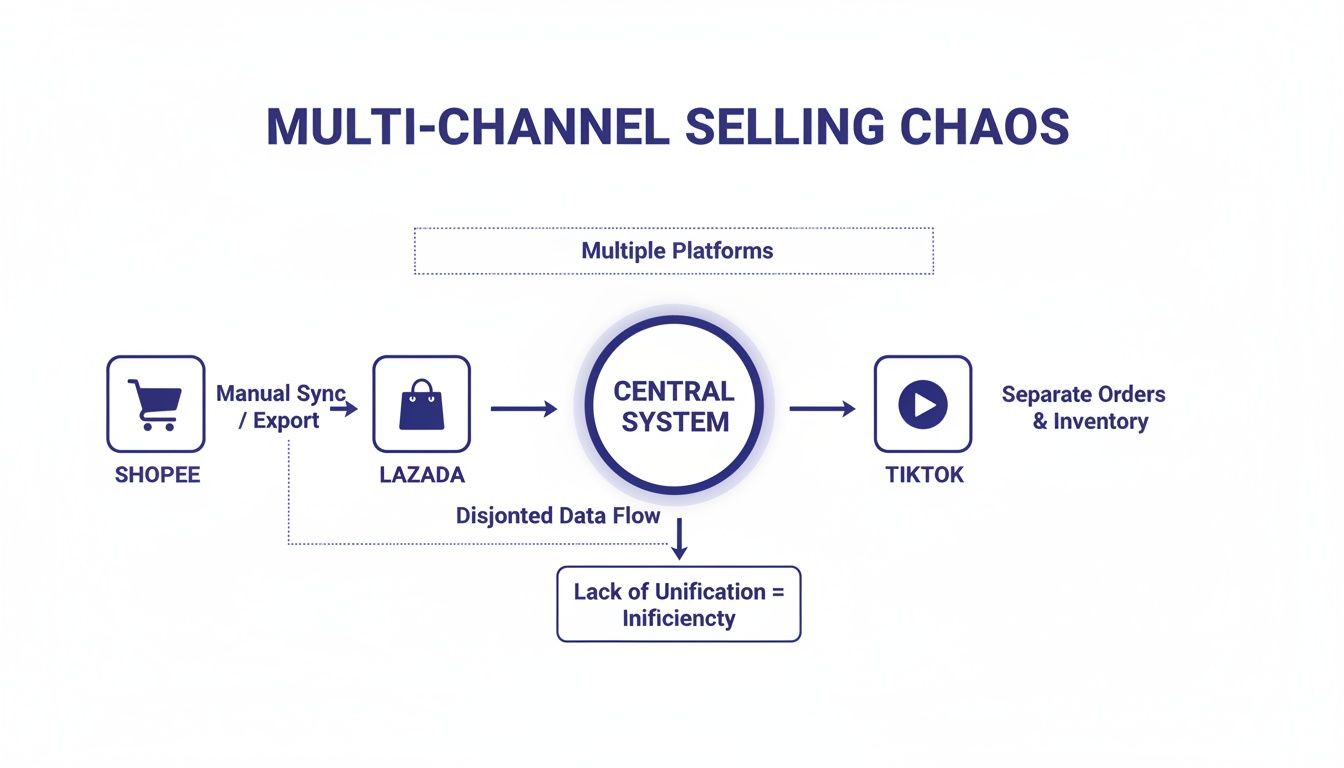
The key takeaway is pretty simple: without this hub, each channel is on its own island. This creates delays and mistakes that lead straight to overselling and unhappy customers.
Let’s say you run a small business in Singapore selling phone cases. You have 10 units of a popular “Merlion Series” case, and you list it on Lazada, Shopee, and TikTok Shop.
Without a system, if you sell one case on Lazada, you’d have to scramble to log into both Shopee and TikTok Shop to manually reduce their stock counts to nine. Good luck doing that during a flash sale—it’s nearly impossible, and overselling is pretty much guaranteed.
Now, let’s see how an inventory management system changes the game:
This instant, automated adjustment means another customer can’t accidentally buy that same out-of-stock case somewhere else. It’s a simple function that has a massive impact on your day-to-day operations. This is the core idea behind a perpetual inventory system, which you can learn more about in our detailed guide.
While real-time sync is the main event, the benefits don’t stop there. It frees up your valuable time, letting you focus on actually growing your business instead of getting stuck in the weeds of repetitive data entry.
Actionable Insight: The system doesn’t just track what’s sold; it gives you a complete, real-time picture of what you own and where it is. This visibility is crucial for making smart decisions about purchasing, marketing, and expansion.
With cross-border e-commerce making up a whopping 55% of online purchases in Singapore and social commerce set to hit USD 3.17 billion by 2025, real-time inventory control is essential. Spreadsheets simply can’t keep up, and it’s reported that 25% of Singapore SMEs face stockouts during peak sales periods. This is exactly where an inventory management system in Singapore becomes a critical tool for survival and growth.
When you’re hunting for the right inventory management system in Singapore, you need to zero in on features that tackle the real, everyday headaches of selling on platforms like Shopee, Lazada, and TikTok Shop. It’s about finding tools that genuinely save you time, stop you from making expensive mistakes, and let you grow without piling on more manual work.
Let’s break down the absolute must-haves.
This is the big one. If you only look for one feature, make it this.
Picture this: you have five units left of a popular product. Someone buys one on Shopee. A proper system will instantly slash the available stock to four on your Lazada, TikTok Shop, and Shopify stores. We’re talking seconds, not minutes.
This real-time sync is your best line of defence against overselling, a massive pain point for anyone juggling multiple channels. If you want to dive deeper, we’ve got a great guide on the 10 ways to prevent overselling in ecommerce without manual hassle. Without this, you’re still basically running on a manual system, just with a prettier interface.
Practical Example: During a 12.12 flash sale, a customer snags your last Bluetooth speaker on Lazada. A solid system immediately pulls that stock from every other channel. But a slow one might take five minutes to catch up—just enough time for another shopper to buy that same sold-out item on Shopee. Now you’re stuck cancelling an order and dealing with an unhappy customer.
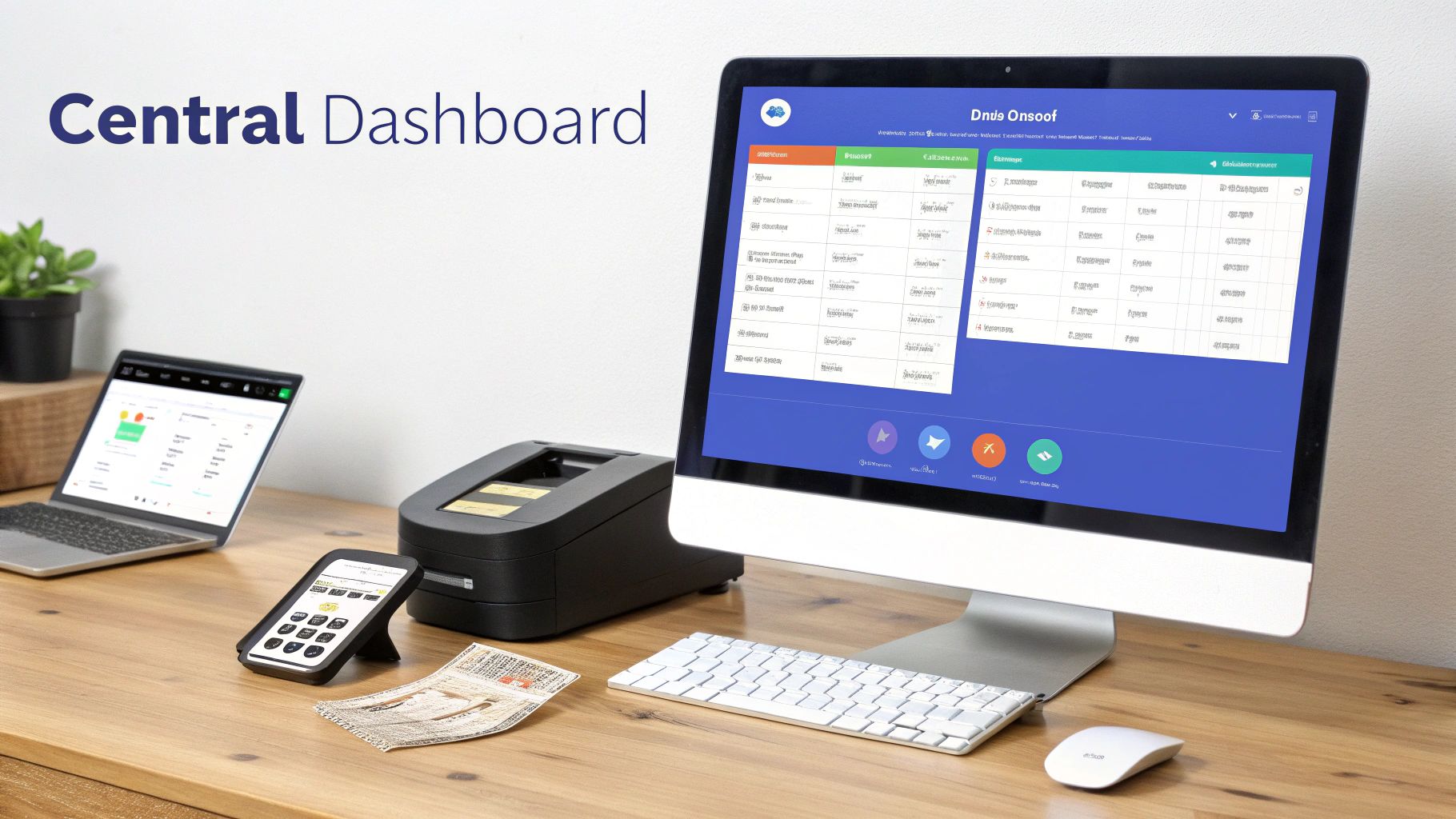
Constantly jumping between different seller centres to manage orders is a colossal waste of time. A centralised dashboard is a game-changer, pulling all your orders from every single channel into one clean, unified view. Your team can see, process, and ship every order without ever leaving the system.
Actionable Insight: This single screen becomes your command centre for fulfilment. You can filter orders by their status (like “To Ship” or “Pending”), by marketplace, or even by specific products. This kind of organisation is crucial for getting orders out the door quickly and accurately, especially when the sales start flooding in.
Processing orders one by one just won’t cut it as you grow. You need tools that let you handle tasks in bulk. This is where a good inventory management system pays for itself, turning hours of mind-numbing work into a few simple clicks.
Look for these key bulk actions:
The Singaporean e-commerce logistics market is on track to hit USD 309.6 billion by 2033, and with platforms like TikTok Shop reaching USD 16.3 billion in GMV in 2023, the competition is intense. Sticking to manual fulfilment can lead to 20-30% delays. For any SME handling over 50 orders a day, an inventory management system in Singapore that can generate picking lists and handle bulk printing is absolutely essential. You can find more insights on the growing Singapore e-commerce market on imarcgroup.com.
Listing a new product across all your channels is another one of those repetitive tasks begging for automation. A product cross-posting (or “listing”) feature lets you build a product profile once and then push it live to all your marketplaces at the same time.
Practical Example: Instead of spending an hour uploading images, writing descriptions, and setting prices on Shopee, then doing it all over again for Lazada, you do it just once. The system takes care of the rest, ensuring everything is consistent and saving you a huge chunk of time.
This feature is a lifesaver when you’re launching a new collection or just expanding your product range. It helps you get your products in front of customers faster and with way less effort.
To help you vet different systems, here’s a handy checklist based on these core features.
Use this table to evaluate potential systems and make sure they have what it takes to support a Singapore-based, multi-channel seller like you.
| Essential Feature | Why It’s Critical for Singapore Sellers | Example Solution |
|---|---|---|
| Real-Time Inventory Sync | Prevents overselling during major sales events like 11.11 or 12.12 across Shopee, Lazada, and TikTok Shop, which can lead to penalties and bad reviews. | When a product sells on Lazada, the stock count is instantly updated across all other connected channels within seconds. |
| Centralised Order Dashboard | Consolidates orders from all marketplaces into one view, eliminating the need to log into multiple seller centres to process daily shipments. | Your team logs into one system to see all new orders from Shopee and TikTok Shop, then filters by “Ready to Ship” to start the fulfilment process. |
| Bulk Shipping & Fulfilment | Dramatically speeds up order processing by allowing bulk printing of shipping labels and generation of picklists, crucial for handling high volumes. | At the end of the day, select 100+ unshipped orders and print all airway bills with a single click, ready for the courier pickup. |
| Multi-Channel Product Listing | Saves hours of manual work by letting you create a product once and push it to all your stores simultaneously, ensuring consistent branding. | You create a new listing for a t-shirt and publish it to your Shopee, Lazada, and Shopify stores from one central product catalogue. |
| Local Courier Integration | Needs to work seamlessly with Singapore’s key logistics partners (like J&T Express, Ninja Van, SingPost) for automated booking and label generation. | The system automatically books a J&T Express pickup for all your fulfilled Shopee orders and generates the correct shipping labels. |
| Sales & Inventory Reporting | Provides clear data on what’s selling, where it’s selling, and when you need to reorder, helping you make smarter, data-backed business decisions. | Generate a report showing your top-selling products on TikTok Shop for the last 30 days to inform your next marketing campaign. |
Take your time with this checklist during demos and trial periods. Asking the right questions and seeing these features in action will help you find a partner that truly understands the unique challenges of selling in Singapore.
Choosing an inventory management system in Singapore is about finding a reliable partner for your business’s growth. The right provider should feel like an extension of your own operations team. The wrong one will create more headaches than it solves.
This decision requires looking beyond the price tag. You need to focus on what really matters in the local market: performance, reliability, and support.
It’s tempting to just go for the cheapest option, but that can be a seriously costly mistake. A low price often means hidden trade-offs like sluggish inventory updates, flaky marketplace integrations, or support that’s nowhere to be found when you desperately need it. These are the kinds of issues that can bring your entire operation to a grinding halt during a critical sales event like 11.11.
A much smarter way to go about it is to evaluate vendors based on a clear set of criteria that directly affects your ability to sell effectively in Singapore.
When you’re sitting down for a demo or a sales call, you’ve got to be ready with some sharp, specific questions. This is how you cut through all the marketing fluff and figure out if a system can actually handle the heat of your business.
Use this checklist to guide the conversation:
Asking these questions helps you build a complete picture of not just what the software does, but how it performs under real-world pressure.
Let’s play out a practical scenario. It really highlights why this evaluation is so critical.
Business A: The Price-Focused Choice A seller picks a system because it’s the cheapest one they can find. During the 9.9 sale, their inventory sync slows to a crawl, taking over five minutes to update. They end up overselling dozens of items, which leads to angry customers, cancelled orders, and a penalty from Shopee. When they try to contact support, they get an automated reply: “someone will respond within 24 hours.” Those initial savings are completely wiped out by lost sales and total operational chaos.
Business B: The Performance-Focused Choice Another seller invests in a slightly pricier system, but only after they’ve verified its sync speed is under five seconds and confirmed it has a dedicated Singapore-based support team. During the 9.9 sale, their stock levels update instantly, preventing any overselling. They run into a small issue with a new courier setting but get an immediate response from local support, who sorts it out in minutes. They have a record-breaking sales day and come out the other side with an even stronger brand reputation.
Actionable Insight: The difference is clear. Business B didn’t just buy software; they invested in operational stability and reliability. This is the heart of choosing the right inventory management system in Singapore—it’s an investment in your ability to scale smoothly and profitably.
A reliable system isn’t just an expense. It’s a foundational asset that protects your revenue and your customers’ trust, especially when the stakes are at their highest.
Taking on new software can feel like a massive task, but when you break it down into clear, manageable stages, the whole process becomes much more straightforward. A successful rollout of an inventory management system in Singapore is all about smart preparation and taking it one step at a time. This guide is your simple roadmap to get from setup to daily operations without throwing a wrench in your business.
The journey begins with organising your data. Think of it as laying a strong foundation for a house; without clean, solid data, even the best system will wobble.
The very first job is to clean up all your product information. This means making absolutely sure every single product variation has its own unique Stock Keeping Unit (SKU). A messy SKU list is the number one reason for sync errors down the line, so this step is non-negotiable.
Next up, you’ll need to do a complete physical stock count. Your new system needs an accurate number to start with if you want it to be effective. It’s a tedious job, for sure, but getting this right from day one will save you countless headaches later.
Actionable Tip: Don’t try to get your entire product catalogue onboarded at once. Start small. Pick your top 10 best-selling items and focus on them first. This lets you test the system, see some quick wins, and build momentum before rolling it out across your full product range.
Once your data is clean and your counts are verified, you’re ready for the fun part: connecting your sales channels.
Now it’s time to link your marketplaces and webstores to the new system. Most modern platforms have made this incredibly simple, often offering one-click integrations for major Singaporean channels like Shopee, Lazada, and Shopify.
Start by connecting just one channel. This lets you confirm that orders are flowing in correctly and stock levels are syncing exactly as they should. Once you’re confident everything is working perfectly on that first channel, you can move on to connecting the rest. This phased approach minimises risk and makes it so much easier to troubleshoot if any issues pop up.
Let’s walk through a real-world example:
With your data prepped and channels connected, the final piece of the puzzle is training your team. A system is only as good as the people using it, after all. Run dedicated training sessions for everyone involved in fulfilment, from the pick-and-pack crew to the folks handling customer service.
Make sure you focus on the key daily workflows:
Try to schedule your ‘go live’ day during a typically slower period. Definitely don’t do it right before a massive sales event like 11.11! This gives your team a chance to get comfortable with the new workflows under normal conditions.
Getting this foundation right will also set you up for success as you scale and begin using more advanced strategies. You can learn more about inventory forecasting for multiple channels in our detailed article.
So, you’re thinking about getting an inventory management system in Singapore. It’s a big step, and you’re probably asking yourself, “Is it really worth the money?” It’s a fair question. The payoff, or return on investment (ROI), comes from real, measurable savings in time and cold, hard cash—plus the ability to grow your business without pulling your hair out.
Let’s break down how this actually works. The most immediate win is getting your time back. All those manual tasks—updating stock levels on each platform, pulling together orders, fixing mistakes—they add up fast. We’re talking hours every single day that could be spent finding new products, marketing, or, you know, sleeping.
Let’s do some simple back-of-the-napkin maths. First, take a guess: how many hours a day does your team spend just on manual inventory and order busywork? Now, multiply that by their hourly wage. That’s your daily cost right there.
Simple Formula: (Hours Spent on Manual Tasks Per Day) x (Average Hourly Rate) x (Working Days Per Month) = Monthly Cost of Manual Work
A Practical Example: Imagine your team spends 3 hours every day just updating stock levels between your Shopee and Lazada stores. If your staff’s time is worth, say, $15 an hour, you’re spending $1,350 every month just to keep things in sync ($15/hr * 3 hrs/day * 30 days). A system that automates this puts that $1,350 straight back into your pocket, every single month.
Overselling is a killer. It does more than just disappoint a customer; it hits your wallet directly. You’ve got platform penalties to worry about, the cost of return shipping, and the hours your team wastes sorting out the mess. Each mistake is a tiny cut that bleeds your profit margins dry.
Actionable Insight: A good inventory management system is a lifesaver. By syncing your stock in real-time, it stops you from selling items you don’t actually have. This protects your revenue and, just as importantly, your seller rating on those hyper-competitive marketplaces.
This is the big one. The most powerful ROI comes from being able to scale. Automation lets you handle a massive spike in orders without having to hire a bunch of new people. The system does the heavy lifting, allowing your current team to manage five, or even ten times the order volume with the same efficiency.
Here’s a Real-World Scenario: A local Singaporean merchant we know was manually processing about 100 orders a day. When a huge sales campaign like 11.11 came around, they brought in an inventory management system. The result? They handled a surge to 500 orders a day without hiring a single extra person for fulfilment.
The extra profit they made from that one sales campaign—powered by the system’s efficiency—more than paid for the software’s entire annual subscription. The system didn’t just save them money; it unlocked a level of growth that was completely impossible with their old, manual ways.
Alright, let’s tackle some of the common questions we hear from Singaporean merchants who are on the fence about getting an inventory management system. These are the real-world, practical answers you’re probably looking for.
This is a big one, and the answer is probably faster than you think. For most of the user-friendly systems out there, you’re not looking at a months-long project. Many Singaporean merchants can get their main sales channels, like Shopee and Lazada, connected and running within a single afternoon.
Actionable Tip: The real secret to a quick, smooth setup is having your product data organised before you start. This just means making sure your SKUs are clean and your initial stock counts are accurate. A good provider will also have a solid onboarding team to walk you through everything, making the whole process pretty painless.
It’s easy to think this is a tool only for the big players, but that’s a common mistake. The sweet spot for jumping in is usually when you’re hitting around 50 orders a day.
Why then? At this point, you’re busy enough that doing everything by hand is becoming a major time-suck, but you’re not so swamped that learning a new system feels impossible. Getting a system in place early means you build good, scalable habits before the chaos of high order volumes hits. It’s about setting a solid foundation for growth, so you can focus on selling more, not on fixing spreadsheet errors.
Absolutely. Most solid inventory systems are built to talk to popular accounting software like Xero or QuickBooks. This connection usually happens via an API, which is just a techy way of saying they share data automatically.
Practical Example: This integration is a total game-changer for your bookkeeping. It eliminates the soul-crushing (and error-prone) task of manually keying in sales data from Shopee and Lazada into Xero. Your finances will finally be in perfect sync with what’s actually happening in your warehouse.
It feels counterintuitive, but automation actually gives you more control, not less. Think about it: right now, you’re probably wrestling with messy spreadsheets and have blind spots all over your operation. A centralised system changes all that.
You get a single, real-time dashboard showing exactly what’s going on—stock levels, which products are flying off the shelves on which channels, and how your business is performing overall. This kind of clarity empowers you to make sharp, data-backed decisions on what to buy, where to market, and how to grow. It’s a level of control you simply can’t achieve by hand.
Ready to stop overselling and start scaling your business with a powerful, centralized system? OneCart is built for Singaporean sellers, syncing your inventory across Shopee, Lazada, and TikTok Shop in seconds. Book a demo today and see how OneCart can transform your operations.
Automate & Scale Your Online Business with OneCart
Start a Free TrialUsed by hundreds of merchants in Singapore & Southeast Asia