Mastering Inventory Management in Singapore for Ecommerce Success 2026
A practical guide to inventory management Singapore for Shopee, Lazada, and Shopify. Sync stock, prevent overselling, and scale your online business.
A practical guide to inventory management Singapore for Shopee, Lazada, and Shopify. Sync stock, prevent overselling, and scale your online business.

Effective inventory management in Singapore is the backbone of a successful e-commerce business. It ensures you have the right products ready to ship at the right time, every time.
For anyone selling across multiple channels like Shopee, Lazada, and a Shopify store, a central system acts as your single source of truth. It provides one reliable number for your stock levels, no matter where a sale happens. Getting this right helps you stop overselling during flash sales and keeps your customers happy.
Trying to run an e-commerce store in Singapore without synchronised inventory is like a hawker stall trying to manage walk-in, GrabFood, and Foodpanda orders from three separate notebooks. It’s a recipe for chaos.
You might sell a popular item on Shopee, only to realise minutes later your very last piece was just purchased on your Shopify store. This leads directly to cancelled orders, frustrated customers, and damage to your seller rating.
This problem intensifies during major sales events like 11.11 or the Great Singapore Sale. Orders fly in from every direction, and manually updating stock levels becomes impossible. Overselling becomes practically guaranteed. Each cancelled order is not just lost revenue; it’s a direct hit to your store’s reputation and your marketplace ratings.
Beyond the obvious headache of overselling, poor inventory management creates smaller, sneakier problems. These issues quietly drain your money, time, and energy, holding your business back from real growth.
When your systems are manual or disconnected, you’ll start noticing these problems:
Actionable Insight: Start by tracking the time your team spends on manual inventory updates for one week. Multiply that by their hourly wage to see the direct financial cost. This simple calculation often provides a powerful business case for automation.
To really get a grip on the value of inventory and navigate its complexities, it helps to explore the foundational best practices in inventory management. Adopting a structured approach is the first step toward transforming your operations, boosting efficiency, and unlocking your business’s full potential.
For many Singaporean e-commerce sellers, the dream of scaling up crashes into a harsh reality. The very tools that got you started—spreadsheets, manual stock counts, and separate logins for each marketplace—quickly become the biggest roadblocks to growth. These disconnected systems don’t just cause small headaches; they create serious, costly problems that eat into your profits and break customer trust.
Imagine this all-too-common scenario: a customer in Jurong orders your last popular electronic gadget from your Lazada store. Seconds later, someone in Tampines buys the very same item on Shopee. Without a central system to sync your stock in real-time, you’re forced to cancel one of those orders. That’s not just a lost sale. It’s a ding on your seller rating, a disappointed customer who probably won’t come back, and a direct hit to your brand’s reputation.
This single event gets to the heart of the problem. When your stock levels aren’t unified across all your channels, you’re essentially flying blind, making promises to customers that your warehouse simply can’t keep.
Beyond the immediate crisis of overselling, the operational drag of doing everything by hand is a constant drain on your resources. Every day, your team is stuck performing repetitive, low-value tasks that could easily be automated.
Think about the time spent printing individual pick lists and shipping labels from each seller centre. This manual process is not just slow; it’s prone to human error, leading to mispicks and sending the wrong items out the door. Every mistake requires even more time to fix, from handling customer complaints to managing returns, putting even more strain on your team.
This daily inefficiency compounds over time, creating bottlenecks that slow down your entire fulfilment process.
Actionable Insight: For one day, create a “mistake log.” Note down every picking error, wrong shipment, or inventory discrepancy. Assign an estimated cost (in time and money) to fix each one. The total will highlight the true cost of manual processes.
Having a clear view of your inventory is non-negotiable for making smart financial decisions. Without it, you’re likely falling into two costly traps: running out of your bestsellers or getting stuck with too much stock that doesn’t move.
When a popular item sells out, you lose more than just the immediate sale. You also lose visibility in marketplace search results, as platforms like Shopee and Lazada often penalise listings with zero stock. This makes it harder for customers to find you even after you’ve restocked.
On the flip side, tying up your capital in slow-moving or trend-based items is just as damaging. This “dead stock” is cash that could be reinvested into products people actually want, marketing campaigns, or expanding your operations. Effective inventory management in Singapore is all about striking that delicate balance—making sure you have enough of what sells and not too much of what doesn’t.
This is a key reason for the market’s growth. Singapore commands a 2.96% share of the Asia Pacific inventory management solutions revenue, which is about US$83.3 million. This reflects its status as a major trading hub where multi-channel sellers are constantly battling overselling during peak periods like 11.11, driving demand for platforms that can sync stock instantly. You can explore more data on the inventory management solutions market to understand these trends better.
Ultimately, these pain points—overselling, operational drag, and financial strain—are all connected. One problem fuels another, creating a cycle of inefficiency that makes it incredibly difficult to scale your business. Breaking this cycle means moving from manual guesswork to a data-driven, automated approach.
To really get a handle on your stock, you need to speak the language of inventory. This is about using simple, powerful numbers to make smarter, more profitable decisions for your business.
Think of these numbers as the vital signs for your e-commerce store. They tell you exactly where your cash is flowing, which products are clear winners, and where potential problems are hiding long before they start eating into your profits. Let’s break down the essentials every Singaporean seller should have in their toolkit.
Two of the most important ideas in inventory management are Safety Stock and Reorder Point. They work hand-in-hand to prevent that dreaded “out of stock” message that sends your hard-won customers straight to your competitors.
Actionable Insight: Calculate the reorder point for your top 5 best-selling products today. This simple exercise will give you immediate clarity on when to restock to avoid stockouts and protect your sales momentum.
Once you have your safety net sorted, you can start tracking Key Performance Indicators (KPIs) to measure just how efficiently your operation is running. These are not just numbers for a spreadsheet; they reveal powerful insights that can change the way you run your business.
A quick look at the most important metrics can tell you a lot about the health of your inventory. This table breaks down what each KPI measures and why it’s so critical for your store’s success.
| KPI (Key Performance Indicator) | What It Measures | Why It Matters for Your Business |
|---|---|---|
| Inventory Turnover Ratio | How many times you sell and replace your entire inventory over a specific period (usually a year). | A high ratio means products are selling fast and you’re not tying up cash. A low ratio signals slow-moving stock is costing you money. |
| Sell-Through Rate | The percentage of a specific product’s inventory that you sell within a set timeframe (e.g., a month). | Perfect for judging the success of new products or promotions. A high rate is a hit; a low rate means it’s time for a flash sale. |
| Stock Accuracy | The difference between what your system says you have and what’s actually on the shelf. | Low accuracy leads to overselling and unhappy customers. High accuracy, often achieved via cycle counting, builds trust and sales. |
Tracking these KPIs isn’t just about collecting data. It’s about turning that data into actionable decisions that directly boost your bottom line.
This metric tells you how many times you sell through your entire stock in a year. Think of it as a measure of speed—it shows how efficiently you’re turning inventory into cash.
A high turnover ratio is generally a great sign. It means your products are in demand and you aren’t letting money sit on a shelf. A low ratio, however, could be a red flag that you have slow-moving items collecting dust and locking up your capital. For instance, a fast-fashion store might aim for a turnover ratio of 8, while a furniture store’s might be closer to 2.
Calculated as (Units Sold / Units Received) x 100, this KPI measures the sales performance of a single product over a specific period, often monthly. It’s the perfect tool for figuring out if a new item is a hit or a miss.
For instance, if you brought in 200 units of a trendy new phone case for an 11.11 campaign and sold 150, your sell-through rate is a solid 75%. That’s a strong signal that the product resonated with your customers. A low rate, on the other hand, tells you it might be time to run a clearance sale and make room for something that sells better.
Relying on a single, massive stocktake once a year just isn’t effective in Singapore’s fast-moving e-commerce market. The modern approach is all about continuous accuracy.
Smart inventory software centralises your stock counts across all channels—Shopee, Lazada, your Shopify store—into one real-time dashboard. This alone slashes discrepancies. But to keep it sharp, you need cycle counting. Instead of a disruptive full stocktake, you perform small, routine checks on different sections of your inventory throughout the year. For example, you could count one specific shelf or product category each day. This ongoing process confirms that your digital records match physical reality, preventing the overselling that leads to cancelled orders and frustrated customers.
To scale an e-commerce business in Singapore, you need more than just great products; you need a powerful operational blueprint. The most effective structure is the ‘hub-and-spoke’ model. This approach organises your entire workflow around a central inventory management platform, which acts as the single ‘brain’ for all your operations.
This central brain connects to everything else in your business. It plugs into your sales channels like Shopee, Lazada, and your Shopify store. It talks to your accounting software, maybe something like Xero. And critically, it links directly to your warehouse or your third-party logistics (3PL) partner. This setup creates a single source of truth for your stock levels.
When a sale happens on any channel, the central system updates your inventory count everywhere, instantly. This is what puts an end to the data errors and confusion that come from trying to juggle multiple platforms separately.
The whole point of the hub-and-spoke model is to create seamless, automated communication between the different moving parts of your business. The goal is to make sure every system—from sales to accounting to fulfilment—is working from the same, completely accurate set of data. This prevents the kind of operational bottlenecks that stop small businesses from growing.
Let’s say your Lazada store and your Shopify site both have their own separate stock counts. You are constantly at risk of overselling. But with a central hub, if you have 10 units of a product, all your channels know there are exactly 10 units available. When one sells, they all instantly know there are now only 9.
A single source of truth is the foundation of scalable inventory management. It stops the guesswork, ends the manual data entry, and gives you a real-time, accurate picture of your business at all times.
The magic that connects your central inventory platform to all your other tools is the API, or Application Programming Interface. Think of an API as a universal translator that allows different software systems to talk to each other automatically. For any serious e-commerce operation in Singapore, a strong, reliable API is non-negotiable.
It’s the API that lets your Shopify store tell your central system, “Hey, I just sold a product,” and for your system to then tell your 3PL partner, “Okay, get ready to ship one.” This all happens in seconds, without a single human needing to intervene. This automated communication is what allows a business to process hundreds, or even thousands, of orders a day without collapsing under the weight of manual work.
When you’re looking at different inventory management systems, always ask about their API capabilities and native integrations with the platforms you already use.
This infographic shows how core metrics like stock control, safety stock, and turnover are managed within an integrated system.
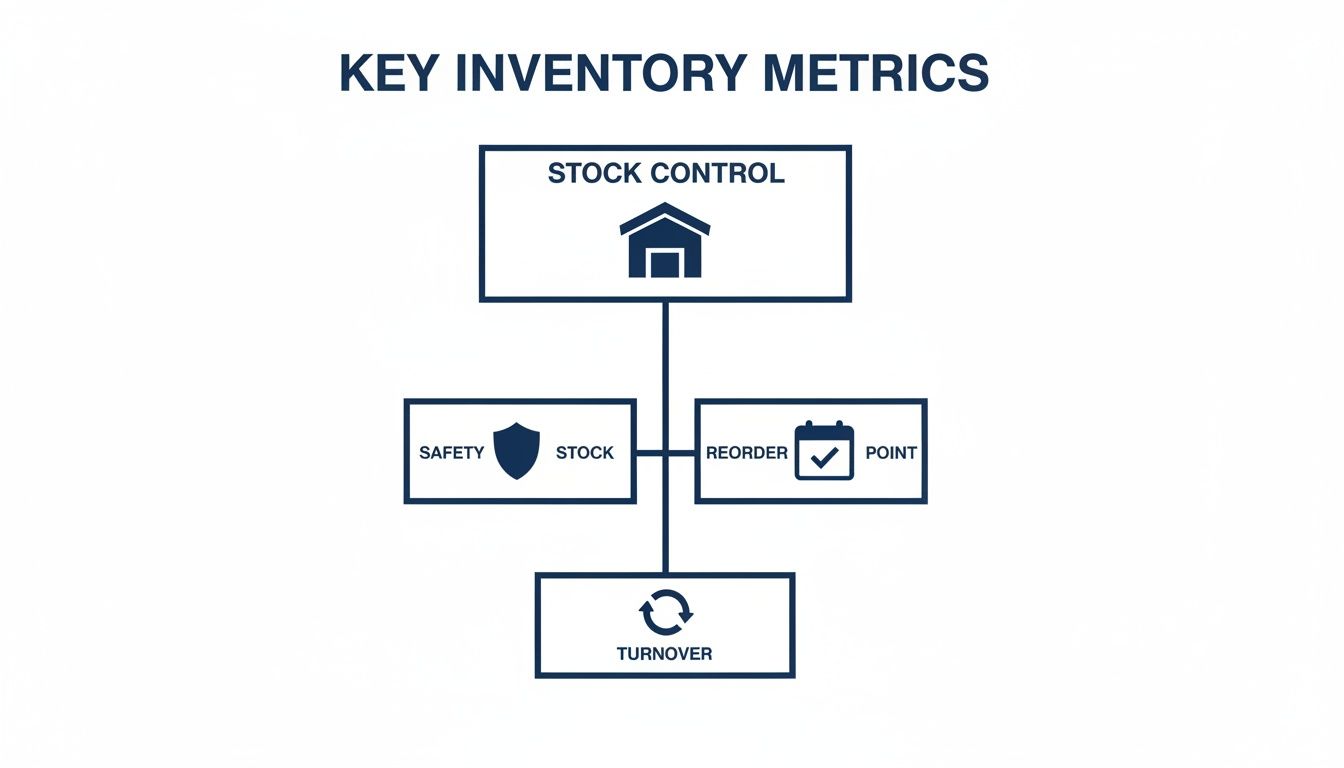
The diagram highlights that good stock control is built upon a solid foundation of knowing your safety stock levels, reorder points, and turnover rates—all of which a central system helps you track.
Once a hub-and-spoke system is in place, your entire workflow becomes more efficient and a lot less prone to human error. Here’s a practical look at how it actually works day-to-day:
By structuring your operations this way, you build a foundation that can actually scale. To go from 50 orders a day to 500, you don’t need to hire ten more people for data entry—you just need a system that can handle the volume. This integrated approach turns your inventory management from a daily chore into a strategic asset.
Making the leap from spreadsheets to a proper inventory system is a huge step. For any Singaporean seller looking to scale, picking the right platform is one of the most important decisions you’ll make. The goal is to find a partner that can grow with you, so you aren’t forced into a painful migration a year down the road.
This is about finding a system that delivers real-world value and performs flawlessly when it matters most—like during a chaotic 11.11 flash sale. Forget the flashy extras; focus on core performance.
When you start comparing different inventory management systems, it’s easy to get lost in a sea of technical jargon and sales pitches. To cut through the noise, you need a practical checklist that focuses on what actually moves the needle for a local e-commerce business. Think of this as your guide to separating the “nice-to-haves” from the “can’t-live-withouts.”
The table below is designed to help you ask the right questions and compare vendors on the features that truly matter for navigating the fast-paced Singaporean market.
| Feature/Criteria | Why It’s Important | Questions to Ask Vendors |
|---|---|---|
| Real-Time Sync Speed | A delay of even a few minutes can lead to overselling during a flash sale. You need stock levels to update across Shopee, Lazada, and your website in seconds, not minutes. | What is your average sync latency? Can you show me a live demo of an update pushing to multiple channels? |
| Native Marketplace Integrations | Direct, pre-built connections to Shopee, Lazada, and TikTok Shop are non-negotiable. Clumsy third-party connectors are slow, unreliable, and often the first thing to break. | Are your integrations with local marketplaces native, or do they use a third-party API connector? |
| Bulk Order Processing | The ability to generate pick lists, print packing slips, and create shipping labels for hundreds of orders at once can save your team hours of manual work every single day. | Can your system process 500+ orders from a single screen? How does it handle consolidated shipping labels? |
| Scalability and Performance | Your system must handle thousands of orders a day without slowing down, especially during peak sales periods like 9.9 or 11.11. | Is your platform built to handle high order volumes? What kind of stress testing have you done for peak sale days? |
| Local Support & Onboarding | Having a support team that understands the local market and operates in your time zone is critical when issues inevitably arise. | Where is your support team based? What does your onboarding process for Singaporean sellers look like? |
Ultimately, the best system will feel like it was built with the Singaporean seller in mind. It understands the dominance of Shopee and Lazada and has the raw speed to keep up with demanding online shoppers.
For a deeper dive into what features matter most, you might find it helpful to review our guide on choosing an inventory management system in Singapore.
Switching systems can feel like a massive, risky project, but a good software partner will break it down into a smooth and manageable process. A simple, phased approach ensures you can transition from your old messy methods to a new automated workflow without disrupting your daily sales.
Here’s a practical roadmap that we guide our partners through:
1. Clean Up Your Data First Before you do anything else, get your existing data in order. Make sure your product SKUs, names, and initial stock counts are 100% accurate in your spreadsheets. A little prep work here makes the import process dramatically faster and saves you from a world of headaches later.
2. Set Up and Integrate, One Channel at a Time Connect your new software to your sales channels step-by-step. Start with your biggest marketplace—maybe Shopee—and get that connection stable and syncing perfectly before you add Lazada, TikTok Shop, and the rest.
3. Train Your Team on What Matters Get your team comfortable with the new dashboard by focusing on the most critical daily tasks first. Show them how to view incoming orders, how to print shipping labels in bulk, and how to check stock levels at a glance. Keep it simple.
4. Go Live and Monitor Closely Pick a slow day, like a Tuesday morning, to officially “go live.” For the first week, we strongly recommend running your old spreadsheet system in parallel as a backup. This gives you a safety net, allows you to cross-check the data, and builds your team’s confidence that everything is working as it should.
This step-by-step plan helps de-risk the entire transition, allowing your team to get comfortable with the new tools while your business keeps humming along.

Putting a new system in place can feel like a big investment, but the return on investment (ROI) often shows up much faster than you’d think. You don’t need to wait months to see the payoff. There are immediate, measurable wins that build a clear business case for upgrading your inventory management in Singapore.
The most powerful way to see the value is by doing simple ‘before-and-after’ comparisons of your daily grind. These scenarios shine a spotlight on exactly how automation frees up your two most valuable resources: time and money.
Let’s walk through a common scenario for a Singaporean seller. Before a centralised system, a small team might burn hours every single day just trying to keep up with manual tasks. The change is often dramatic.
This shift is about reallocating your team’s energy from soul-crushing admin work to strategic tasks that actually grow the business. Suddenly, your team is focused on generating revenue, not just managing data entry.
Beyond clawing back time, a unified system unlocks quick-win strategies that were previously too complex or risky to even try. These moves deliver measurable results that you’ll see on your next profit and loss statement.
One of the fastest ways to grow is simply by adding another marketplace to your mix.
These immediate improvements give you clear, hard data. You can draw a straight line from the investment in better inventory management to increased revenue from new channels, lower operational costs, and a measurable drop in costly fulfilment errors. Think about how effective pricing strategies, which rely on real-time stock levels, can also lead to huge wins and a better ROI.
Got questions about inventory management in Singapore? You’re not the only one. Even experienced sellers sometimes need a quick refresher on the specifics.
Let’s clear up some of the most common queries we hear from local sellers to help you make clear, confident decisions for your e-commerce business.
The single most impactful thing you can do is create a single source of truth for your stock. That means finally ditching the separate spreadsheets for Shopee, Lazada, and your website.
Actionable Insight: Start by cleaning up your product data. Give every single product variation—like size or colour—its own unique SKU (Stock Keeping Unit). A good SKU format could be BRAND-PRODUCT-COLOUR-SIZE, like NIKE-AIRMAX-BLK-42. Once those SKUs are consistent across every sales channel, you can centralise your stock counts into one system. That’s the foundation for everything that follows.
Costs can vary a lot, but you’d be surprised how accessible modern platforms are for SMEs. Most pricing plans are tiered, usually based on your monthly order volume or how many SKUs you have.
Always look for a provider that offers a free trial. You need to test its speed and reliability for yourself before you commit. The key is to find a plan that grows with you, not one that holds you back.
Remember this: the cost of good software is almost always less than the money you lose from overselling, wasted manual work, and dead stock. Most businesses see a clear return on their investment within the first few months.
Managing pre-orders comes down to using a system that understands the difference between available stock and allocated stock. A good inventory platform lets you take pre-orders without messing up your real-time “available-to-sell” numbers for other customers.
For example, you can list a product with a future shipping date on your Shopify store. When a pre-order comes in, the system simply reserves that unit. Your inventory count for immediate dispatch stays exactly the same, which stops you from accidentally selling that reserved item to someone else. It’s a great way to lock in future sales and protect your cash flow.
Ready to stop overselling and start scaling your business with a single, unified platform? OneCart centralises your inventory, orders, and listings across every channel, syncing stock in seconds. See how much time you can save by exploring our features.
Automate & Scale Your Online Business with OneCart
Start a Free TrialUsed by hundreds of merchants in Singapore & Southeast Asia