How to Sell on Temu in 2026: Step-by-Step Guide + 2-5% Fees
How to sell on Temu in 2026: step-by-step seller registration, the real 2-5% fee breakdown, and how to sync your Shopee, Lazada or Amazon catalogue.
How to sell on Temu in 2026: step-by-step seller registration, the real 2-5% fee breakdown, and how to sync your Shopee, Lazada or Amazon catalogue.
Learning how to sell on Temu gives you access to over 200 million monthly active buyers across the US, Europe, and Southeast Asia, with referral fees of just 2% to 5% and zero listing fees. This step-by-step Temu seller guide covers everything from registration and approval requirements to the full fee breakdown, consignment vs semi-managed seller models, and tips for maximising your sales. Already selling on Shopee, Lazada, Amazon, or Shopify? We also explain how multichannel sellers can sync their existing catalogue to Temu without re-listing manually.
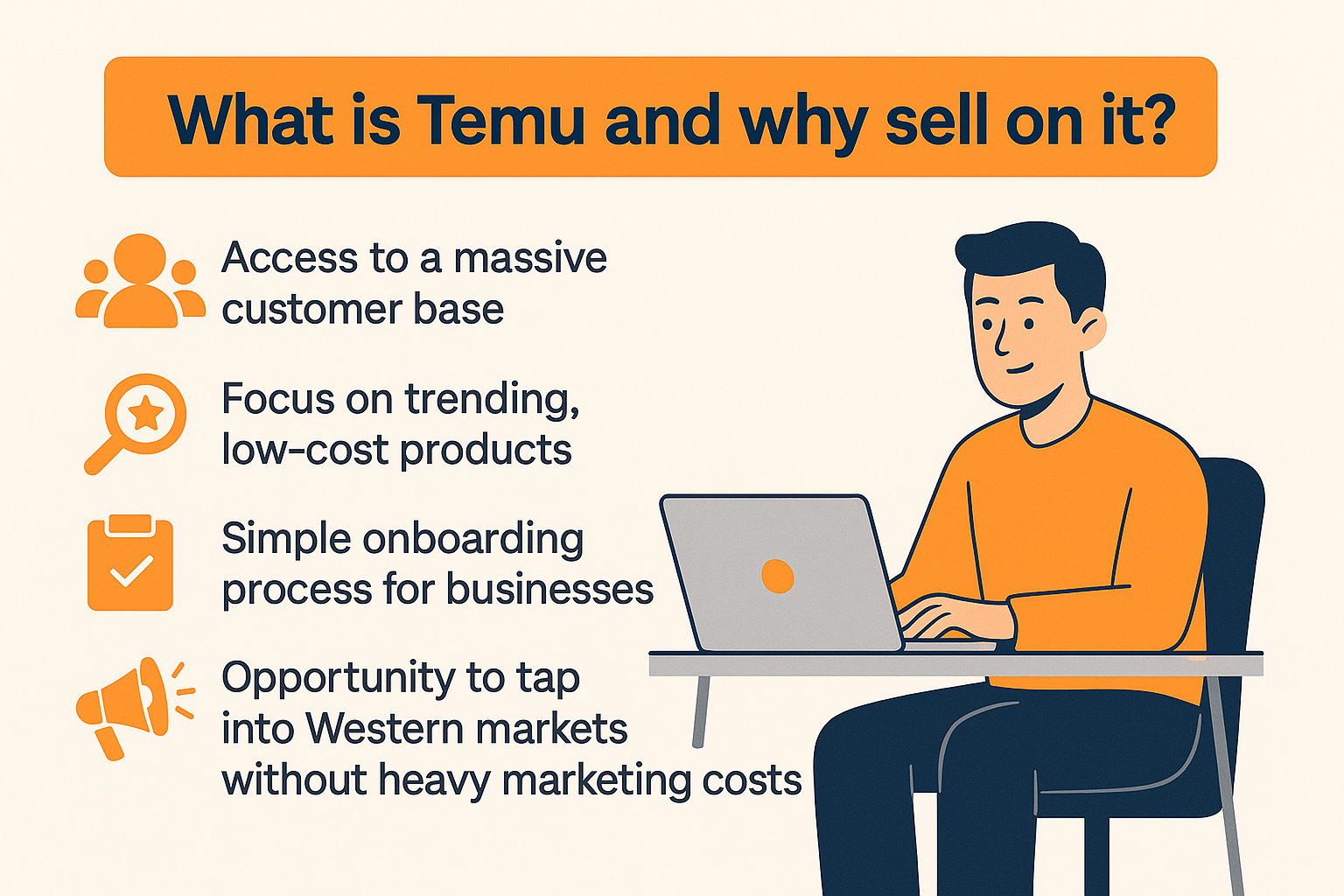
Temu is a fast-growing eCommerce platform known for offering affordable products across categories like fashion, electronics, home goods, and more. Backed by PDD Holdings, Temu has gained significant traction in markets like the US and Europe.
Access to a massive customer base. Temu’s rapid expansion across the US and Europe gives sellers exposure to millions of active buyers. Instead of relying solely on local or regional markets, businesses can tap into a global audience without needing to build their own traffic. This broad reach increases the chances of higher sales volumes, especially for competitive product categories.
Focus on trending, low-cost products. Temu has built its reputation around offering affordable, in-demand items that appeal to price-conscious shoppers. For sellers, this means a ready-made marketplace where customers are actively searching for budget-friendly deals. Businesses that can source or manufacture cost-effective products are well-positioned to thrive in Temu’s value-driven ecosystem.
Simple onboarding process for businesses. Unlike some marketplaces that require complex approvals or high upfront fees, Temu offers a streamlined registration process for qualified sellers. Once basic business documentation is submitted, sellers can quickly set up their store and start listing products. This ease of entry allows businesses to get started with minimal friction and begin generating sales faster.
Opportunity to tap into Western markets without heavy marketing costs. Entering markets like the US and Europe typically demands significant investment in advertising and customer acquisition. Temu removes that barrier by providing a built-in platform where traffic is already established. Sellers can focus on offering competitive products while Temu handles much of the customer reach, saving businesses from the high costs of running independent marketing campaigns.
Before you apply, it’s important to understand that Temu offers two distinct seller models — and they work very differently from Shopee or Amazon seller accounts.
Under the consignment model, you ship inventory to Temu’s warehouse. Temu handles everything from that point: pricing, customer service, returns, and last-mile delivery. You agree on a supply price with Temu, and they set the retail price. Your effective commission is lower (typically 2-5%), but you give up control over pricing.
Best for: Manufacturers, wholesalers, and sellers who want hands-off operations and can ship in bulk.
In the semi-managed model, you list products, set your own prices, and handle fulfillment directly to customers. This gives you more control but comes with higher referral fees (8-15% depending on category) and the responsibility of managing logistics, returns, and customer service.
Best for: Existing multichannel sellers on Shopee, Lazada, or Amazon who already have logistics infrastructure.
Actionable Insight: If you’re already selling on Shopee or Lazada with your own fulfillment, the semi-managed model lets you add Temu as a channel without changing your operations. If you’re a manufacturer looking for volume, the consignment model lets Temu do the selling.
Temu has shifted faster in the last twelve months than any other major marketplace, and most of the changes touch the seller P&L directly. If you read about Temu in 2024 or early 2025, several of the rules below have already been replaced. The table below collects the eight changes most likely to break a 2024-era playbook in 2026.
| Change | What it is in 2026 | Why it matters for sellers |
|---|---|---|
| Y2 (semi-managed) global rollout | Semi-managed seller accounts now open in 70+ buyer markets, including the US, UK, EU-5, AU/NZ, JP/KR, MX/BR and SEA pilots | You no longer need a Mainland China entity to sell on Temu — local-to-local fulfilment is increasingly preferred for shipping SLA |
| US de minimis ended (EO 14256 May 2025, then EO 14324 from 29 Aug 2025) | EO 14256 first eliminated the US$800 Section 321 exemption for goods of Chinese / Hong Kong origin (MFN duty + Section 301 + flat per-parcel duty on postal lanes through mid-2025); EO 14324 then suspended duty-free de minimis for all countries effective 29 Aug 2025 | Every cross-border Temu listing into the US now pays MFN duty + fees; Chinese-origin SKUs additionally carry Section 301 — factory-direct US$5–US$15 listings lose 30–50% of gross margin and need re-pricing or re-sourcing |
| Temu Mall (verified seller programme) | Branded storefront tier with a verified-seller badge, separate placements, and stricter onboarding (registered IP/trademark, 60+ day on-platform record, conversion-rate threshold) | Mall listings get separate ranking surfaces and visibly higher conversion than the standard semi-managed feed; commission is the same but qualification is gated on review/return performance |
| Boost (paid placement) auction expanded | CPC auction now covers category, search, and detail-page “similar items” surfaces; budget min lowered to ~US$5/SKU/day in most markets | Cheaper to test, but the auction is now the dominant traffic lever once you exit Lightning-Deal-only cold start |
| AI listing tools mandatory in some categories | AI image enhancement, attribute extraction and translation are auto-applied; sellers can opt back to manual but the auto path is the default for new listings | Reduces listing-prep time but introduces a non-trivial QA step — auto-translated SKUs occasionally mis-state material, voltage, or compliance text |
| Stricter category compliance (CE/FCC/UL/CPSC) | Electrical, children’s and beauty SKUs now require uploaded certificates before the SKU goes live in regulated markets | Plan an extra 2–4 weeks for first-time approvals on regulated categories — and budget for testing fees that can run US$300–$2,000 per SKU family |
| Returns policy tightened on low-ticket items | The 90-day buyer return window remains, but Temu’s “refund-without-return” auto-decision is now confined to lower price bands and certain categories | Higher-ticket SKUs (electronics, premium home goods) pull more physical returns — see the returns management software comparison for tools that handle multichannel return reconciliation |
| Quality bond / deposit on launch | New semi-managed sellers are typically asked to lock a quality bond (refundable, often US$500–$2,000 depending on category and country) | Plan working capital — this sits alongside Temu’s holdback on early payouts (see First Sale Timeline below) |
The two changes with the biggest 2026 P&L impact are the US de minimis cliff and the Mall qualification gate. We dig into both — the de minimis math sits in the tariff section below; Mall qualification is covered in the first sale timeline.
Actionable Insight: Re-price every SKU before you flip it live in 2026. The 2024 “factory-direct works because de minimis covers the duty” mental model is dead for US-bound goods regardless of origin — Chinese-origin SKUs took the hit in May 2025 (EO 14256), every other origin took it on 29 Aug 2025 (EO 14324). The algorithm will not re-rank a SKU that loses money for you in week 1.
Temu is now live in more than 70 buyer markets, but the seller models you can use depend on where you (the seller) are based and which storefront you want to ship to. The 2026 rollout has been semi-managed first — Temu opens semi-managed seller accounts in a market well before it opens consignment, because semi-managed shifts fulfilment cost back to the seller.
| Seller location | Consignment available | Semi-managed (Y2) available | Notes |
|---|---|---|---|
| China (Mainland) | Yes — original model | Yes — earliest market for Y2 | Default route for most factory sellers |
| United States | Limited (warehouse partners) | Yes — open in 2025–2026 | Local-to-local sellers prioritised for fast delivery |
| United Kingdom | Limited | Yes | UK domestic sellers can fulfil to UK buyers in 2–4 days |
| EU (DE, FR, IT, ES, NL) | Limited | Yes | VAT registration required at the relevant threshold |
| Australia / New Zealand | No | Yes | Local stock improves Boost eligibility |
| Japan / South Korea | Limited | Yes | Korean and Japanese listings supported |
| Mexico / Brazil | No | Yes | RFC (MX) or CNPJ (BR) typically required |
| Singapore / Malaysia / Thailand | No (as of 2026) | Yes — semi-managed onboarding | SEA sellers typically ship cross-border into US/EU buyers; some local SEA storefronts in pilot |
| Vietnam / Philippines / Indonesia | No | Limited / pilot | Pilot rollout — confirm with Temu Seller Center |
A few practical implications for Singapore and SEA sellers in 2026:
Actionable Insight: Don’t apply for the wrong seller market. If you’re in Singapore but most of your buyers will be in the US, set up your Temu Seller Center in the US semi-managed flow and ship from your SG warehouse — it routes you onto the right ad units, payouts in USD, and the right return address.
The eligibility table above answers “can I sign up?” The harder question for an SEA seller is “which buyer market do I actually point my listings at, and which storefront generates the cleanest payback?” The answer depends on your origin country, your category mix, and whether you already have a US/UK/EU buyer base from Shopee International, TikTok Shop, or your own Shopify store. Below is a country-by-country snapshot for the six SEA seller markets we get the most questions about in 2026.
Singapore is the easiest SEA seller-side onboarding for Temu. ACRA UEN + a SG business bank account plus proof of sourcing capability is normally enough to clear semi-managed approval in 2–3 weeks. Most SG sellers ship cross-border into the US, UK, and AU buyer markets — local SG storefront access is in pilot with a small number of categories (home, kitchen, baby) but is not the volume play in 2026. The strongest fit is for sellers already running Lazada Singapore, Shopee SG, or Qoo10 (QSM) at scale who want to extend the same SKUs into US/UK demand without re-doing photography.
Malaysia’s cross-border lane into the US is the fastest-growing SEA-to-Temu corridor in 2026. SSM-registered sellers can semi-managed-onboard in 3–4 weeks; Malaysia-domestic Temu is in active pilot for a handful of FMCG categories. Logistics is the swing factor — Penang/KL hubs feed the US lane through air consolidators with 6–10 day door times, and Malaysian SST handling for cross-border returns is more straightforward than ID/VN. Most successful MY sellers we see come from Shopee MY top-100 categories.
Thailand sellers can onboard semi-managed in 3–5 weeks but the local Thai storefront is not yet open in 2026. The volume play is cross-border into Japan, Korea, Australia, and parts of Europe. Thai exporters in fashion, beauty, accessories, and home decor show the strongest match for Temu’s Y2 buyer profile; pure electronics are harder because of the category-compliance gate. THB-USD swings make pricing discipline non-optional — set US prices in USD and re-translate weekly, not at order time.
Philippine sellers can apply but routing is bumpier than Singapore or Malaysia. SEC registration is required, and BIR documentation occasionally creates resubmission cycles during semi-managed onboarding (4–6 weeks is realistic). Local PH storefront pilot is open in selected categories. The strongest cross-border lane is into the US (West Coast) because of trans-Pacific consolidator economics. Sellers already on Shopee PH and TikTok Shop PH tend to onboard most cleanly.
Indonesia’s Temu story is the most complicated in SEA in 2026. Local Temu was paused in late 2024 by regulatory pressure protecting domestic SMEs, then reopened in pilot for a narrow set of categories. Indonesia-origin sellers can still semi-managed-onboard for outbound cross-border sales (US/EU lanes), and many Jakarta-based exporters do exactly that. Selling Indonesia-origin into Indonesia-domestic Temu is currently restricted — confirm category status in the Seller Center before assuming a route is open.
Vietnam-origin sellers have a structural cost advantage on apparel, footwear, and home goods cross-border into the US. Semi-managed onboarding for VN entities takes 4–6 weeks; the local VN storefront is in pilot. The largest 2026 growth lane is VN → US for sellers already shipping Shopee Vietnam and TikTok Shop Vietnam volume; VN → EU lanes have been slower because of stricter EU IOSS / customs paperwork than the US lane (which itself just got harder — see the de minimis section).
Actionable Insight: Match your SEA origin to one primary buyer storefront for the first 90 days. Splitting attention across US + UK + AU storefronts on day one usually means none of them gets enough listings, photos, or promotion budget to break out of cold start. Pick the buyer market your existing Shopee/Lazada/TikTok-Shop catalogue is closest to and concentrate spend there.
Yes, but Temu is more selective than marketplaces like Shopee or Amazon. Individual hobbyist sellers aren’t typically accepted. Temu works mainly with manufacturers, wholesalers, and established businesses that can offer competitive pricing and handle bulk operations.
Manufacturers and OEM producers
Distributors or wholesalers with established supply chains
Businesses with existing eCommerce operations on platforms like Shopee, Lazada, Amazon or Shopify
Sellers capable of meeting Temu’s pricing and logistics expectations
If you’re already selling on other platforms, you’re in a strong position — you already have the product catalogues, supplier relationships, and operational workflows that Temu looks for.
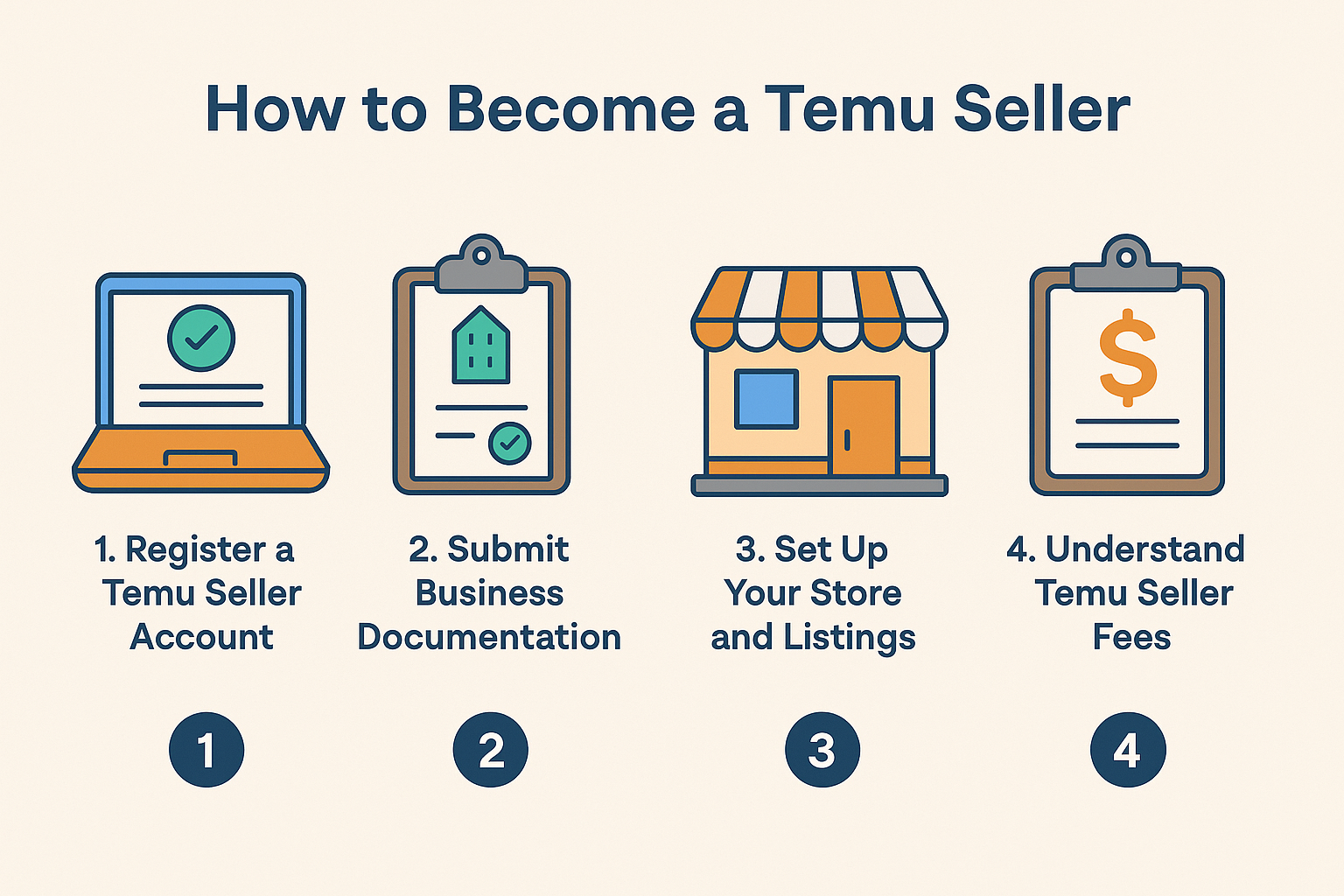
Head over to the Temu Seller Center to start your temu seller registration. You’ll need to create a Temu business account by submitting basic information.
Temu requires:
Business license
Tax identification details
Bank account for payments
Proof of manufacturing or sourcing capabilities
Approval times can vary, but having complete documents speeds up the process.
Once approved, you’ll get access to the Temu Seller Center dashboard where you can:
Upload product listings
Set prices (keeping in mind Temu’s focus on affordability)
Configure shipping and logistics details
Listings must comply with Temu’s guidelines regarding product descriptions, images, and categories.
Understanding the fee structure is crucial for any seller considering Temu as a sales channel. For a comprehensive analysis including marketplace comparisons and real cost examples, see our dedicated Temu seller fees guide — or jump straight into our Temu fee calculator to model consignment vs semi-managed, pro-rate the US$39/month subscription against your monthly order volume, and see net profit per order before you list a single SKU. Here’s a summary of the costs involved:
Registration Fee: Temu does not charge any fees to register as a seller.
Listing Fee: There are no fees to list products on the platform.
Individual Sellers: No monthly subscription fee.
Business Sellers: A monthly subscription fee of $39 is applicable.
Temu charges a commission on each sale, which varies based on product category and your seller model.
Consignment sellers: Commission rates are generally lower (around 2% to 5%) because Temu handles pricing and fulfillment — you supply at a wholesale price.
Semi-managed / direct sellers: Referral fees are higher, typically 8% to 15%, since you control pricing and logistics. For comparison, eBay’s final value fees average 13.6% across most categories — use our eBay fee calculator to see exactly what you’d keep after all fees.
Check the Temu Seller Center for the exact commission rate in your product category before listing, as rates vary by country and category.
All transactions are processed through PayPal.
Fee Structure: 2.9% of the transaction amount plus $0.30 per transaction.
While customers often enjoy free standard shipping, sellers are responsible for covering shipping expenses.
Cost Determinants: Based on the size and weight of the package — couriers typically charge whichever is higher between actual weight and volumetric weight.
Sellers utilizing Temu’s fulfillment services will incur additional fees.
Fee Basis: Determined by the dimensions and weight of the products.
The single most disorienting thing about new Temu sellers is how quiet week one is. Even with approved listings, semi-managed sellers commonly see fewer than 50 impressions per SKU per day for the first 5–10 days. The algorithm has no click data to work with yet, and Temu front-loads visibility on listings that already convert. Below is what to expect — and what good performance looks like at each stage — based on the patterns we see across SEA multichannel sellers onboarding to Temu in 2026.
| Week | What’s happening | Healthy benchmarks |
|---|---|---|
| Days 1–7 | Listings going live; AI tools auto-running on images and attributes; first quality bond / payout holdback set | <50 impressions/SKU/day, 0–2 orders for the catalogue, all from algorithm exploration |
| Weeks 1–2 (cold start) | Algorithm gathers click & conversion signals; Lightning Deals are the main visibility lever | 100–500 impressions/SKU/day for SKUs in deals; conversion rate 2–5% is the bar to clear |
| Weeks 3–6 (algorithm learning) | SKUs that converted in cold start get organic placement; underperformers get throttled | Hero SKUs reach 1,000–3,000 impressions/day; first Boost campaigns make sense once organic conversion holds |
| Weeks 7–12 (scale) | Mall qualification opens for sellers with stable conversion + low return rate; sustained organic placements | Stable 5–10% conversion on hero SKUs; first Mall application typically in week 8–12 |
| Months 4–6 | Boost auction becomes the dominant traffic lever; product-mix decisions baked in | 30–50% of GMV from Boost-influenced placements; AOV trending up via stacked promotions |
These are the operational numbers semi-managed Temu sellers are typically asked to hold in 2026. Slipping below the “warning” thresholds rarely results in an immediate suspension, but it will throttle your impression share well before any formal action.
| Metric | Healthy 2026 range | Warning threshold | Suspension risk if sustained |
|---|---|---|---|
| Late shipment rate | <2% rolling 30 days | >5% | >10% |
| Cancellation rate (seller-side) | <1% | >3% | >5% |
| Buyer-issue rate (defects, wrong item, missing item) | <1% | >3% | >5% |
| Return rate (fashion / beauty) | 8–12% | >18% | >25% |
| Return rate (hardgoods / accessories) | 2–4% | >7% | >10% |
| Negative review rate | <2% of orders | >5% | >8% |
| Response time to disputes | <24h median | >48h | >72h auto-resolve |
| Boost ROAS (after first 14d learning) | 3–6x category-dependent | <2x | n/a (not a suspension metric, but burns budget) |
If you’re past day 14 and still seeing fewer than 200 impressions/SKU/day across a launched catalogue, the most common causes are: (a) listings priced above the category median when Temu’s algorithm explicitly favours value, (b) no Lightning Deals submitted in the first two weeks (the cold-start algorithm needs the click signal), (c) auto-generated AI listings with translation or attribute errors that fail to match buyer queries, or (d) compliance documents pending in regulated categories. Walk through those four in order before assuming the catalogue is the problem.
Actionable Insight: Track impressions, conversion rate, and return rate by SKU — not by store. Most struggling new Temu sellers have 2–3 SKUs already converting at scale and a long tail dragging their store-wide metrics down. Cull or pause the bottom quartile by week 6, not week 12.
Temu attracts price-sensitive buyers, so competitive pricing is essential. But “competitive” doesn’t mean “cheapest at all costs.” If you source products overseas, use our landed cost calculator to work out the true per-unit cost including shipping, duties, and taxes — many sellers underestimate landed costs and end up losing money. You’ll need a commercial invoice for customs clearance on every import shipment. Use our markup calculator to set prices that cover all costs while hitting your target margin.
Actionable Insight: Calculate your break-even point with our break-even calculator before committing to Temu’s pricing requirements. If your landed cost per unit is too high to compete, the consignment model may not be viable for that product.
Don’t just list your entire catalogue. Temu rewards sellers who identify trending products with strong demand. Use the Temu Seller Center analytics to spot which categories are underserved, and cross-reference with what’s performing on your other channels (Shopee, Lazada, Amazon). Products that sell well on Shopee at a similar price point often perform on Temu too.
Temu penalises slow shipping — late deliveries directly affect your seller score and product visibility. If you’re using the semi-managed model, partner with reliable logistics providers. In Singapore, couriers like Ninja Van and J&T Express offer competitive rates for ecommerce fulfillment. For cross-border shipments, factor in your lead time to set realistic delivery promises.
Temu’s search algorithm weighs title keywords, image quality, and conversion rate. Use high-resolution images (at least 800×800 pixels) with white backgrounds. Our ecommerce product photography guide covers lighting, backgrounds, and editing workflows that meet Temu’s image standards while staying reusable across Shopee, Lazada, and Amazon. Front-load your product title with the most searched terms. Write descriptions that address buyer concerns (materials, dimensions, care instructions) rather than marketing fluff.
Customer satisfaction directly impacts your seller ranking and product visibility on Temu. Respond to negative reviews within 24 hours — Temu tracks response times. Proactively address common complaints (sizing, colour accuracy, packaging) by updating your listings rather than waiting for returns. If you’re selling on Temu alongside Shopee, Lazada, TikTok Shop, or your own Shopify store, pipe marketplace messages and review alerts into a shared inbox or ecommerce CRM — that way one complaint pattern (e.g. a sizing issue) surfaces once across every channel rather than requiring separate investigations in each seller centre.
Temu’s discovery is price-driven and promotion-driven more than any other major marketplace. A semi-managed listing at full retail almost never out-ranks an identical listing enrolled in a promotion. Knowing which lever to pull — and when — is what separates sellers who get traffic from sellers who only get impressions.
The four levers most semi-managed sellers should plan around in 2026:
| Promotion type | What it is | Typical use case | Cost to seller |
|---|---|---|---|
| Lightning Deals | Time-limited discount slot (often 1–4 hours) shown on the Lightning Deals tab and category feeds | Move slow inventory or test demand for a new SKU | Discount margin you fund + Temu may co-fund storefront banner |
| Limited-Time Discounts | Multi-day percentage discount with a strikethrough price | Sustained traffic during launch or category sale events | Discount margin you fund |
| Coupons / Free Gift | Buyer-applied coupon code or free add-on item above an order threshold | Lift average order value, recover abandoned carts | Coupon value + the free item COGS |
| Boost (Paid Placement) | Sponsored placement on category and search pages, similar to Shopee Ads or Lazada Sponsored | Push hero SKUs in competitive categories | CPC bid; budgets typically start in low double digits per SKU per day |
A few rules that consistently hold for Temu’s 2026 algorithm:
Actionable Insight: Build a simple promotion calendar against your stock cover. SKUs sitting on >120 days of cover should be on a recurring Lightning Deal until the cover comes back to your target. SKUs on <30 days of cover should never be on a deep discount — protect margin instead.
For sellers running Temu alongside TikTok Shop, the planning is similar but the cadence differs: TikTok Shop rewards LIVE sessions and affiliate commissions, while Temu rewards always-on Lightning Deals. Don’t copy the same calendar across both — match the lever to the channel.
Temu’s 2024 economics were built on the assumption that low-ticket parcels into the US, EU and UK could move duty-light or duty-free under each region’s de minimis thresholds. That assumption no longer holds in 2026 — every major buyer market has either eliminated, narrowed, or operationalised its de minimis rules in a way that materially affects a semi-managed Temu seller’s landed margin. If you priced your catalogue before April 2025, you almost certainly need to re-price it.
| Buyer market | 2024 baseline | 2026 reality | Practical implication |
|---|---|---|---|
| United States (Section 321) — Chinese / Hong Kong origin | US$800 de minimis applied to most low-value parcels | Executive Order 14256 (effective May 2025) eliminated the US$800 exemption for goods of Chinese / Hong Kong origin and replaced it with MFN duty + Section 301 tariffs plus, for postal lanes through mid-2025, a flat per-parcel duty | A US$15 cross-border SKU of Chinese origin typically loses US$2.50–US$6.00 of margin to duty + clearance vs the 2024 baseline; pricing has to absorb or pass through |
| United States — all other origins | US$800 de minimis | Executive Order 14324 (effective 29 Aug 2025) extended the suspension of duty-free de minimis treatment to goods from all countries. All low-value parcels now require formal entry and pay applicable MFN duty + fees; non-Chinese origin still avoids Section 301 but no longer ships duty-free | Vietnam-, Malaysia-, Mexico-origin goods still beat Chinese-origin on landed cost (no Section 301), but the duty-free 2024 baseline is gone for every origin |
| EU-27 (IOSS) | €150 commercial value threshold; VAT collected at order via IOSS | Same threshold, but IOSS enrolment + correct HS codes are now strictly enforced; non-IOSS parcels frequently held at customs | A correctly-IOSS-registered seller is materially faster through customs; a non-IOSS seller can lose 7–14 days at the border |
| United Kingdom | £135 threshold for VAT-at-checkout | Unchanged in policy; HMRC enforcement tighter, post-Brexit returns flow still clunky | Treat the UK like the EU — IOSS-equivalent VAT-at-checkout is mandatory; returns reverse-customs is a separate workflow |
| Australia | Goods under A$1,000 cleared under the simplified GST scheme | Unchanged; ATO collects GST at sale via the marketplace | Marketplace handles most of the heavy lifting; pricing impact is mostly the GST line, not duty |
| Mexico | De minimis set at MX$1,000 (~US$50); higher thresholds for FTA-eligible goods | RFC-registered importer required for higher-value parcels; T-MEC FTA preferences require origin documentation | Worth pursuing for FTA-origin goods; semi-managed pricing should price-in 16% IVA |
| Canada | C$20 / C$40 thresholds for postal vs courier | Unchanged in policy, but CBSA verification of low-value declarations stepped up | Modest pass-through; CUSMA preferences apply to qualifying origin goods |
Pricing a US$15 retail SKU on Temu USA, Chinese-origin, semi-managed, shipped via air consolidator. Numbers below illustrate the structural change rather than precise duty rates for a specific HS code.
| Line | 2024 baseline | 2026 (post-EO 14256) |
|---|---|---|
| Buyer price | US$15.00 | US$15.00 |
| Temu commission (~10%) | -US$1.50 | -US$1.50 |
| Payment fee (2.9% + $0.30) | -US$0.74 | -US$0.74 |
| Outbound shipping (air, US lane) | -US$3.50 | -US$3.50 |
| MFN duty + Section 301 + clearance | -US$0.00 (de minimis) | -US$3.50 to -US$5.50 (illustrative) |
| Cost of goods (factory landed) | -US$5.50 | -US$5.50 |
| Net margin | +US$3.76 (~25%) | +US$0.26 to -US$1.74 (~2% to negative) |
This is the structural reason factory-direct US$5–US$15 listings became unprofitable for many semi-managed sellers in 2025. The fix is rarely “add a tariff line in the cart” — Temu’s discovery is price-driven, so adding US$5 to the buyer price typically halves clicks. The fix is some combination of:
For broader cross-border ecommerce trade-offs across marketplaces — including how Shopee and Lazada cross-border programmes price duty differently from Temu’s semi-managed lane — see our cross-border guide. For ecommerce accounting treatment of the new duty lines (which most marketplace settlement reports do not itemise cleanly in 2026), pipe Temu payouts into Xero or QuickBooks via your bookkeeping provider with a duty-and-tariffs sub-account so the cost shows on its own line.
Actionable Insight: Don’t average duty across the whole catalogue. Tariff exposure is HS-code-specific — a fashion SKU and a small electronics SKU on the same buyer price can have radically different post-tariff margins. Run the landed cost calculator per HS family before re-pricing.
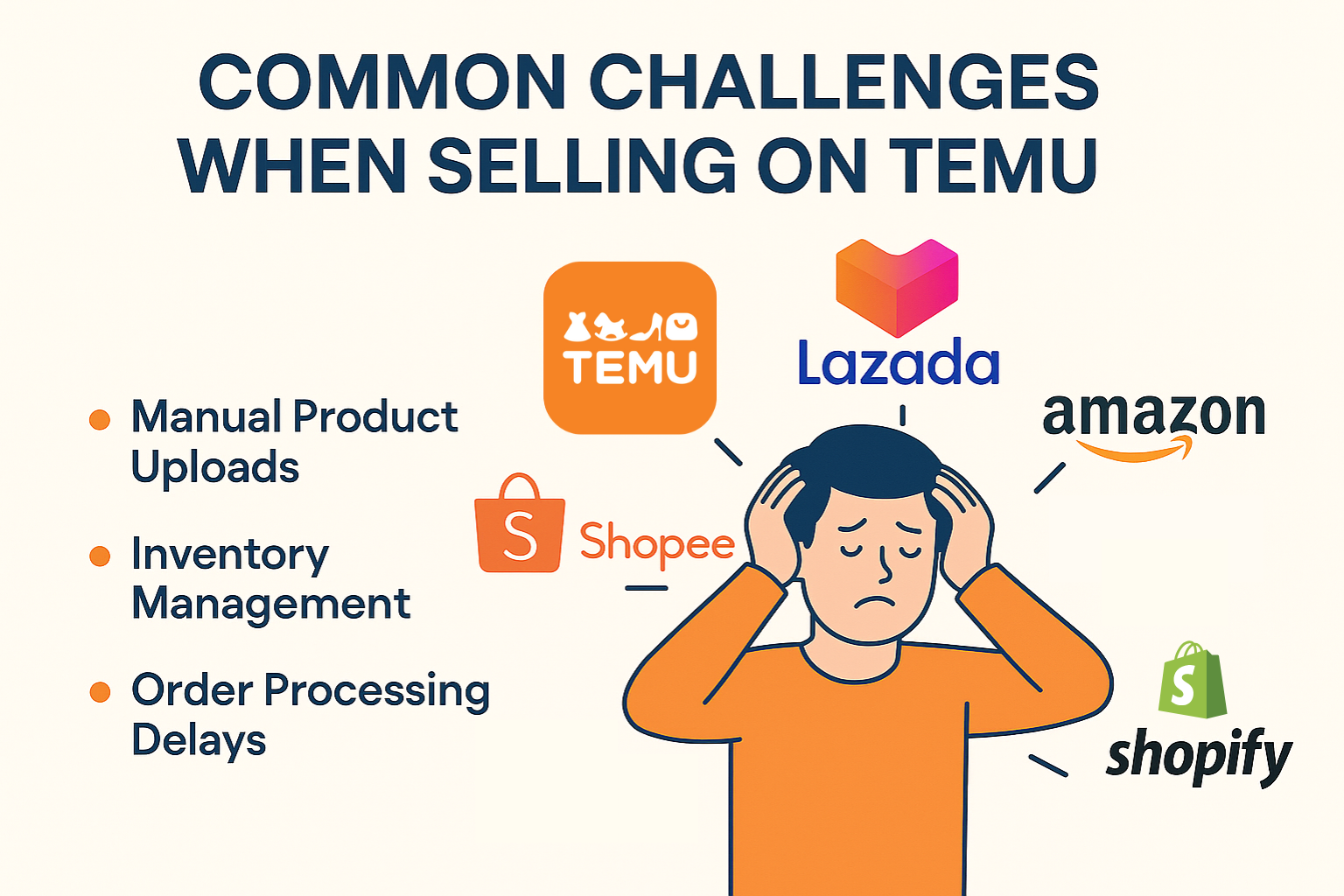
If you’re already selling on other platforms, re-uploading every SKU to Temu can be time-consuming.
Selling on multiple platforms increases the risk of overselling if stock levels aren’t synced in real-time, and overcompensating by stocking too much can leave you with dead stock that ties up cash and warehouse space. Monitor your sell-through rate across channels to spot slow-moving inventory before it becomes a problem. The right multichannel inventory management software keeps stock accurate across Temu and your existing channels. Calculating the right economic order quantity for each SKU also becomes harder when demand is split across Temu, Shopee, Lazada, and other channels.
Handling orders separately across Temu, Shopee, Lazada, Amazon, and Shopify can overwhelm your operations. If you’re scaling across channels, ecommerce order management software can centralise fulfillment so nothing falls through the cracks. A clean pick, pack and ship workflow — with consistent SKU labelling and packing slips — is what stops the cracks from forming in the first place.
Temu’s buyer protection is one of the most generous in ecommerce. Buyers get a 90-day return window in most categories and, for low-value items, Temu often issues a refund without requiring the item back. That’s great for buyers, but for semi-managed sellers it shows up as:
Three habits keep this manageable:
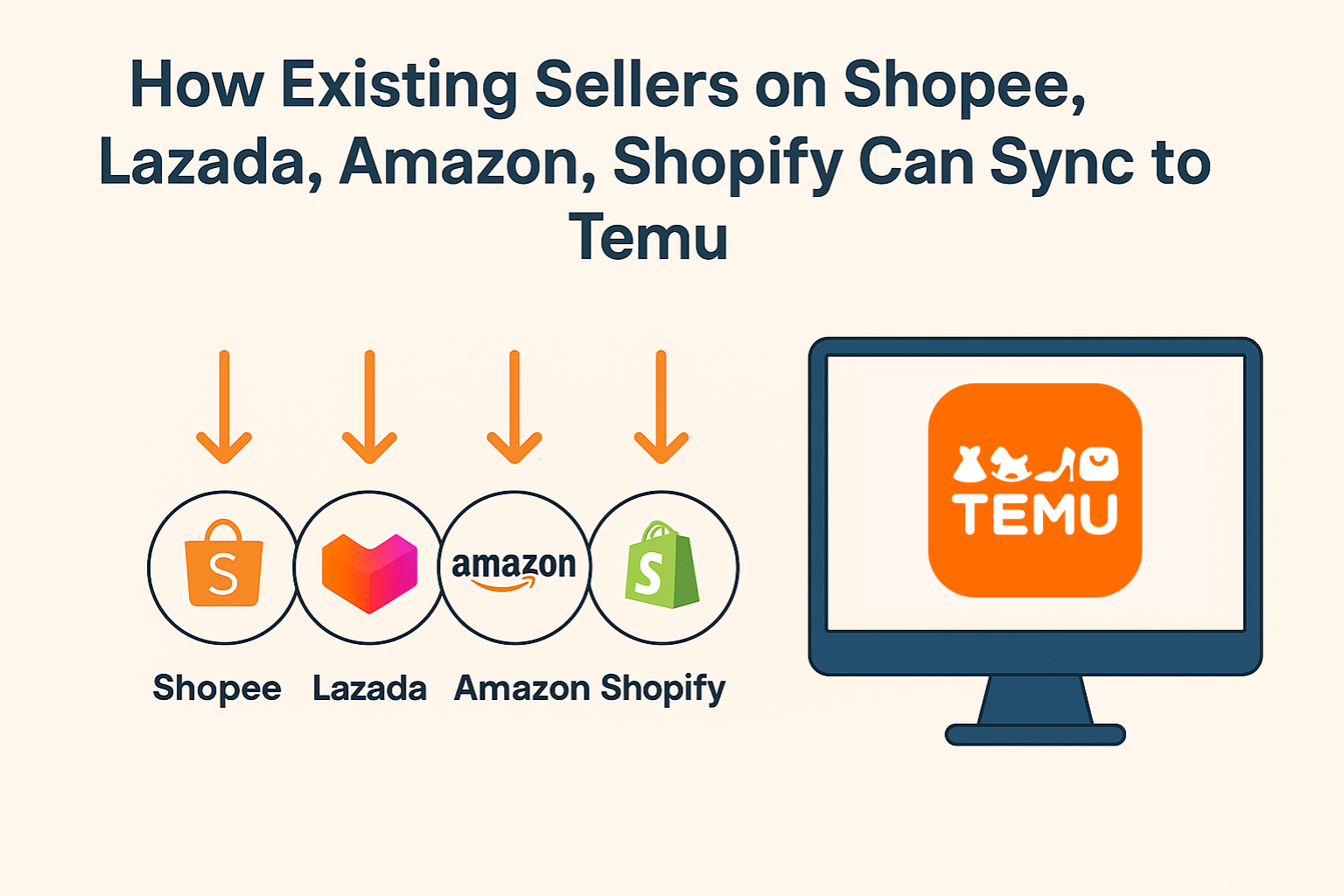
If you’re already active on marketplaces like Shopee, Lazada, TikTok Shop, Amazon, Shopify, or fashion resale platforms like Depop and Vinted, managing Temu as a separate channel adds unnecessary manual work.
This is where OneCart becomes essential.
Sync Product Listings
Copy listings from Shopee, Lazada, or Shopify directly to Temu without manual duplication. (Make sure your Shopify inventory is set up correctly before syncing to new channels.)
Automatic Inventory Updates
Prevent overselling by keeping stock levels updated across all platforms in real-time.
Centralized Order Management
View and process orders from Temu and other marketplaces in a single dashboard.
Simplify Multichannel Growth
Focus on expanding your business, not managing platform logistics.
👉 Learn more about how to streamline your Temu operations here: OneCart Temu Integration
Visit the Temu Seller Center, fill out the registration form, and submit your business documents for approval.
Yes — and you’ll have a head start. Existing sellers already have product catalogues, supplier relationships, and operational workflows in place. With a tool like OneCart, you can sync your Shopee, Lazada, Amazon, or Shopify listings directly to Temu without re-uploading everything manually. Your existing SKU data, images, and descriptions carry over, so you can be live on Temu in hours rather than weeks. If you’re still getting started on Amazon, our guide on how to sell on Amazon without inventory covers FBA, dropshipping, and other low-investment models.
It depends on your seller model. Registration and listing are free. Under the consignment model, Temu takes a margin on your supply price (effectively 2-5%). Under the semi-managed model, referral fees range from 8% to 15% depending on product category. Business sellers may also pay a $39/month subscription fee. Payment processing fees (typically 2.9% + $0.30 per transaction via PayPal) and shipping costs are additional. Use our markup calculator to work out your net margin after all fees.
You can access the Temu Seller Center at seller.temu.com for global sellers or seller-eu.temu.com for European markets. From the dashboard you can manage product listings, track orders, view sales analytics, and handle customer inquiries. Temu also has a Seller Center mobile app for managing your store on the go.
Not directly, but with OneCart, you can sync your Shopify listings and manage inventory across both platforms.
Use multichannel management software like OneCart to automate inventory updates and avoid stock issues.
Yes. Under the consignment model, Temu handles warehousing, packaging, and last-mile delivery entirely — you ship bulk inventory to their warehouse. Under the semi-managed model, you handle fulfillment yourself, though Temu provides logistics partnerships in some regions.
If you’re a manufacturer producing at scale and want hands-off selling, the consignment model is simpler — Temu manages pricing and fulfillment. If you’re an existing multichannel seller who wants to control pricing and already has logistics set up (e.g., via Ninja Van or J&T Express), the semi-managed model gives you more margin control. Many sellers start with consignment and switch to semi-managed once they understand Temu’s demand patterns.
Temu targets a global, price-conscious audience (primarily US and Europe), while Shopee and Lazada focus on Southeast Asian markets. Temu’s fees are competitive (2-15% depending on model), but the platform is more selective about seller onboarding. The biggest difference is Temu’s consignment model, which no other major marketplace offers — it lets you sell without managing individual customer orders. For a side-by-side comparison of marketplace fees, see our Lazada fee calculator, TikTok Shop seller fees guide and Shopee seller fees guide.
Yes — but currently only via the semi-managed model, with limited consignment access in SEA storefronts. Most SEA-based sellers register a semi-managed account that ships cross-border into the US, UK, EU, AU and JP storefronts where buyer demand is strongest. A locally-registered company (ACRA UEN in Singapore, SSM in Malaysia, SEC in the Philippines), a business bank account, and proof of sourcing or manufacturing capability are normally enough to start. Local-storefront pilots in Malaysia, Thailand and the Philippines are gradually opening up — confirm the current status in your Temu Seller Center before assuming a route is available.
Lightning Deals are the most reliable way to break a cold-start SKU out of low impressions. Even a short, deeply-discounted slot generates the click-through and add-to-cart signals Temu’s algorithm uses to re-rank your listing in category and search feeds for days afterwards. Boost (paid placement) is best layered on SKUs that already convert — using it to rescue a low-converting SKU usually just burns budget. Most semi-managed sellers run a rolling Lightning Deals calendar on slow movers and reserve Boost spend for hero SKUs in their highest-margin categories.
Plan for 3–6 percentage points higher than Shopee or Lazada for the equivalent SKU. Fashion, footwear and beauty typically settle around 8–12% in 2026; hardgoods like phone accessories and home items run 2–4%. Temu’s buyer protection often issues refunds without requiring the item back on low-ticket orders, so build the loss into your pricing — not into your customer service workflow. Track returns SKU-by-SKU (not platform-wide) so you can delist the small number of items that typically drive most of the refunds. Our ecommerce returns guide puts Temu’s 90-day window alongside Shopee, Lazada, TikTok Shop, Amazon, and eBay so you can reconcile policy obligations across channels — useful if you are still building the post-purchase ledger. Once volumes justify dedicated software, our returns management software comparison ranks 10 tools (Loop, AfterShip Returns, ReturnGO, Yayloh, Happy Returns, Narvar, ReturnLogic, Optoro, Outvio, Returnly) by GMV, store model, and geography — though note that none of the Shopify-native apps will pull a Temu return into the same workflow as your Shopify D2C return.
Yes — and it’s the single biggest change to Temu’s seller economics since the platform launched. The change came in two waves: Executive Order 14256 (effective May 2025) first eliminated the US$800 Section 321 de minimis exemption for goods of Chinese / Hong Kong origin, then Executive Order 14324 extended the suspension to all countries effective 29 Aug 2025. Chinese / Hong Kong origin pays MFN duty + Section 301 tariffs (the heaviest exposure); other origins now pay MFN duty + fees with no Section 301 (cheaper than the China lane, but no longer duty-free either). For semi-managed Temu sellers shipping Chinese-origin goods cross-border into the US, this typically erodes 30–50% of gross margin on factory-direct US$5–US$15 listings unless the catalogue is re-priced or re-sourced. See the De Minimis & Tariff Impact section for a worked margin example and the four ways most sellers are responding (re-source, move up the price band, pre-clear duties via the landed cost calculator, or switch the SKU to consignment).
Temu Mall is the verified-seller storefront tier — branded, badged, and shown in dedicated placements that convert visibly higher than the standard semi-managed feed. Qualification gates in 2026 typically include a registered IP/trademark in the buyer market, 60+ days of clean on-platform performance, conversion-rate and return-rate thresholds inside the warning ranges in the First Sale Timeline table, and a per-category review-score floor. Commission rates are the same as standard semi-managed; the value is in placement quality and the trust signal. Most well-performing semi-managed sellers apply for Mall in week 8–12, after the algorithm has rewarded clean cold-start metrics with stable organic traffic.
For a semi-managed catalogue with at least one Lightning Deal in the first two weeks: 7–14 days is typical from listing approval to first order. The first 5–10 days are usually quiet (under 50 impressions per SKU per day) because Temu’s algorithm needs click and conversion data before it will rank you. Submitting at least one Lightning-Deal-priced SKU in the cold-start window is the single biggest accelerator. If you’re past day 14 with under 200 impressions per SKU per day, walk through the stuck cold start checklist before assuming the catalogue is the problem — it’s usually pricing or compliance, not product.
Yes. The most common 2026 suspension or impression-throttling triggers are: late-shipment rate above ~10% sustained over 30 days, cancellation rate above ~5%, buyer-issue rate above ~5% (defects, wrong item, missing item), category-specific compliance failures (electrical, children’s, beauty SKUs without uploaded certificates), and IP / trademark violations. Most actions start as soft throttling — your impressions drop quietly before any formal warning lands. The performance benchmarks table shows the warning thresholds Temu typically uses; the practical fix is to monitor those metrics weekly, not at quarter-end. If you cross a warning line, pause your worst-performing SKUs immediately and respond to any open dispute inside 24 hours.
In the first 4–6 weeks, Lightning Deals do most of the work — they’re how the algorithm gets the click and conversion data that ranks you organically. Boost (the paid-placement auction) is most efficient on already-validated SKUs, i.e. ones that organically converted at 3–5% from a Lightning Deal slot. Running Boost on a SKU that hasn’t cleared organic conversion is the most common way new sellers waste budget. By month 3–6, Boost typically becomes the dominant traffic lever (30–50% of GMV influence) — but the funnel into it is still Lightning Deals. Treat them as sequential stages of the same playbook, not alternatives.
Want to sell smarter across multiple platforms? Try OneCart today to simplify your eCommerce operations!
OneCart connects Temu to your other marketplaces — sync inventory, push listings, and process orders from one dashboard.
Connect Temu freeUsed by hundreds of merchants in Singapore & Southeast Asia