How to Sell on Shopee Singapore [2026]: A Beginner's Guide
New to Shopee? Learn how to sell on Shopee Singapore in 2026 step by step: Seller Centre setup, seller fees, shop tiers, performance metrics, and Shopee Ads.
New to Shopee? Learn how to sell on Shopee Singapore in 2026 step by step: Seller Centre setup, seller fees, shop tiers, performance metrics, and Shopee Ads.
New to selling online? This beginner’s guide takes you from opening your Shopee seller account to your first sale, step by step. Selling on Shopee Singapore in 2026 means getting four things right from day one: your fee stack (commission, transaction, service, ads), your shop tier (Marketplace, Preferred, Mall, or Shopee Choice), your performance metrics (Late Shipment Rate, Chat Response Rate, Non-Fulfilment Rate), and your multi-country plan if you want to ride Shopee’s footprint across SG, MY, PH, TH, ID and VN. This guide walks each of those — from registration and seller fees through Shopee Ads, the new 2026 programme changes, and when to expand to Lazada, TikTok Shop, or your own Shopify store.
Getting a new Shopee store off the ground is exciting, but turning that excitement into actual sales requires a clear strategy from day one. Think of this guide as your high-level roadmap, walking you through the entire process from creating your account to scaling your business. Before we get into the nitty-gritty of how to do everything, it’s important to understand the landscape and the key milestones you need to hit.
First things first: Shopee is the undisputed leader in Singaporean e-commerce. If you want to reach local online shoppers, this is where you need to be.
Shopee’s dominance is built on a massive and seriously engaged user base. Heading into 2026 it remains the most-used e-commerce platform across most of Southeast Asia by both visits and gross merchandise value, processing billions of orders a year region-wide. In Singapore alone, Shopee.sg continues to be the most visited e-commerce platform.
A lot of this success comes from a mobile-first approach that clicks with Singaporean consumers. They have pioneered features like Shopee LIVE (live-stream shopping), which has seen its engagement triple. Shopee’s affiliate programme has also matured in 2026, giving sellers access to a network of content creators who promote products for a commission — a powerful growth lever for new shops.
This powerful mix of market share, user engagement, and integrated services makes it an incredibly attractive place for sellers to build a business.
A successful Shopee business is about building a trusted brand through excellent listings, reliable fulfillment, and proactive customer engagement. Your store’s reputation is your most valuable asset.
This visual breaks down the simple, four-stage journey of a successful Shopee seller.
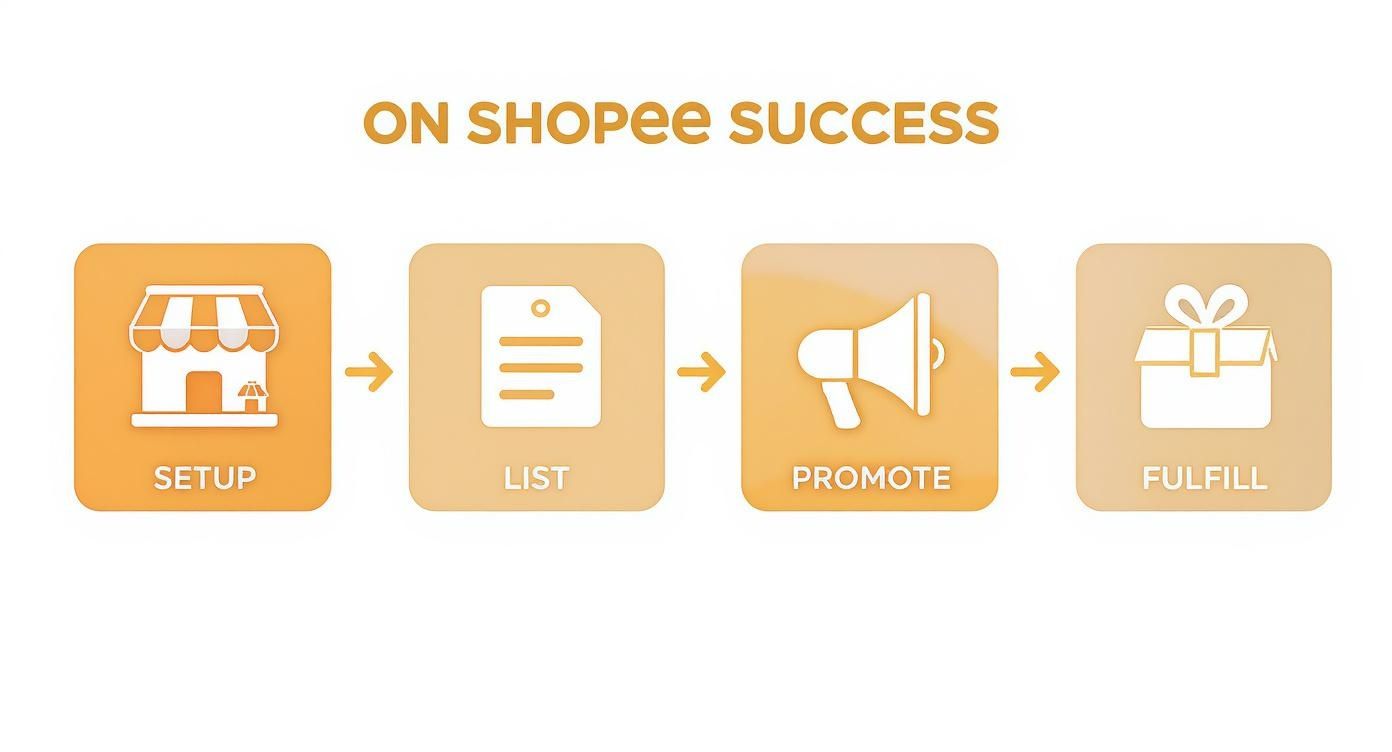
Each step builds on the last. Getting one right strengthens the next, creating a positive cycle of growth and happy customers.
To help you visualise the journey from start to finish, here’s a quick checklist of the essential milestones for any new seller in Singapore.
| Milestone | Key Action | Primary Goal |
|---|---|---|
| Account Creation | Register and verify your seller account. | Establish your official presence on the platform. |
| Store Setup | Complete your shop profile with a logo and description. | Build initial trust and brand recognition. |
| Product Listing | Upload your first 5-10 products with great photos. | Create a foundational product catalogue for buyers to discover. |
| Initial Promotion | Set up a “New Shop” voucher or discount. | Drive your first sales and attract early followers. |
| First Order Fulfilment | Process and ship your first order successfully. | Establish a reputation for reliability and good service. |
This checklist provides a clear path forward, ensuring you cover all the critical bases as you launch your Shopee store.
To get immediate traction, focus on a few critical actions right away. This is about prioritising what delivers the biggest impact at the beginning.
Here’s a practical to-do list to guide your first moves:
These initial steps are all about creating momentum. By focusing on a credible store and attractive listings from the get-go, you are setting the stage for long-term growth. We’ll break down exactly how to execute each of these actions in the sections ahead.
Before you build out a pricing model or commit to a particular shop tier, you need to understand how Shopee’s current programme and fee structure across SEA shapes your margins. Several of these levers (your shop tier, the marketing programmes you opt into, and your ad routing) can move the cost base by a few percentage points, which is the difference between a healthy margin and a break-even sale on a low-AOV category like fashion or beauty. Treat the figures below as illustrative starting points and confirm the exact rates and thresholds for your account and market in Shopee Seller Centre, since Shopee adjusts these periodically and does not publish a single fixed schedule across all markets.
| Change | Who It Affects | Impact |
|---|---|---|
| Sponsored Ads consolidation | All sellers running Shopee Ads | Product Search, Discovery and Boosted Search rolled into one Shopee Ads dashboard with smart-bid defaults. Manual-bid sellers retain control but the default routing pushes spend toward smart bids first. |
| Mall commission premium | Shopee Mall sellers | Shopee Mall sellers pay a commission premium over the Marketplace baseline on most categories, in exchange for the brand-authenticity tier and its traffic priority. The exact premium varies by category and market, so check the current Mall rate card in Seller Centre before assuming a Mall upgrade pays back. |
| Seller Tier requirements | Preferred and Preferred+ sellers | Preferred-tier qualification depends on performance metrics including your Late Shipment Rate, Non-Fulfilment Rate and Chat Response Rate. Shopee sets and periodically updates the exact qualifying thresholds, which are shown live in Seller Centre, so treat them as moving numbers rather than fixed values. |
| Shopee Choice expansion | Sellers with price-competitive SKUs | Shopee Choice (the curated low-price programme) has expanded into more categories. Listings that pass Shopee Choice review get a green badge, lower commission on enrolled SKUs, and traffic priority, but margins are tightly capped. |
| SCO (Shopee Cross-border Outbound) | SG sellers wanting regional reach | SG-based sellers can ship into MY, PH, TH and ID without a local entity through Shopee’s cross-border programme. This removes the biggest historical blocker for SG sellers wanting SEA-wide volume. |
| Service fee tiers | All sellers | Service-fee tiers are set by your shop’s performance and the marketing programmes you opt into. Review your current tier and its qualifying window in Seller Centre rather than assuming last year’s banding still applies. |
Take a fashion seller on Shopee SG selling a S$30 dress. The fees that bite first are the Commission, the Transaction Fee (a flat 2.18% on the buyer’s total payment, unchanged in 2026) and any Service Fees for marketing programmes you opt into (Coins Cashback, Free Shipping Special — typically 3–5% of the final price).
Marketplace seller, no service-fee programmes:
Marketplace seller, opted into Coins Cashback (5% Service Fee):
Shopee Mall seller, opted into Coins Cashback (5% Service Fee):
In this illustration the Mall premium adds a few percentage points of commission per order on top of the Marketplace baseline, which is why the Shopee Mall decision is one of the most important calls you make as a seller, not a default upgrade. Confirm the current premium for your categories in Seller Centre or our fee guide. We unpack the qualification rules and the actual ROI in a dedicated section below.
Run every category you sell through a fresh fee re-baseline before you set your 2026 prices. The cleanest way is to start with our Shopee fee calculator, which bakes in the Shopee commission tiers (Mall, Non-Mall, Preferred), the 2.18% transaction fee, optional Coins Cashback / Free Shipping service fees, and the new-seller commission-free window across SG, MY, PH, ID, TH, and VN, so you get the Shopee-specific take-rate without rebuilding a spreadsheet. Then layer in product cost, packaging, shipping, and ad spend in our profit margin calculator or markup calculator for a fast first pass, and move the surviving SKUs into a proper break-even model before you commit ad spend. Once a SKU is live, run your Shopee Ads spend through our ROAS calculator; the break-even ROAS overlay (1 ÷ gross margin) tells you the floor your campaigns have to clear before they make money. Anything below 15% net margin before ads is a high-risk SKU.
Actionable Insight: The all-in cost picture depends heavily on your tier and the programmes you opt into. In the illustration above, Marketplace sellers without service-fee programmes pay around 5% in fees, those opted into Coins Cashback or Free Shipping pay roughly 8–10%, and Mall sellers running promotions pay around 12–13%. Re-baseline by tier before you set your next quarter’s prices, and confirm your category’s current rates in Seller Centre.
Think of your Shopee store as your digital storefront. Getting the account set up is just the first step; the real goal is to build a shop that customers trust and want to come back to. This initial setup phase is your one chance to make a strong first impression, so it’s worth getting it right from the get-go.
Once you’ve registered on the Shopee platform, the real work begins. This is where you’ll choose a memorable name, create a clean logo, and write a description that tells people exactly what you sell and why they should buy from you. These pieces all work together to build a professional and credible presence.
Your shop name is a massive part of your brand identity. It needs to be easy to remember, simple to spell, and ideally, hint at what you are selling. Steer clear of generic names with random numbers—they look unprofessional.
Your shop logo and cover photo are your visual handshake with customers. You do not need to be a pro designer. A simple, clean logo made with a tool like Canva can be surprisingly effective. For the cover photo, pick a shot that showcases your best products or a lifestyle image that captures your brand’s vibe.
This is your chance to connect with potential buyers. Use the shop description to tell your story, explain what makes your products special, and build that all-important trust. A well-written description can be the final nudge a hesitant customer needs.
Here’s a simple template you can adapt:
“Welcome to [Your Shop Name]! We are a Singapore-based seller passionate about [Your Niche/Product Type]. All our products are [Key Selling Point, e.g., ‘carefully curated for quality,’ ‘handmade with natural ingredients,’ or ‘100% authentic’]. We ship out orders within 24 hours. Follow us for new arrivals and exclusive deals!”
This format works because it quickly answers the big questions: who you are, what you sell, what your unique value is, and what they can expect from you.
The Shopee Seller Centre is your mission control. This is the dashboard where you’ll manage everything, from listings and orders to marketing and finances. It can feel overwhelming at first, but if you focus on a few key areas to start, you will be on the right track.
Two things trip up new sellers before they even log in. First, Seller Centre is a different site from the shopper app you buy on, so your buyer account is not a seller account. Second, it is country-specific: a Singapore login will not open your Malaysia shop. Each market runs its own portal, which is why sellers who expand across the region end up juggling several sets of credentials.
| Market | Seller Centre portal |
|---|---|
| Singapore | seller.shopee.sg |
| Malaysia | seller.shopee.com.my |
| Philippines | seller.shopee.ph |
| Thailand | seller.shopee.co.th |
| Indonesia | seller.shopee.co.id |
| Vietnam | banhang.shopee.vn |
If you have not registered yet, a new Singapore shop starts at shopee.sg/seller/signup and drops you into Seller Centre once verification clears. One naming quirk worth knowing: Shopee uses “Seller Centre” and “Seller Center” interchangeably across its own portals and help pages, so either spelling gets you to the same dashboard.
Get comfortable with these essential sections first:
Just spending an hour clicking through these sections will give you a solid feel for your day-to-day operations. As you grow, you might want to look into how to authorise Shopee to a management tool like OneCart to pull all your workflows from different channels into one place.
Verification is a non-negotiable step that builds huge trust. Shopee requires all sellers to verify their identity to keep the marketplace safe for everyone. The exact documents you will need depends on whether you are an individual seller or a registered business.
For individual sellers in Singapore, you will usually just need your NRIC. If you are a registered business, you will have to submit your ACRA BizFile. The process is straightforward and is a critical part of learning how to sell at Shopee the right way. If you are still at the sign-up stage, our Shopee seller registration quickstart walks through the individual versus business shop-type decision and the verification steps in order.
Actionable Insight: Filling out your shop profile and getting verified has a direct impact on your store’s credibility and whether a customer decides to trust you with their money. A complete, verified profile is a clear signal that you are a serious and reliable seller.
Once your shop is set up, your product listings become your single most important sales tool. A great listing does more than show what you sell; it’s your silent salesperson, working 24/7 to pull customers in and convince them to hit ‘Add to Cart’. Getting this right is fundamental if you want to succeed on Shopee.
Picture this: a buyer searches for a product on Shopee and is hit with a wall of images and titles. Your job is to stand out from that crowd. It all begins with a title that’s clear, packed with information, and optimised for how real people search.
A weak title is a wasted opportunity. A strong one grabs attention and tells the Shopee algorithm exactly what you are selling, helping you climb higher in the search results. I’ve found a simple formula that works time and time again.
Just follow this structure:
Let’s see it in action. Imagine you are selling noise-cancelling headphones from a brand called “AudioSG”.
The strong title is brimming with keywords, which dramatically increases its chances of being discovered. To really nail this, you need to conduct some effective ecommerce keyword research to understand what terms your customers are actually typing into the search bar.
On Shopee, shoppers cannot touch or feel your product. Your photos and videos have to do all the heavy lifting. Listings with sharp, multi-angle photos and a short video consistently outperform those without. The good news is you do not need a professional studio — our complete guide to ecommerce product photography walks through equipment, lighting, and the exact shot types every Shopee listing should include.
Here are a few simple tips that make a huge difference:
Actionable Insight: Your main image is your first impression. Make it count. It should be a clear, well-lit shot of the product on a clean, uncluttered background. Make the item the hero.
To help you get this right, think of your listing as a series of small optimisations. Here’s a quick checklist comparing weak elements with strong ones that drive search visibility and sales.
| Listing Element | Weak Example (Avoid) | Strong Example (Implement) |
|---|---|---|
| Title | “Nice T-Shirt” | “BrandX Men’s Premium Crew Neck T-Shirt |
| Main Image | Dark, blurry photo on a messy table. | Bright, clear photo on a plain white background. |
| Description | “Material: Cotton.” | “Made from 100% premium cotton for a soft, breathable feel.” |
| Category | “Fashion > Men’s Wear” | “Fashion > Men’s Wear > T-Shirts & Singlets > T-Shirts” |
| Attributes | Left blank. | All relevant attributes filled (Brand, Material, Style, Sleeve Length). |
This table is a blueprint. Consistently applying the “Strong Example” principles will put your listings head and shoulders above the competition.
Your product description is where you close the deal. A good one anticipates a buyer’s questions and answers them upfront, building the confidence they need to buy. Do not just list features—sell the benefits.
Instead of just stating, “Material: 100% Cotton,” try something like, “Made from 100% premium cotton for a soft, breathable feel that keeps you comfortable all day long.” The difference is clear.
Break up your description with clear headings to make it easy to scan. Make sure you cover key details like:
Tapping into local trends also gives you an edge. In Singapore, for example, the biggest categories on Shopee are Home and Living, followed by Beauty, Health, and Personal Care. With Shopee.sg getting around 14.3 million monthly visits, mostly from the 25-34 age group, tailoring your listings to these popular categories can be a game-changer.
Finally, do not overlook the technical details. Choosing the right product category is critical for visibility. If you are selling a phone case, do not just put it under “Mobiles & Gadgets.” Drill down to the most specific sub-category, like “Mobile Accessories > Cases & Covers.” Fill out every single product attribute—brand compatibility, material, colour. This is how Shopee shows your product to the most relevant buyers. If your product has variations like different colours or sizes, set them up properly so customers can easily pick what they want.
For more deep-dive strategies, check out our guide on 10 things to get more sales from your product listing.
Getting shoppers to your product page is one thing; convincing them to click “buy” is another battle entirely. This is where smart pricing and irresistible promotions come into play. Let’s walk through how to set competitive prices, use Shopee’s own marketing tools, and gear up for those massive sales campaigns that every seller in Singapore looks forward to.
First, you need to get your base price right. This means doing a little digital window shopping. A quick search on Shopee for items similar to yours will reveal the going rate. Your goal is to find that sweet spot—a price that’s competitive but does not slash your profit margin to zero.
Speaking of profits, you absolutely have to know your numbers. The final price tag needs to cover a lot more than just what you paid for the product.
Before you set a price, you need to figure out your break-even point. Tally up every single expense tied to that product. This is the only way to ensure each sale puts money in your pocket.
Make sure your calculation includes:
Only when you have a firm grip on these costs can you price your items strategically and run promotions without accidentally losing money. For a deeper dive, it’s a good idea to review a complete guide on understanding Shopee seller fees to make sure your math is spot on.
Shopee’s Marketing Centre is a seller’s toolbox, filled with different tools designed to drive sales. The trick is knowing which tool to use for which task.
Here’s a breakdown of the most useful promotional tools and real-world scenarios for using them:
| Promotional Tool | Best For… | Practical Example |
|---|---|---|
| Discount Promotions | Driving quick sales on specific items or clearing out old stock. | Run a 20% off sale on last season’s T-shirt designs to make way for new inventory. |
| Vouchers | Getting first-time buyers over the line and increasing how much they spend. | Set up a “$5 off with a minimum spend of $50” voucher. This nudges shoppers to add one more item to their cart. |
| Bundle Deals | Boosting your average order value (AOV) by selling multiple items in one go. | Offer a “Buy any 3 phone cases for $25” deal. This can easily turn a single-item purchase into a multi-item sale. |
| Add-on Deals | Cross-selling products that go well together and giving them more visibility. | When a customer adds a digital camera to their cart, you can offer a memory card as an add-on for a special price. |
When you match the right tool to your specific goal, your promotions become powerful, strategic moves to grow your shop.
Big campaigns like 9.9, 11.11, and 12.12 are the Super Bowls of Shopee. These are incredible opportunities to find new customers and hit huge sales numbers, but they demand serious preparation. Success during these events is never an accident.
Shopee’s mega campaigns can make up a huge chunk of a seller’s yearly revenue. If you are not prepared, you are leaving a massive amount of money on the table. The real pros start planning at least four to six weeks out.
Treat each campaign like a project and work through a checklist to make sure you are ready.
Here’s what your campaign prep list should look like:
Having a structured plan for these huge sales is a fundamental part of learning how to sell at Shopee successfully. It’s what separates the casual sellers from the serious ones.
Your shop is live and your listings look great. Now it is time to get people to see them. Waiting for shoppers to stumble upon your products organically is a slow way to build a business. To get real traction and accelerate your growth, you need to dive into Shopee’s advertising and marketing features.
This is what separates casual sellers from serious brands.
Shopee Ads are like paying for a prime spot on the busiest street. You are putting your products right where eager buyers are already looking. It might sound complex, but Shopee has made it surprisingly straightforward. You will mainly be working with two types of ads.
Product Search Ads: This is your bread and butter. When a shopper types something into the search bar, your ad appears at the top of the results. Say you sell “organic dog treats”—you can bid on that exact phrase. When someone searches for it, your product shows up first. It’s effective because you’re catching people who already know what they want to buy.
Discovery Ads: These are different. They pop up in places like the “Daily Discover” section on the homepage or under “You May Also Like” on other product pages. Discovery Ads are perfect for getting your brand in front of people who are browsing for items similar to yours, introducing them to products they did not even know they were looking for.
If you are just starting out, set a small daily budget—maybe $5 to $10 per day—and test the waters with Product Search Ads for one or two of your best-selling items. The key is to be specific with your keywords. Instead of a broad term like “pouch,” bid on something precise like “waterproof running pouch.” This ensures your ad money is spent on the most relevant audience.
Turning on the ads is easy. Making them profitable is the real skill. You will need to get comfortable looking at the data in your Shopee Ads dashboard to figure out what’s working and what is just burning cash.
Keep a close eye on these metrics:
Actionable Insight: Constantly tweak your campaigns to improve your ROAS. If a keyword is getting a ton of clicks but zero sales, pause it. On the other hand, if a keyword has a fantastic ROAS, consider bumping up its bid to get even more sales.
Once you have the hang of the basics, you can dig into more advanced advertising strategies on Shopee’s Seller Education Hub to get the most out of every dollar you spend.
Ads are fantastic for grabbing new customers, but Shopee also gives you a bunch of free tools to build loyalty and encourage repeat business. These help you build a real community around your shop.
Shopee LIVE is a game-changer. You can host live video streams to show off your products in action, answer questions in real-time, and offer special deals only for viewers. A simple stream demonstrating a new kitchen gadget or trying on different t-shirts creates a level of engagement and urgency that a static product photo cannot compete with. Shopee LIVE is part of a broader shift toward social commerce platforms — if you’re exploring where to sell next, that guide covers the full landscape.
The Broadcast feature is your direct line to people who already like your brand. It lets you send messages straight to your shop’s followers. Use it to announce new stock, send out a special voucher code, or give them a heads-up about an upcoming flash sale. It is the perfect way to turn one-time buyers into loyal, repeat customers.
Finally, do not sleep on your Shop Decoration. Use the tools in the Seller Centre to create eye-catching banners and group your products into themed collections. A well-designed shop front looks more professional and helps guide shoppers to your bestsellers and promotions, making your brand feel more established and trustworthy.
Mastering your operations is about creating a solid system for everything, from keeping tabs on stock levels to packing orders with genuine care. It’s about being proactive and sidestepping common issues that can hurt your shop’s standing.
The nightmare scenario for any seller is running out of stock during a massive sales event like 11.11. To avoid this, you need a crystal-clear view of your inventory at all times. Use the Shopee Seller Centre to monitor your stock levels and set up low-stock alerts. This way, you get a heads-up before you run dry. Once you’re scaling across multiple channels, a dedicated ecommerce order management system becomes essential for keeping fulfillment under control.
When an order lands, the clock starts ticking. Sellers handling high volumes often benefit from a structured pick, pack, and ship workflow to keep Late Shipment Rates low. First, acknowledge it. Then, move on to processing, which means generating and printing the Air Waybill (AWB). This document is your parcel’s passport—it has all the essential shipping details and is non-negotiable for sending anything through Shopee’s logistics partners.
Think of your packaging as part of your brand experience. An item that shows up damaged because it was poorly packed is a fast track to returns, negative reviews, and a serious dent in customer trust.
Use the right materials for the job:
Once everything is packed up, stick the AWB securely onto the parcel. Here in Singapore, you will primarily be working with Shopee Supported Logistics partners like Shopee Xpress and J&T Express. From there, you can either schedule a pickup right from your location or drop the parcel off at a designated point. It’s that straightforward.
Actionable Insight: The single most critical metric to obsess over is your Late Shipment Rate (LSR). Shopee penalises sellers who consistently ship orders late. Your goal should be to keep your LSR as close to 0% as possible to maintain a healthy shop rating and avoid any account limitations.
Even with the tightest processes, returns are part of the e-commerce game. The way you handle them can either rescue a customer relationship or lose it for good. When a return request pops up, respond quickly and professionally, and always keep the conversation within the Shopee platform.
Stick to Shopee’s official process for managing returns. It is there to protect both you and the buyer. By handling these situations with a cool head and empathy, you show you are serious about customer service, which goes a long way in protecting your shop’s reputation. A smooth return process can sometimes turn an unhappy customer into one of your most loyal advocates.
Shopee does not just let you set up a store and forget about it. The platform actively tracks your performance through a set of metrics that directly impact your shop’s visibility, eligibility for promotions, and even whether your account stays active. Understanding these numbers is essential for any seller serious about growing on Shopee Singapore in 2026.
Your Shopee Seller Centre dashboard displays several key performance indicators. Here are the ones you should monitor weekly:
| Metric | What It Measures | Target |
|---|---|---|
| Chat Response Rate | Percentage of buyer messages you reply to within 12 hours | Above 90% |
| Late Shipment Rate (LSR) | Orders shipped after the promised timeframe | Below 5% |
| Non-Fulfilment Rate | Orders cancelled by you (not the buyer) | Below 2% |
| Shop Rating | Average star rating from buyer reviews | Above 4.5 stars |
| Return/Refund Rate | Percentage of orders with return or refund requests | Below 2% |
These metrics work together. A seller who replies quickly to chats, ships on time, and resolves issues professionally will naturally earn better ratings and more repeat customers.
Actionable Insight: Check your Seller Centre dashboard at the same time every day — first thing in the morning is ideal. Look at your Chat Response Rate and any pending orders first. Falling below the thresholds above even briefly can affect your shop’s search ranking for weeks.
The Preferred Seller badge is a trust signal that appears next to your shop name in search results and on product pages. Shopee buyers actively filter for Preferred Sellers, so earning this badge can significantly increase your click-through rate and conversions.
To qualify, you generally need to:
The badge is not permanent — Shopee reviews your performance periodically. If your metrics dip, you can lose Preferred Seller status, which is a strong incentive to maintain consistently high standards.
For sellers managing inventory across multiple platforms, keeping your Non-Fulfilment Rate low is especially challenging. When stock levels on Shopee are not synced with your other channels, you risk accepting orders you cannot fulfil — which tanks this metric fast.
This is the single highest-leverage decision you make as a Shopee seller, and it’s the one most new sellers default into without realising it has a measurable margin and traffic consequence. Shopee in 2026 effectively runs three parallel storefronts inside the same app: Marketplace (the open default), Shopee Mall (the brand/authenticity tier), and Shopee Choice (the curated low-price tier). They have different fee structures, different qualification rules, and different traffic priorities.
| Dimension | Marketplace | Shopee Mall | Shopee Choice |
|---|---|---|---|
| Who can apply | Any verified seller | Brand owners or authorised distributors with trademark proof | Sellers with consistently price-competitive SKUs that pass a quality review |
| Commission | 1–5% by category | +1.5–3.5pp on top of Marketplace | Reduced commission on enrolled SKUs (typically 1pp lower) |
| Trust signal | None | “Mall” badge — strongest trust mark on the platform | Green “Choice” badge with low-price guarantee |
| Returns policy | Standard 7–15 day window | Mandatory 15-day return window | Tighter pricing/quality SLA, return protection enforced |
| Traffic priority | Standard algorithm | Boost in branded category pages, “Mall Only” filter inclusion | Surfacing in Shopee Choice landing tabs, daily-deal carousels |
| Cost ceiling | Set your own | High (premium fees + higher ad CPCs in Mall categories) | Tight — margin is capped to qualify |
| Best for | Most starting sellers, niche/non-branded | Established brands, premium positioning, electronics/beauty | High-volume commodity SKUs, FMCG, basics |
Marketplace is the default for a reason — for the vast majority of new sellers it’s the right call.
Pick Marketplace when:
The Mall premium pays back when trust is the binding constraint on conversion, not price. Three categories where this typically holds:
Run this rough test before applying: pick your top 5 SKUs, model Marketplace fees vs Mall fees + 30% conversion lift (a defensible Mall uplift in trust-sensitive categories). If the Mall scenario produces more profit at your current ad spend, Mall is worth the application. If it doesn’t, stay Marketplace and reinvest the would-be Mall premium into paid acquisition or product photography instead.
Shopee Choice is the newest and most polarising tier. It rewards sellers who can hit aggressive price points consistently — think S$1.99 phone cables, S$4.90 lash extensions, S$9.90 wireless earbuds. The traffic boost is real (Shopee curates Choice into landing carousels and home-feed slots), the commission discount is real (~1pp), and the conversion rate is 15–25% higher than equivalent Marketplace listings because the green badge functions as a price-trust signal.
The catch is twofold:
Apply for Choice when you have deep volume on a small number of commodity SKUs, you’ve squeezed your supplier cost to where you can profitably hold the price floor, and your fulfilment workflow is tight (ideally with Fulfilled By Shopee or a 3PL partner doing the picking).
For Shopee Mall:
For Shopee Choice:
Actionable Insight: Don’t apply for Mall just because you qualify. Apply because the fee + premium ROI math works for your specific categories. We’ve seen sellers approved for Mall who quietly downgraded back to Marketplace within a quarter because the premium ate their margin without lifting conversion enough to compensate. Run the numbers on your top 10 SKUs first.
Every experienced seller has made at least a few of these missteps. Learning from them early can save you months of frustration and lost revenue.
Many new sellers set prices based solely on their product cost and a target margin, forgetting about Shopee’s layered fee structure. Commission, transaction, and service fees can total 5-10% of your selling price. If you have not factored this into your pricing from day one, your “profitable” sales might actually be losing you money. Always run the numbers through a calculator or review the full Shopee seller fees breakdown before setting your prices.
Shopee’s algorithm heavily favours sellers with high Chat Response Rates. Many new sellers treat Shopee Chat like email — checking it once or twice a day. Buyers expect near-instant replies, especially during flash sales and campaigns. Set up the Shopee app notifications on your phone and aim to respond within minutes, not hours.
Listings with dark, cluttered, or blurry photos get scrolled past instantly. You do not need a professional photographer, but you do need good lighting, a clean background, and multiple angles. One common mistake is only showing the product from one angle — buyers want to see the front, back, close-up details, and the item in context (being worn, used, or displayed).
Campaigns like 9.9, 11.11, and 12.12 drive enormous traffic spikes on Shopee. Sellers who do not participate — by nominating products, creating campaign-specific vouchers, and adjusting their marketing spend — miss out on some of the highest-traffic shopping days of the year. Start preparing at least four weeks before each major campaign.
The temptation to immediately list on Lazada, TikTok Shop, and your own website is strong. But if your Shopee operations are not running smoothly first, multi-channel selling will multiply your problems. Before expanding, make sure your order fulfillment workflow is solid and you have a system for managing inventory across channels to prevent overselling.
Once your Shopee store is humming along with consistent sales, the natural next step is expanding to other platforms. In Singapore’s e-commerce landscape in 2026, the most successful sellers are not locked into a single marketplace — they sell on Shopee, Lazada, TikTok Shop, and often their own Shopify or WooCommerce store simultaneously. If you’re debating between the two biggest global platforms, our Shopify vs Amazon comparison breaks down fees, fulfilment and control. Some sellers also explore selling on Amazon without holding inventory through models like FBA or dropshipping to reach a global audience. If you want to list on Amazon’s Singapore marketplace specifically, our how to sell on Amazon Singapore guide covers Amazon.sg registration, referral fees, and the FBA versus self-fulfilment decision.
Relying on a single platform is risky. If Shopee changes its algorithm, raises fees, or suspends your account, your entire revenue stream is at risk. Selling on multiple platforms gives you:
The challenge, of course, is managing inventory and orders across multiple platforms without going mad. Manually updating stock levels on three or four seller centres is a recipe for overselling — which leads to penalties and unhappy customers. You can learn more about this problem in our guide on preventing overselling.
The practical solution is a multichannel listing tool that syncs your inventory, orders, and product data across all your platforms in real time. Instead of logging into three different seller centres, you manage everything from one dashboard.
Actionable Insight: Before expanding to a new platform, make sure your fulfilment processes on Shopee are solid. A Late Shipment Rate below 2% and a Shop Rating above 4.5 indicate you are ready to scale. Rushing to multi-channel before your operations are tight will multiply problems, not sales.
For sellers who also handle their own shipping, our free packing slip template generator helps you create professional packing slips with marketplace-specific details, useful when you are processing orders from Shopee, Lazada, and your own webstore in the same day. And if you run your own Shopify or WooCommerce store alongside Shopee, a clear shipping policy tells buyers your dispatch times, delivery windows, and returns process before they check out.
Shopee operates in six SEA markets: Singapore, Malaysia, Philippines, Thailand, Indonesia and Vietnam. The platform looks identical on the surface — same app, same Seller Centre, same overall workflow — but the economics, fee curves, buyer behaviour and operational rules differ enough that a copy-paste expansion strategy will fail. Use this section to plan which country to add second (and which to skip).
| Market | GMV Tier | Avg Order Value | Dominant Categories | Typical SG Seller Reality |
|---|---|---|---|---|
| Singapore (SG) | Smallest by volume, premium AOV | S$30–60 | Beauty, Home & Living, Mobile accessories | Home base. Highest conversion but smallest pool. |
| Malaysia (MY) | Mid (3rd largest SEA) | RM 35–70 (S$10–20) | Fashion, Health & Personal Care, Food | Closest cultural fit to SG. Best second-country pick for most. |
| Philippines (PH) | Large, COD-heavy | ₱400–900 (S$10–22) | Fashion, Mobile accessories, Beauty | High volume, but COD return rates of 15–25% crush margins for first-time entrants. |
| Thailand (TH) | Large, fashion-driven | ฿250–600 (S$10–24) | Fashion, Beauty, Home & Living | High competition; LINE social-commerce integration matters more than Shopee Live. |
| Indonesia (ID) | Largest by GMV in SEA | Rp 80,000–250,000 (S$7–22) | Fashion (especially modest wear), Beauty, Mobile | Volume play. Indonesian Bahasa listings non-negotiable. |
| Vietnam (VN) | Emerging, fastest-growing | ₫200,000–500,000 (S$10–27) | Fashion, Beauty, Home appliances | Vietnamese-language listings required. ShopeePay penetration high. |
The home market most readers will start with. SG buyers are conversion-quality but expensive to acquire — Shopee Ads CPCs in 2026 average S$0.30–S$0.60 versus S$0.05–S$0.15 in PH or VN. Free Shipping vouchers and the 9.9 / 11.11 / 12.12 mega sales drive a disproportionate share of annual revenue. The Mall premium pays back fastest in SG because of the trust-sensitive AOV bracket.
The natural second country for SG sellers, especially for SG businesses with a local Sdn Bhd or those leveraging the new SCO programme to ship cross-border without a local entity. The buyer profile is closest to SG (English/Bahasa Melayu mix, urban concentration), but pricing expectations are 30–40% lower in absolute Singapore-dollar terms. Malaysian SST changes in 2026 affect imported low-value goods — factor an 8% SST equivalent on cross-border SKUs into your landed price.
Highest pure volume opportunity but the most punishing for a new operator. Cash-on-Delivery still represents 50–70% of Shopee PH orders, and COD returns are the silent margin killer — a 15–25% return rate compared to 3–5% on prepaid orders. Ship-on-success unit economics need to absorb that cost from day one. Bank settlement timing is also slower (T+5 to T+7 typical).
Thailand’s e-commerce is a Shopee + Lazada + LINE three-horse race, with social commerce taking a much larger share than in other markets. Lazada and Shopee are roughly tied in active sellers; LINE Shopping is meaningful for fashion and beauty. If you’re going TH, plan for both Shopee Live and a LINE Official Account from day one. Thai-language listings are non-negotiable — auto-translate doesn’t pass the buyer-trust test.
The largest single Shopee market by GMV in SEA — also the most competitive. Shopee competes head-on with Tokopedia (which holds the marketplace lead in many ID categories) and increasingly with TikTok Shop ID post-Tokopedia merger. Sellers entering ID need:
The fastest-growing Shopee market in 2026. AOVs are still low but volume scaling is steep. ShopeePay adoption is high (~60% of Shopee VN orders settle via ShopeePay), simplifying payment vs the COD-heavy PH model. Vietnamese-language listings required. Vietnamese consumer protection law gives buyers a stronger 7–14 day inspection window than other SEA markets — return rates trend higher than SG/MY but lower than PH.
A simple decision tree:
Whichever you pick, sync inventory and order processing across countries from a single dashboard rather than running parallel Seller Centre logins. Manually maintaining stock counts across SG + MY + ID is the fastest path to overselling — see our guide on 10 ways to prevent overselling for the playbook, or skip the manual work entirely with a multichannel inventory tool that pushes stock changes to all your Shopee country shops simultaneously.
Getting ready to launch your store is exciting, but it is natural for a few questions to pop up. We’ve pulled together the most common ones we hear from new sellers in Singapore to give you the clarity and confidence to get started.
Good news for new entrepreneurs: it is completely free to register and set up your shop on Shopee. You do not pay a cent until you start making sales.
Once the orders start rolling in, Shopee deducts fees from each successful transaction. As of 2026, the main costs are:
For a detailed breakdown, see our full guide on Shopee seller fees. Factor all of these costs into your pricing strategy from the start — this ensures every sale you make is profitable.
The data consistently points to a few powerhouse categories in the Singapore market. Home & Living, Beauty & Personal Care, and various Mobile Accessories are perennial top performers.
Real success comes from finding your niche, offering quality products, and marketing them well. I’ve seen sellers with a beautifully curated selection of unique craft supplies easily outperform a generic electronics store.
Always do your homework. Research your target audience and scope out what your competitors are doing. The goal is to find a gap in the market that your products can fill.
Getting those first few sales is all about building momentum. Kick things off by making sure your listings are top-notch—think crystal-clear, high-quality photos and keyword-rich titles that shoppers are actually searching for. It also helps to set a competitive introductory price to tempt those first few buyers.
Actionable Insight: A fantastic tool to get immediate visibility is the free ‘Boost’ feature in the Seller Centre. It lets you push one of your products to the top of its category search results for a short period. You can use this for free every four hours, so make it part of your routine!
You should also create a “New Shop” voucher to give first-time customers a little extra push to click “buy”. Do not underestimate the power of your own network! Share your new shop link with friends and family on your social media channels to drive that crucial initial wave of traffic.
Absolutely — and most successful Singapore sellers do exactly that. Selling on both Shopee and Lazada gives you access to two different buyer pools and lets you diversify your revenue. The main challenge is keeping inventory in sync so you do not accidentally oversell. A multichannel management tool handles this automatically by updating stock across both platforms in real time whenever a sale is made.
For individual sellers in Singapore, the approval process is usually very quick — often within 24 to 48 hours after you submit your NRIC. Business sellers with ACRA registration may take slightly longer as Shopee verifies the business documents. The key is making sure your documents are clear and legible when you upload them to avoid any delays.
To earn the Preferred Seller badge, you need to consistently hit Shopee’s performance benchmarks over a qualifying period. The key requirements are: a Chat Response Rate above 90%, Late Shipment Rate below 5%, Non-Fulfilment Rate below 2%, and a Shop Rating of 4.5 stars or higher. You also need a minimum number of completed orders (typically 100+). Shopee reviews seller status periodically, so maintaining these standards is just as important as achieving them initially. Sellers who manage their warehouse operations efficiently and use automated inventory tools tend to maintain these metrics more easily.
Five things that move the margin or workflow for active sellers: (1) Sponsored Ads consolidated into one dashboard with smart-bid defaults; (2) Shopee Mall continues to carry a commission premium over the Marketplace baseline on most categories; (3) Preferred-tier qualification stays gated on performance metrics including your Late Shipment Rate, with the exact thresholds set and updated by Shopee in Seller Centre; (4) Shopee Choice expanded into more categories with a green-badge price-competitive programme; (5) SCO (Shopee Cross-border Outbound) became available to SG sellers shipping into MY, PH, TH and ID without a local entity. The Transaction Fee stays at 2.18% and Service Fees at 3–5% (per our published fee guide), so the levers that move your take-rate are programme rules and the Mall premium, not the Marketplace baseline fees. If your pricing model dates from 2024 or 2025, re-baseline by tier: Marketplace sellers without programmes pay around 5% in fees, those with Coins Cashback or Free Shipping opt-in pay 8–10%, and Mall sellers with promotions pay 12–13%. Confirm the current thresholds for your account in Seller Centre before you act on any specific number.
Default to Marketplace unless one of three things is true: you sell trust-sensitive categories like electronics, beauty or premium fashion at AOVs above S$50 (Mall pays back via conversion lift), you have a registered trademark and a brand-authorisation paper trail (you qualify for Mall), or you sell deep volume on commodity SKUs you can hold below the price floor (Shopee Choice gives you a traffic boost and a small commission discount). The Mall premium is 3 percentage points of fees per order on top of Marketplace — only worth it if you can show 30%+ conversion lift. If your category is price-sensitive or your AOV is under S$25, stay Marketplace and put the would-be Mall premium into paid acquisition or better product photography instead.
Juggling all these strategies — especially if you are selling on more than just Shopee — can get overwhelming. That is where OneCart comes in. You can centralise your inventory, process orders from Shopee, Lazada, and TikTok Shop all in one dashboard, and get your entire e-commerce operation running smoothly.
OneCart syncs your Shopee inventory and orders with every other marketplace you sell on — no more overselling, no more manual updates.
Connect Shopee freeUsed by hundreds of merchants in Singapore & Southeast Asia