How to Calculate Profit Percentage for Your Business [2025]
Learn how to calculate profit percentage with our clear guide. Get practical formulas and real-world examples for Singaporean businesses to measure success.
Learn how to calculate profit percentage with our clear guide. Get practical formulas and real-world examples for Singaporean businesses to measure success.
Figuring out your profit percentage is simple on the surface. You take your total profit, divide it by your total revenue, and multiply that by 100.
The formula looks like this: (Profit / Revenue) x 100.
This straightforward calculation tells you what portion of every dollar you earn is actual profit. Mastering this is the first, most crucial step to truly understanding your business’s financial health.
Think of your profit percentage as the pulse of your business. It’s a core indicator that shows how well your company is turning sales into real, spendable profit. For any Singaporean business, whether you’re a hawker stall owner or a growing online brand, this number gives you instant clarity on whether you’re built to last.
A healthy profit percentage suggests your pricing is on point and you have a good handle on your costs. A low or dropping percentage is an early warning sign. It could be pointing to problems with your operations, pricing that’s too low, or costs that are slowly creeping up and eating away at your bottom line.
To get the full picture, you need to look at two different types of profit percentage:
Keeping an eye on both is non-negotiable, which is why they are some of the most important e-commerce KPIs for business success. If you want to dive deeper, getting familiar with basic financial reports is a great next step. Check out this simple guide to Profit and Loss (P&L) statements to get started.
Profit percentage is a tool for making smarter decisions. It helps you set achievable growth targets, decide if a new investment makes sense, and spot areas where you can tighten things up to boost your profits.
In Singapore’s fast-moving market, this metric is everything. Imagine a local company brings in S$1 million in revenue and has S$700,000 in costs. Their profit is S$300,000, which gives them a 30% profit percentage. This single figure is vital for planning ahead and making sure the business stays healthy.
To get a real look into the health of your business, the first place to start is your gross profit percentage. This number cuts through all the noise—rent, marketing budgets, salaries, and everything else—to answer one critical question: are you actually making money from the products you sell?
Think of it as your efficiency score. A high gross profit percentage is a great sign. It usually means you have a solid pricing strategy and you’re keeping your production costs in check. A low number, on the other hand, can be a red flag, hinting that your costs are creeping up or your prices are too low to sustain the business.
Before we jump into any formulas, you need a crystal-clear understanding of your Cost of Goods Sold (COGS). This is simply the sum of all the direct costs tied to creating your products or delivering your services. Getting this number right is non-negotiable for an accurate calculation.
What you include in COGS really depends on what kind of business you run.
Here’s a simple rule of thumb: if a cost vanishes when you stop selling a specific item or service, it’s probably part of your COGS. General overheads like your office rent or your company’s Instagram ad spend don’t belong here. We’ll deal with those later when we talk about net profit.
With your COGS figure ready, calculating the gross profit percentage is pretty straightforward. The formula gives you a clean percentage showing how much of your revenue is left after you’ve paid for the goods themselves.
Here’s the formula: Gross Profit Percentage = [(Revenue - COGS) / Revenue] x 100
Let’s walk through a practical example that a local Singaporean business owner might encounter.
Practical Example: A Singaporean E-commerce Store Let’s say you run an online shop selling custom-printed tote bags. In a typical month, your numbers look like this:
- Total Revenue: S$10,000
- Cost of Goods Sold (COGS): S$4,000 (this covers the blank tote bags, printing supplies, and labour costs)
First, you need to find your Gross Profit in dollars: S$10,000 (Revenue) - S$4,000 (COGS) = S$6,000 (Gross Profit)
Now, plug that into the formula to get your percentage: (S$6,000 / S$10,000) x 100 = 60%
Your business has a gross profit percentage of 60%. This is a fantastic result! It means for every dollar you earn from selling a tote bag, 60 cents is left over to cover your other operating expenses and, hopefully, leave you with a nice profit.
This metric is vital for the small and medium enterprises (SMEs) that form the backbone of Singapore’s economy. For an SME pulling in S$500,000 in annual revenue with S$400,000 in total costs, their S$100,000 profit gives them a 20% profit percentage—a core indicator of their financial footing.
Understanding your gross profit empowers you to make smarter decisions. If you’re a multi-channel seller on platforms like Shopee, Lazada, and your own website, you can even drill down and analyse profitability on a per-product basis. If you’re curious about that, we have a whole guide on how to calculate gross margin per SKU across platforms.
By keeping a close eye on your gross profit percentage, you can spot trouble early. If your COGS starts creeping up because a supplier raised their prices, your gross profit percentage will dip. That’s your cue to either renegotiate, find a new supplier, or adjust your own pricing to protect your margins.
While gross profit is a great starting point, it only gives you a partial view of your business’s health. It tells you if you’re making money on your products, but it completely ignores the costs of actually running the business.
To get the real story, you need to dig deeper and calculate your net profit percentage. This is the number that really matters—it’s what’s left in the bank after every single bill has been paid. For good reason, it’s often called the “bottom line.”
Think of it as the ultimate report card for your business. It accounts for not just your product costs (COGS), but every other operational expense needed to keep the lights on and the orders flowing.
First, we need to tally up all the other costs of doing business. These are often called operating expenses, and they’re the costs that aren’t directly tied to producing one specific item but are absolutely essential.
For a typical e-commerce seller in Singapore, these usually include things like:
Add all these operating costs to your COGS, and you’ve got your Total Expenses. This number gives you the complete picture of what it costs to run your shop over a certain period.
Once you have your total expenses nailed down, calculating your net profit percentage is straightforward. This metric tells you exactly what percentage of your revenue is pure, take-home profit.
Here’s the formula:
Net Profit Percentage = [(Revenue - Total Expenses) / Revenue] x 100
Let’s jump back to our Singaporean tote bag store to see how this plays out in the real world.
Practical Example: The Tote Bag Store’s True Profitability
From the previous section, we know the store’s monthly numbers were:
- Total Revenue: S$10,000
- Cost of Goods Sold (COGS): S$4,000
- Gross Profit: S$6,000 (which gave us a 60% gross profit percentage)
Now, let’s add in their monthly operating expenses:
- Marketing Spend: S$1,500
- Part-time Staff Salary: S$1,000
- Software Fees (Shopify, etc.): S$200
- Warehouse Rent & Utilities: S$800
First, let’s find the Total Expenses: S$4,000 (COGS) + S$1,500 + S$1,000 + S$200 + S$800 = S$7,500
Next, we calculate the Net Profit in dollars: S$10,000 (Revenue) - S$7,500 (Total Expenses) = S$2,500 (Net Profit)
And finally, the Net Profit Percentage: (S$2,500 / S$10,000) x 100 = 25%
The store’s net profit percentage is 25%.
That’s a massive drop from the 60% gross profit we saw earlier. This new figure is far more realistic, showing that for every dollar the store makes, only 25 cents is actual profit after paying for everything.
There’s one last, crucial expense that many new business owners forget: corporate tax. For any registered business in Singapore, this is a major factor that directly eats into your final profit. Ignoring taxes can give you a dangerously optimistic view of how well you’re actually doing.
Taxes are a serious part of the business landscape here. You can look into the numbers and check out Singapore’s tax revenue structure on Trading Economics.
So, if a small business has a pre-tax profit percentage of 20% and has to pay Singapore’s headline corporate tax rate of 17%, its actual net profit percentage shrinks to around 16.6%.
The takeaway is that the most accurate calculation of net profit is always done after taxes. This gives you the true picture of the cash your business is generating, helping you make smarter decisions about growth, investment, and your day-to-day operations.
Many business owners confuse profit margin with markup. They both use the same core numbers—cost and price—but they tell two completely different stories about your business’s health.
Getting this wrong can lead you to underprice your products, which quietly chips away at your bottom line until it becomes a serious problem. You might think you’re profitable, but the numbers don’t lie.
Simply put, markup tells you how much more your selling price is than your cost. Margin, on the other hand, reveals what percentage of your revenue is actual profit. Understanding this difference is absolutely critical for setting prices that actually cover all your expenses and leave you with a healthy profit at the end of the day.
The distinction boils down to the denominator in the formula. Markup uses your product’s cost as the starting point, while profit margin uses the final selling price.
This might feel like a tiny detail, but its impact on the final percentage is huge. A big markup percentage doesn’t automatically mean you have a big profit margin—and margin is the number that truly matters for keeping your business afloat and growing.
Let’s walk through a real-world example to make this crystal clear.
Practical Example: Selling a T-Shirt
Imagine you run an online store in Singapore and you’ve designed a great new graphic T-shirt.
- Your Cost to produce one shirt (fabric, printing, etc.) is S$20.
- You decide to sell it for S$30.
The raw profit is straightforward for both calculations: S$30 (Price) - S$20 (Cost) = S$10.
Now, let’s see how markup and margin look at that S$10 profit from two very different angles.
For Markup, the formula is: (Profit / Cost) x 100
Plugging in our T-shirt numbers:
(S$10 / S$20) x 100 = 50%
You’ve got a 50% markup. This means your selling price is 50% higher than your cost. Simple enough.
But for Profit Margin, the formula is different: (Profit / Revenue) x 100
Using the same example:
(S$10 / S$30) x 100 = 33.3%
Your profit margin is 33.3%. This tells a much more accurate story: for every dollar you make selling a shirt, only about 33 cents is gross profit. The rest goes to covering the cost of the shirt itself.
The key takeaway is that a 50% markup is a different metric than a 50% profit margin. Internalising this protects you from accidentally setting prices that don’t generate enough cash to sustain your business.
To make this even clearer, this head-to-head comparison is something every business owner should know.
| Metric | Formula | Example (Cost S$20, Price S$30) |
|---|---|---|
| Profit Margin | (Price - Cost) / Price | (S$30 - S$20) / S$30 = 33.3% |
| Markup | (Price - Cost) / Cost | (S$30 - S$20) / S$20 = 50% |
As you can see, the markup percentage will always be higher than the profit margin for a profitable product. Why? Because you’re dividing the same profit amount by a smaller number (the cost) instead of a larger one (the selling price).
The smart approach is to use both metrics together.
Here’s an actionable insight: Use a target markup to establish your prices across your product line. Then, immediately calculate the resulting profit margin. If that margin is too low to cover your other operating expenses (like marketing, platform fees, salaries, and rent), you know you have a problem. You’ll either need to increase your markup or find ways to lower your product costs.
Selling online in Singapore isn’t as simple as just buying low and selling high. For anyone running a modern e-commerce business—especially if you’re juggling multiple channels like Shopee, Lazada, and your own Shopify store—the basic profit formulas barely scratch the surface. Hidden costs can quietly eat away at what looks like a healthy margin.
To get a real grip on your profit percentage, you need to dig deeper and account for all the variable expenses that come with selling online. These aren’t fixed costs like rent; they change with every single sale, which makes them a real headache to track if you’re not prepared.
When you sell on a platform like Lazada or Shopee, you’re paying for the privilege of tapping into their huge customer base. This payment comes in the form of marketplace commissions, transaction fees, and service fees, all of which take a decent slice of your revenue.
For example, a platform might charge a 2% commission plus a 1.5% payment processing fee on every order. On a S$50 sale, that’s S$1.75 gone before you’ve even factored in the cost of your product or shipping. Think of these fees as a silent, non-negotiable cost in every transaction.
Actionable Insight: Keep a simple spreadsheet with separate columns for each marketplace (Shopee, Lazada, TikTok Shop). List out their specific fee structures and make a habit of checking and updating it every quarter. Platforms change their rates more often than you’d think, and using old numbers is a fast track to miscalculating your profits.
Shipping is another one of those big, fluctuating costs. Offering free shipping is a fantastic marketing tool, no doubt about it, but that cost doesn’t just vanish—it comes directly out of your margin. It’s the same story with promotional discounts. That “10% off” or “S$5 voucher” might clinch the sale, but it also lowers your final revenue and directly shrinks your profit percentage on that order.
Let’s break it down with a practical example:
Suddenly, your effective revenue is S$90, not S$100. Your total direct costs for this sale are S$45 (S$40 COGS + S$5 shipping). This means your gross profit is S$45, making your real profit percentage 50% (S$45 profit / S$90 revenue). That’s a far cry from the 60% you might have calculated based on the original S$100 price tag.
Trying to track all these variables manually for every single order is a recipe for disaster as your business grows. This is where a little automation in a tool like Google Sheets can be a lifesaver. You can set up formulas to automatically deduct these costs.
For instance, you could build a formula that looks something like this:
= (Selling_Price * (1 - Discount_%) - Marketplace_Fee - Shipping_Cost - COGS) / (Selling_Price * (1 - Discount_%))
This gives you a much more accurate, real-time net profit percentage for each transaction. To make things even simpler, you can use our free e-commerce profit margin calculator to quickly run the numbers without building your own sheet from scratch.
For modern sellers, understanding these numbers is everything. It’s also why mastering things like PPC ROI calculation is so important, as ad spend is yet another variable cost that needs constant monitoring to protect your margins.
This diagram helps visualise how your initial cost is just the starting point for setting a profitable price.
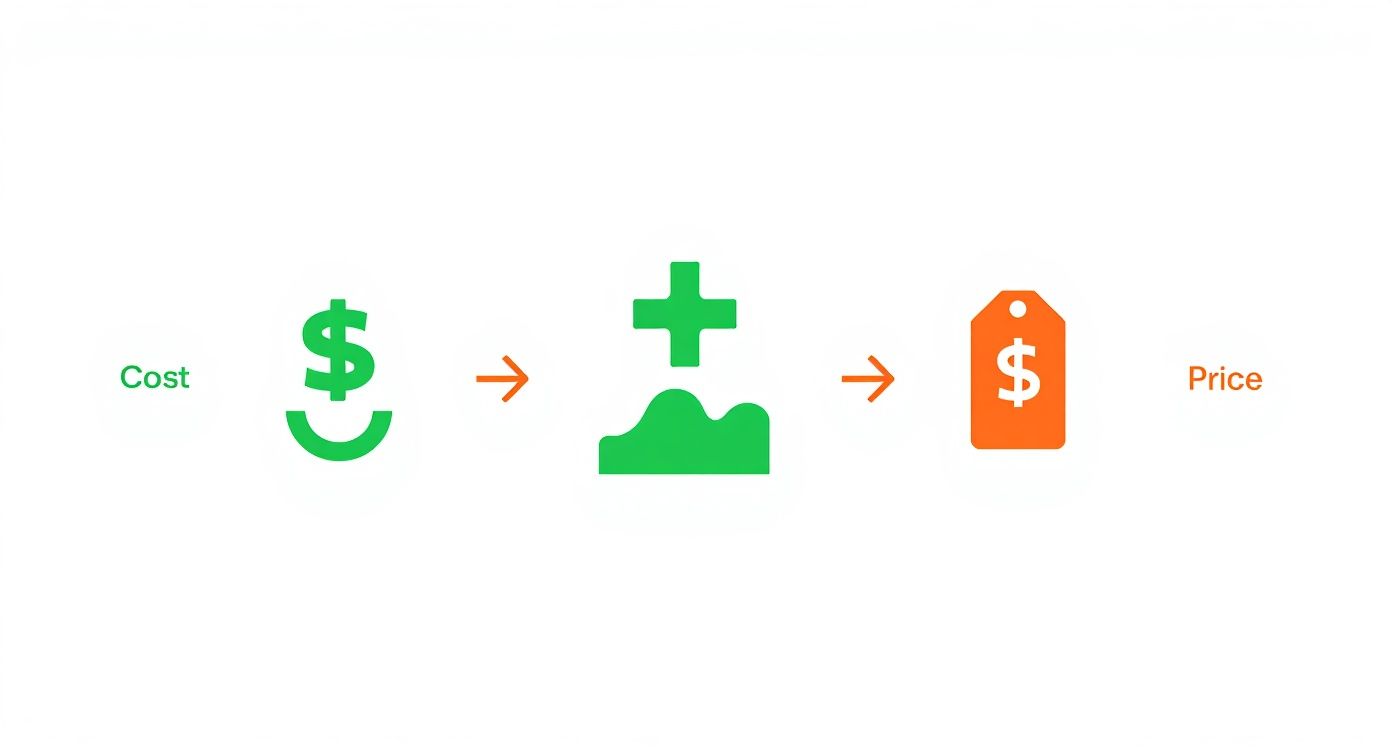
As you can see, the final price needs to cover not just the item’s cost but all the other selling expenses before you can call it a true profit.
Profit percentage is a crucial health metric, even for large companies. For instance, if a major airline reports a net profit of S$2 billion on revenues of S$15 billion, that works out to a profit percentage of about 13.3%. It’s a testament to incredible operational efficiency, and a reminder that every percentage point counts.
Ultimately, while spreadsheets are a great place to start, a helpful solution for sellers across multiple channels is an integrated platform like OneCart. It automatically syncs data from all your sales channels, consolidating orders and factoring in all the associated fees. This gives you a single, unified dashboard showing your true profitability in real-time—saving you countless hours and helping you avoid the costly mistakes that come from crunching numbers by hand.
Even after you’ve got the formulas down, some practical questions always pop up. Here, we’ll tackle some of the most common ones we hear from business owners, giving you clear, straightforward advice to apply these concepts with confidence.
The most honest answer is: it completely depends on your industry.
There’s no magic number that works for everyone. A high-volume retail shop operates in a totally different financial world than a specialised software company.
Actionable Insight: Don’t chase a universal figure. Instead, research the typical profit benchmarks for your specific industry in the Singaporean market. Your goal is to land on a percentage that comfortably covers all your expenses, leaves you enough cash to reinvest in growth, and lets you pay yourself a reasonable salary.
Consistency is key when it comes to your finances. How often you should crunch the numbers really depends on which profit figure you’re looking at and what you plan to do with that information.
For big-picture, strategic planning, you need to calculate your net profit percentage at least quarterly. An annual calculation is also essential for year-end reporting and tax preparation. This gives you a clear view of your business’s long-term financial health and performance over time.
For day-to-day operations, keep a much closer eye on your gross profit percentage—ideally on a monthly basis. This lets you react quickly to any issues with your pricing, supplier costs, or sales strategies before they snowball into bigger problems.
For example, if you run a huge campaign for an event like 11.11, calculating the profit percentage for that specific period can give you invaluable insights into how successful the promotion really was.
Seeing a low profit percentage is a clear signal that it’s time to take action. Fundamentally, improving this number comes down to pulling two main levers: increasing your revenue or decreasing your costs. The best results usually come from doing a bit of both.
Ultimately, making small, consistent improvements across a few of these areas can lead to a substantial and sustainable boost in your overall profit percentage. This is how you build a stronger financial foundation for your business.
Ready to stop juggling spreadsheets and get a real-time, unified view of your true profitability across all your sales channels? OneCart centralises your orders, inventory, and analytics from Shopee, Lazada, TikTok Shop, and Shopify into a single powerful dashboard. Discover how top sellers save time, prevent errors, and scale faster by visiting https://www.getonecart.com to see how it works.
Automate & Scale Your Online Business with OneCart
Start a Free TrialUsed by hundreds of merchants in Singapore & Southeast Asia