How Do I Calculate Margin for My E-commerce Store 2026
Struggling with 'how do I calculate margin' for your SG e-commerce business? This guide offers clear formulas and practical tips for lasting profitability.
Struggling with 'how do I calculate margin' for your SG e-commerce business? This guide offers clear formulas and practical tips for lasting profitability.
If you want to know your profit margin, the basic formula is straightforward: Margin % = (Selling Price - Cost of Goods Sold) / Selling Price × 100%. This number shows you the percentage of revenue you actually keep as profit from each sale. Getting this right is essential for understanding if your business is truly profitable.
For any e-commerce seller in Singapore, especially on competitive platforms like Shopee and Lazada, mastering your margin is the core of sustainable growth.
A solid grasp of your profitability is what separates thriving businesses from those that quietly burn through cash, mistaking high revenue for actual profit.
This concept map breaks down the basic relationship between your cost, the final price, and the margin you’re left with.
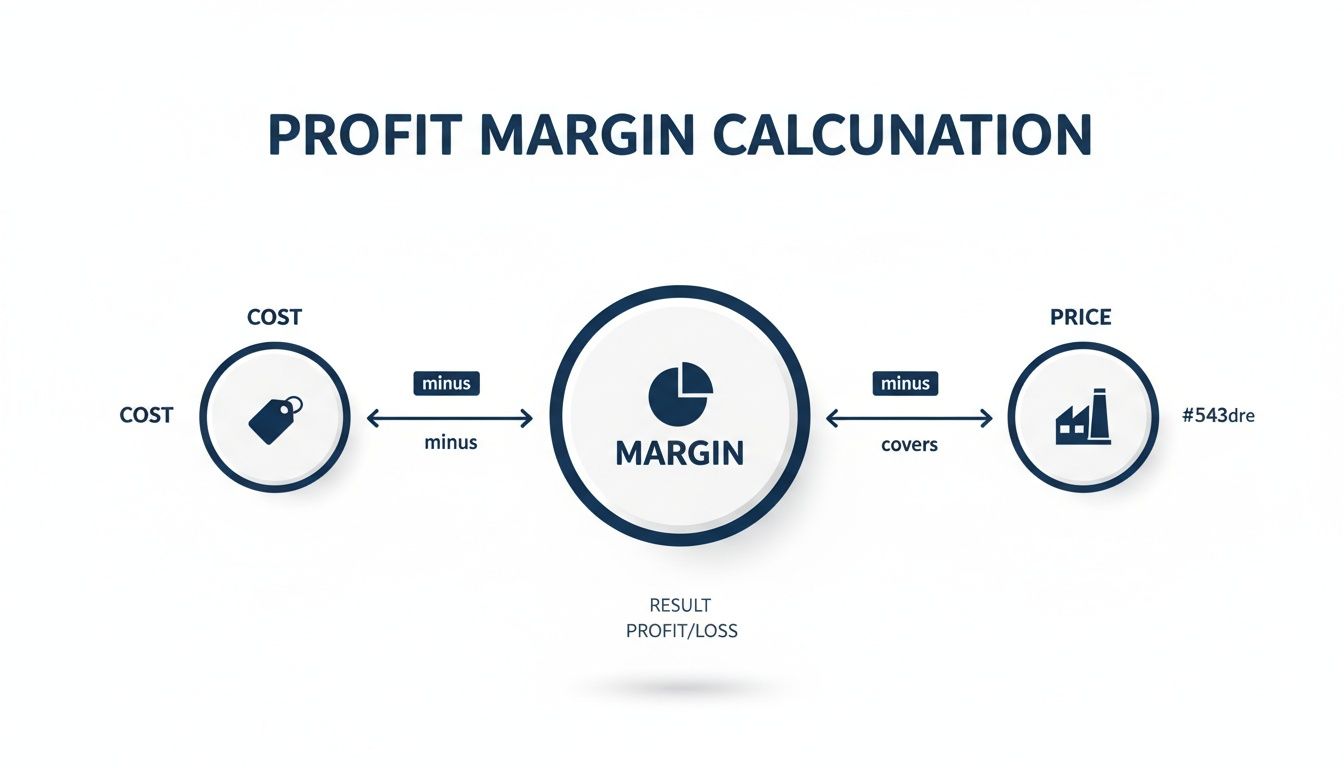
As you can see, the margin is the slice of the final selling price you retain after accounting for what the product cost you to acquire. It’s a direct measure of your efficiency and pricing power.
Before we get into the nitty-gritty, here’s a quick overview of the key formulas we’ll be exploring.
This table summarises the essential margin formulas every seller needs to know. Think of it as your cheat sheet for building a profitable business.
| Margin Type | Formula | What It Tells You |
|---|---|---|
| Gross Margin | (Revenue - COGS) / Revenue | Your profitability on the product itself, before other business costs. |
| Markup Percentage | (Selling Price - Cost) / Cost | How much you’ve marked up the price relative to its cost. |
| Net Margin | (Net Income / Revenue) | The ultimate profitability of your entire business after all expenses. |
| Contribution Margin | (Revenue - Variable Costs) | How much each sale contributes to covering your fixed costs. |
We’ll break down each of these in detail, but this gives you a solid starting point for the concepts we’re about to cover.
Let’s put this into a practical context. Imagine you’re a Shopee seller in Singapore pushing out 100 orders a day. Your secret weapon for staying profitable, especially during massive sales events like 11.11, is a precise understanding of your margin.
Let’s say you sell a gadget for SGD 185—which aligns with the average order value in Singapore—and your cost of goods sold (COGS) is SGD 111. The calculation looks like this:
(185 - 111) / 185 × 100% = 40%
You can get more insights on these e-commerce market trends from recent findings on Cube Asia.
A 40% margin looks healthy on the surface. But this is just the gross margin. It doesn’t yet account for platform fees, marketing spend, shipping subsidies, or the cost of handling returns. If you ignore these additional expenses, that 40% can get eroded so quickly that you end up unknowingly losing money on every single sale.
Actionable Insight: Even a minor miscalculation, when multiplied across hundreds or thousands of orders during a sales event, can have a devastating impact on your bottom line. It’s the difference between celebrating a successful campaign and facing an unexpected financial shortfall.
When you know how to calculate your margins accurately, you unlock the ability to make much smarter business decisions.
Before we dive into the specific formulas for different types of margin, keep this foundational principle in mind. Every strategic decision you make, from marketing campaigns to inventory management, should be guided by its impact on your margins. This is how you build a resilient and scalable e-commerce business.
To really get a grip on your business’s health, you have to look past total revenue. The first metric to master is your gross profit margin. This tells you exactly how much profit you make on a product before you factor in all your other business expenses. It’s the purest measure of your product-level profitability.

This number is powerful because it isolates the core profitability of your goods. It cuts through the noise and answers one simple but critical question: are you pricing your products effectively compared to what they cost you?
Calculating your gross profit margin is refreshingly simple. The formula is designed to show the percentage of revenue you actually keep after paying for the direct costs of your products.
Gross Margin % = (Revenue - COGS) / Revenue × 100
In this formula, Revenue is the total income you get from selling a product. COGS stands for the Cost of Goods Sold. Getting your COGS right is the most crucial part of this whole equation.
For any e-commerce seller, COGS covers all the direct costs tied to getting your products landed and ready for sale.
Think of it as the sum of these key expenses:
Actionable Insight: Your gross margin is the financial pulse of your product line. A low margin signals that a product might be a “vanity metric”—driving revenue but eating up profits. A high margin indicates a strong, profitable item worth promoting.
Let’s ground this in a practical example. Picture a local fashion brand in Singapore selling on their own WooCommerce store and expanding to Shopee. As a DTC brand moving into a competitive marketplace, knowing their gross margin is non-negotiable for surviving high-volume events like 11.11, where managing over 10,000 orders is the norm.
Let’s say they sell a popular dress for SGD 150. Their COGS is SGD 75, which includes sourcing from China—a common supply route for Singaporean retailers.
Here’s the calculation:
(150 - 75) / 150 × 100% = 50%
That 50% gross margin means that for every dollar in sales from that dress, they keep 50 cents to cover all other business expenses and, eventually, profit. This single number gives them the power to take immediate action. If a product has a dangerously low margin, you can start renegotiating supplier terms, confidently increase the selling price, or create product bundles to improve the average order value. If you want to get hands-on with calculations for your own business, Shopify’s guide on profit reports provides a solid starting point.
While gross margin is great for spotting product-level profitability, it only tells part of the story. If you want to understand the real financial health of your entire business, you need to calculate your net profit margin.
This is the metric that reveals exactly what percentage of revenue is left after every single business expense has been paid. Net margin goes beyond just the cost of your products and factors in all the operational costs of running your business. It is the ultimate report card on your overall profitability.
The formula for net profit margin is straightforward, but it demands that you account for every single cost your business takes on.
It’s calculated like this:
Net Profit Margin = (Total Revenue - Total Costs) / Total Revenue × 100
In this formula, “Total Costs” includes all your operating expenses, too. Getting a true picture of your business’s profitability means digging into the full scope of revenues and expenses, which is a lot like learning how to calculate net income. This knowledge is the foundation for an accurate net margin calculation.
Many sellers are shocked when they see how quickly these “hidden” costs add up and eat into what they thought were their profits. You have to be meticulous here.
Operating costs, often just called overheads, are all the expenses that aren’t directly tied to producing one specific item but are essential for keeping your business running.
Here are some of the most common operating costs that e-commerce sellers tend to overlook:
These expenses stack up fast, and you have to account for them if you want an honest picture of your financial health. A deep understanding of your net sales margin gives you a much clearer view of what’s actually left after all these crucial deductions.
Actionable Insight: Net margin is your business’s final report card. It answers the most important question: After everything is paid for, is the business actually making money? A healthy net margin proves your business model is sustainable and scalable.
For a multi-store SME in Singapore, maybe juggling channels like TikTok Shop, Amazon, and Shopify, getting a grip on net margin is absolutely critical for growth.
Here’s a practical example. Imagine a business processing 200 orders a month. Their average order value (AOV) is SGD 185, which brings in SGD 37,000 in revenue. If their COGS per order is SGD 111 (total SGD 22,200), shipping is SGD 20 per order (total SGD 4,000), and platform fees average 8% (total SGD 2,960), the calculation looks like this:
(37,000 - (22,200 + 4,000 + 2,960)) / 37,000 × 100% = 21.25%
This 21.25% net margin gives them a realistic view of their profitability. You can explore more about trends and their impact on SMEs in the U.S. Trade.gov Singapore E-Commerce Market report.
Getting your margin calculations wrong can lead to some seriously costly business decisions. Knowing the formulas is one thing, but sidestepping the common pitfalls is what really protects your profitability. Many sellers fall into the same traps, turning products that look profitable on paper into hidden money-losers.

Let’s break down the most frequent errors. Think of this as your troubleshooting guide to keeping your bottom line safe.
One of the biggest mistakes is focusing only on the Cost of Goods Sold (COGS). If you forget the mountain of other small expenses, they’ll quietly chip away at your profits until there’s nothing left. These costs often fly under the radar until it’s too late.
Here are the usual suspects:
To fight this, create a detailed cost checklist for every product you sell. List every single potential expense, from the packing tape and bubble wrap to those sneaky transaction fees. This simple habit forces you to account for everything, giving you a much more honest picture of your true costs.
This is a common point of confusion for sellers, yet the difference is absolutely critical for your pricing strategy and understanding your actual profitability. If you mix them up, you can trick yourself into thinking you’re way more profitable than you really are.
Actionable Insight: Margin and markup are two different ways of looking at the relationship between cost, price, and profit. Margin is your profit as a percentage of the selling price, while markup is your profit as a percentage of your cost.
They sound similar, but the numbers they produce are worlds apart. Let’s look at a quick comparison to make this crystal clear.
Imagine you buy a product for SGD 50 and sell it for SGD 100. Here’s how the two metrics tell a very different story with the exact same numbers.
| Metric | Formula | Example (Cost SGD 50, Price SGD 100) | Purpose |
|---|---|---|---|
| Margin | (Price - Cost) / Price | (100 - 50) / 100 = 50% | Tells you what percentage of your revenue is actual profit. It’s your profitability yardstick. |
| Markup | (Price - Cost) / Cost | (100 - 50) / 50 = 100% | Shows how much you’ve increased the price relative to what it cost you. It’s a pricing tool. |
See the difference? The profit is SGD 50 in both scenarios, but the percentages are drastically different. A 100% markup sounds amazing, but it only translates to a 50% margin.
Always use margin to evaluate how profitable your business is and markup as a tool to set your initial prices. Getting this right is fundamental to making sound financial decisions.
Manually calculating margins in a spreadsheet for every single order is a recipe for disaster. As your business scales across multiple channels, this process quickly goes from tedious to dangerous for your profitability. All that time spent exporting sales data, matching it with costs, and wrestling with formulas is time you aren’t spending on actually growing your business.
This is the point where smart sellers switch from manual calculations to an automated approach. Using a centralised system like OneCart means you can track your profitability in real-time across Shopee, Lazada, TikTok Shop, and Shopify—all from a single, clear dashboard.
The idea behind automation is simple but powerful. Instead of reacting to last month’s numbers, you get an instant, accurate picture of your financial health with every sale that comes in. This lets you make proactive decisions that can directly boost your bottom line.
A crucial first step is to diligently input your Cost of Goods Sold (COGS) for every product directly into your OneCart system. This is the foundation of accurate tracking. When a sale comes through from any channel, the system automatically subtracts your pre-loaded COGS to calculate the gross profit on that specific order.
The OneCart dashboard gives you a clean, visual breakdown of your sales and profit data, completely eliminating the guesswork.
This kind of snapshot shows how a unified platform consolidates sales data into one easy-to-read view, which is the first step towards automated profit analysis.
One of the biggest wins from automation is getting channel-specific analytics. You might have a hunch that your Shopee store is more profitable than your Lazada store, but an automated system gives you the hard data to prove it.
Actionable Insight: By comparing the net margins of each channel, you can uncover which platforms are your true money-makers and which might be underperforming. This is about data-backed insights, not guesswork.
This information is incredibly actionable. Here’s what you can immediately do with it:
For businesses that want a head start, you can play around with a free e-commerce profit margin calculator to get a baseline understanding of your numbers. Automating this process with a tool like OneCart takes that clarity to the next level, turning raw data into a strategic advantage that fuels real growth.
Even with the formulas in hand, specific questions always pop up when you start applying these calculations to your actual business. It’s one thing to know the theory; it’s another to handle the messy reality of discounts, shipping fees, and industry benchmarks.
Let’s tackle some of the most common questions sellers have about calculating margins accurately and what those numbers really mean for your bottom line.

These are direct, clear answers to help you navigate real-world e-commerce scenarios and sharpen your understanding of profitability.
There’s no single “good” margin. The right number varies wildly depending on your industry, product category, and business model.
That said, a healthy gross profit margin for many e-commerce businesses often lands somewhere between 40% and 60%. This range typically gives you enough breathing room to cover all your operating expenses and still walk away with a solid net profit.
For a practical example, a business selling handmade jewellery might need a 60-70% gross margin to make up for the high cost of labour. On the flip side, a high-volume electronics reseller might get by on a much tighter 20-30% gross margin, relying on sheer volume to make their money. The key is to stop looking for a magic number and start benchmarking against your specific industry to make sure your margin is sustainable.
This one is critical: discounts must be subtracted from your revenue before you calculate your margin. If you sell a product for SGD 100 but give the customer a 20% discount, your actual revenue for that sale is SGD 80. Your margin calculation has to start from this lower number.
Let’s say the product cost you SGD 50 to acquire.
If you don’t use the discounted revenue figure, you’ll get a dangerously inflated sense of profitability. Always calculate your margin based on what the customer actually paid you.
How you handle shipping costs depends on your business model. If you offer “free shipping,” the courier fee becomes part of your overall operating expenses and will directly reduce your net margin. It is not usually included in the Cost of Goods Sold (COGS) for your gross margin calculation.
But if you charge customers for shipping, that revenue helps to offset the shipping expense. Many businesses prefer to treat shipping revenue and shipping costs as separate line items that effectively cancel each other out. This keeps them out of the product margin calculation, giving you a cleaner view of product-level profitability.
Actionable Insight: The most important thing here is consistency. Decide on a method for handling shipping costs and stick to it across all your calculations. This ensures your data is comparable over time, which is critical for spotting trends in your profitability.
Ready to stop wrestling with spreadsheets and get a real-time, accurate view of your profitability across all your sales channels? OneCart centralises your operations and automates margin tracking, so you can focus on making data-backed decisions that drive growth. Discover how to streamline your business at https://www.getonecart.com.
Automate & Scale Your Online Business with OneCart
Start a Free TrialUsed by hundreds of merchants in Singapore & Southeast Asia