The Perfect Format of Packing List for E-Commerce Growth 2026
Discover the ideal format of packing list to prevent shipping errors and scale your e-commerce operations. Get actionable templates and automation strategies.
Discover the ideal format of packing list to prevent shipping errors and scale your e-commerce operations. Get actionable templates and automation strategies.

A proper format of a packing list is the detailed roadmap that tells everyone exactly what’s inside a shipment. It acts as the single source of truth connecting your warehouse team, your shipping carriers, and your customer, making sure everyone is on the same page.
Before a pilot takes off, they run through a meticulous pre-flight checklist, verifying every control to ensure a safe flight. Your packing list serves the same function for your warehouse team. It is the critical checklist they rely on to make sure every order is picked, packed, and shipped with perfect accuracy.
Without a clear, standardized format, things can go wrong quickly. A poorly structured list is a direct line to costly mistakes. When item descriptions are vague or SKUs are missing, your pickers are left to guess. Guesswork leads to mis-picks, which means sending the wrong products to customers, triggering expensive returns, painful one-star reviews, and a permanent loss of trust.
The fallout from a confusing packing list goes beyond simple mix-ups. It creates serious operational friction that puts a hard ceiling on your ability to scale. Consider the daily impact:
Standardizing this one document is a key step to scaling from 50 orders a day to 5,000. A clean, consistent format empowers your team to work faster and more accurately, building an efficient system that fuels growth.
A packing list is the central nervous system of your fulfillment operation. It connects your inventory data, warehouse actions, and the final customer experience into one cohesive flow. When it fails, the entire system breaks down.
The need for this kind of precision is only getting more intense. The global e-commerce packaging market is expected to hit a staggering USD 207.17 billion by 2030. That explosive growth means millions more packages are flying through fulfillment centers every single day.
A precise format—detailing item SKUs, quantities, and weights—is non-negotiable for preventing overselling and streamlining the bulk printing of shipping documents. For any merchant handling thousands of orders, this is absolutely critical. You can explore the data behind this growth in this e-commerce packaging report.
A great packing list is the blueprint for warehouse accuracy. It is the single document that guides your team through the entire fulfillment process, from locating the right products to confirming the order is perfect before the box is sealed. Let’s break down what turns a simple piece of paper into a powerful operational tool.
Each element on this document has a specific job. When you put them all together correctly, you create a clear, scannable, and virtually error-proof guide for every order. This is the ideal format of a packing list.
At the top of the list, you need the foundational information that instantly identifies the order and its destination. This section is non-negotiable and must be clear at a glance.
These details act as the document’s header, giving immediate context before a picker even thinks about the items inside.
Here’s a great example of a packing list that nails these core elements right at the top.
See how the shipper, consignee, and order details are neatly separated? That makes the document easy to read in a split second.
This is where the real work happens. The item section must be designed for speed and absolute clarity. Any vague descriptions or missing information here will grind your entire fulfillment line to a halt.
A strong item section must include:
TSHIRT-BLU-LG. It should be prominent and paired with its own scannable barcode for scan-to-verify workflows.6109.10. Putting it on the packing list helps streamline cross-border shipments and avoid delays.When these fields are laid out in a clean table or grid, your team can fly through the picking process with confidence and precision.
A well-formatted packing list doesn’t just list items; it directs action. Every field should answer a potential question from your warehouse team before they even have to ask it.
The bottom of the packing list is all about confirming the shipment is complete and ready to go out the door. This final section closes the loop on the fulfillment process.
One of the most crucial elements here is Carton Numbering. If an order is split into multiple boxes, labeling each list as “Box 1 of 3,” “Box 2 of 3,” and so on is absolutely essential. This tells the customer their entire order has arrived and helps carriers keep related packages together. This one simple step prevents those dreaded “Where is the rest of my order?” customer service tickets. You can find more templates and real-world examples to perfect your own system by exploring our complete guide to packing list templates. By structuring your format this way, you create a comprehensive document that serves everyone involved, from your internal team all the way to the end customer.
Selling across different platforms and borders means your packing list can’t be a one-size-fits-all document. The simple list that works for a domestic Shopify order is different from what a cross-border shipment to a customer on Lazada or Shopee needs. If you treat them the same, you’re setting yourself up for customs delays and compliance headaches.
Think of your packing list as a dynamic document that changes based on its destination. For a simple domestic sale, the basics—shipper, consignee, and item details—are usually enough. But the moment a package crosses a border, that packing list becomes an official customs document, and the information required gets much more specific.
Major marketplaces have their own finely tuned operational flows. They often require specific information on packing documents to keep their massive logistics networks running. Getting this wrong can lead to penalties or hold-ups.
FBA15G8XYZ0U001 and the list must show it contains 50 units of SKU B08H9D9V3P.For any international shipment, your packing list must include critical data for customs officials. This part is non-negotiable and directly impacts how quickly your package clears customs. When adapting your format of a packing list for global shipping, even thinking about the details of your packaging, like choosing the right packaging for your products, can make your fulfillment more efficient.
For international orders, your packing list is no longer just an internal tool; it’s a legal declaration. Every field must be accurate to ensure a smooth journey through customs and avoid costly fines or seizures.
The following fields become absolutely mandatory:
To give you a clearer picture of how these needs change, here’s a quick-reference guide.
| Requirement | Domestic (e.g., Shopify) | SEA Marketplaces (e.g., Shopee/Lazada) | International (Cross-Border) |
|---|---|---|---|
| Shipper/Consignee Info | Required | Required | Required |
| Item Description & SKU | Required | Required | Required |
| Quantity | Required | Required | Required |
| Marketplace Order ID | Optional | Required | Required |
| HS Code | Not Needed | Optional (often automated) | Required |
| Country of Origin | Not Needed | Not Needed | Required |
| Declared Value | Not Needed | Not Needed | Required |
| Weight & Dimensions | Recommended | Required for Shipping | Required |
As you can see, the data required escalates quickly once a package leaves the country. Getting this right is what separates smooth, professional global sellers from those who are constantly dealing with shipping problems.
This is where the sheer scale of global e-commerce becomes clear. With global sales projected to top USD 6.42 trillion, the need for precision is massive. In major markets like the US (over USD 1.17 trillion in sales), getting customs data right is essential for market access.
The most effective solution is to create a dynamic template. Using an order management system, you can set rules that automatically add these international fields only when an order’s destination is outside your home country. This saves your team time and ensures every package leaves with the correct, compliant documentation. Learn more about simplifying this process in our guide to successful cross-border e-commerce. For cross-border shipments, you’ll also need a commercial invoice alongside your packing list — it’s the key document declaring your goods’ value, HS codes, and Incoterms for customs clearance. Before the commercial invoice, many B2B sellers start with a formal quotation to confirm pricing and terms with the buyer. Use our landed cost calculator to work out the total per-unit cost including shipping, duties, and taxes before setting your price. For freight shipments, the carrier issues a bill of lading that serves as the legal contract of carriage and proof of shipment. To formally authorise the release of goods from your warehouse, create a delivery order — it serves as proof of dispatch and links your packing list to the shipment.
A perfectly formatted packing list is a powerful tool, but its real value comes from how your team uses it on the warehouse floor. Even the best design won’t prevent errors if your operational workflows aren’t aligned with it. Putting smart practices in place turns your packing list from a simple document into the engine of an efficient, error-proof fulfillment process.
The goal is to make accuracy the path of least resistance. This means designing your workflows around the information on the packing list, ensuring every step is intuitive and verifiable.
How you physically handle packing lists can make a huge difference in your team’s efficiency. Instead of printing one list at a time, consider batch printing for “wave picking.” This is where you print all the lists for a group of similar orders—for example, all single-item orders going to California. This approach lets a single picker grab all the necessary items in one optimized trip through the warehouse, dramatically cutting down on travel time.
To make this even more effective, your format of a packing list should be optimized for scanning speed and durability.
The single most effective way to eliminate packing errors is to implement a “scan-to-verify” system. This simple process makes it nearly impossible to send the wrong item or quantity to a customer.
The workflow is straightforward:
This process provides a digital confirmation for every single item packed, reducing human error to almost zero. To ensure your packing list integrates seamlessly with your overall operations and optimize warehouse workflows, understanding the capabilities of robust WMS and ERP systems is a great next step.
Beyond verification, the packing list can serve as a strategic guide. A well-designed format can help organize picking routes by listing items in the order of their physical location in the warehouse (e.g., Aisle 1, Bay 2, Shelf 3). This creates a more efficient path for pickers, minimizing unnecessary walking and maximizing the number of orders they can fulfill per hour.
Think of the packing list as the final quality control checkpoint. Before the box is sealed, a team member should do a final review, ticking off each item on the printed list to physically confirm everything is present and correct.
This final manual check, guided by the document, catches any potential issues before they leave your facility. For more insights on structuring your warehouse for success, check out our ultimate guide to warehouse inventory management.
Creating packing lists by hand for every order is slow, tedious, and a breeding ground for mistakes that doesn’t scale with a growing business. As your order volume climbs, the time you burn on data entry and the risk of a simple typo derailing a shipment both shoot through the roof.
The fix is to move to an automated system. This is how you reclaim hundreds of hours and guarantee perfect accuracy on every single package that leaves your warehouse.
This is where a centralized platform like OneCart becomes your command center. Instead of jumping between Shopee, Lazada, and Shopify seller panels, all your orders pour into one unified dashboard. This creates a single source of truth for your entire fulfillment operation.
This flow diagram shows just how simple and powerful the process becomes once you let automation take over in your warehouse.
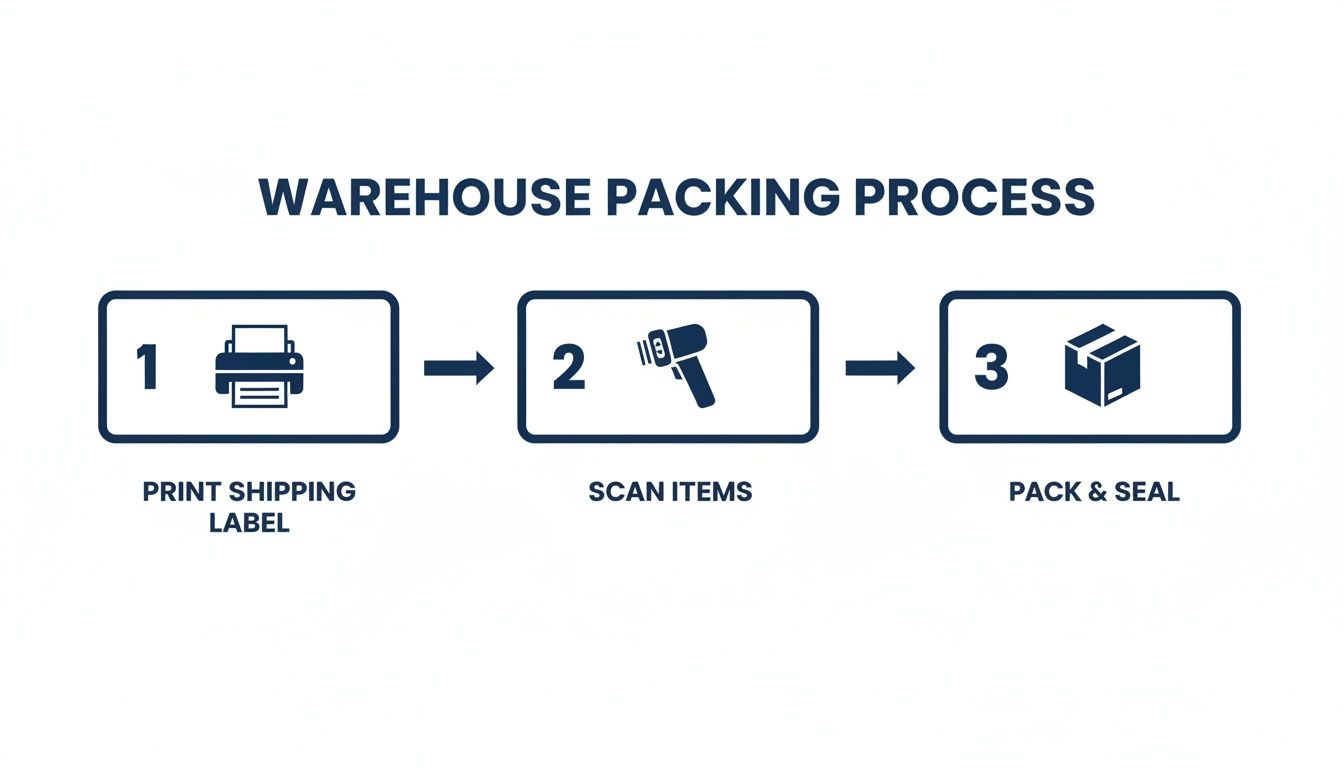
What was once a complicated manual job gets boiled down to three core actions: Print, Scan, and Pack.
With an automated system, you can design your perfect format of packing list once and save it as a template. This means you can add any field your business depends on—like bin locations to speed up picking, custom notes for the packer, or even your company logo. It ensures every document is perfectly tuned to how your warehouse actually works.
Once your template is locked in, the real magic happens. You can select hundreds—or even thousands—of orders and generate all their packing lists and shipping labels in a single click. No more mind-numbing copy-pasting of customer addresses or manually typing out SKUs.
Automation transforms packing list generation from a tedious, order-by-order chore into a strategic, batch-driven process. It frees your team from administrative headaches so they can focus on what they do best: getting orders out the door fast.
Making the switch to an automated packing list system delivers a powerful, immediate payoff. The benefits go beyond saving time; they touch every part of your fulfillment process, building a more resilient and scalable operation.
Here are the core advantages you’ll see right away:
Automation also has a huge role to play in sustainability. In 2019, the global e-commerce sector produced an incredible 942 million kilograms of plastic packaging waste. A smarter, automated packing list can include precise item weight and dimension data. This allows systems to recommend the right-sized box for every order, reducing material waste by as much as 25% and helping your business operate more sustainably. You can discover more insights about e-commerce packaging statistics to see the full impact.
By automating your packing list generation, you are building a faster, more accurate, and more scalable fulfillment operation.
Even with a perfectly designed system, questions always come up. When you’re managing hundreds or thousands of orders, you need clear, direct answers to keep your warehouse running smoothly. Let’s tackle some of the most common questions we hear from warehouse managers and e-commerce sellers about the format of a packing list.
Getting these fundamentals right clears up confusion and empowers your team to work with confidence.
A packing list is for logistics, while an invoice is for finance. A packing list tells everyone involved—your warehouse team, customs officials, and the customer—exactly what physical items are inside a shipment. It details SKUs, quantities, weights, and descriptions. Critically, it almost never includes prices.
An invoice is all about the money. It lists the cost of each item, payment terms, taxes, and the total amount due. The packing list makes sure the right items get into the box; the invoice makes sure the right amount gets paid.
Yes, and many modern warehouses have gone mostly digital. Using tablets or handheld scanners for your pickers is a great way to cut down on paper waste and allow for real-time order updates. It’s a core part of an efficient, modern workflow.
However, a printed copy is still essential in many situations. Customers appreciate having a physical list for their own records, and customs officials almost always require a printed copy for international shipments.
The most effective strategy is often a hybrid approach. Use digital lists for your internal picking and packing process, then slip a final printed copy inside the box for the customer and for compliance.
Adding barcodes is simpler than it sounds and is usually handled by your order management software. The system automatically generates a unique barcode for each order number and embeds it directly into your printable template.
When your warehouse team scans this barcode, the order details instantly pop up on their device. This simple action kicks off the scan-to-verify process, making fulfillment much faster and more accurate than having someone manually punch in an order number.
This depends on where the package is going. For domestic shipments, a packing list isn’t always a legal mandate, but it’s an operational best practice that’s essential for accuracy and customer satisfaction. Skipping it domestically is asking for errors.
For all international shipments, however, a packing list is almost always mandatory for customs clearance. It’s a critical document that allows customs officials to verify that the package contents match the customs declaration. A missing or inaccurate list can lead to costly delays, fines, or even having your goods seized.
Need a packing slip right now? Try our free packing slip template generator to create professional, printable packing slips in seconds — no signup required.
Ready to stop wasting time on manual data entry and eliminate packing errors for good? OneCart centralizes all your orders from Shopee, Lazada, and Shopify into a single dashboard, allowing you to generate and bulk-print hundreds of accurate packing lists and shipping labels in a single click. Discover how you can automate your fulfillment process by visiting https://www.getonecart.com.
Automate & Scale Your Online Business with OneCart
Start a Free TrialUsed by hundreds of merchants in Singapore & Southeast Asia