7 ERP System Examples You Should Know 2026
Discover the top 7 erp system example strategies and tips. Complete guide with actionable insights.
Discover the top 7 erp system example strategies and tips. Complete guide with actionable insights.
As an e-commerce seller juggling platforms like Shopee, Lazada, and your own Shopify store, you know the pain of disconnected systems. Manually syncing inventory, reconciling orders, and managing finances across channels consumes valuable time and invites costly errors. An Enterprise Resource Planning (ERP) system centralises these operations, providing a single source of truth for your entire business. But with so many options, how do you find the right fit for your multi-channel operations?
This guide cuts through the complexity. We provide a detailed breakdown of top ERP system examples specifically tailored for Singapore-based merchants. We analyse each platform’s strengths and weaknesses for e-commerce, focusing on crucial modules like inventory and order management, financial centralisation, and integration capabilities.
You will find a strategic analysis of each erp system example, complete with actionable takeaways and direct links to explore further. We examine real-world implementation scenarios, helping you visualise how each solution could work for your business, whether you’re a growing SME processing 50+ orders daily or a 3PL managing multiple client catalogues. This list is designed to help you make an informed decision, equipping you with the insights needed to select a platform that can truly scale with your ambitions.
OneCart establishes itself as a powerful, performance-focused ecommerce management platform, serving as an excellent ERP system example for merchants who need to centralise their multi-channel operations. It is specifically engineered to be the operational core for businesses selling across diverse marketplaces like Shopee, Lazada, and TikTok Shop, alongside direct-to-consumer channels such as Shopify and WooCommerce. Its architecture is built for high-volume scenarios, capably handling peak sales events and daily order volumes exceeding 10,000.
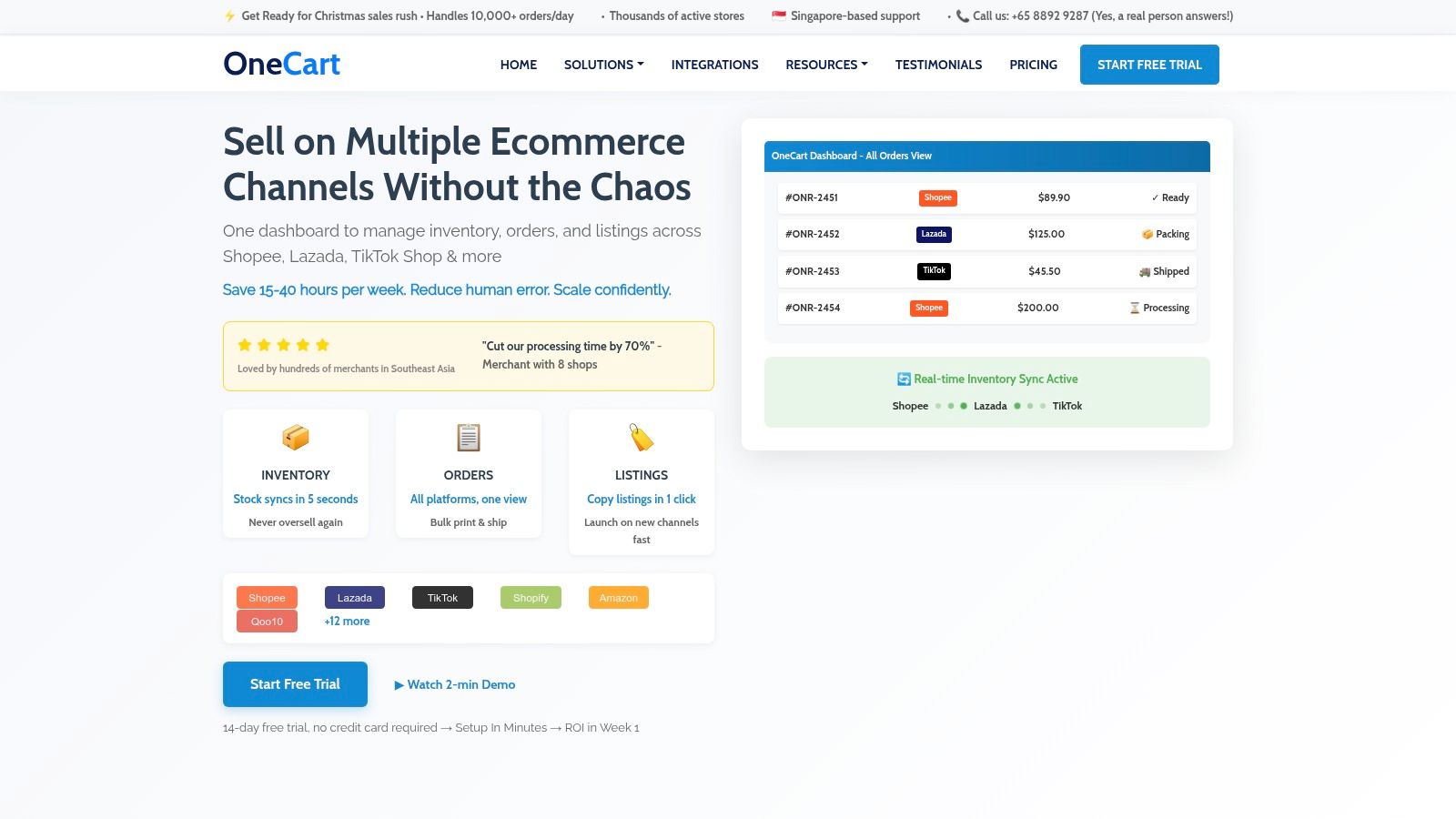
The platform’s core strength lies in its real-time synchronisation capabilities. By syncing inventory levels across all connected stores in approximately five seconds, OneCart effectively eliminates overselling, a critical pain point for multi-channel sellers. This high-speed data flow ensures stock accuracy and maintains a smooth fulfilment pipeline, even during high-traffic periods like 11.11 and 12.12 sales.
OneCart’s value proposition is rooted in operational efficiency and scalable growth. It moves beyond simple inventory management by providing a suite of tools that significantly reduce manual labour and administrative overhead. For merchants looking to expand their footprint, the ability to edit a product listing once and cross-post it to multiple channels is a major accelerator.
Actionable Insight: Leverage the unified order processing dashboard to create a standardised fulfilment workflow for all sales channels. Instead of logging into five different platforms, your team uses a single interface to generate pick lists, bulk-print shipping labels, and arrange courier pickups. This centralisation can cut processing time by up to 70%. For example, a team that previously spent 4 hours a day processing orders from Shopee, Lazada, and Shopify separately can consolidate this into just over an hour using OneCart’s unified interface.
Practical Example: Utilise the platform’s standard API to create a lightweight integration with your existing accounting or logistics software. A practical application is to set up a daily automated export of settled orders from OneCart into your accounting software like Xero. This eliminates manual data entry for bookkeeping, ensuring your financial records are always accurate and up-to-date with sales data. For deeper insights on how this fits into a larger ecosystem, you can learn more about how OneCart complements ERP systems for Singaporean businesses.
| Feature | Primary Benefit |
|---|---|
| Multi-Channel Centralisation | Manages inventory, orders, and listings from a single dashboard. |
| High-Performance Sync | Near real-time stock updates (≈5s) prevent overselling during peaks. |
| Unified Operations | Streamlines order processing, pick/pack, and courier logistics. |
| Responsive Local Support | Singapore-based team available via phone, email, and chat. |
Pros:
Cons:
Best Fit For: Multi-channel merchants, particularly in Southeast Asia, who are scaling their operations and need a robust system to manage high order volumes and prevent stockouts. It is an ideal solution for businesses looking to streamline fulfilment and expand to new marketplaces efficiently. OneCart offers a 14-day free trial with no credit card required, allowing businesses to validate its impact firsthand.
Website: https://www.getonecart.com
Oracle NetSuite’s Singapore-specific portal serves as a premier erp system example for multi-channel merchants aiming for regional and global expansion. Unlike generic ERP websites, this platform is hyper-localised, providing direct access to resources on Singaporean compliance standards like InvoiceNow and the Peppol network. It’s designed for businesses that have outgrown basic accounting software and require a unified system to manage complex operations across multiple countries, currencies, and legal entities.
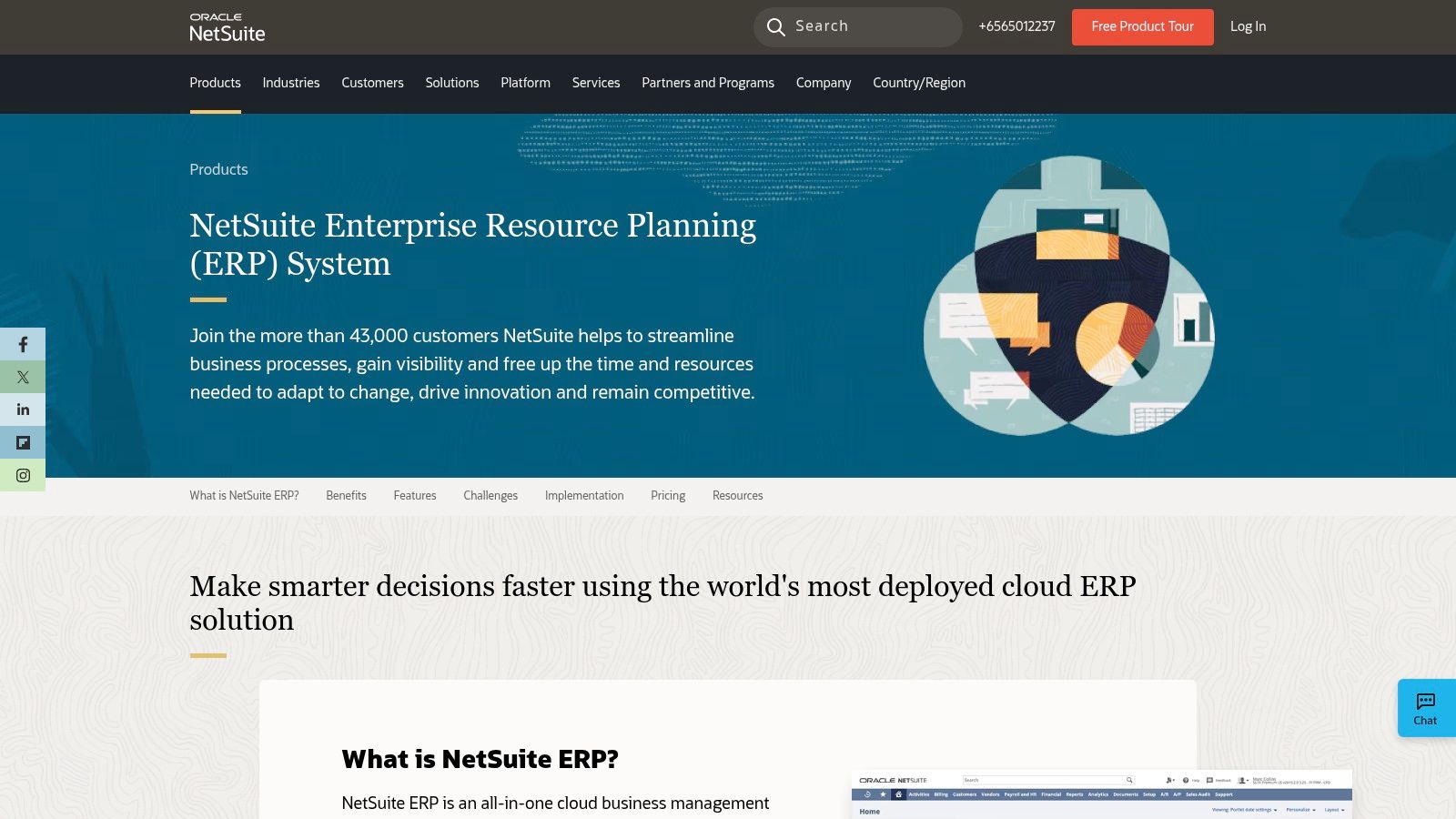
The platform stands out by demonstrating its end-to-end capabilities, from advanced financials and inventory management to sophisticated supply chain and order fulfilment modules. This comprehensive approach is a key differentiator, as it helps businesses avoid the data silos that often arise from stitching together multiple disparate applications. The website offers product tours and outlines a staged implementation process, acknowledging that adopting a full ERP is a significant project.
NetSuite is positioned for scale. Its greatest strength lies in its multi-subsidiary consolidation, making it ideal for a Singapore-based brand with warehouses in Malaysia and customers across Southeast Asia. The system can handle different tax regulations, currencies (over 190 supported), and financial reporting standards within a single, unified dashboard.
However, the power of such a system comes with complexity. The pricing isn’t public because it’s tailored to each business’s specific module requirements, user count, and implementation scope. SMEs should be prepared for a partner-led implementation, which can be a lengthy and resource-intensive process compared to simpler, off-the-shelf solutions.
Actionable Insight: Before engaging with NetSuite sales, map your cross-border operational workflows in detail. Document exactly how you handle multi-currency transactions, inter-company stock transfers, and regional tax reporting. For example, create a flowchart detailing the step-by-step process of transferring stock from your Singapore warehouse to your Malaysian 3PL, including customs documentation and currency conversion for accounting. This preparation will help you get a more accurate quote and ensure the implementation partner fully understands your needs from day one.
Key Features for Multi-Channel Merchants:
| Feature | Strategic Advantage | Best For |
|---|---|---|
| Multi-Subsidiary Consolidation | Provides a real-time, unified view of financials and operations across different legal entities and countries. | Businesses with regional offices or warehouses in multiple ASEAN countries. |
| Advanced Inventory & WMS | Manages stock across multiple locations, including 3PLs, with features like demand planning and cycle counting. | Sellers with high SKU counts and complex fulfilment networks. |
| Localised Compliance | Includes built-in support for Singapore-specific requirements like InvoiceNow, simplifying e-invoicing. | Any Singapore-based business aiming for digital transformation and compliance. |
This robust feature set is a core part of its value, but successfully connecting it to various e-commerce platforms requires careful planning. For merchants exploring this level of integration, understanding the technical requirements is crucial. You can dive deeper into the strategies for connecting such systems by mastering ERP integration solutions.
Website: https://www.netsuite.com.sg/portal/sg/products/erp.shtml
Microsoft’s Singapore-specific portal for Dynamics 365 Business Central is an excellent erp system example for small and medium-sized businesses (SMBs) seeking a scalable cloud solution. The website directly addresses local needs by highlighting its free trial, transparent per-user pricing, and partner packages eligible for government grants like the Productivity Solutions Grant (PSG). This approach demystifies ERP adoption for growing merchants who need to unify finance, sales, and inventory management within the familiar Microsoft ecosystem.
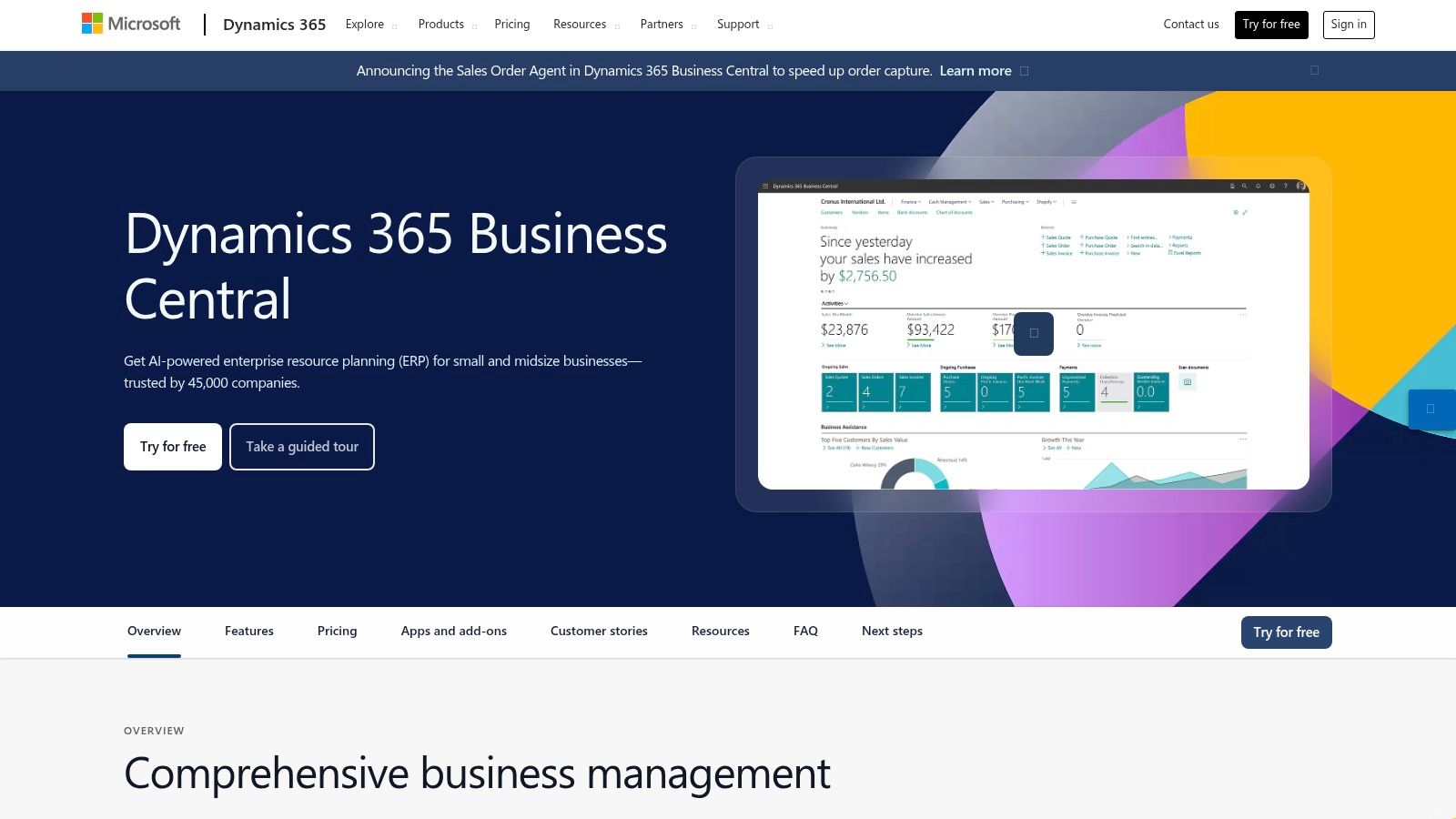
The platform stands out by leveraging its deep integration with Microsoft 365, Power Platform, and Teams, allowing businesses to operate from a single, connected environment. This native connectivity is a major differentiator, enabling workflows like converting a sales quote from Outlook directly into an order in Business Central. The website’s clear distinction between “Essentials” and “Premium” plans helps businesses self-qualify their needs before engaging with a local implementation partner.
Business Central is positioned as the logical next step for businesses heavily reliant on the Microsoft software stack. Its greatest strength is the seamless user experience and data flow between everyday tools (like Excel and Outlook) and the core ERP functions. For a Singaporean merchant, this means staff can generate reports in familiar formats and manage sales communications efficiently, significantly reducing training time and boosting adoption rates. To gain a deeper understanding of this comprehensive business solution, consider reading this guide on What Is Dynamics 365.
However, the system’s reliance on a partner-led model means the total cost of ownership extends beyond the public licence fees. Customisations, data migration, and specific e-commerce integrations will require expert configuration from a third-party vendor, adding to the initial investment. While the AppSource marketplace offers many add-ons, vetting and implementing them requires careful planning.
Actionable Insight: Before starting the 30-day free trial, identify your single most inefficient, manual process that involves both your inventory and finance teams. A practical example is reconciling Shopify payouts against fulfilled orders. Use the trial period to focus exclusively on automating this one workflow. This will provide a clear, measurable ROI and a solid business case for a full implementation.
Key Features for Multi-Channel Merchants:
| Feature | Strategic Advantage | Best For |
|---|---|---|
| Deep Microsoft 365 Integration | Allows users to manage sales, purchasing, and financial data directly from Outlook and Excel, reducing app-switching. | Businesses where staff are already highly proficient with Microsoft Office tools. |
| AppSource Marketplace | Provides access to a wide ecosystem of third-party apps for e-commerce, warehousing, and industry-specific functions. | Merchants needing specialised functionality without costly custom development. |
| Transparent Licensing & Trial | Clear per-user, per-month pricing and a 30-day trial allow for predictable budgeting and risk-free evaluation. | Cost-conscious SMBs and start-ups looking to scale from basic accounting software. |
The platform’s true power is unlocked when connected to the wider commerce ecosystem. This integration ensures that data from various sales channels flows seamlessly into a central system, providing a single source of truth for decision-making.
Website: https://www.microsoft.com/en-sg/dynamics-365/products/business-central
SAP’s S/4HANA Cloud public edition website is a definitive erp system example for established enterprises seeking to standardise operations on a global scale. The platform details a cloud-native ERP built on decades of industry best practices, designed for large organisations that require robust, pre-configured processes. It’s positioned for businesses that need to manage immense complexity in logistics, finance, and compliance across numerous countries and legal entities.
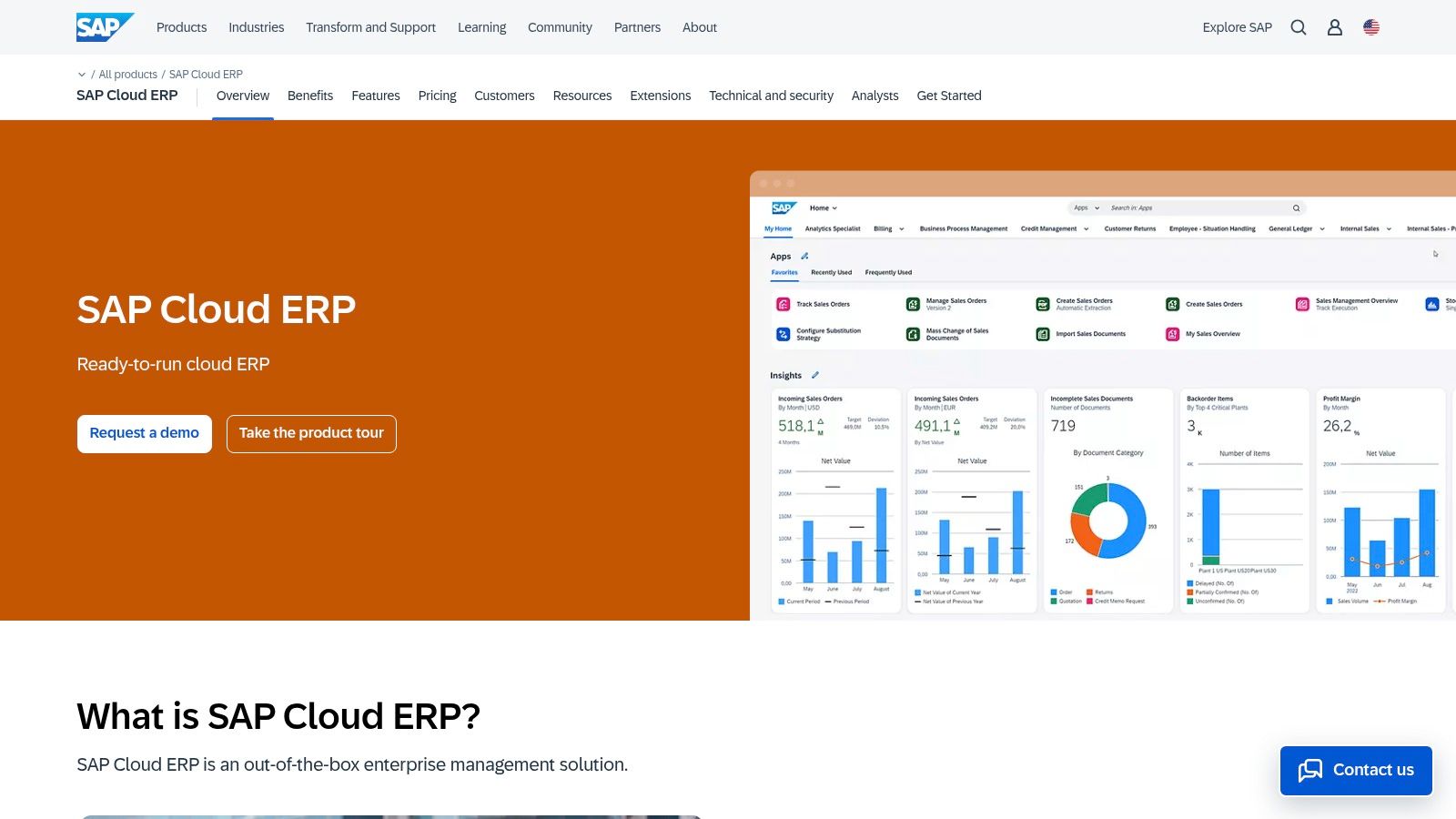
The website stands out by showcasing its guided activation and standardised update cycle, which offers predictability and reduces the long-term maintenance burden often associated with enterprise systems. It presents a comprehensive, integrated suite covering everything from supply chain and manufacturing to subscription billing and project management. This unified approach is crucial for large merchants looking to eliminate data fragmentation and gain a single source of truth across all their international operations.
SAP S/4HANA Cloud is engineered for enterprise-grade scalability and standardisation. Its primary strength is its extensive localisation footprint, with over 1,000 local versions available to handle specific regulatory and tax requirements. This makes it a powerful choice for a multi-channel brand operating across Asia, Europe, and the Americas, ensuring compliance in each market without custom development.
However, this level of standardisation requires significant change management. The system’s value comes from adopting its best-practice processes, which may mean re-engineering your existing workflows. The pricing is not public and requires detailed scoping with SAP or a partner, reflecting the solution’s enterprise focus and complexity compared to more flexible SMB-oriented ERPs.
Actionable Insight: Before approaching SAP, conduct a thorough “as-is” vs. “to-be” process analysis. For instance, map your current returns process from customer request to refund and restocking. Then, compare it to SAP’s standard returns management workflow. This internal audit will accelerate the scoping process by identifying which of your current operational workflows are non-negotiable and which can be adapted to SAP’s best practices, clarifying the extent of change management your organisation must be prepared for.
Key Features for Multi-Channel Merchants:
| Feature | Strategic Advantage | Best For |
|---|---|---|
| Guided Activation & Best Practices | Accelerates initial implementation and enforces process standardisation across the organisation. | Large enterprises aiming to unify disparate regional operations under one system. |
| Extensive Localisation Footprint | Provides built-in compliance for tax, legal, and reporting requirements in dozens of countries. | Merchants with a significant physical or legal presence in multiple international markets. |
| Integrated Logistics & Services | Unifies supply chain, inventory, service, and project management into a single data model. | Businesses with complex value chains involving manufacturing, 3PLs, and post-sale services. |
The system’s enterprise-grade architecture offers unparalleled depth, but connecting it to diverse e-commerce front-ends and marketplace channels demands a well-defined integration strategy. Merchants must plan for robust API-led connectivity to ensure seamless data flow between their sales channels and this powerful operational core.
Website: https://www.sap.com/products/erp/s4hana.html
Odoo’s pricing page is a powerful erp system example because it demystifies the cost and modularity of modern ERPs. Unlike traditional systems that hide costs behind sales consultations, Odoo provides transparent, public pricing, allowing businesses to start small and scale. This approach is ideal for growing e-commerce merchants who can begin with essential apps like Sales, Inventory, and Accounting, and add more complex modules like Manufacturing (MRP) or HR as their operations expand.
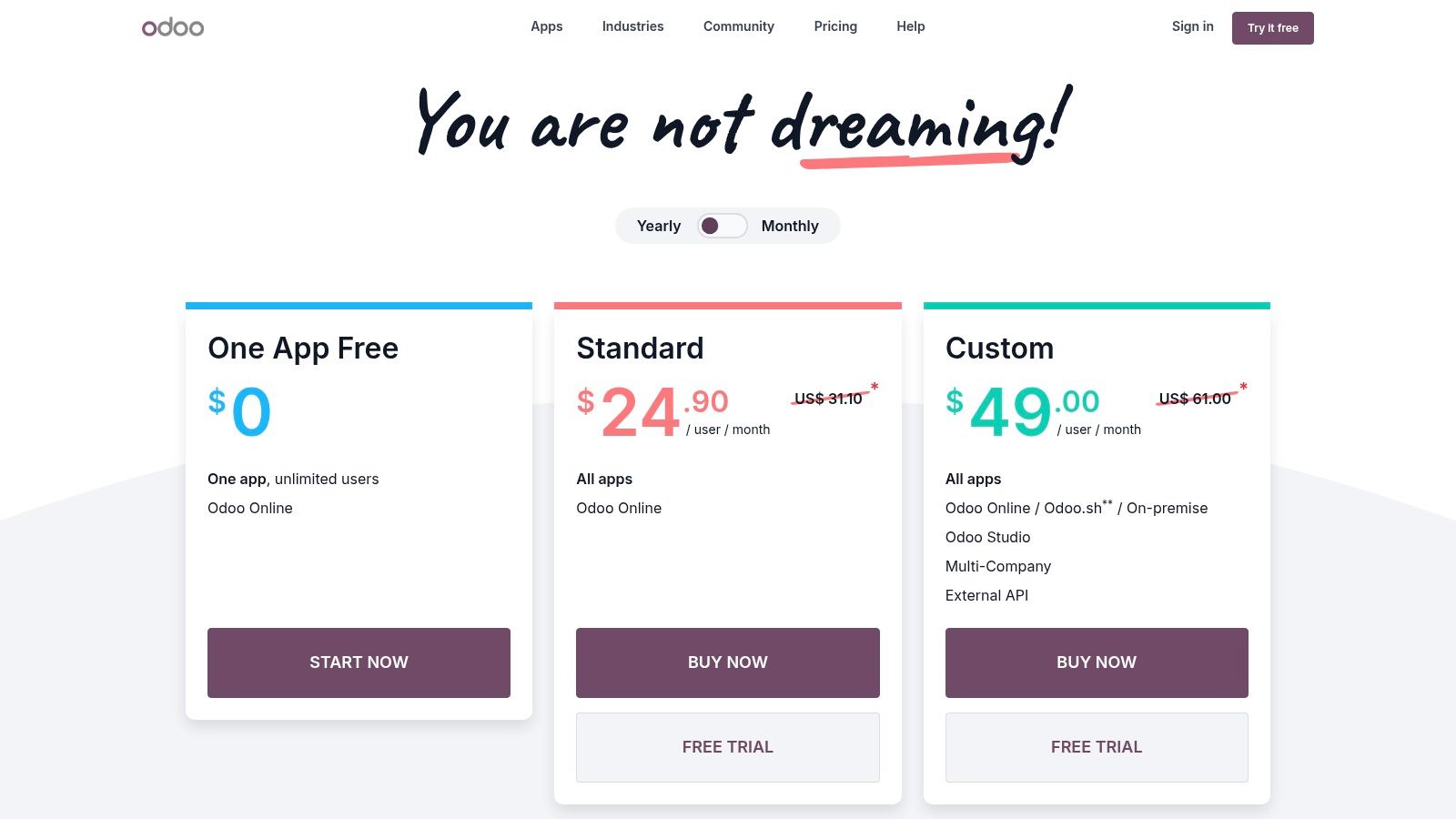
The platform’s strength lies in its flexibility, offering cloud hosting for ease of use or self-hosted options (Odoo.sh/on-prem) for businesses requiring deep customisation. For Singaporean SMEs, the availability of pre-approved packages from PSG-listed partners streamlines procurement and budgeting. This combination of transparency, modularity, and local support makes Odoo an accessible yet powerful entry point into a comprehensive business management solution.
Odoo’s modularity is its greatest asset for multi-channel merchants. A seller can start with the free ‘One App’ tier to manage inventory, then upgrade to a paid plan to integrate their Shopify store, accounting, and CRM as order volume grows. This “pay-as-you-grow” model avoids the high upfront investment typical of monolithic ERPs.
However, this flexibility means the implementation partner is critical to success. The quality of customisation and support can vary significantly between partners. A poorly chosen implementer can lead to a disjointed system, defeating the purpose of an integrated ERP. Heavier customisations also require moving to more complex hosting like Odoo.sh, which adds another layer of technical management.
Actionable Insight: Before selecting an Odoo partner, request case studies specifically from e-commerce businesses similar to yours. Ask them to demonstrate how they handled integrations with your key platforms (e.g., Lazada, Shopee, Shopify) and what custom workflows they built for inventory or order management. A practical example would be asking them to show how they configured Odoo to manage pre-orders for an upcoming product launch, ensuring inventory is reserved correctly. This vetting process is crucial to ensure they understand your operational needs.
Key Features for Multi-Channel Merchants:
| Feature | Strategic Advantage | Best For |
|---|---|---|
| Modular App Structure | Allows businesses to start with essential functions and add capabilities as they grow, controlling costs. | SMEs and startups who need a scalable ERP without a large initial investment. |
| Transparent Public Pricing | Simplifies budgeting and comparison, removing the guesswork often associated with ERP procurement. | Businesses that prefer clear, upfront cost structures for financial planning. |
| Flexible Deployment Options | Offers both simple cloud hosting and advanced on-premise/PaaS options for deep customisation. | Merchants with unique workflows who may need custom code or integrations. |
The modularity of Odoo, especially its inventory and manufacturing apps, provides a solid foundation for optimising your operations. To fully leverage these tools, it is vital to understand the principles of effective supply chain and logistics management.
Website: https://www.odoo.com/pricing
Acumatica provides a refreshing erp system example by challenging the traditional per-user licensing model that often penalises growing businesses. Its pricing page immediately highlights a consumption-based approach, where companies pay for the computing resources they use, not the number of employees who need access. This structure is particularly appealing for mid-market e-commerce businesses and distributors with large teams in warehousing, customer service, or sales who need system access without incurring prohibitive costs.
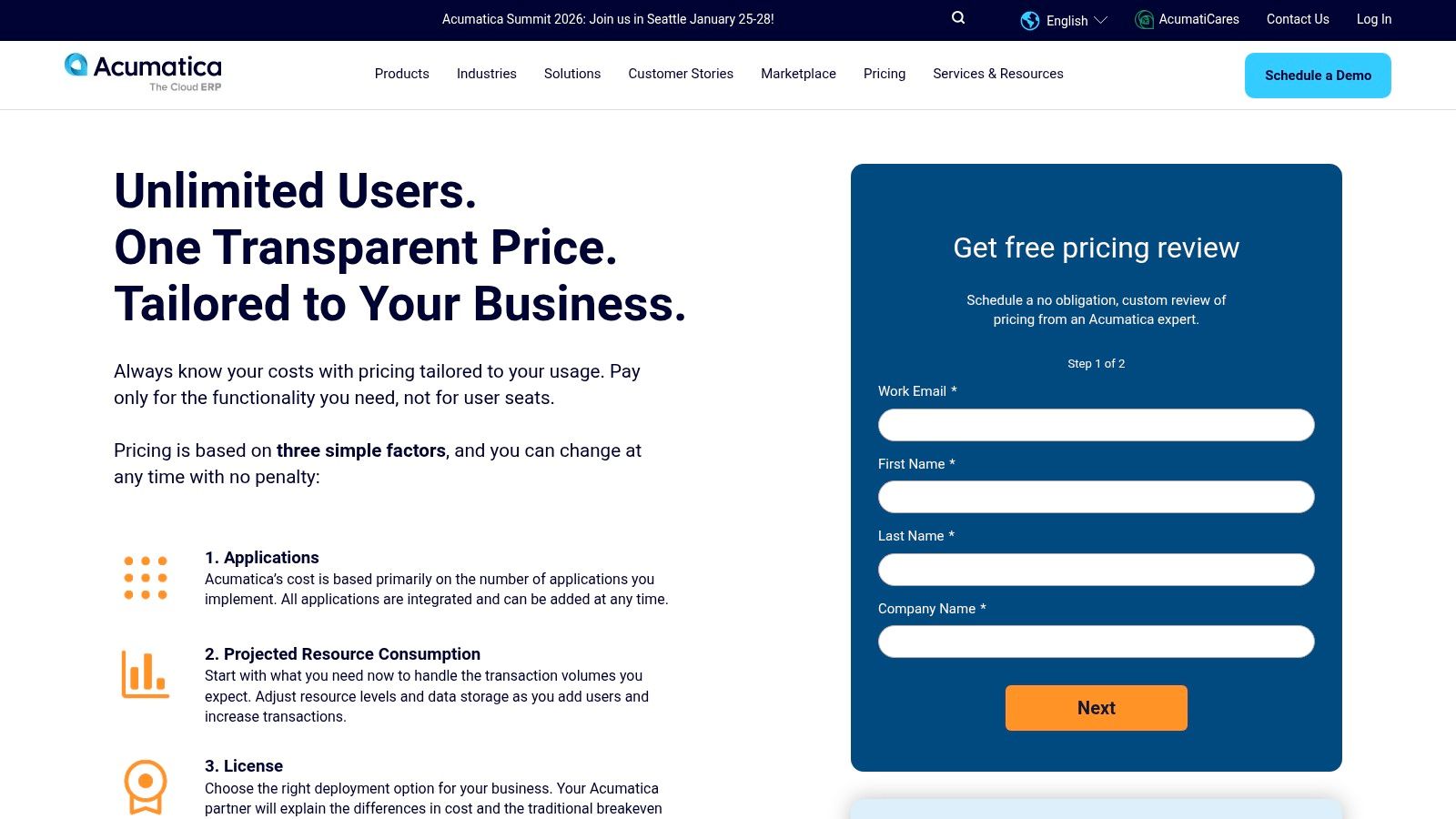
The platform is built on a modern, flexible xRP framework, designed for easier customisations and integrations compared to older, monolithic systems. The website organises its offerings into clear industry editions, such as “Distribution” and “Retail-Commerce,” allowing potential customers to quickly identify the solution tailored to their specific operational needs. It also offers deployment flexibility, allowing businesses to choose between a SaaS model or a private cloud instance.
Acumatica’s core strength is its unlimited user model, which fundamentally changes how a business can leverage its ERP. It encourages widespread adoption across the organisation, from the warehouse floor to the executive suite, without escalating subscription fees. This is ideal for a multi-channel merchant with fluctuating seasonal staff or a large customer service team that needs real-time order and inventory data.
While the pricing is not fully public and requires scoping with a partner, the value proposition is clear: costs scale with business growth (transaction volume) rather than headcount. The reliance on a partner network for implementation means the quality of deployment can vary, making partner selection a critical step in the process.
Actionable Insight: When evaluating Acumatica, identify every role in your company that could benefit from ERP access, even if they wouldn’t justify a per-user licence in another system. For example, give your customer service team read-only access to inventory and order status dashboards. Present this “full access” scenario to a potential implementation partner to understand the true value of the unlimited user model and get a resource-based quote that reflects your actual operational scope.
Key Features for Multi-Channel Merchants:
| Feature | Strategic Advantage | Best For |
|---|---|---|
| Consumption-Based Licensing | Eliminates per-user fees, allowing unlimited staff access and encouraging widespread system adoption. | Businesses with large or fluctuating teams in logistics, sales, or customer support. |
| Industry Editions | Provides pre-configured workflows and features for distribution, retail, and manufacturing. | Merchants in specific verticals who need industry-standard processes out of the box. |
| Flexible Deployment | Offers a choice between SaaS or private cloud hosting, including on AWS Marketplace. | Companies with specific data residency, security, or infrastructure requirements. |
The system’s modern architecture and strong partner ecosystem make it a powerful contender for businesses planning significant growth. Connecting its specialised modules to various sales channels requires a well-defined integration strategy to maximise its potential.
Website: https://www.acumatica.com/pricing/
Sage 300cloud’s Singapore-focused website presents a robust erp system example for established mid-market businesses, particularly those in trading and distribution. Evolved from the well-known Accpac system, it blends the stability of a traditional desktop application with the flexibility of cloud connectivity. The site is tailored for Singaporean SMEs, emphasising its readiness for local compliance like the PEPPOL e-invoicing network (InvoiceNow) and its strong multi-company and multi-currency capabilities.
The platform distinguishes itself by showcasing a practical, operations-first approach to ERP. It highlights core modules like financials, inventory management, and CRM integration, appealing to businesses needing a reliable system without the extensive customisation overhead of enterprise-level solutions. The website directs users to a network of local partners, signalling that implementation and support are handled by experts with deep regional knowledge.
Sage 300cloud is positioned as a pragmatic upgrade for companies moving beyond entry-level accounting software. Its greatest strength is its long-standing presence and extensive local partner network in Singapore, which provides hands-on expertise for implementation and support. This makes it a dependable choice for trading or distribution businesses that require solid inventory and financial controls to manage goods flowing through Singapore.
However, its legacy roots mean it may require more initial setup compared to newer, cloud-native ERPs. Pricing is not public and is provided through quotes from Sage or its partners, reflecting a more traditional sales and implementation process. This requires a deeper engagement from the business to define its needs accurately before getting a clear cost picture.
Actionable Insight: When evaluating Sage 300cloud, leverage its key advantage: the local partner network. Request consultations with at least two different Singapore-based partners. Ask them to provide specific case studies of how they have implemented the system for businesses with similar operational complexities. For example, you could ask for a demonstration of how they handled multi-currency inventory costing and cross-company reporting for another local distributor.
Key Features for Multi-Channel Merchants:
| Feature | Strategic Advantage | Best For |
|---|---|---|
| Multi-Company & Multi-Currency | Simplifies managing financials and inventory for distinct but related business entities, all from one system. | SMEs with separate legal entities for retail and distribution arms. |
| Inventory & Operations Mgmt | Provides robust control over stock levels, order entry, and purchasing, crucial for distribution-heavy models. | Wholesalers and distributors managing a diverse product catalogue. |
| Local Partner Expertise | Ensures implementation and support are handled by experts familiar with Singaporean business practices and regulations. | Businesses that prefer hands-on, localised support over a self-service model. |
The system’s architecture provides stability, but connecting it to modern e-commerce platforms like Shopify or Lazada will likely require a dedicated integration solution. For merchants considering this step, a clear integration strategy is vital. To better understand how to bridge such systems, you can learn more by mastering ERP integration solutions.
Website: https://www.sage.com/en-sg/products/sage-300cloud/
| Product | Implementation complexity | Resource requirements | Expected outcomes | Ideal use cases | Key advantages |
|---|---|---|---|---|---|
| OneCart | Low–Medium — fast setup, standard API | Minimal IT; SKU/catalog standardization helps; Singapore-based support | Centralized multi‑channel order/inventory, fewer oversells, faster processing, quick ROI | High-volume multi‑channel ecommerce sellers and marketplace merchants in SEA | Real‑time stock sync (~5s), unified dashboard, fast integrations, responsive local support |
| Oracle NetSuite ERP (Singapore) | Medium–High — partner‑led, staged implementations | ERP project team, partner services, budget for licensing/customization | End‑to‑end ERP with multi‑subsidiary consolidation and cross‑border capabilities | Growing regional companies with multi‑entity or global operations | Broad module depth, strong multi‑entity features, mature ecosystem, local compliance resources |
| Microsoft Dynamics 365 Business Central (Singapore) | Medium — partner delivered; configurable | Partner implementation, per‑user licenses, Microsoft 365/Power Platform integration | SMB ERP with unified finance/sales/inventory and fast adoption | SMBs using Microsoft ecosystem seeking clear pricing and local grant support | Transparent per‑user pricing, 30‑day trial, deep MS365/Teams/Power Platform integration |
| SAP S/4HANA Cloud (public edition) | High — enterprise change management and scoping | Significant consultants/IT resources; partner/licensing scoping required | Enterprise‑grade scalability, standardized processes, extensive localization | Large enterprises with complex global/regulatory requirements | Guided activation, standardized updates, wide localization footprint and implementation accelerators |
| Odoo (Enterprise and Community) | Low–Medium — modular; straightforward to start, more work for heavy customizations | Lightweight for core apps; partners/Odoo.sh for custom code; public pricing | Flexible, modular ERP that grows with needs; cost‑effective for core functions | SMEs wanting modular, affordable ERP or highly customizable deployments | Transparent pricing, free one‑app tier, flexible deployment, large app ecosystem |
| Acumatica Cloud ERP | Medium — partner‑led with platform extensions | Consumption‑based licensing (scales), partner services, optional AWS deployment | Scalable mid‑market ERP with unlimited users and industry editions | Mid‑market firms needing usage‑based cost model and industry functionality | Consumption licensing, industry editions, modern xRP platform, AWS marketplace availability |
| Sage 300cloud (Singapore) | Medium — partner implementation; legacy roots | Local partners, configuration effort; supports multi‑company/multi‑currency | Robust financials and operations suited to trading/distribution SMEs | Trading/distribution SMEs in Singapore requiring local e‑invoicing (PEPOL/InvoiceNow) | Established local partner network, PEPPOL readiness, hybrid cloud/desktop flexibility |
Navigating the landscape of ERP systems can feel complex, but as we’ve explored, the right solution is often a matter of matching features to your specific business needs. From the comprehensive, enterprise-grade power of Oracle NetSuite and SAP S/4HANA to the adaptable, modular approach of Odoo and Acumatica, each ERP system example offers a distinct pathway to operational excellence for Singaporean multi-channel merchants.
The key is to move beyond brand names and focus on the functional core of your e-commerce operations. Whether you are managing inventory across Lazada and your Shopify store, synchronising financial data, or optimising order fulfilment, the examples in this guide demonstrate that there is no one-size-fits-all answer. Your ideal ERP is the one that solves your most pressing challenges today while providing a scalable foundation for future growth.
To crystallise your decision-making process, here are the most important takeaways from our analysis:
Armed with this information, your path forward is clear. Begin by mapping your current workflows from order placement to final delivery. Document every touchpoint and identify where inefficiencies occur. Use this map to create a shortlist of essential features.
Next, schedule demonstrations with your top three contenders. Prepare a list of specific scenarios relevant to your business, such as “How does the system handle a product bundle sold on Shopee?” or “Show me how a return from a Shopify customer is processed in the system.” This practical approach will reveal which platform truly aligns with your operational reality. By focusing on these tangible outcomes, you transform the abstract idea of an “ERP” into a powerful, practical tool for your e-commerce success.
If you found the integrated, e-commerce-centric approach of a system like OneCart appealing, it may be the perfect starting point for your business. Designed specifically for multi-channel merchants in Southeast Asia, it streamlines inventory, orders, and listings across platforms like Shopee and Lazada without the complexity of a traditional ERP. Explore how OneCart can unify your operations and fuel your growth.
Automate & Scale Your Online Business with OneCart
Start a Free TrialUsed by hundreds of merchants in Singapore & Southeast Asia