7 Best Ecommerce Platforms in Singapore [2026] 2026
Shopee, Lazada, TikTok Shop, Temu, Shopify, WooCommerce & Qoo10 compared. Fees, traffic stats, seller requirements & which platform fits your business in 2026.
Shopee, Lazada, TikTok Shop, Temu, Shopify, WooCommerce & Qoo10 compared. Fees, traffic stats, seller requirements & which platform fits your business in 2026.

Singapore has 7 major ecommerce platforms worth considering in 2026 — from established marketplaces like Shopee and Lazada to fast-growing channels like TikTok Shop and Temu, plus self-hosted options like Shopify and WooCommerce. The right choice depends on whether you want to build a branded store for full control or tap into marketplace traffic for faster sales.
Below, we compare all 7 on fees, traffic volume, seller requirements, and which type of business each platform suits best.
Jumping into Singapore’s buzzing ecommerce scene means making a fundamental choice that will shape your entire business. Will you build your own standalone online boutique, or will you open a stall inside a massive, bustling digital shopping mall? Each path has its own advantages and challenges, and understanding them is your first step.
Singapore’s e-commerce market continues to grow, surpassing $10 billion USD in gross merchandise volume (GMV) in 2024 and projected to reach $13 billion by 2027. This is driven by strong consumer habits: nearly 60% of internet users here shop online every week, and they spend more than anyone else in the region, with an average order value exceeding $140. In 2026, TikTok Shop and Temu have joined Shopee and Lazada as major marketplace options, giving sellers more channels than ever.
A brand store—built on a platform like Shopify or WooCommerce—is your own flagship shop on Orchard Road. You control everything: the design, the customer journey, and all the customer data. This is where you build direct relationships, which is essential for encouraging loyalty and repeat business. The challenge? You are responsible for bringing every visitor to your virtual door, which requires effort in marketing and SEO. For example, a local jewellery brand would use its own Shopify store to tell its unique story, showcase high-quality product photos, and collect customer emails for future marketing campaigns.
On the other hand, selling on marketplaces like Shopee or Lazada is like setting up a pop-up in ION Orchard. You get instant access to millions of shoppers who are already there and ready to buy. The downside is that you are one of many stalls, operating by the mall’s rules. It is difficult to make your brand stand out, and you do not truly “own” the customer relationship, making it harder to build a memorable brand identity. A practical example would be a seller of phone cases who uses Shopee to quickly reach a large audience searching for that specific product, leveraging the platform’s traffic for immediate sales.
This decision tree can help you visualise whether you should prioritise brand control or chase immediate sales volume.
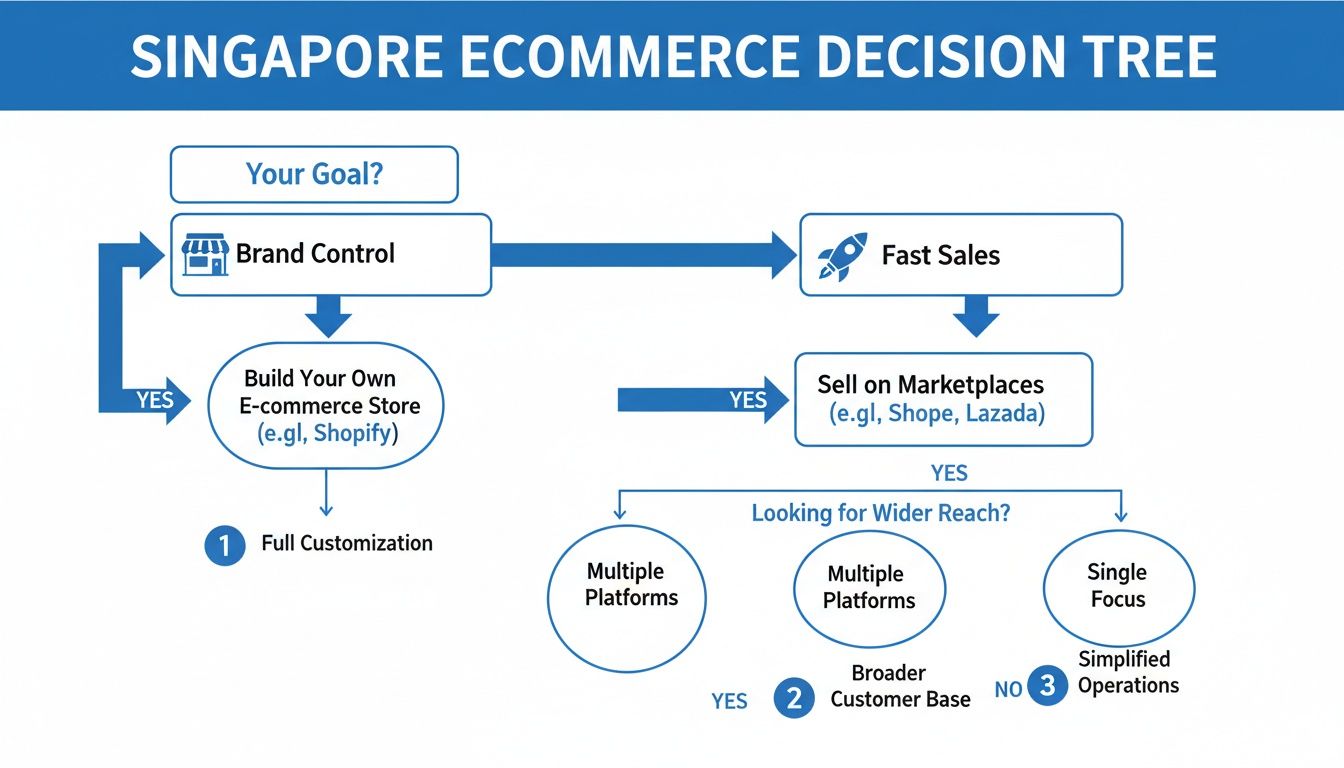
To give you a clearer picture, here’s a quick breakdown of how these options stack up for local sellers.
| Platform Type | Best For | Level of Control | Key Singapore Advantage |
|---|---|---|---|
| Hosted (e.g., Shopify) | Brands focused on long-term growth and customer relationships. | High | Easy integration with SG payment gateways (HitPay, Stripe) and local couriers. |
| Self-Hosted (e.g., WooCommerce) | Tech-savvy sellers wanting ultimate customisation and no monthly fees. | Total | Complete freedom to tailor the store for specific local needs, but requires technical know-how. |
| Marketplaces (e.g., Shopee, Lazada) | New sellers wanting to test products and make quick sales. | Low | Immediate access to a huge, ready-to-buy Singaporean customer base. |
| Cross-Border (e.g., Temu, Amazon) | Sellers with supply chain access wanting to reach global buyers. | Low | Tap into international demand with managed logistics and fulfilment. Use our Amazon FBA calculator to estimate referral and fulfilment fees before committing. |
Ultimately, the best path is different for everyone; it really depends on your immediate business goals. For a deeper dive into listing across channels, check out our guide to the best multichannel listing software.
Actionable Insight: If you’re a new seller with a unique product and a long-term vision, starting with a Shopify store to build your brand from day one is a solid move. However, if your main goal is to test an idea and generate cash flow quickly, launching on Shopee or Lazada first is the more practical route. Many successful businesses end up doing both.
So, you’re ready to build your own direct-to-consumer (DTC) brand store. This is a significant step, giving you complete control over your brand’s look, feel, and the entire customer journey. When you go down this road, you’ll quickly encounter the two biggest names in the game: Shopify and WooCommerce.

You could rent a beautifully fitted-out unit in a popular shopping centre, or you could buy your own plot of land and construct a building exactly to your specifications. Both paths can lead to a thriving business, but they demand very different things from you in terms of effort, technical skill, and cost.
Shopify is a ‘Software as a Service’ (SaaS) platform. This is the “renting a shop” option. For a monthly fee, Shopify provides everything you need, handling all the technical details behind the scenes.
This all-in-one approach is excellent for getting started quickly. An entrepreneur in Singapore could launch a fully functioning store in a single weekend. You simply pick a theme, upload your products, and connect to local payment gateways like Stripe or HitPay with a few clicks. The trade-off is that you are operating within Shopify’s system, which means you have less control over the foundational code.
WooCommerce is the self-hosted path. It’s a free, open-source plugin that integrates with a WordPress website, turning it into a powerful online store. This is like buying your own plot of land—you own it outright and have total freedom to build whatever you can imagine.
With that freedom comes significant responsibility. You are in charge of every technical detail.
Actionable Insight: WooCommerce offers limitless customisation, but you are responsible for managing your own hosting, setting up security measures like SSL certificates, and staying on top of regular software updates and maintenance to keep things running smoothly. For example, if you want a highly customised product builder for bespoke furniture, WooCommerce gives you the flexibility to build that feature from scratch.
This route requires more technical confidence. You’ll need to select a reliable hosting provider, install WordPress and WooCommerce yourself, and manage various plugins for any additional features you want. While it is more work upfront, the payoff is absolute control and potentially lower running costs in the long run, since you are not paying a monthly subscription fee. If you’re running WooCommerce alongside an ERP system, our NetSuite WooCommerce integration guide covers the full setup process. For a deeper dive on the platform itself, check out Shopify’s comparison with WooCommerce that unpacks the design differences.
When choosing between these two excellent ecommerce platforms in Singapore, the best choice depends on your resources, skills, and goals. Neither is inherently “better” than the other; they just serve different needs. To figure out which one is right for you, ask your team these direct questions:
Technical Skills Assessment
Budget and Resource Planning
Answering these questions honestly will guide you to the platform that truly fits your business. A good platform is the foundation, but a successful store also needs an efficient setup. To learn more, see what it takes to build an effective ecommerce website in Singapore that’s geared for the local market. It’s not just about launching; it’s about operating smoothly as you grow.
While building your own brand store is a great long-term goal, ignoring Singapore’s major marketplaces is like opening a fantastic boutique in a quiet back alley. You might have the best products, but if no one knows you’re there, it doesn’t matter. To get visibility and sales from day one, you need to be where the crowds are.
Platforms like Shopee, Lazada, and the fast-growing TikTok Shop are the digital versions of Orchard Road or Jewel Changi. They attract millions of shoppers who are already in the mood to buy. This gives you access to a massive, ready-made audience that would otherwise take years and a huge marketing budget to build yourself.
Shopee dominates Singapore’s e-commerce scene. The platform is designed to be an interactive experience, not just a transaction. It uses gamification, flash sales, and live streams to keep users engaged and returning.
This approach has built a large and loyal user base. For you as a seller, that means a direct line to an enormous pool of potential customers, especially during their massive shopping events like 9.9 and 11.11. Shopee invests heavily in promoting these campaigns, giving your products a visibility boost you could not achieve on your own.
The screenshot below shows Shopee’s homepage—a vibrant, deal-driven environment.
Notice how it immediately presents time-sensitive vouchers, flash sales, and special promotions. This design is highly effective at triggering impulse buys and driving significant sales volume. For a deeper dive into how it compares to its main rival, check out our guide on Lazada vs Shopee.
Lazada also has a massive audience, but it offers a unique advantage for established brands through LazMall. This is a curated, “premium” section of the platform reserved for authorised brand distributors and official stores. Think of it as a powerful stamp of authenticity.
Getting your brand onto LazMall immediately signals trust and quality to Singaporean shoppers, who are often cautious about counterfeit goods online. It allows you to command better prices and builds brand credibility within a crowded marketplace. This makes Lazada an ideal channel for brands that want to project a more premium, trustworthy image.
TikTok Shop has changed the game by blending social media entertainment with seamless shopping. It leverages the power of short-form video and influencer marketing to drive sales in a way that feels organic and engaging.
Actionable Insight: Imagine a local snack brand using a TikTok livestream to launch a new flavour. They could partner with a local food influencer, demonstrate the product, answer questions in real-time, and offer a flash discount. This creates massive urgency and can trigger a flood of instant sales, all without the customer ever leaving the app.
This “shoppertainment” model is excellent for triggering impulse purchases. A user can be scrolling through videos one moment and completing a purchase the next. The buying journey is so smooth and integrated that it is an incredibly powerful tool, especially for brands with visually appealing products. For a complete walkthrough, see our guide on how to sell on TikTok Shop.
Temu has rapidly gained traction in Singapore since its 2023 launch. Backed by PDD Holdings (the parent company behind Pinduoduo), Temu’s model focuses on ultra-competitive pricing by connecting sellers directly with consumers, cutting out middlemen.
For sellers, Temu offers two main models: a fully managed option where Temu handles pricing, shipping, and customer service (you simply ship products to their warehouse), and a seller-fulfilled option where you maintain more control. Commission rates typically range from 2-5%, making it one of the most affordable marketplaces. The platform’s aggressive customer acquisition campaigns mean strong buyer traffic, though the focus on low prices can squeeze margins. If you are considering Temu, read our full guide on how to sell on Temu.
Qoo10 is sometimes overlooked, but it remains a strong local player, particularly for categories like beauty, health, and lifestyle products. What sets Qoo10 apart is its niche focus and loyal user base of deal-hunting Singaporean shoppers.
Seller fees are competitive (typically 8-12% commission depending on category), and the platform has a straightforward seller dashboard. For sellers with products in beauty, supplements, or K-beauty, Qoo10 can be a surprisingly effective channel alongside the bigger marketplaces.
The numbers confirm the strength of Singapore’s marketplace ecosystem. Shopee alone attracts 13.21 million monthly visitors in Singapore, while TikTok Shop’s global gross merchandise value exceeded $30 billion in 2024. With Temu’s rapid expansion and Lazada’s continued profitability, sellers now have more viable channels than ever. You can find more stats on the Singapore ecommerce market on mordorintelligence.com.
To effectively use these platforms, you need a solid plan.
Understanding platform fees is critical for protecting your margins. Here is a quick comparison of what each marketplace charges sellers in Singapore:
| Platform | Commission Rate | Payment Fee | Other Fees | Best For |
|---|---|---|---|---|
| Shopee | 2-6.5% (varies by category) | ~2% (ShopeePay/credit card) | Shipping subsidies, ads | High-volume, price-sensitive categories |
| Lazada | 1-6% (varies by category) | ~2% | LazMall premium fees, ads | Brand-conscious sellers, LazMall credibility |
| TikTok Shop | 1-5% (varies by category) | ~1% | Affiliate commissions (if used) | Visual products, younger demographics |
| Temu | 2-5% | Included | Fully-managed model has different terms | Cross-border, ultra-competitive pricing |
| Qoo10 | 8-12% (varies by category) | Included | Lower ad costs | Beauty, health, niche categories |
| Shopify | $0 commission (own store) | 2.4-2.9% + $0.30/txn | Monthly plan from $39/mo | Brand building, DTC |
For detailed fee breakdowns, use our free calculators: Shopee Fee Calculator, Lazada Fee Calculator, and TikTok Shop Fee Calculator.
To succeed in Singapore’s crowded online space, your ecommerce platform must do more than just display your products and process credit card payments. It needs to support the specific payment methods and delivery services that Singaporean shoppers use and expect.
A beautiful storefront with a jammed door is useless. If your customers cannot pay the way they prefer or get their orders delivered efficiently, they will abandon their cart and find a competitor who gets it right.
Choosing a platform that connects effortlessly with these local services is the foundation of turning casual browsers into loyal customers.
Your payment gateway options are one of the most important decisions for your business. While credit cards are widely used, a large portion of the local market prefers other methods. Not offering these is like telling a customer you don’t want their money.
Your platform must support these key payment types:
Actionable Insight: Before committing to a platform, go to its app store or integrations list. Search for “PayNow,” “Atome,” and “GrabPay.” Check if they are available and read the reviews from other merchants. This will tell you if the platform is truly ready for the Singaporean market. For a full comparison of local options, see our list of payment gateways in Singapore.
To see how these local needs are met across different platform types, here’s a quick checklist. This should give you a clearer picture of where each option excels and where you might face challenges.
| Feature | Shopify (Hosted) | WooCommerce (Self-Hosted) | Shopee/Lazada (Marketplace) |
|---|---|---|---|
| PayNow Integration | Available via third-party apps, may require some setup. | Available via plugins, some free, some paid. Requires you to install and configure it. | Natively supported. Customers can select it directly at checkout. |
| GrabPay & Atome (BNPL) | Available via official apps in the Shopify App Store. Generally easy to install. | Available via plugins. Installation and setup are your responsibility. | Natively supported and heavily promoted within the marketplace ecosystem. |
| Ninja Van/J&T Express | Available via third-party apps for automated shipping labels and rate calculation. | Available via plugins. Setup can be more technical. | Deeply integrated. The marketplace handles rate negotiation, labels, and tracking. |
| Mobile-Optimised Checkout | Excellent. Shopify’s checkout is a global benchmark for mobile performance. | Depends entirely on your chosen theme and plugins. Can be great or poor. | Best-in-class. The entire experience is built around their mobile apps. |
| Ease of Setup | Easiest for beginners. | Requires technical knowledge. | Very easy to start selling. |
As you can see, marketplaces like Shopee and Lazada have these local features built-in, which is a major advantage. Hosted platforms like Shopify offer them through well-supported apps, while self-hosted solutions like WooCommerce provide the most flexibility but place the burden of setup and maintenance on you.
A customer’s satisfaction peaks when the package arrives safely and on time. In Singapore, expectations for shipping are high: it must be fast, dependable, and affordable. Your platform must integrate cleanly with the country’s top last-mile delivery partners.
Look for platforms with native or simple plug-and-play integrations for couriers such as:
A solid integration is a massive time-saver. It allows you to automatically generate shipping labels, display real-time shipping rates at checkout, and send tracking updates to customers without manual intervention. This automation frees up countless hours and reduces the risk of human error, leading to happier, repeat customers. For a full breakdown of courier options, see our guide to last-mile delivery in Singapore.
The shift to mobile commerce is also significant. Mobile commerce in Singapore now accounts for more than 60% of all online purchases, with most shopping happening directly in marketplace apps like Shopee, Lazada, and TikTok Shop. A smooth mobile checkout and delivery tracking experience is absolutely critical for any platform you choose.
You’ve expanded your business across multiple ecommerce platforms in Singapore. Your Shopify store is running, and you’re also on marketplaces like Shopee and Lazada. It feels like a win—more visibility, more sales.
But behind that initial success, operational headaches are often growing. You’re no longer running one business; you’re trying to manage three separate digital storefronts. Each has its own dashboard, order processing quirks, and inventory count. This manual approach is slow and creates opportunities for costly mistakes that can damage your brand.
Imagine this scenario during an 11.11 flash sale. You have 10 units left of your most popular product. A customer buys all ten from your Shopify site. At the same moment, another customer on Shopee adds five to their cart and completes the purchase. Your inventory did not update instantly, and now you have oversold. If you’re hitting these limits, our Shopify inventory management guide explains exactly when Shopify’s built-in tools stop being enough and what to do next.
This is a common risk for sellers managing channels manually. You are now in a difficult position: you must cancel an order, apologize to a disappointed customer, and face the negative review that could lower your seller rating. For strategies to prevent this, see our guide on 10 ways to prevent overselling.
A local Singaporean entrepreneur selling handcrafted leather goods faced this exact problem. To prevent overselling, his team had to manually check and update stock levels between Shopify, Lazada, and Shopee every hour. This was stressful and time-consuming, and still resulted in human errors, shipping delays, and unhappy customers.
This reactive work is not scalable and creates friction at every step.
When you sell on multiple platforms without a central system, your team’s day becomes inefficient. They are forced to:
Each extra step adds time and increases the chance of errors. An order might be missed. The wrong item could be packed. A package could be shipped to the wrong address. These are expensive mistakes that lead to returns, refunds, and unhappy customers who may not buy from you again.
This piecemeal process might work when you are handling a few orders a day. But as your business grows, it becomes unsustainable. The more you sell, the more complex the tasks become, and the higher the risk of making costly mistakes.
Hiring more people to update spreadsheets faster is not the solution. The core problem is the lack of a single, unified command centre for your business.
Without it, you are constantly putting out fires instead of focusing on growth activities like marketing, product development, or improving the customer experience. This constant friction is a clear sign that you have outgrown your current setup. To scale effectively, you need a system that automates repetitive tasks, eliminates errors, and provides a clear, real-time view of your entire operation.
You’ve expanded to multiple platforms. The initial excitement of sales from Shopify, Shopee, and Lazada is now overshadowed by operational chaos.
The manual work of juggling inventory, processing orders from different dashboards, and printing labels one by one is inefficient and hinders your business’s growth. The solution is to centralise your entire ecommerce operation.
A multi-channel management tool like OneCart acts as the air traffic control tower for your business. Instead of managing planes on three separate runways from three different windows, you get a single, unified view of everything. This central command centre turns complexity into a smooth, efficient, and scalable process.
The most immediate problem centralisation solves is overselling. A management platform connects to all your sales channels and serves as the single source of truth for your stock levels.
Here’s a practical example of how it works:
This real-time syncing eliminates the need for manual stock checks and prevents the customer disappointment that comes from cancelled orders. This protects your seller ratings and frees up your team to focus on fulfilling orders instead of managing mistakes.
Actionable Insight: Centralised inventory management is essential for any serious multi-channel seller in Singapore. It is the core function that prevents revenue loss and protects your brand’s reputation, especially during high-traffic sales events like 11.11.
A centralised platform pulls all your orders from every channel into one organized dashboard. This transforms your warehouse or packing team’s operations from chaotic to efficient. This unified dashboard brings clarity to your day-to-day work.
This unified view means you can manage orders from Shopee, Lazada, and your own website without leaving the platform.
Instead of your team logging into three different seller centres, the workflow becomes simple.
This approach significantly reduces processing time per order and lowers the risk of human error. It helps your team operate efficiently instead of constantly reacting to problems.
This level of organisation is often the first step before implementing more advanced solutions. You can learn more about how these systems fit into a bigger picture in our guide to ERP systems in Singapore. This structured process is how you stop working in your business and start working on it.

Here are clear answers to the most common questions from Singaporean merchants navigating the world of ecommerce platforms.
There is no single “best” platform. The right choice depends on your business goals. It’s about finding the right tool for the job.
If your priority is getting online quickly without technical complications, Shopify is an excellent starting point. Its interface is user-friendly, and the app store allows you to easily add features. If you prefer to customize every detail and have full control over the code, then WooCommerce is a better fit.
However, don’t overlook marketplaces. For instant access to a large base of ready-to-buy customers, you need to be on Shopee or Lazada. The most effective strategy for most small businesses is a combination: use a branded store to build your identity and marketplaces for sales volume.
The setup cost varies greatly depending on the path you choose. Understanding these costs is a key step in planning your online venture.
Here’s a breakdown of what to expect:
Yes, if you are serious about long-term, sustainable growth, you need your own website. Marketplaces are excellent for getting initial sales and reaching new customers, but they have limitations.
Your own website is your brand’s home online. It is where you control the narrative, build a unique identity, and—most importantly—own your customer data for activities like email marketing. Additionally, you keep more of your profit without paying commissions on every sale.
Think of it this way: marketplaces are powerful channels to find new customers. Your website is where you turn them into loyal fans. Using both gives you immediate reach and a solid foundation for building a lasting brand.
Both platforms are worth considering in 2026, but they serve different purposes. TikTok Shop is ideal if your products photograph well, you can create engaging video content, or you want to work with influencers. The platform’s algorithm-driven discovery means even new sellers can get visibility quickly. Temu works better if you have strong supply chain access and can compete on price — its buyer base is looking for deals. Many sellers use both alongside their Shopee and Lazada presence to maximise reach. The key is to ensure you can manage inventory across all channels without overselling.
Selling on multiple platforms simultaneously means your stock levels must stay synchronised in real time. If you sell a product on Shopee, that stock must be deducted from Lazada, TikTok Shop, and your Shopify store instantly — otherwise you risk overselling and cancelled orders. A multichannel management tool like OneCart acts as a central hub, syncing inventory, consolidating orders, and letting you print shipping labels from a single dashboard. For a comparison of options, see our guide to the best multichannel inventory management software.
Expanding your brand across multiple ecommerce platforms in Singapore is the key to scaling, but it brings operational headaches. OneCart centralises your inventory, orders, and listings from Shopee, Lazada, TikTok Shop, Temu, Shopify, WooCommerce, and more into a single dashboard. Stop overselling, eliminate manual errors, and reclaim your time. See how OneCart can streamline your operations.
Automate & Scale Your Online Business with OneCart
Start a Free TrialUsed by hundreds of merchants in Singapore & Southeast Asia