Choosing the Best Ecommerce Platform Singapore for Your Business 2026
Find the perfect ecommerce platform Singapore for your business needs. This guide breaks down Shopify, Shopee, and Lazada to help you scale effectively.
Find the perfect ecommerce platform Singapore for your business needs. This guide breaks down Shopify, Shopee, and Lazada to help you scale effectively.

Trying to figure out the best ecommerce platform for your business in Singapore? The right answer depends on your business model, your current stage of growth, and your long-term goals.
For brands that want to build a direct, lasting relationship with their customers, a platform like Shopify is usually the best bet. It lets you create your own branded online store. However, if you are a seller looking for immediate traffic and sales, you will probably lean towards a marketplace like Shopee or Lazada.
The key is to match a platform’s strengths to your day-to-day operational needs and business strategy.

Choosing the right ecommerce platform is the first—and most critical—step in launching or scaling your online business here in Singapore. With so many options out there, it’s easy to feel overwhelmed. The best way forward is to first understand the main paths you can take to sell online.
Think of it like setting up a physical shop. You wouldn’t open a high-end boutique in a crowded food court. Each online option serves a different purpose and attracts a different kind of shopper.
Your decision boils down to two things: where you want to meet your customers and how much control you want over their experience. For merchants in Singapore, there are three main models to consider, each with its own pros and cons.
The most successful sellers often build a strong brand on their own site while tapping into the massive audiences on marketplaces. This creates a powerful, diversified sales strategy that isn’t reliant on a single channel. For example, a local skincare brand might use Shopify to tell their story and capture customer emails, while using Shopee to acquire new customers during major sales events like 11.11.
To help you get started, here’s a quick comparison of the main platform types.
Use this table to quickly identify which platform category best fits your business goals and operational style.
| Platform Type | Best For | Key Advantage | Example |
|---|---|---|---|
| Hosted Platform | Brands focused on building a direct customer relationship and unique brand experience. | Full control over branding, marketing, and customer data. | Shopify |
| Marketplace | Sellers looking for immediate access to a large, active customer base with minimal setup. | High built-in traffic and simplified selling tools. | Shopee, Lazada |
| Multichannel OMS | Established businesses selling on multiple platforms and needing to sync operations. | Centralized inventory, order, and listing management. | OneCart |
This guide will help you frame this important decision, breaking down each option so you can find the perfect fit for your business.
Singapore’s e-commerce market is growing at a staggering pace, with projections showing it could hit USD 116.3 billion by 2025. This explosive growth is driven by high internet penetration and a rising e-commerce adoption rate, which is expected to reach 80.4% by 2029. There has never been a better time to establish your digital presence. You can learn more about Singapore’s ecommerce market trends on imarcgroup.com.
Before you can pick the right ecommerce platform for your Singapore business, you need to understand the basic models available. Each one works differently and is built for different goals, technical skills, and ways of finding customers.
Think of it like setting up a physical shop. You could rent a space in a trendy neighbourhood, buy your own building and design it from the ground up, or open a small stall in a massive, bustling market. Each choice comes with its own rules, costs, and opportunities.
We can sort the options into four main camps: hosted platforms, self-hosted platforms, online marketplaces, and multichannel management systems. Getting a feel for how each one operates is the first step to building a sales engine that can grow with you.
Hosted platforms like Shopify are the all-in-one answer to building your own branded online store. They take care of all the technical details—server maintenance, security patches, software updates—so you can pour your energy into your products and customers.
You pay a monthly subscription, and in return, you get everything you need out of the box: a website builder, secure payment processing, and a suite of tools to run your business. This model is perfect for brands that want to craft a unique customer journey and build a direct relationship with their audience. You control the look, the feel, and the entire experience.
Actionable Insight: If you choose a hosted platform, customize your theme to reflect your brand identity. More importantly, install apps that add crucial local features, like integrations with Singaporean payment gateways (think PayNow and GrabPay) and local couriers (like Ninja Van and J&T Express). This simple step makes a significant difference in providing a smooth local shopping experience.
Self-hosted platforms give you the ultimate freedom, with WooCommerce (a plugin for WordPress) being the most well-known. The software itself is often free and open-source, but you are responsible for everything else. That means buying a domain name, finding and paying for web hosting, and handling all the security yourself.
This is like owning the building your shop is in, not just renting the space. You have total control to tweak and customize every single pixel of your store. But that power comes with heavy technical responsibility. If something breaks, it’s up to you or your developer to fix it.
Self-hosted solutions are best for businesses with very specific, complex needs or those that already have technical talent in-house. For most new sellers in Singapore, the simplicity of a hosted platform is a much more practical place to start.
Marketplaces like Shopee, Lazada, and TikTok Shop are the giant online shopping malls where millions of Singaporeans are already browsing and buying every day. Instead of building your own store from scratch, you set up a seller account and list your products inside their massive ecosystem.
The biggest advantage is immediate access to a huge, ready-made customer base. You don’t have to spend a large marketing budget just to get your first visitors. The trade-off is that you are up against thousands of other sellers and must follow the marketplace’s strict rules on everything from pricing and promotions to how you fulfil orders.
These platforms dominate the Singaporean e-commerce scene. To put it in perspective, Shopee contributed 53% of Singapore’s total online sales volume in 2022, while Lazada captured another 35%. This sheer dominance makes them an essential sales channel for almost any brand trying to succeed in the local market. You can read more about Singapore’s ecommerce industry on datainsightsmarket.com.
Finally, we have multichannel management systems. This isn’t a place where customers shop. Instead, it’s a powerful operational tool that sits in the middle and connects all your other sales channels. Think of it as the central nervous system for your entire e-commerce operation.
For example, if you sell on your Shopify store, on Shopee, and on Lazada, a tool like OneCart ties them all together. It lets you:
This model is for merchants who have grown beyond a single sales channel and need to get their operations under control to handle the growing order volume efficiently.
Picking an ecommerce platform is about more than choosing a familiar name. To succeed in Singapore, your platform needs to handle the specific local requirements that shoppers expect and that keep your back-office operations running smoothly. Getting this wrong can lead to lost sales, accounting headaches, and a competitive disadvantage.
Think of these features as the essential utilities for your digital shop. A physical store in Singapore needs a NETS terminal and working air-con to open its doors. Your online store needs the right digital tools to operate effectively.
The fastest way to lose a sale is by not offering the customer’s preferred payment method. In Singapore, people use a variety of payment options beyond credit cards, and if you can’t cater to them, they’ll simply buy from a competitor.
Your platform must connect with the payment options Singaporeans actually use. These are non-negotiables:
Imagine a customer is ready to buy a new gaming chair from you. If they cannot use PayNow, they will likely abandon the cart and buy it from a competitor’s Shopee store. A good platform lets you integrate with different payment processors to cover all your bases. To learn more, check out our detailed guide on choosing the right payment gateway for Singapore.
If your business is GST-registered, manually calculating Goods and Services Tax (GST) for every order is inefficient and prone to errors. One mistake can lead to major compliance issues. A platform with built-in, automated GST calculation is essential.
This feature automatically adds the correct tax at checkout, generates tax-compliant invoices, and creates the reports you need for filing your returns. It removes guesswork and helps you stay compliant with the Inland Revenue Authority of Singapore (IRAS).
Here’s a helpful snapshot from IRAS showing how GST works for different e-commerce sales.
As you can see, the rules change depending on whether goods are supplied locally or imported. A platform with smart, automated tax rules handles this complexity for you.
Fast, reliable shipping is the backbone of a good customer experience. Manually booking deliveries, printing labels, and typing in tracking numbers for every order is not scalable. Your platform must integrate directly with Singapore’s top courier services.
Look for built-in connections with trusted names:
These integrations let you generate shipping labels, show real-time shipping rates at checkout, and book pickups right from your dashboard. This saves a significant amount of time and reduces human error.
For most brands in Singapore, your own website is just one piece of the puzzle. Real growth often happens where the customers are—on marketplaces like Shopee and Lazada. The challenge is that managing inventory and orders across your site and a marketplace can quickly become an operational nightmare.
This is where marketplace syncing becomes critical, usually handled by a central management tool.
Imagine it’s the 11.11 sale. You have 10 units of your top-selling product. Without syncing, you could sell 8 on your Shopify store and 5 on Shopee in the same hour. Now you have 3 unhappy customers and a damaged reputation.
A system that syncs inventory in real-time prevents this. It acts as the single source of truth for your stock. When an item sells on one channel, the count is instantly updated everywhere else. This is an essential feature for any merchant serious about multichannel growth in Singapore.
Choosing the right ecommerce platform is a strategic choice that needs to evolve with your business. The platform that is perfect for a new startup can become a bottleneck for a growing SME a year or two later.
It is like picking a vehicle for deliveries. A small scooter is great for zipping around the city when you are just starting out. But once your order volume increases, you will need a proper delivery van. The key is to match your technology to your current size and complexity.
For new businesses, startups, and one-person operations, the goal is speed to market with minimal technical headaches. This is where hosted solutions like Shopify shine. They provide an all-in-one package that handles security, payments, and design, letting you focus your energy on getting those first critical sales.
The simplicity is the main advantage. You can get a professional-looking store up and running in days, not months, without hiring a developer. It is the most efficient way to test your product ideas and start building your brand.
A major shift happens when a business starts hitting 50 or more orders a day. At this stage, managing a single sales channel—like only a Shopify store or just a Shopee account—starts to create significant friction. The manual work becomes overwhelming.
Consider this common scenario for a growing Singaporean business:
This is the exact moment a dedicated multichannel management platform becomes essential. It automates the work of syncing inventory and processing orders from a single dashboard. This prevents costly stock-outs and saves you hours of manual data entry every day. You can learn more about streamlining these operations with the right inventory management software in Singapore.
A local lifestyle brand selling handcrafted goods faced this exact problem. After being featured on a popular blog, their daily orders jumped from 20 to over 100. Their small team spent entire days reconciling stock between their website and Lazada, which led to shipping delays and unhappy customers. By adopting a central dashboard, they automated the entire process, freeing up their team to focus on new products and customer service instead of spreadsheets.
For large enterprises and third-party logistics (3PL) providers, the focus shifts to deep integration and scalability. These businesses need powerful, API-first solutions that can connect seamlessly with their existing Enterprise Resource Planning (ERP) and Warehouse Management Systems (WMS).
The goal is to build a fully connected ecosystem where data flows automatically between sales channels, inventory systems, and accounting software. This level of integration is essential for managing complex, high-volume operations where control and visibility are paramount. Finding the best ecommerce platform means choosing a solution that can serve as the programmatic backbone for your entire venture.
Here’s a quick look at how platform needs change as a business grows.
| Business Stage | Primary Need | Recommended Platform Strategy | Why It Works |
|---|---|---|---|
| Startup / Solopreneur | Speed to market, low tech overhead | Single Hosted Platform (e.g., Shopify) | All-in-one solution that’s fast to launch and easy to manage without a developer. |
| Growing SME (50+ orders/day) | Operational efficiency, avoiding overselling | Hosted Platform + Multichannel OMS | Centralises inventory and order management across multiple channels, automating manual work. |
| Large Enterprise / 3PL | Scalability, system integration | Headless or API-First Platform | Offers deep integration with existing ERP and WMS for a fully connected, scalable ecosystem. |
This table makes it clear that your platform strategy should be dynamic. The right choice is the one that solves today’s problems while providing a clear path to scale for tomorrow.
This flowchart breaks down the must-have features every Singaporean merchant should look for, no matter their business size.
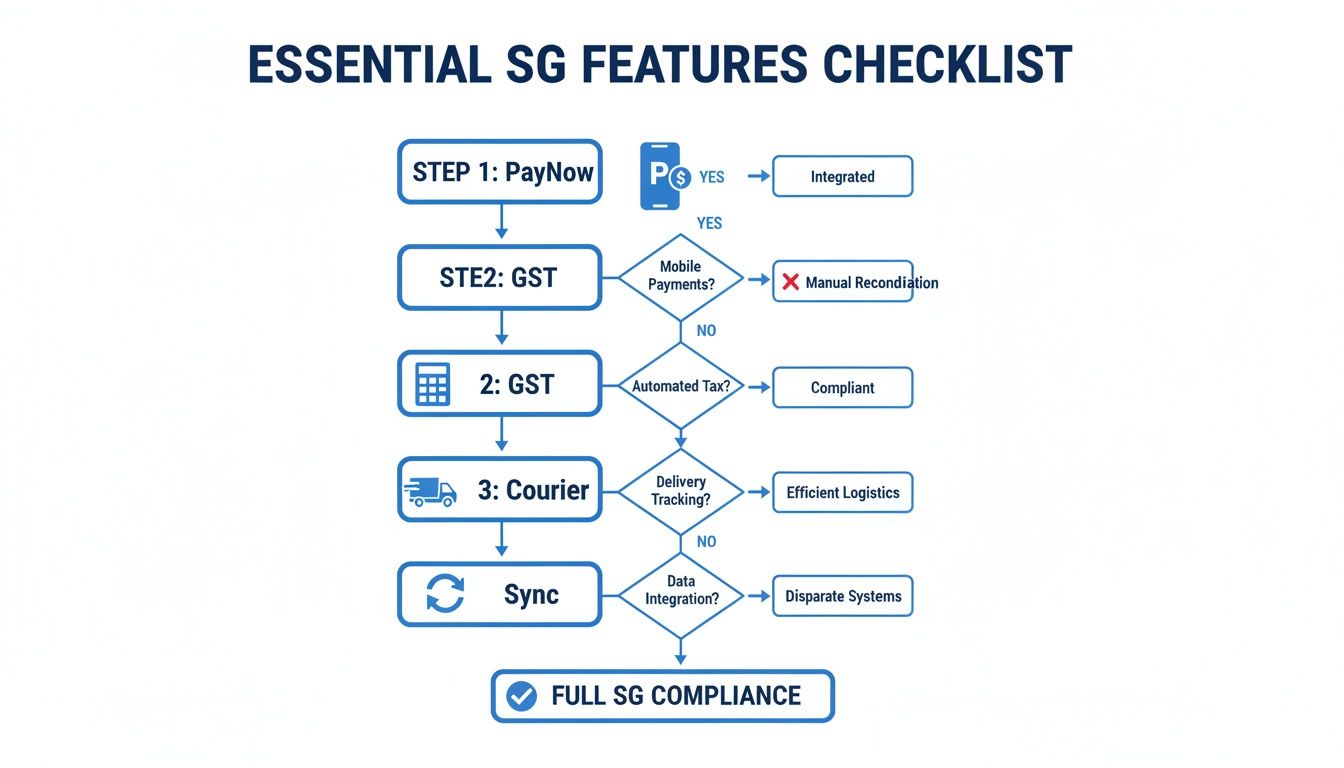
As the visual shows, essentials like local payment options, GST compliance, courier integration, and inventory sync are the fundamental building blocks for success in the Singapore market. With the local market generating USD 8,539 million in 2024 and showing a steady growth rate of 10-15%, having these operational pillars in place is more critical than ever.

Choosing your e-commerce platform is a huge decision, but the real work starts after that. A solid plan is what separates a smooth launch from a chaotic mess. This section provides a practical, step-by-step checklist to get you from selection to launch day.
Think of it like preparing for the grand opening of a physical shop. You would check your inventory, test the cash register, and make sure the lights are on. Your online launch needs the same level of methodical preparation to give your first customers a great experience.
Before you commit to a platform, evaluate your top contenders with this checklist. This focuses on practical considerations for a business in Singapore. For a more detailed look at the strategic side of this decision, reading a guide on how to choose an ecommerce platform can give you valuable perspective.
1. Pricing Models and True Costs
2. Local Integration Quality
3. Scalability for Sales Events
Actionable Insight: Use a simple spreadsheet to score each platform from 1 to 5 on these points. The one with the highest score is likely your safest, most practical choice. This approach helps you make a data-driven decision.
Platform chosen? Great. Now, follow these steps to ensure launch day goes smoothly. This checklist covers you whether you are selling on one site or across multiple channels.
1. Foundational Store Setup
2. Multichannel Preparation (If Applicable)
3. Final Pre-Launch Testing
When you methodically complete these steps, you replace launch-day anxiety with the confidence that comes from knowing you have covered your bases.
Launching your new online store is a huge milestone, but it is just the starting line. Real, sustainable growth is about more than just getting visitors. It is about understanding the key numbers that drive your business forward and making smart decisions on everything from marketing spend to inventory.
It is tempting to get excited about surface-level metrics like traffic or social media likes, but you need to go deeper. The most valuable information is in the data that directly impacts your bottom line. Any decent ecommerce platform for a Singapore business will have a solid analytics dashboard that makes this data easy to find and understand.
To get a true pulse on the health of your online store, you need to dig into specific performance metrics. These numbers tell a story about how efficiently you are bringing in customers, how much they are worth to you over time, and where you might be losing sales.
Keeping a close eye on these KPIs lets you see what is really working. For example, you can calculate your CAC for different marketing channels, like Google Ads versus Shopee Ads. If Google Ads cost you $15 to land a customer while Shopee Ads only cost $5, you know exactly where to allocate more of your budget for a better return.
The goal is not just to make a sale today; it is to build a profitable business for the long haul. A low CAC combined with a high CLV is the winning formula. It means you are not just acquiring customers cheaply, but the customers you acquire keep coming back.
Beyond customer-focused metrics, your operational KPIs are vital for managing cash flow and ensuring you have the right products in stock. This is where a centralized platform dashboard becomes a game-changer for any merchant in Singapore.
One of the most important numbers to watch here is your Inventory Turnover Rate. This tells you how many times you have sold and replaced your entire stock over a set period.
A high turnover rate is generally good—it means products are selling quickly. A low rate, however, can indicate a problem. It might mean you have slow-moving products tying up capital that could be better spent on faster-selling items or new marketing campaigns.
For instance, by tracking this on your dashboard, you might discover one product line has a turnover rate of just 0.5 over the past year. That data gives you the clear insight you need to either run a clearance sale to liquidate that stock or decide not to reorder it, freeing up cash for more profitable ventures.
Even experienced sellers have questions when evaluating their platform options. Let’s tackle some of the most common ones we hear from merchants in Singapore.
For a small business in Singapore, the most cost-effective platform depends on your sales volume. Marketplaces might seem cheaper at first, but the fees can add up quickly.
Let’s break it down with two common scenarios:
A platform with a fixed fee, like Shopify, often becomes the more financially sound choice once you have a steady stream of sales. Your costs do not increase as your revenue grows. Marketplaces are cheaper to start on, but they can become expensive as you scale.
Absolutely. In fact, running a hybrid model is one of the most powerful growth strategies in Singapore. You can use your own website (built on something like Shopify) to build your brand and nurture customer loyalty, while tapping into the massive, ready-made audience on marketplaces like Shopee.
The main challenge is managing both channels without a central system, which can lead to overselling stock during a big sale. This is where a multichannel management tool becomes essential. It syncs your inventory in real-time, so when an item sells on your website, the stock count on Shopee is updated instantly. This prevents you from selling products you do not have.
Moving from one ecommerce platform to another requires careful planning to avoid downtime. A rushed migration can lead to lost data, broken links, and frustrated customers.
Here’s a simple, structured plan to follow:
Ready to stop juggling multiple platforms and start growing your business from a single, unified dashboard? OneCart brings your inventory and orders from Shopee, Lazada, TikTok Shop, Shopify, and more into one place, so you can manage everything without the chaos. Explore how OneCart can streamline your operations.
Automate & Scale Your Online Business with OneCart
Start a Free TrialUsed by hundreds of merchants in Singapore & Southeast Asia