Demand Planning and Forecasting: Mastering Your Supply Chain [2026 Guide]
Master demand planning and forecasting with AI-powered tools. Learn proven models, key metrics, and real-world strategies to reduce stockouts by up to 35% and cut excess inventory costs.
by Arvind, Junior Content Marketer
Dec 6, 2024
13 min read
Demand planning and forecasting are the backbone of profitable ecommerce operations in 2026. With marketplace dynamics shifting faster than ever — flash sales, viral TikTok products, and cross-border expansion — sellers who master demand prediction gain a decisive competitive edge. Research shows that effective demand planning can reduce stockouts by up to 35% and cut excess inventory costs by 20-30%.
In this comprehensive guide, we’ll break down demand planning fundamentals, explore proven forecasting models (including AI-powered approaches), and show how multichannel sellers can use platforms like OneCart to consolidate data and automate planning across Shopee, Lazada, TikTok Shop, Amazon, and beyond.
Demand planning is a strategic process of predicting and managing future customer demand for products or services. When demand planning, your main goal is to balance supply with demand in order to minimize waste and maximize customer satisfaction through order fulfillment. When inventory levels and stock purchases are aligned correctly, businesses will see a significant improvement in operational efficiency.
The Role of a Demand Planner
A demand planner is a professional responsible for creating and managing accurate demand forecasts. The roles of a demand planner include analyzing data, market trends, and customer behavior to identify demand patterns. Demand planners play a big part in procurement, production, and inventory decisions.
Example:
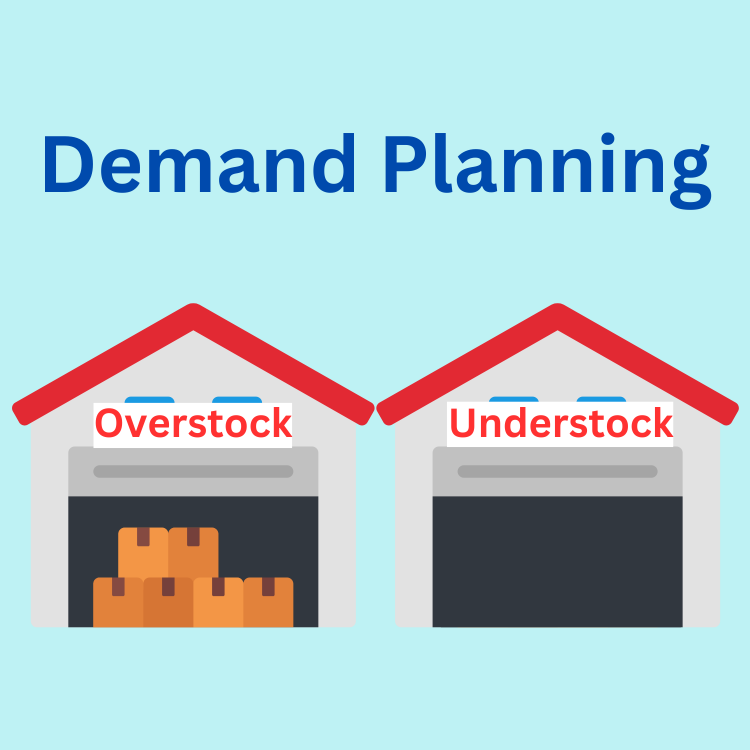
If a company sells seasonal products like winter coats, without proper demand planning, they might overstock, leading to extra inventory costs, or understock, resulting in lost sales during the most important sales period.
What is Demand Forecasting?
Demand Forecasting Definition
Demand forecasting is the practice of predicting future customer demand using historical data, market analysis, and statistical methods. Forecasting activities are actually the foundation of demand planning by providing actionable insights into future demand.
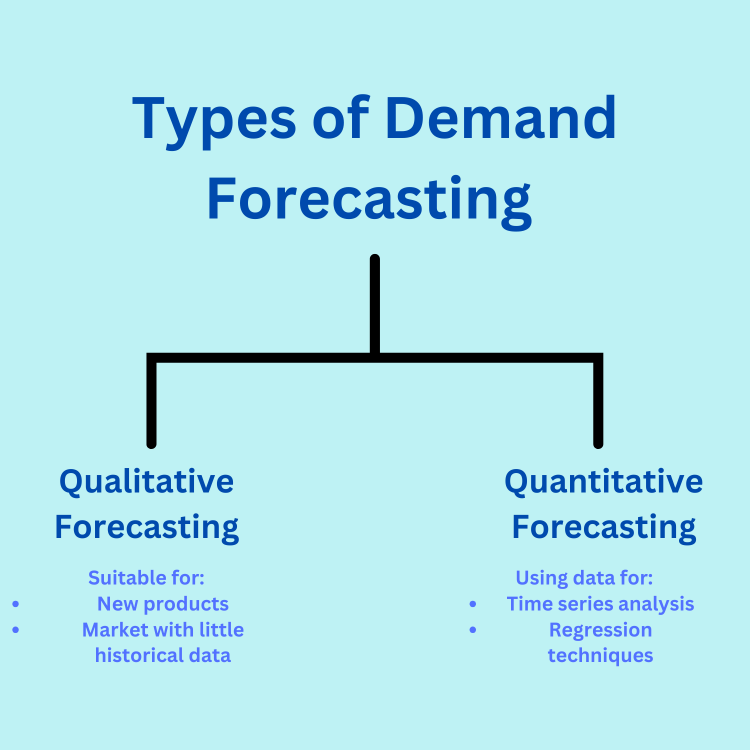
Types of Demand Forecasting
Qualitative Forecasting: Based on market research, surveys, and expert opinions. Suitable for new products or markets with little historical data.
Quantitative Forecasting: Based on historical data and statistical models, such as time series analysis and regression techniques.
Demand Planning vs. Forecasting
Key Differences
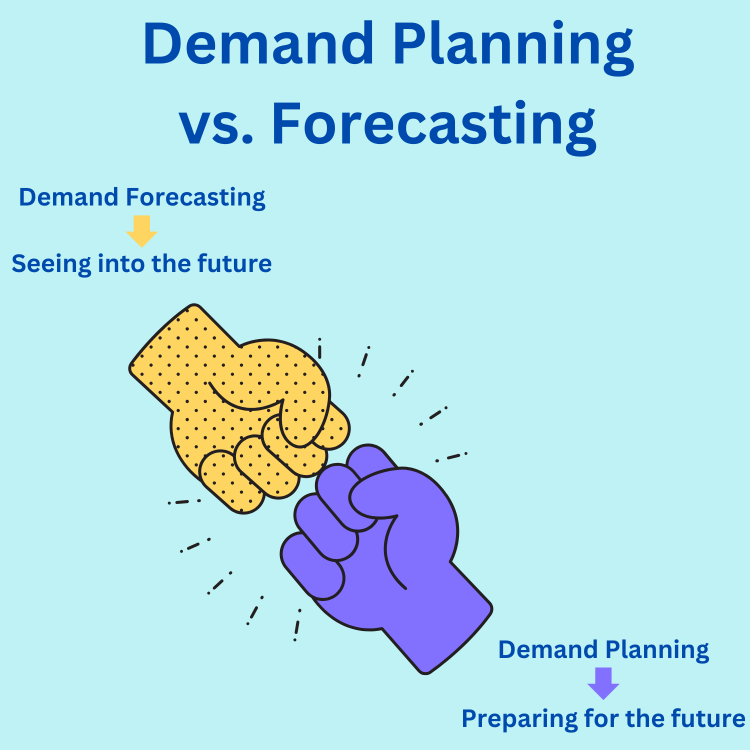
Demand Forecasting is about predicting what might happen in the future. For example, you estimate how many customers might want a product next month based on past sales and market trends.
Demand Planning is about taking action based on those predictions. It involves deciding how much inventory to order, how to schedule production, and how to manage the supply chain to meet the predicted demand.
Think of forecasting as seeing into the future and planning as preparing for it.
How They Work Together
We can explain things in the simplest way with an example:
Forecasting provides the numbers: For example, it predicts that 1,000 units of a product will be needed next month.
Planning makes the decisions: Based on the forecast, you decide how many units to procure, where to store them, and how to deliver them to customers.
When demand planning and forecasting are done correctly together, it allows a business to be proactive rather than to scramble at the last minute to fix any demand issues that come up.
Why Are Demand Planning and Forecasting Crucial?
Benefits in Supply Chain Management
Optimized Inventory Levels: Prevent overstocking or stockouts.
Cost Efficiency: Reduce holding and production costs.
Inaccurate data: Leads to poor decisions and inefficiencies.
Lack of Technology: Makes it difficult to analyze large datasets effectively.
OneCart offers real-time analytics and automated insights to overcome these challenges, ensuring a better operations plan for your business
Understanding Demand Planning Models
Statistical Models
There are machine learning models available as well, but for our discussion today, we shall focus on statistical models. These mathematics-based models analyze historical data to identify trends and patterns. Two key examples are:
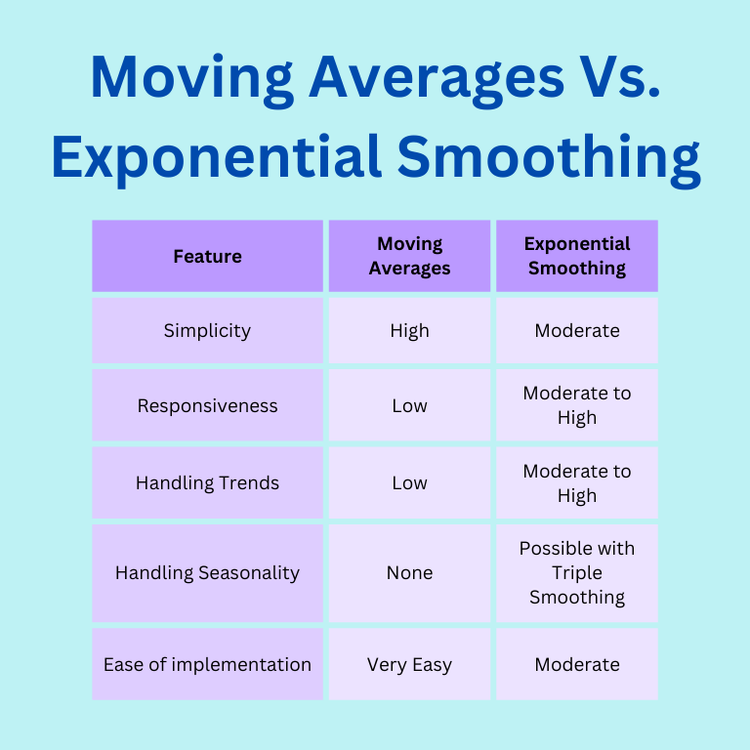
Moving averages
Definition: This method calculates the average demand over a specified number of past periods. As new data becomes available, the oldest data point is dropped, and the average is recalculated.
Advantages:
– Simple to calculate and implement
– Helps reduce the impact of random variability in demand data.
Limitations:
– Lag in responsiveness to sudden demand changes.
– Limited capability to handle seasonality or complex trends.
Exponential Smoothing
Definition: A forecasting technique that applies decreasing weights to older data points, giving more importance to recent observations. Variants include simple, double, and triple exponential smoothing.
Usage:
– Simple exponential smoothing: For data without trend or seasonality.
– Double exponential smoothing: For data with trends.
– Triple exponential smoothing: For data with both trends and seasonality.
Advantages:
– More responsive to recent changes compared to moving averages.
– Adjustable smoothing factor for customization based on data characteristics.
Limitations:
– Less effective in cases of sudden, unpredictable demand shifts.
– Requires parameter tuning for optimal performance.
Moving averages and exponential smoothing are both great models to use for planning. However, for a start, moving averages would be the best to start out with as this would allow a business to have a better overall insight over its sales. Any needed adjustments can be made later on, as demand planning is a continuous process.
The Demand Forecasting and Planning Process
Step 1: Data Collection and Cleaning
Gather accurate and relevant data from multiple sources, such as sales records, customer feedback, and market trends, to build a comprehensive dataset. Ensure the data is cleaned to eliminate outliers, duplicates, or errors that could distort the forecasting process.
Step 2: Forecast Demand
Use demand forecasting tools, such as statistical models or machine learning, to analyze historical patterns and predict future trends. Consider external factors like seasonality, market conditions, and competitor activity to refine accuracy.
OneCart uses a simple moving average model to better calculate possible stockouts. This feature is a perfect complement for demand planning as it provides more relevant and recent data based on historical sales.
Step 3: Plan Execution and Review
Implement the demand plan by aligning inventory and procurement efforts with the forecasted demand. When sourcing internationally, request a proforma invoice from suppliers to confirm pricing and quantities before committing — this helps you lock in costs that match your demand forecast. Once pricing is confirmed, formalise the order with a purchase order template to document agreed quantities, delivery dates, and payment terms. Continuously monitor performance metrics to identify variances between actual and predicted outcomes.
Demand Forecasting Models
Step 1: Causal Models
Identify relationships between demand and external factors, such as prices changes, marketing campaigns, or economic conditions. By understanding these relationships, businesses can make proactive decisions to respond to demand fluctuations effectively.
Step 2: Time Series Analysis
Analyze historical data to identify patterns and make forecasts. This approach is best for stable markets where historical trends are likely to continue. By analyzing the timing and magnitude of demand, businesses can create close-to-perfect forecasts for inventory and resource planning.
Step 3: Judgment-Based Approaches
Use expert opinions and market insights for situations with limited data. These methods are most appropriate for forecasting new products or entering unfamiliar markets. With the combination of expert insight with available market intelligence, businesses are able to generate informed estimates to guide their decisions. While some may be critical of such methods, it is definitely better than doing nothing at all like jumping into the water without any preparation.
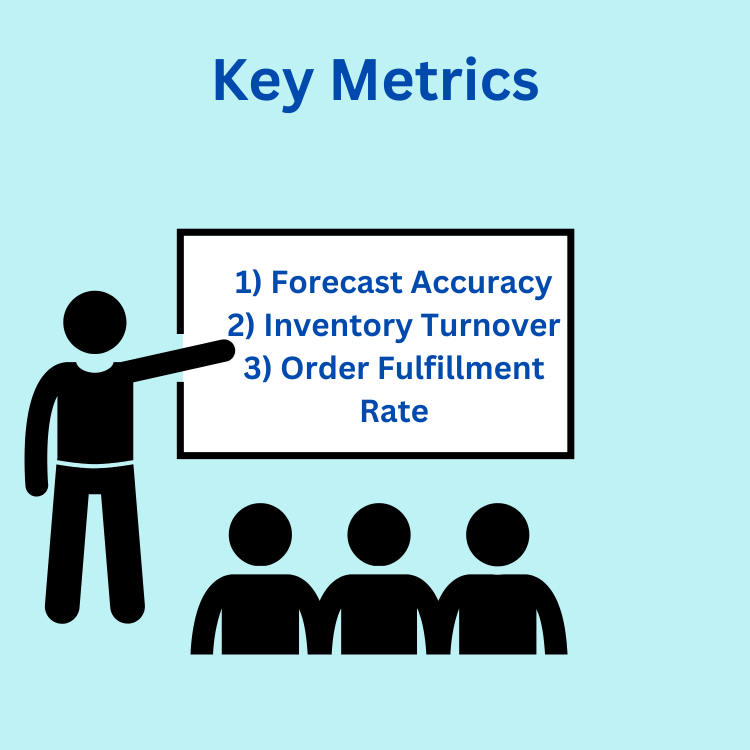
Key Metrics for Measuring Success
Forecast Accuracy: Measure the percentage of accurate predictions. High accuracy indicates better alignment between demand predictions and real-world outcomes, reducing risk of overstocking or stockouts.
Inventory Turnover: Track how often inventory is sold and replaced. A high turnover rate indicates efficient inventory use, while a low rate may signal overstocking or slow-moving products.
Order Fulfillment Rate: Assess the percentage of orders fulfilled on time. A high rate demonstrates the business’s ability to meet customer expectations, improving satisfaction and loyalty.
Common Pitfalls and How to Avoid Them
Over-Reliance on Historical Data
Avoid relying solely on past data. Doing this can lead to inaccurate forecasts when market conditions shift unexpectedly. For instance, unforeseen disruptions like economic shifts, supply chain interruptions, or sudden demand spikes leaves any historical data to be of no use and irrelevant. Thus, go the extra mile and incorporate market trends and real-time insights. The need for the human element cannot be understated in this case.
Ignoring Market Trends
Stay updated with changing customer preferences and external factors. It is important to monitor market trends and leverage tools like OneCart that provide actionable, real-time data. Failing to account for such external factors can lead to outdated and ineffective demand forecasts.
AI-Powered Demand Forecasting: The 2026 Frontier
Traditional statistical models remain valuable, but AI-powered forecasting is rapidly becoming the standard for serious ecommerce operations. Here’s what’s changed in 2026:
Why AI Forecasting Matters Now
Multichannel complexity is the driving force. Sellers operating across Shopee, Lazada, TikTok Shop, Amazon, and their own Shopify stores face a data consolidation nightmare. AI systems can ingest sales data from all these channels simultaneously and identify patterns that would take humans weeks to spot manually.
Key advantages of AI-powered forecasting:
Pattern recognition: AI can identify complex demand patterns across product categories, seasons, and promotional periods that traditional models miss.
External factor integration: Modern AI systems factor in social media trends, competitor pricing changes, and marketplace algorithm updates.
Continuous learning: Unlike static models, AI systems improve their accuracy over time as they process more data.
Real-time adjustments: AI can recalculate forecasts hourly based on incoming sales data, not just weekly or monthly.
Practical Implementation for Multichannel Sellers
For most ecommerce businesses, implementing AI forecasting doesn’t require building custom machine learning models. The practical approach:
Consolidate your data first: Before any AI can help, you need all your sales data from every platform in one place. Tools like OneCart automatically sync order and inventory data across marketplaces.
Calculate your Economic Order Quantity (EOQ): Use our EOQ Calculator to balance ordering costs against holding costs — the mathematical foundation of demand planning.
Monitor and iterate: Track forecast accuracy weekly and adjust your models based on actual vs predicted demand.
Actionable Insight: The biggest forecasting gains come not from fancy algorithms, but from clean, consolidated data. Focus on getting accurate inventory counts and complete sales history before investing in advanced forecasting tools. Set up an ABC-based cycle counting program so the numbers your forecast model sees actually match what’s on the warehouse floor — anything above a 1.5% system-vs-physical variance will quietly poison every reorder recommendation downstream.
How OneCart Can Transform Your Demand Planning and Forecasting
OneCart provides the data foundation that effective demand planning requires. For multichannel sellers on Shopee, Lazada, TikTok Shop, Amazon, and Shopify, here’s what that means in practice:
Consolidated Sales Data Across All Channels
Instead of logging into five different seller dashboards and manually combining data in spreadsheets, OneCart aggregates all your order and sales data into a single view. This is the prerequisite for any meaningful demand forecasting — you can’t predict future demand if you don’t have a complete picture of past demand.
Real-Time Inventory Tracking
Demand planning fails when your inventory counts are wrong. OneCart’s real-time inventory sync ensures that your planning decisions are based on accurate stock levels, not stale data that’s hours or days old.
Low Stock Alerts and Reorder Triggers
OneCart’s low stock alerting system connects directly to your demand planning process. Set reorder points based on your lead time calculations and average daily sales, and get notified before you run out — not after.
The result: high efficiency, better customer satisfaction, and significant cost savings through data-driven planning rather than guesswork.
FAQs about Demand Planning and Forecasting
1) What is Demand Planning?
Demand planning is the strategic process of predicting and managing future customer demand to align inventory, production, and resources, ensuring efficiency and customer satisfaction. For ecommerce sellers, this means having the right stock levels across all your marketplaces — Shopee, Lazada, Amazon, TikTok Shop — without overstocking or running out.
2) What is Demand Forecasting?
Demand forecasting is the practice of predicting future customer demand using historical data, market analysis, and statistical methods to provide actionable insights. In 2026, the most effective forecasting combines traditional statistical models with AI-powered pattern recognition.
3) What is the difference between Demand Planning and Demand Forecasting?
Demand forecasting predicts what might happen in the future (the numbers), while demand planning uses these predictions to take actionable steps (the decisions). Forecasting tells you “1,000 units next month.” Planning tells you “order 800 now, allocate 400 to Shopee warehouse, 300 to Lazada, 300 to your own fulfilment.”
4) What are the benefits of Forecasting and Demand Management?
Forecasting and demand management help optimize inventory levels, reduce costs, and improve customer satisfaction by ensuring product availability. Specific benefits include: reduced stockout rates (fewer lost sales), lower holding costs (less dead stock), better supplier relationships (predictable orders), and improved cash flow (capital not tied up in excess inventory).
5) How do multichannel sellers manage demand across different platforms?
Multichannel demand planning requires consolidating sales data from all platforms into a single view. This is where tools like OneCart become essential — they automatically aggregate orders and inventory across Shopee, Lazada, TikTok Shop, Amazon, and Shopify, giving you the complete demand picture needed for accurate forecasting.
6) What’s the best forecasting model for new products with no sales history?
For new products, use judgment-based approaches: analyse similar products in your catalogue, research competitor performance, and factor in your planned marketing spend. Start conservative (under-forecast rather than over-forecast), then adjust rapidly as real sales data comes in. After 2-4 weeks of sales, switch to statistical methods.
Summary
Demand planning and forecasting are no longer optional for ecommerce sellers competing in 2026. With marketplace dynamics changing rapidly — flash sales, viral products, and multi-channel complexity — the businesses that thrive are those with data-driven planning capabilities.
Key takeaways from this guide:
Start with clean data: Accurate forecasting requires consolidated sales and inventory data across all your platforms.
Use the right model for your situation: Moving averages for stable products, exponential smoothing for trending items, judgment-based approaches for new products.
Leverage AI where practical: Modern AI-powered tools can identify patterns and external factors that traditional models miss.
Measure and iterate: Track forecast accuracy, inventory turnover, and order fulfillment rates to continuously improve.
Don’t forget the human element: Automation should complement, not replace, your business intuition and market knowledge.
For multichannel sellers on Shopee, Lazada, TikTok Shop, Amazon, and Shopify, the path forward is clear: consolidate your data, implement systematic planning processes, and use tools that give you a single view across all your operations.
Ready to master demand planning?OneCart consolidates your inventory and order data across Shopee, Lazada, TikTok Shop, Amazon, and Shopify — the foundation for effective forecasting. Start your free trial today.
Stop tracking inventory in spreadsheets
OneCart's Item Master keeps stock levels in sync across every marketplace you sell on, automatically.