
Cross-Border E-Commerce: Logistics, Taxes & Payments Guide [2026]
Sell internationally on Shopee, Lazada, TikTok Shop & Amazon. A practical guide to customs duties, international logistics, cross-border payments and fulfilment for 2026 sellers.

Sell internationally on Shopee, Lazada, TikTok Shop & Amazon. A practical guide to customs duties, international logistics, cross-border payments and fulfilment for 2026 sellers.

Cross-border e-commerce means selling products to customers in other countries, and it is one of the fastest-growing opportunities for online sellers in 2026. Southeast Asia’s online retail market alone exceeds US$100 billion, with platforms like Shopee, Lazada, TikTok Shop, Amazon, and Temu making it easier than ever to reach international buyers. This complete guide walks you through how to start selling internationally: from customs duties and shipping logistics to cross-border payments and fulfilment operations.
Imagine you run a successful local bakery in Singapore. Your unique pandan chiffon cakes are a huge hit, and you’re selling dozens every day through your website. Cross-border e-commerce is the next step: offering delivery to customers in Johor Bahru, and then expanding your reach to Kuala Lumpur or Jakarta.
You are extending your reach beyond your immediate neighbourhood, using the internet as your global storefront.
For sellers in Singapore, this is a massive, ready-and-waiting market. Shoppers worldwide are constantly on the hunt for new products, better prices, and the quality that many Singaporean brands are known for. Selling internationally is an achievable path for small and medium businesses.
The numbers show a clear trend. Southeast Asia’s e-commerce market reached US$146 billion in 2024 and continues to grow rapidly, with cross-border transactions accounting for a significant share of online purchases. In Singapore alone, cross-border purchases make up over 55% of all online orders, driven largely by demand for products from China (fashion, electronics, cosmetics).
For any seller managing multiple channels, going international multiplies your potential revenue, but it also multiplies operational complexity. You need your inventory management, fulfilment workflows, and stock tracking completely dialled in before scaling cross-border. You can find more insights into Singapore’s e-commerce landscape on trade.gov.
Selling to another country brings a new set of puzzles to solve. These are the main hurdles that any seller, especially those already managing 50 or more orders a day, needs to figure out:
The key is to see these as solvable problems. With the right strategies and technology in place, you can build a smooth process that turns international expansion from a headache into a powerful engine for your business growth.
Taking your business global requires a solid game plan for five core parts of your operations. Each one has its own unique challenges, but if you tackle them with the right strategy, they become clear, manageable steps on your path to growth.
This map breaks down the global e-commerce world, showing how sellers like you connect with customers and platforms, and the hurdles you’ll face along the way.

As you can see, success means balancing what your customers want with what platforms demand, all while navigating international challenges.
Think of customs like declaring a gift you’re sending overseas. The receiving country needs to know what’s in the box and its value to determine if any taxes are owed. For a cross-border e-commerce business, this usually involves three key costs:
For Singaporean sellers, it’s vital to understand rules like the GST on low-value imported goods. Getting these calculations right is non-negotiable, because surprise fees are a primary reason customers abandon a cart or refuse a delivery.
Duty rates, GST/VAT percentages, and low-value import thresholds vary from country to country and change often, so always confirm the current rules for each destination market with that country’s official customs or tax authority (for example, Singapore’s IRAS for GST) before you set your prices.
This all-in price, your product cost, shipping, and all taxes, is called the landed cost. It’s the final number your customer pays to get the product. Use a landed cost calculator to work out the per-unit figure before setting your selling price. You’ll also need a commercial invoice for every international shipment, it’s the key customs document that declares the value of your goods and determines duty rates. For ocean and air freight, the carrier issues a bill of lading as proof of shipment, it’s required for customs clearance at the destination. Once customs paperwork is sorted, a delivery order authorises the actual release and dispatch of goods from your warehouse.
Choosing where to sell internationally is one of your first decisions. Each marketplace has different cross-border programmes, fee structures, and logistics support. Here’s how the major platforms compare for cross-border sellers:
| Platform | Cross-Border Markets | Fulfilment Options | Seller Commission | Key Cross-Border Feature |
|---|---|---|---|---|
| Shopee | SG, MY, PH, TH, ID, VN, TW, BR | SLS (Shopee Logistics), self-ship, 3PL | 2–6% + transaction fees | Cross-Border Hub with bonded warehouses |
| Lazada | SG, MY, PH, TH, ID, VN | LGS (Lazada Global Shipping), FBL | 2–6.5% + payment fees | LazGlobal for China-to-SEA sellers |
| TikTok Shop | SG, MY, PH, TH, ID, VN, UK, US | TikTok Fulfilment, self-ship | 2–8% | Global Selling programme (sell to multiple countries from one account) |
| Amazon | 20+ marketplaces worldwide | FBA, FBM, SFP | 6–20% (category-dependent) | Remote Fulfilment with FBA (sell in CA/MX from US inventory) |
| Temu | 60+ countries | Temu fulfilment (China-based), local fulfilment | Commission-free model (consignment) | Fully managed or semi-managed seller models |
| Walmart Marketplace | US (open to sellers from selected countries) | WFS, seller-fulfilled | 6–15% referral (category-dependent) | No monthly, setup, or listing fees; Walmart Fulfilment Services for 2-day delivery |
Actionable Insight: Don’t try to launch on every platform at once. Start with one cross-border marketplace where your product category has strong demand, prove your logistics work, then expand. A multichannel listing tool makes it far easier to scale to additional platforms once your first market is running smoothly.
Getting your product from a warehouse to a customer’s home in another country is the physical heart of cross-border e-commerce. Your shipping method directly affects costs, delivery speed, and customer satisfaction. The pick, pack, and ship process becomes more complex when you add international parcels, customs forms, volumetric weight calculations, and carrier-specific packaging requirements all come into play.
Before loading a container, use a CBM calculator to work out your total shipment volume in cubic metres for accurate freight quotes, then a container loading calculator to check how many cartons actually fit inside a 20ft or 40ft container before you book, and a pallet calculator to maximise how many cartons fit per pallet and avoid wasted freight space. For US-bound LTL shipments, you’ll also need to determine the correct freight class based on your product’s density and handling characteristics.
There are two main ways to approach this:
For brands planning to expand through major marketplaces, you can find Amazon’s official guide on selling globally. If Singapore is your home base, our guide to selling on Amazon Singapore walks through Amazon.sg registration, the Individual versus Professional plan fees, and choosing FBA or self-fulfilment.
To help you decide which fulfilment model fits your business, let’s compare the most common international shipping strategies.
Choosing the right shipping method is a balance between cost, speed, and the level of control you want over the customer experience. This table breaks down the pros and cons of the main options.
| Strategy | Best For | Pros | Cons |
|---|---|---|---|
| Direct Shipping (In-House) | New businesses with low order volumes or those selling highly customised products. | Complete control over branding and packaging; simple to start. | Becomes very time-consuming and expensive as you scale; limited shipping options. |
| Third-Party Logistics (3PL) | Growing businesses looking to scale operations and improve delivery speed. | Access to expert logistics; cheaper shipping rates; faster delivery from local warehouses. | Less control over the final package; requires finding a trustworthy partner. |
| Dropshipping | Entrepreneurs who want to test products without investing in inventory. | No need to hold stock; low startup costs; wide product selection. | Very low profit margins; no control over quality or shipping times; high competition. |
| Marketplace Fulfilment (e.g., FBA) | Sellers who primarily use one major platform like Amazon and want to leverage its logistics network. | Fast, reliable shipping; access to marketplace perks like Prime; simplified logistics. | Strict packaging rules; high fees; inventory is tied to one platform. |
Ultimately, the best strategy depends on your product, your target market, and your growth ambitions. Many successful brands use a hybrid approach, combining different methods for different regions. If you’re not ready to manage your own warehouse, a third-party logistics provider or a fulfilment software platform can handle the heavy lifting.
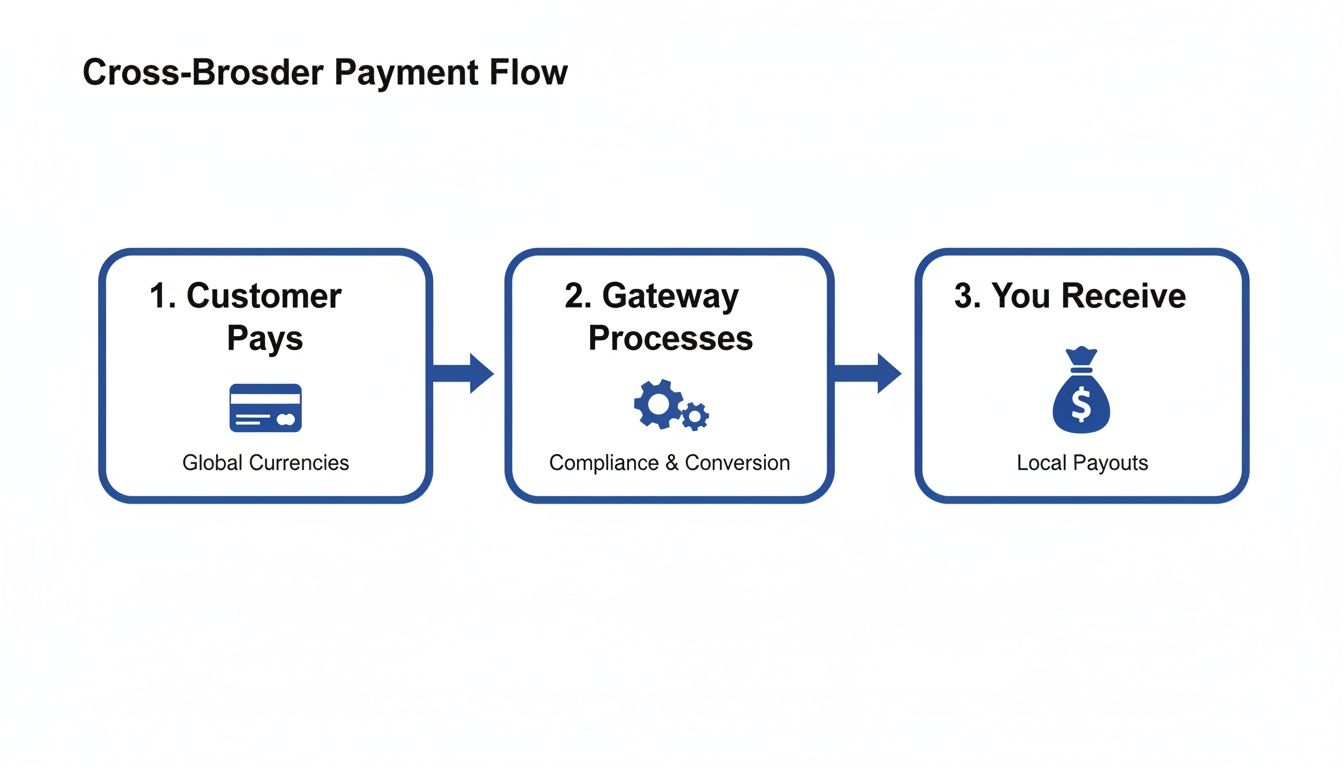
A customer in Thailand probably won’t buy from you if they can only pay in Singapore Dollars with a payment method they’ve never heard of. You have to offer familiar, local payment options to build trust and drive conversions.
Handling currency conversion is the other side of this coin. You need a way to show prices in your customer’s local currency without letting fluctuating exchange rates destroy your profit margins. Actionable Tip: Most marketplaces handle currency display automatically for local buyers. For your own Shopify or WooCommerce store, enable multi-currency display and set your product prices with a small buffer (e.g., 3-5%) to absorb minor currency fluctuations without needing to update prices daily. Track your true margins per market using a profit margin calculator.
International returns can be a logistical and financial challenge. The cost of shipping a product back across a border, getting it through customs again, and restocking it can erase any profit from the original sale. The all-in cost per return for parcel-sized goods sits between US$13 and US$30 domestically and runs 2x–4x higher cross-border once you factor in dual-customs clearance and longer reverse transit, see our ecommerce returns playbook for the full cost breakdown and the RMA workflow that scales across markets. To issue the authorisation itself on a cross-border return, our free RMA form generator produces a printable form with the order, reason, and disposition fields already laid out.
Your best defence is a proactive one. Focus on preventing returns before they happen by:
Localisation is more than just translating your website. It’s about tailoring the entire customer experience to feel native in each new market. This means understanding cultural nuances, local tastes, and regional habits to connect with people.
For example, a marketing campaign pushing heavy winter coats won’t work for shoppers in tropical Southeast Asia. Product sizing also needs to be adapted, a “Medium” in one country might be a “Large” elsewhere. Practical Example: A Singaporean snack brand expanding to the Philippines could create a marketing campaign around “merienda” (afternoon snack) culture and offer a spicy flavour variant, which is popular there, instead of just promoting their original flavours.
The operational strain of this growth is real. Customs authorities across the region are processing record volumes of low-value cross-border parcels, which can cause delivery delays during peak seasons. However, new solutions like real-time cross-border payment links and simplified customs declarations are making things smoother. For sellers, the takeaway is clear: maintain accurate inventory tracking and monitor your sell-through rates by market so you can re-stock before you run dry in any country.
Knowing your audience is critical when you start selling internationally. To win over shoppers in Singapore, you need to understand what they want and how they buy.
It’s easy to assume that younger, digital-native generations are driving all online sales. The reality in Singapore is quite different. The data reveals a powerful customer group that many businesses overlook.

Recent demographic shifts are reshaping e-commerce in Singapore. Of the country’s 3.51 million online shoppers, a remarkable 24% of those aged 55-64 are leading the charge. This group is the most active segment when it comes to cross-border shopping.
They significantly outpace the 13% of 18 to 24-year-olds who shop internationally. This experienced, digitally savvy demographic is now fuelling a massive 55% of all online purchases from abroad. With Singapore’s internet penetration at 96%, it’s time to adjust your strategy. You can dig deeper into these trends with insights on Singapore’s cross-border market from Statista.
The data offers a clear takeaway: if your marketing only targets Gen Z, you’re missing a large piece of the international sales pie. Your marketing, product presentation, and customer service must be designed to meet the expectations of an experienced, discerning, and financially empowered audience.
Understanding who is buying is the first step. The next is knowing what they are buying and where it’s coming from. The most popular product categories for Singaporean international shoppers consistently include:
A huge portion of these cross-border purchases originates from China, driven by competitive pricing and an enormous variety of goods. This highlights the importance of having efficient supply chains and logistics partners capable of handling shipments from major global manufacturing hubs.
Here’s how to translate these market insights into practical actions for your business, whether you’re selling on marketplaces, your own store, or both.
1. Refine Your Social Media Marketing Research shows about half of Singaporeans make purchases through social platforms like Facebook and Instagram. Create campaigns that speak to the values of mature buyers. This means highlighting product quality, durability, and excellent customer service rather than just flash sales. Actionable Tip: Use Facebook ads with clear, high-contrast images and simple text overlays. Target interests like “quality craftsmanship” or “gardening” alongside age demographics, instead of relying on trend-based interests.
2. Optimise Your Product Listings This demographic values clarity and trust. Make sure your product descriptions are detailed, your images are high-quality, and your sizing charts are easy to understand. Customer reviews and testimonials are especially powerful, so make them prominent on your product pages.
3. Simplify the Customer Experience Your website needs to be easy to navigate, with clear menus and a straightforward checkout process. Offer familiar and secure payment options. A complicated experience will quickly turn away these savvy shoppers.
By aligning your strategy with how Singapore’s international shoppers actually behave, you position your business for real, sustainable growth.
When you first started selling online, jumping between your Shopee, Lazada, and Shopify dashboards was probably manageable. But as you expand across borders and your order volume climbs, that manual process starts to break.
Time spent frantically updating stock levels, copying and pasting order details, and editing product listings one by one is time you’re not spending on strategy and growth. It’s chaotic and unsustainable.
Think of it like running a restaurant chain. You wouldn’t have each kitchen ordering its own ingredients without any central oversight. You’d have a central system managing supplies and tracking performance. For your e-commerce business, a unified commerce platform is that central system.
This centralised approach is the backbone that lets you handle more orders without your systems falling apart. To build a robust tech stack that can support global growth, it helps to explore essential e-commerce tools and see how they fit together.
The single biggest risk of selling on multiple channels is overselling, taking an order for a product you don’t actually have. This leads to cancelled orders, unhappy customers, and potential penalties from marketplaces.
A multi-channel platform eliminates this by syncing your inventory in real-time across every channel. When a product sells on Lazada Malaysia, the stock count is instantly updated on your Shopify SG store, Shopee Philippines, and everywhere else. This is a game-changer for maintaining inventory accuracy and protecting your brand’s reputation.
Imagine trying to process 100 orders a day by logging in and out of three different seller centres. It’s slow and a recipe for mistakes like shipping the wrong item. Centralisation creates massive efficiency gains.
With a unified dashboard, you can:
This consolidation transforms your fulfilment process from a manual chore into a smooth, organised workflow. It frees up your team’s time so they can focus on getting orders out the door faster and with fewer mistakes.
Updating product details across multiple platforms is another major time-sink. A simple price change means you have to log into each marketplace and make the same edit over and over.
A central platform fixes this with a “list once, sync everywhere” approach. You create or edit a product listing in one central place and then push those changes to all your connected channels simultaneously. This saves an incredible amount of time and ensures your branding and product information are consistent across your entire cross-border e-commerce footprint.
For merchants still weighing their options for a foundational platform, our detailed comparison of top e-commerce platforms in Singapore can offer some valuable direction.
You can’t make smart business decisions with fragmented data. When your sales figures are scattered across different dashboards, it’s nearly impossible to get a clear picture of your overall performance.
A unified analytics dashboard pulls all your performance data together. This single view lets you track key metrics like revenue, order volume, and profit margins across all your markets. Armed with this clear insight, you can make informed decisions about pricing strategies, inventory allocation, and marketing spend to drive real, scalable growth.
Jumping into cross-border e-commerce can feel massive, but you don’t have to do everything at once. Break the process down into a clear, step-by-step plan. This makes your global launch more manageable.
We’ve boiled down the essential strategies into a practical checklist. This approach is about building momentum, letting you learn and adapt. The goal is to start small, prove your strategy works, and then scale up with confidence.
Your first move into selling internationally should be a calculated one. It all starts with figuring out where your products will make the biggest splash and making sure your business is ready for the operational shifts ahead.
Conduct Market Research: Don’t try to conquer the world in one go. Pinpoint your top one or two target countries by looking at product demand, local competition, and cultural fit. A great place to start is your own website analytics, see which countries are already sending you traffic.
Perform a Compliance Check: Before shipping, get a clear picture of the tax and customs rules for your chosen markets. Dig into the specifics on duties, GST/VAT, and any restricted products to avoid expensive surprises at the border. In some countries, you’ll need a proforma invoice to apply for import permits before goods arrive. It’s also good practice to provide international buyers with a formal quotation that clearly states pricing, payment terms, and delivery conditions.
Audit Your Technology: Take an honest look at your current systems. Can they handle pricing in multiple currencies? Can they sync inventory across different regional marketplaces? Spotting these gaps now highlights where a unified platform can plug critical holes.
A successful launch is about starting with a solid foundation, being prepared to learn, and having the right tools to adapt quickly as your international sales grow.
With your research and audits done, it’s time for a controlled test launch. A pilot programme minimises risk while giving you priceless, real-world data to shape your full-scale expansion.
Plan Your Logistics: Start getting quotes from different shipping carriers and 3PL providers. Compare their rates, delivery times, and tracking capabilities to find the fulfilment strategy that gives you the best balance of cost and customer experience. Cross-border deliveries fail the “where is my order?” test more often than domestic ones, so budget for order tracking software that consolidates carrier updates into one branded page, customers forgive slower shipping far more easily than they forgive a black box.
Localise a Pilot Channel: Pick just one international marketplace to start, like Shopee Malaysia. Concentrate your efforts on localising your top 10 best-selling product listings for this channel. That means translating descriptions, adjusting sizing to local standards, and setting prices in the local currency.
Launch and Measure: Go live! From here, use a centralised dashboard to keep an eye on your initial sales, customer feedback, and how your operations are holding up. The right technology partners and e-commerce enablers will give you the support you need to manage this new channel efficiently. This data is what you’ll use to fine-tune your approach before you expand any further.
Most first-time international shipments fail at customs because the paperwork has the wrong HS code, an unrealistic declared value, or a missing field on the commercial invoice. Here’s the practical checklist for getting a parcel through customs cleanly the first time:
Actionable Insight: Build a pre-flight checklist into your fulfilment workflow, a Google Form your packing team fills before sealing the carton (HS code attached? declared value matches order? Incoterm flagged?). One missing field can hold a parcel for a week.
Stepping into international markets naturally brings up a lot of questions. Let’s tackle some of the most common practical concerns sellers have when they start their cross-border e-commerce journey.
Two big missteps can sink your profits and reputation. The first is underestimating your total shipping costs. It’s easy to look at the base rate, but sellers often forget to factor in fuel surcharges, customs clearance fees, and final-mile delivery charges. Couriers also charge based on volumetric weight rather than actual weight for bulky items, which catches many sellers off guard. These add up and will eat your margins.
The second major error is treating localisation as an afterthought. Just running your product descriptions through a translator isn’t enough. You have to adapt everything, sizing charts, marketing messages, and even product photos, to fit the cultural norms of your new market. Practical Example: A seller might use a direct translation of a marketing slogan that sounds clever in English but is confusing or even offensive in another language, instantly alienating potential customers.
Good international customer service boils down to being accessible and understandable. First, tackle time zone differences. Use chatbots or automated email responses to instantly acknowledge queries that come in while your team is offline. A simple “We’ve got your message and will get back to you” is much better than silence.
When it comes to language barriers, user-friendly translation tools can get your team surprisingly far. The key is to manage expectations. Clearly post your support hours in both your local time (SGT) and the customer’s time zone so they know when to expect a human response.
Yes, absolutely. Sellers in Singapore can list their products on global marketplaces like Amazon, Shopee Malaysia, or Lazada Philippines. If you’re weighing up Shopify vs Amazon, the right choice depends on whether you prioritise brand ownership or access to an established buyer base. The process involves setting up a seller account on the specific international platform and making sure you follow their rules for listing products and handling fulfilment.
This is where a unified platform becomes a game-changer. Instead of juggling your Singaporean Shopify store in one tab and your Malaysian Amazon listings in another, you can sync your inventory and process all your orders from a single dashboard. This prevents you from accidentally overselling a popular item and makes managing a multi-channel, cross-border e-commerce business feel organised and scalable.
The biggest challenge in cross-border inventory management is preventing overselling when the same stock pool serves customers in multiple countries. A sale on Shopee Philippines needs to instantly reduce available stock on Lazada Thailand and your Shopify store. Without real-time inventory sync, you’ll either oversell (leading to marketplace penalties and cancelled orders) or keep excessive safety stock in every warehouse (tying up cash).
The practical approach: start with a single warehouse and ship cross-border, then graduate to local warehousing in your highest-volume market. Use a FIFO costing method to track landed costs per batch, since customs duties and shipping costs vary by shipment, your COGS for the same product can differ significantly across countries.
Temu operates differently from traditional marketplaces. Under their “fully managed” model, you ship inventory to Temu’s warehouse and they handle pricing, listing, and fulfilment. This means zero logistics complexity for you, but also limited control over pricing and branding. Their newer “semi-managed” model gives sellers more control but requires you to handle shipping yourself. Read our complete guide to selling on Temu for a full breakdown of both models, fees, and whether it fits your business, or our Temu Seller Center guide for the portal login links and account verification process.
The two models look similar on a per-unit basis but diverge once you stack the variable costs. Fully managed (consignment) keeps your effective take-rate low because Temu absorbs payment processing, shipping, and returns, while semi-managed adds a referral fee plus payment processing and any platform subscription that you must weigh against your real monthly order volume. The exact rates change by category and over time, so check Temu’s current published schedule rather than relying on a fixed figure. Use our free Temu fee calculator to model net profit per order under each programme using your own selling price, category, and returns reserve, then decide which fits your unit economics.
Ready to scale your business across borders without the operational headaches? OneCart centralises your inventory, orders, and listings from Shopee, Lazada, TikTok Shop, Amazon, Temu, Shopify, and more into a single powerful platform, with real-time sync across every marketplace and country you sell in. Start your free trial today and see how you can grow globally with confidence.
OneCart unifies inventory, orders and listings across Shopee, Lazada, TikTok Shop, Amazon, Shopify and 20+ other platforms. List once, sell everywhere.
Try OneCart freeUsed by hundreds of merchants in Singapore & Southeast Asia