Best ERP Software Singapore: Top Choices for Your Business [2025]
Explore the best erp software singapore for e-commerce and DTC brands, with side-by-side comparisons of features, pricing, and compliance.
Explore the best erp software singapore for e-commerce and DTC brands, with side-by-side comparisons of features, pricing, and compliance.

If you’re looking for the best ERP software in Singapore, the right choice really boils down to what your e-commerce business needs. For growing brands, names like NetSuite, Acumatica, and Odoo are fantastic places to start. For any Singaporean business juggling sales across Shopee, Lazada, and Shopify, a modern ERP acts as a central hub, bringing your operations under one roof and cutting out expensive mistakes.
Growing a local marketplace or DTC brand often feels like managing organised chaos. You’re handling sales on Shopee, your own Shopify store, and maybe even a pop-up stall. Before you know it, these disconnected systems become your biggest bottleneck. This split leads to frustrating stockouts on one channel while you’ve got perfectly good inventory just sitting idle elsewhere—a surefire way to annoy customers.
Manual work is the other huge hurdle. Trying to scale your business with spreadsheets and basic accounting software just doesn’t work for long. Your team gets bogged down for hours, manually piecing together orders, updating inventory counts, and processing shipments. This inevitably leads to shipping delays and fulfilment errors. Without one single source of truth, getting a clear picture of your business’s health is next to impossible.
Let’s look at a practical example. A local fashion brand is running a flash sale on Lazada. At the same time, a big order comes in through their Shopify store, and they sell a few pieces at their pop-up shop on Orchard Road.
Without a central system, these platforms aren’t talking to each other. The team might oversell a popular dress on Lazada because the Shopify sales weren’t reflected in real-time. This forces them to cancel orders and takes a hit on their marketplace rating. Meanwhile, fulfilling all these orders means logging into multiple platforms, printing separate shipping labels, and updating different spreadsheets—it’s a recipe for mistakes. This is exactly where an order management system becomes essential; it automates these workflows to stop these problems before they happen. We break this down further in our article on what an order management system is and why your business needs one.
A modern, e-commerce-focused ERP is designed to solve this exact problem. It acts as the central brain for your entire operation, connecting inventory, orders, and financials into one unified system. It is a fundamental shift in how you manage and grow your business.
Bringing in the right ERP software is a strategic decision that gets your business ready to scale. A modern ERP is crucial for tapping into powerful tools like real-time e-commerce analytics, which lets brands react quickly to what’s happening in the market. This shift is clear in market trends; the Singapore ERP market hit a value of USD 245.7 million in 2024 and is expected to grow, pushed by SME digitalisation and government support. This kind of investment makes sure you can handle a flood of new orders without your operations buckling under the pressure.
Choosing the right ERP software in Singapore isn’t about ticking boxes on a generic feature list. For e-commerce brands, especially those selling across multiple channels, certain capabilities are simply non-negotiable. These are core functions that solve the daily operational headaches holding your business back from scaling profitably.
Trying to run a modern e-commerce operation without these tools is like directing rush-hour traffic with signals that are all out of sync. It creates gridlock, frustrates customers, and bleeds revenue. Let’s break down the essential features that truly power a modern e-commerce engine.
If there’s one feature that’s absolutely critical for any multi-channel seller, this is it. Real-time inventory sync ensures your stock levels are accurate and updated instantly across all your sales platforms. The moment an item sells, the system should automatically deduct it from the available quantity everywhere else.
Practical example: Imagine you have 10 units of a hot-selling product. A customer buys one from your Shopee store. A good ERP instantly drops your available stock to 9 units on Lazada, TikTok Shop, and your own Shopify site. This simple, automated action prevents the dreaded overselling scenario, protecting your marketplace ratings and, more importantly, your customer’s trust.
Juggling orders from different channels in separate dashboards is a recipe for disaster. It’s inefficient and practically invites human error. A centralised order management module is the solution, pulling every single order into one unified interface, no matter where it came from.
This gives your team a single source of truth to view, process, and track every sale. It simplifies the entire fulfilment process, from generating pick lists in the morning to printing shipping labels in the afternoon.
Actionable insight: For a business with warehouses in both the east and west of Singapore, this feature becomes a game-changer. An order from a customer in Jurong can be automatically routed to the Tuas warehouse for fulfilment, cutting down shipping times and costs. Meanwhile, an order from a Tampines resident gets handled by the Changi facility. That’s smart logistics in action.
Operating in Singapore comes with specific financial rules. Your ERP needs to handle local requirements right out of the box, without needing clumsy manual workarounds. This means built-in support for Goods and Services Tax (GST) calculations and invoicing standards set by the Inland Revenue Authority of Singapore (IRAS).
An ERP with strong localisation ensures that:
This automation doesn’t just save your finance team countless hours; it drastically reduces the risk of expensive compliance mistakes.
To help you evaluate your options, here’s a quick checklist of the core features and why they matter for a Singapore-based e-commerce business.
| Feature | Why It’s Critical for Singaporean E-commerce | Example Use Case |
|---|---|---|
| Real-Time Inventory Sync | Prevents overselling and stockouts across platforms like Shopee, Lazada, and your website. Maintains seller ratings and customer trust. | Selling the last of an item on Lazada automatically removes the listing from Shopee and your Shopify store, avoiding angry customers. |
| Multi-Channel Order Management | Centralises orders from all channels into one dashboard, simplifying processing and reducing errors. Improves fulfilment speed. | A single operator can manage orders from three different marketplaces and a DTC site without switching between multiple tabs or systems. |
| Local GST & IRAS Compliance | Automates correct GST calculation and generates IRAS-compliant invoices, ensuring tax accuracy and saving time on manual accounting. | The ERP automatically applies the correct GST rate to an order and generates a valid tax invoice for a corporate customer without manual input. |
| Integrated WMS | Optimises warehouse operations with features like barcode scanning and pick-path generation, leading to faster, more accurate fulfilment. | A warehouse worker uses a handheld scanner to follow an optimised route through the aisles, picking items for 10 different orders in one go. |
| Robust API & Integrations | Connects the ERP to other essential tools like 3PLs (Ninja Van, J&T) and payment gateways, creating a seamless operational workflow. | An order marked as “shipped” in the ERP automatically triggers a tracking number generation with your logistics partner and updates the customer. |
Having these core capabilities in place is what separates the businesses that struggle to keep up from those that scale efficiently.
For brands that manage their own inventory, an integrated Warehouse Management System (WMS) module is a must-have. This goes far beyond basic stock counting. It helps you optimise your entire physical warehouse operation.
A WMS provides tools for efficient pick-pack-ship workflows, like generating the smartest picking routes for your staff, enabling barcode scanning to eliminate errors, and managing bin locations so you always know where everything is. This directly translates to faster order processing, better accuracy, and a more productive warehouse team.
No ERP is an island. Its real power is unlocked by how well it connects with the other tools you depend on. A robust Application Programming Interface (API) is what makes this connected ecosystem possible. Your ERP should offer pre-built connectors or a flexible API to link up with your essential third-party services.
This connectivity is vital for a smooth operation. To get a deeper understanding of how these connections work, check out our guide on mastering ERP integration solutions. A system with strong integration capabilities means you can easily connect with logistics partners like Ninja Van for automated shipping label creation or sync with payment gateways for headache-free reconciliation.
Choosing the right ERP software in Singapore means looking past the sales pitches and focusing on how a system solves real-world e-commerce problems. A solution that’s perfect for a massive manufacturing firm will likely be a clunky, expensive mess for a growing DTC brand. So, instead of a one-size-fits-all list, let’s compare some leading options through the lens of a marketplace seller or direct-to-consumer business.
We’ll focus on NetSuite, Acumatica, and Odoo—three heavy hitters in the Singaporean market—along with a few other key systems. The goal is to judge them on what actually matters to you: how deep their multi-channel integrations are, whether they can handle huge order volumes without crashing, and if they come with local compliance features baked in.
Oracle NetSuite is often seen as the go-to for businesses that are serious about rapid growth and cross-border sales. It’s a true all-in-one suite. This means core functions like financials, inventory management, CRM, and e-commerce aren’t just bolted together; they were built to work as a single, unified platform from day one.
Practical example: For a Singaporean business juggling thousands of orders daily across Lazada Thailand, a Shopify store, and a local retail outlet, this integrated model is a game-changer. There’s no need to manually sync data between different systems. A sale flows instantly from the marketplace to your central inventory and straight into your Singapore-based finance team’s dashboard. This single source of truth gives you a crystal-clear, real-time view of your entire operation, which is critical for making smart decisions on the fly.
A great practical example is handling multi-currency sales and international tax. NetSuite’s powerful finance tools can manage Singapore’s GST, European VAT, and US sales tax from within the same system. For any brand looking to expand beyond Southeast Asia, this built-in capability is a massive time-saver and seriously cuts down on compliance headaches.
Acumatica takes a different tack that really clicks with many mid-sized businesses. It also offers a complete suite of tools, but its main hook is a unique pricing model. Instead of charging per user, Acumatica’s costs are based on the computing resources you actually use.
This is a huge plus for businesses with lots of part-time or occasional users, like temporary warehouse staff during the 11.11 sale or your external accountant who only logs in once a month. A Singaporean e-commerce company can give every single person on the team access without seeing their subscription fees skyrocket. This drives wider adoption, ensuring everyone from sales reps to warehouse pickers is working from the same live data.
Practical example: Imagine a local distributor with a sales team of 20 people who all need access to real-time stock levels and order histories. With Acumatica, the business pays for its transaction volume and data processing, not for each of those 20 user accounts. This makes it a much more scalable and often more cost-effective choice as the team expands.
Actionable Insight for Decision-Makers The choice between an all-in-one like NetSuite and a resource-based model like Acumatica boils down to your growth plans and user base. NetSuite is built for complex, multi-national operations that need a single, undisputed source of truth. Acumatica, on the other hand, offers fantastic, cost-effective scalability for businesses with a large or fluctuating number of system users.
Odoo’s strength lies in its modularity and open-source roots. The system is essentially a collection of individual apps—like Inventory, Sales, Accounting, and Manufacturing—that you can switch on one by one. This “start small, add as you grow” approach is perfect for new DTC brands or small businesses that need to keep a close eye on their budget.
Practical example: A startup selling artisanal coffee on a Shopify store could kick things off with just the Odoo Inventory and Sales apps. This gives them immediate control over stock and orders without the heavy cost or complexity of a full-blown ERP. Later, as they expand to Shopee, they can simply add the Accounting and CRM apps to manage their growing operation.
This flexibility lets a business piece together a custom ERP that fits its exact needs, paying only for what it actually uses. Its open-source nature also means there’s a huge community and plenty of local partners in Singapore who can build custom features, like a direct integration with a local last-mile delivery provider.
While NetSuite, Acumatica, and Odoo are big players, they aren’t the only options. When comparing top ERP software solutions for Singapore, it’s worth taking a look at systems like Microsoft Dynamics 365 to get a full picture of the market. For a deep dive into its capabilities, the guide, Microsoft Dynamics 365 Explained, is a really helpful resource. Its tight integration with the Microsoft ecosystem (think Office 365 and Power BI) offers some seriously powerful reporting and productivity perks.
The broader trend is clear: businesses are moving toward adaptable, cloud-based solutions. Recent studies on ERP adoption in Singapore highlight a major shift to cloud and hybrid models, which are now the largest and fastest-growing segments. In fact, forecasts suggest cloud deployments will make up around 48% of the revenue in Singapore’s ERP implementation market by 2037. This is being driven by companies prioritising remote work capabilities and lower upfront costs. You can discover more about Singapore’s ERP implementation market trends. This data just goes to show why modern, flexible systems are quickly becoming the new standard.
When you’re figuring out the finances for an ERP software in Singapore, you have to look past the sticker price. The real cost and how it impacts your daily operations are tied directly to the deployment model you pick. Getting this right is a huge piece of the puzzle for a solid long-term investment.
Essentially, you have two main roads you can go down: Cloud/SaaS (Software-as-a-Service) or the more traditional On-Premise route. Each has its own way of structuring costs and responsibilities, and the right choice really depends on your business’s needs and where you are on your growth journey.
A Cloud or SaaS ERP is hosted and managed by the vendor on their own servers. Your team just logs in and uses it over the internet. This model has become the go-to for Singaporean SMEs, and for good reason—it’s predictable from a cost perspective and much simpler to manage day-to-day.
Instead of a massive upfront payment, you pay a subscription fee, usually every month or year. This single fee typically bundles everything: the software licence, server upkeep, security patches, and all the latest updates. This model keeps your initial cash outlay low, which is a massive win for growing e-commerce brands that need that capital for other things.
An On-Premise ERP is the complete opposite. You buy the software licence outright and install it on your own physical servers. This is the old-school approach, and its main selling point is control. You are in the driver’s seat for your data, security, and any customisations you want to make.
But all that control comes with a lot of heavy lifting. You’ll need your own IT team to babysit the servers, keep things secure, and roll out any software updates. The initial hit to your wallet is also much bigger, thanks to that one-time licence fee plus the cost of buying server hardware. This model tends to work better for large corporations with very specific security needs or those who need to tinker with the source code.
The infographic below gives a quick snapshot of how some of the top ERP players in Singapore approach this.
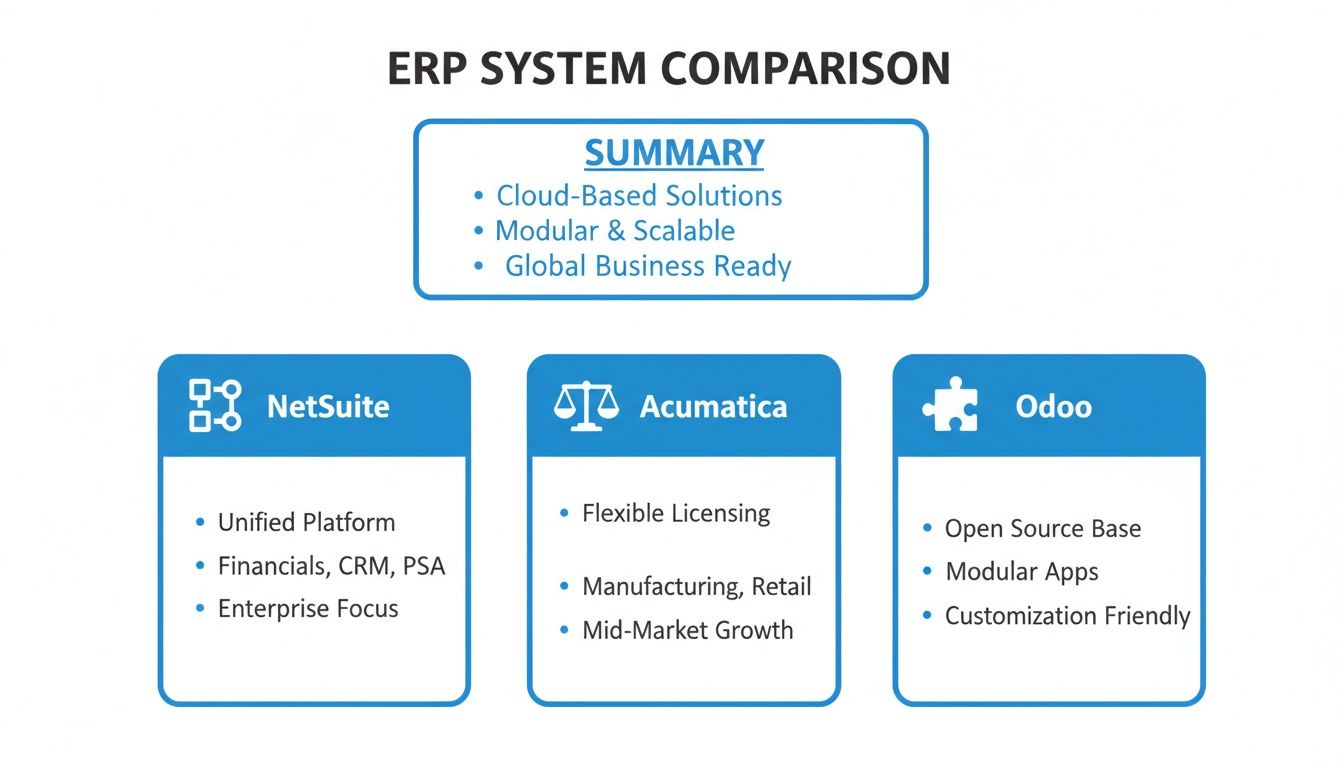
As you can see, major providers like NetSuite, Acumatica, and Odoo are all leaning heavily into the cloud model, whether it’s an all-in-one suite, a scalable platform, or a modular system.
Let’s make this real. Imagine a Singapore-based e-commerce brand with 10 users. We’ll break down the first-year Total Cost of Ownership (TCO) to see how the numbers really stack up.
| Cost Component | Cloud / SaaS ERP | On-Premise ERP |
|---|---|---|
| Software Licence | $15,000 (Annual Subscription) | $35,000 (One-Time Fee) |
| Implementation & Training | $10,000 | $15,000 |
| Hardware & Infrastructure | $0 (Included in subscription) | $12,000 (Servers, Networking) |
| Internal IT Staff | $0 (Managed by vendor) | $20,000 (Portion of IT salary) |
| Maintenance & Support | Included in subscription | $6,300 (18% of licence fee) |
| First-Year TCO | $25,000 | $88,300 |
The table doesn’t lie. The first-year outlay for an on-premise system can be over 3.5 times higher than a comparable cloud setup. This massive difference in upfront capital is a key reason why 78% of businesses have already moved to cloud-based ERP systems.
The numbers make it pretty clear. For most growing DTC brands and marketplace sellers, a cloud ERP is the more sensible and efficient choice. It frees up your cash to be invested in what really matters—marketing, inventory, and growth—instead of sinking it into IT hardware and maintenance.
Picking the right ERP for your Singapore business isn’t just about ticking boxes on a feature list. It’s a strategic move that demands a structured evaluation to confirm a vendor can actually handle your real-world operational headaches, not just look good in a generic demo.

You need to get past the glossy brochures and see tangible proof the software will work for your specific e-commerce workflows. The best way to do that? A well-crafted Request for Proposal (RFP).
A truly effective RFP for an e-commerce brand isn’t some huge list of every feature under the sun. It’s a targeted document that forces vendors to directly address your biggest pain points. Your RFP has to be built around your critical operational flows.
Actionable tip: Before you even think about writing a question, map out your entire order-to-cash process. Seriously, document every single step an order takes from Lazada, through your warehouse, and finally landing in your accounting records. This process map becomes the blueprint for your questions, guaranteeing you evaluate systems based on your day-to-day reality.
The whole point is to get specific, actionable answers. Don’t ask, “Do you support multi-channel e-commerce?” That’s too easy. Ask pointed questions that require detailed, thoughtful responses. This is how you quickly separate vendors who genuinely get the Singaporean e-commerce scene from those just peddling a generic solution.
When you’re putting together your RFP, you need questions that really test a vendor’s technical chops, their grasp of local compliance, and how deep their integrations go. These questions force them to prove their system’s worth in a context that actually matters to you.
Here are a few essential questions to get you started:
A vendor’s hesitation or inability to answer these questions with a live demonstration is a major red flag. If they can only show you PowerPoint slides, they may lack the proven experience your e-commerce business needs. Understanding how APIs work is crucial for modern e-commerce; you can get a better grasp of this by reading our guide on why e-commerce APIs are essential.
The table below provides a more structured list of questions you should include in your RFP. Think of it as your cheat sheet to cut through the sales talk and get to what really matters.
| Category | Question to Ask Vendor | What to Look for in the Answer |
|---|---|---|
| E-commerce Integration | Can you demonstrate a live, two-way sync with Shopee, Lazada, and our Shopify store, including product listings, inventory, and order status? | Look for a seamless, real-time demo, not just screenshots. They should prove the integration handles complex scenarios like bundle products and pre-orders. |
| Inventory & Order Management | Show us how your system handles a batch of 100 mixed orders from multiple channels, generates a consolidated picklist, and prints shipping labels. | The workflow should be intuitive and fast. Can they easily handle order splitting, backorders, and returns without manual workarounds? |
| Local Compliance (SG) | How does the system manage GST calculations, IRAS-compliant invoicing, and generate the necessary tax reports for Singapore? | They must show specific features for Singaporean compliance, not a generic tax module. Ask them to demo a GST rate change. |
| Scalability & Performance | What are your system’s API rate limits? Can you share case studies of Singaporean e-commerce clients with similar order volumes to ours? | You need concrete numbers and proof. Vague answers about “high performance” are a warning sign. The system must handle your peak season volumes. |
| Implementation & Support | What is your typical implementation timeline for a business like ours? Who will be our point of contact, and what does your local support in Singapore look like? | Look for a clear, realistic timeline with defined milestones. A dedicated, local support team is a huge plus over a generic international helpdesk. |
| Total Cost of Ownership | Provide a detailed breakdown of all costs: licensing, implementation, training, support, and any transaction-based fees. Are there hidden costs? | Transparency is key. A clear, all-in quote shows they understand your business needs. Watch out for vendors who are cagey about ongoing costs. |
Using these questions will force vendors to give you substantive answers, making your final decision much clearer and better informed.
A generic sales demo is pure theatre. It’s designed to impress, not to inform. You have to insist that vendors tailor their demonstrations to your actual business processes. Give them a sample data set that reflects your product catalogue and typical order volume.
For instance, throw this scenario at them: “Show us how your system processes 50 orders that just came in simultaneously from Shopee and our website, generates a consolidated picklist, prints shipping labels with Ninja Van, and updates the order status on all channels.”
This kind of practical test quickly reveals how intuitive the software really is and whether it can actually keep up with your daily grind without causing more headaches.
Choosing an ERP should never be a top-down decision made in a vacuum. Your team on the ground—the people who will use this system every single day—are your best source for identifying potential deal-breakers. Their input is gold.
Set up demo sessions and make sure key people from different departments are there:
When you gather feedback from these end-users, you ensure the system you pick will actually boost productivity across the company, not just in one department. This collaborative approach dramatically increases your chances of a smooth implementation and gets your whole team on board from day one.
Jumping into the world of ERP software brings up a lot of questions, especially when you’re running an e-commerce business in Singapore. You need clear, practical answers to make a decision you won’t regret. This section tackles the most common queries we hear from local business owners, helping you move forward with confidence.
Finding the right ERP is more than just a feature comparison. It’s about understanding implementation timelines, local support, and the classic mistakes to avoid. Let’s get into it.
This is the classic “how long is a piece of string?” question, but I can give you a realistic ballpark. For a small or medium-sized e-commerce business using a cloud-based ERP with mostly standard features, you should budget for three to six months.
This timeframe breaks down into a few key stages:
A local Shopify seller who’s just expanding to Lazada might hit the shorter end of this timeline. On the other hand, if you need a lot of custom work or your existing data is a complete mess, you could easily push past six months. Having a clear project plan with hard milestones is the only way to keep things on track.
Yes, absolutely. Singaporean SMEs can and should look into government grants to help pay for an ERP system. The main one you’ll want to look at is the Productivity Solutions Grant (PSG), which is specifically designed to help businesses adopt tech that makes them more efficient.
Plenty of good ERP vendors and their solutions are pre-approved under the PSG. You can find the official list on the GoBusiness GovAssist portal. The grant usually covers a good chunk of the costs—including the software subscription and implementation fees—making the whole project a lot more affordable for a growing business.
Actionable Insight: Before you sign any ERP contracts, check the Enterprise Singapore website for the latest on the PSG. Getting your eligibility confirmed and understanding the application process early can make a huge difference to your final bill.
The single biggest mistake we see people make is getting wowed by vendor demos before they’ve done their own homework. It’s so common. You see a slick presentation with all the bells and whistles and get excited, without having a firm grasp of the actual operational problems you need to solve.
This almost always leads to one of two bad outcomes: you pick a system that’s way too complex and expensive for what you need, or even worse, one that doesn’t actually fix your biggest headaches.
Before you even think about booking a demo, sit down with your team and map out your key processes. For instance, document every single step of your order fulfilment, from the moment a sale hits your Shopee store to the second the package is handed to Ninja Van. When you have that internal clarity, you can judge software based on how well it fits your reality, not how impressive their sales pitch is.
While you can work directly with an international vendor, I would highly recommend using a local implementation partner here in Singapore. The value they bring isn’t just about the technical setup; it’s about the on-the-ground expertise that can save you from major headaches later.
A Singapore-based partner gives you a few key advantages:
Their local knowledge is a massive asset. It’s what ensures your ERP project actually gets rolled out smoothly and works in the context of the Singapore market.
Ready to centralise your e-commerce operations and scale without the chaos? OneCart unifies your inventory, orders, and listings from Shopee, Lazada, Shopify, and more into a single powerful platform. Stop overselling, streamline your fulfilment, and make smarter decisions with real-time data. Discover how OneCart can transform your business today.
Automate & Scale Your Online Business with OneCart
Start a Free TrialUsed by hundreds of merchants in Singapore & Southeast Asia