3PL vs 4PL A Strategic Guide for E-commerce Growth [2025]
Struggling with the 3PL vs 4PL decision? This guide provides clear comparisons, real-world scenarios, and actionable advice for scaling e-commerce logistics.
Struggling with the 3PL vs 4PL decision? This guide provides clear comparisons, real-world scenarios, and actionable advice for scaling e-commerce logistics.
The 3PL vs 4PL conversation comes down to a simple question: are you looking for a partner to do the logistical work, or a partner to manage the entire process? A 3PL is your hands-on crew, physically handling warehousing and shipping. A 4PL acts as the general contractor for your supply chain, managing all the different players (including 3PLs) to ensure the entire system works together seamlessly.
Choosing the right logistics partner is a critical decision for any e-commerce business. As you scale, wrestling with inventory, fulfilling orders, and arranging shipments becomes a major drain on your time. Outsourcing to a specialist becomes essential for growth. Before diving deep, it helps to have a solid grasp of e-commerce supply chain management as a whole.

A Third-Party Logistics (3PL) provider handles the physical side of your supply chain. Think of them as the operational muscle. They own or lease warehouses, employ staff to fulfill orders, and hold contracts with shipping carriers. When you bring a 3PL on board, you are handing off the daily tasks of getting products from your shelf to your customer’s doorstep.
A Fourth-Party Logistics (4PL) provider, also known as a Lead Logistics Provider (LLP), operates at a strategic level. A 4PL typically doesn’t own warehouses or trucks. Instead, they act as your single point of contact to design, manage, and run your entire supply chain. This means they manage your network of 3PLs, freight companies, customs brokers, and tech providers for you.
To make the differences clear, here’s a straightforward table breaking down the core attributes of 3PLs and 4PLs.
| Attribute | 3PL (Third-Party Logistics) | 4PL (Fourth-Party Logistics) |
|---|---|---|
| Primary Focus | Daily logistics execution (warehousing, shipping) | Overall supply chain strategy and optimisation |
| Scope of Work | Manages a specific set of operational tasks | Manages the entire supply chain, including other partners |
| Relationship | Tactical and transactional | Strategic partnership and integration |
| Control Level | Business retains strategic control over the supply chain | Business outsources strategic control and management |
| Assets | Typically owns or leases assets (warehouses, trucks) | Often asset-neutral; manages assets of other providers |
| Best For | Startups and SMEs needing to outsource fulfilment | Larger or complex businesses seeking full supply chain optimisation |
This side-by-side view helps highlight the fundamental shift in responsibility. With a 3PL, you’re outsourcing a function; with a 4PL, you’re outsourcing the management of the entire function.
When you bring a 3PL provider on board, you’re hiring a specialist team to manage the physical side of your logistics. Think of them as the engine for your daily operations, handling the demanding, hands-on tasks required to get products to your customers quickly and correctly.
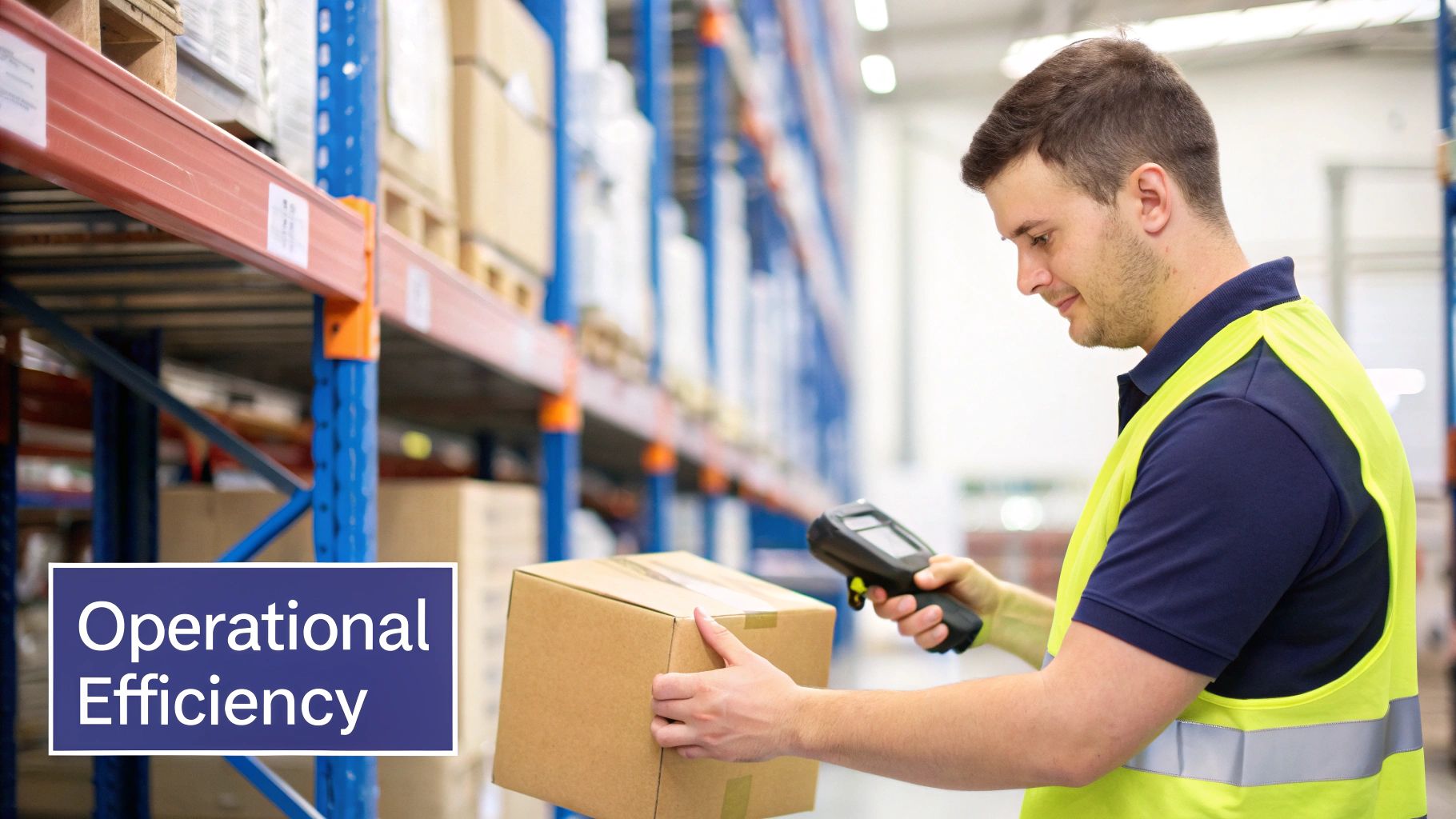
This partnership lets you maintain full strategic oversight of your supply chain while outsourcing the day-to-day execution. You decide which products to stock and the new markets to pursue; the 3PL ensures every order is fulfilled accurately and shipped on schedule.
A 3PL’s value lies in its specialized infrastructure and expertise across key areas. These services form the backbone of your fulfilment process.
Imagine a Singapore-based fashion brand that experiences massive sales spikes during events like the Great Singapore Sale or 11.11. Managing this fluctuation in-house would mean hiring temporary staff and finding extra warehouse space, which is both inefficient and expensive.
By partnering with a local 3PL, the brand can scale operations up or down seamlessly. The 3PL has the flexible space and trained staff to handle the surge in orders. During quieter months, the brand only pays for the space and services it actually uses, turning a fixed cost into a variable one. This adaptability is a significant advantage. For more on this process, explore our detailed guides on order fulfillment.
Actionable Insight: A 3PL transforms your logistics from a fixed overhead into a scalable, on-demand service. You gain access to professional infrastructure without the long-term capital investment, allowing you to focus on growing your brand.
Choosing a 3PL is about finding a reliable partner who can handle the operational side of your business. Start by evaluating their core competencies. Do they have experience with products like yours? Can their technology integrate smoothly with your e-commerce platform, whether it’s Shopify or Shopee?
The logistics scene in Singapore is incredibly advanced. Singapore’s 3PL market is projected to hit USD 5.84 billion by 2030, fueled by a thriving e-commerce sector and major infrastructure projects. Domestic transportation management holds a 33% market share to meet the demand for fast, final-mile delivery.
This means you should look for a 3PL that knows how to navigate Singapore’s dense urban landscape. Integrating a solid ecommerce automation software can also help streamline operations, working hand-in-hand with the efficiencies gained from a 3PL. By vetting potential partners carefully, you ensure your chosen 3PL will genuinely support your growth.
While a 3PL handles the heavy lifting, a 4PL acts as the strategic brain behind the entire operation. Moving from a 3PL to a 4PL means shifting from outsourcing tasks to outsourcing the management of your whole supply chain. A 4PL is a partner who designs, builds, and runs your logistics network for you.
A 4PL is like the architect and general contractor for your supply chain. They don’t own the trucks or warehouses. Instead, their main asset is deep expertise, powerful technology, and a network of providers. They manage all your vendors—from 3PLs to freight forwarders—creating a unified system focused on your business goals.
A 4PL’s work begins with high-level strategy. They analyze your business needs, market ambitions, and operational weaknesses to engineer the most efficient supply chain possible.
Actionable Insight: A 4PL provides a single point of accountability for your logistics. Instead of juggling multiple vendors, you have one strategic partner whose success is directly tied to your supply chain’s performance.
For any business aiming for growth across borders, this strategic oversight is a game-changer. A well-orchestrated supply chain and logistics management strategy, led by a 4PL, becomes a competitive advantage.
Imagine a successful Singaporean electronics retailer planning to expand into Malaysia, Thailand, and Vietnam. The complexity of this move can be overwhelming.
Instead of trying to find and manage separate 3PLs, navigate customs regulations, and juggle different currencies, they bring in a 4PL. The 4PL handles everything:
This frees the retailer to focus on marketing and selling in new regions, confident that the logistics are in expert hands. The 4PL doesn’t just execute tasks; it constantly seeks new efficiencies and drives strategic improvements as the business scales.
The true value of a 4PL partnership becomes clear over the long term. Their objective is continuous improvement, using data to fine-tune every aspect of your supply chain. This is a significant shift from the often transactional relationship with a 3PL.
While 3PLs are a popular choice in Singapore for e-commerce fulfilment, the demand for strategic oversight is growing. Globally, 76% of businesses using 3PLs are looking for more innovation from their partners—a signal that they are ready for the value a 4PL brings. The global 4PL market is on track to hit USD 121 billion by 2033, driven by this demand for comprehensive supply chain optimisation. By handing over strategic control to a 4PL, businesses can achieve sustained efficiency and accelerate their market expansion.
When weighing a 3PL versus a 4PL, the decision often comes down to cost, control, and scalability. These factors determine how you want to manage and grow your e-commerce business. The right choice is a partner that aligns with your long-term vision.
A 3PL partnership often feels more direct and hands-on, while a 4PL relationship is built on strategic trust and a big-picture view of your supply chain.
The payment models for 3PLs and 4PLs are very different, reflecting their distinct roles.
With a 3PL, costs are typically transactional and predictable. You pay for specific, tangible services:
This model is straightforward, making it easy to forecast fulfilment expenses as your order volume changes. For a new or growing business, this direct cost structure is often simpler to manage.
A 4PL works on a more strategic, performance-based model. Their fees are often structured as a management fee, a percentage of your total logistics spend, or a gain-sharing deal where they take a cut of the cost savings they generate. For instance, a 4PL might help a company save $5.6 million in operating expenses by optimizing inventory and reducing storage fees for outdated stock. A 4PL is financially incentivized to find efficiencies across your entire supply chain.
How much direct, day-to-day control do you want over your logistics? Your answer is a key factor in the 3PL vs. 4PL decision.
Working with a 3PL means you keep direct operational command. You outsource the physical work but still make the strategic decisions. You decide on inventory strategy, manage the 3PL relationship, and direct the overall supply chain. This is ideal for founders who want to maintain a tight grip on fulfilment quality.
A 4PL partnership involves handing over high-level strategic decisions. You trust the 4PL to be the architect of your logistics network. They manage vendor relationships, integrate technology, and fine-tune the system for you. This requires a high degree of trust, but it frees you to focus on your core business—product development, marketing, and sales.
This decision tree offers a simple way to frame the choice based on your needs.
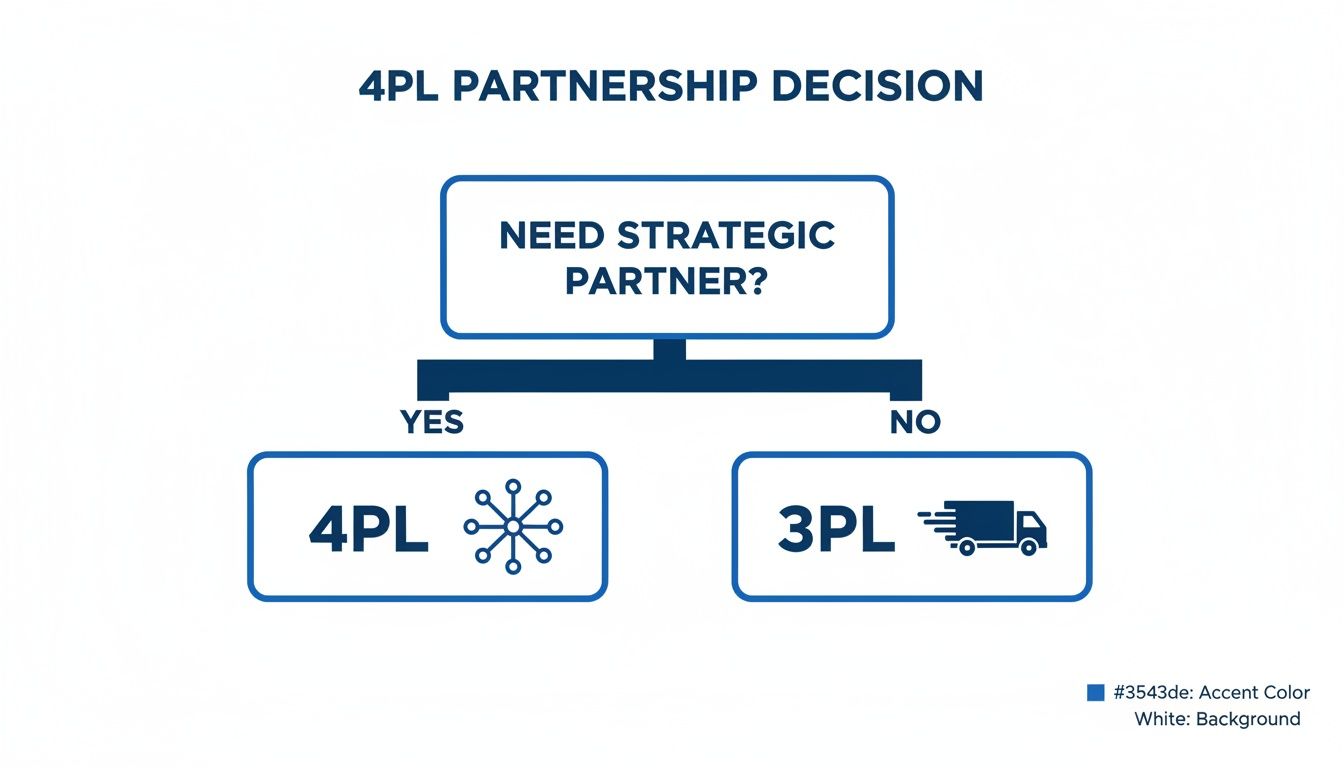
As the visual shows, if you need strategic oversight and end-to-end management, a 4PL is the logical step. If you just need someone to handle tactical execution, a 3PL is a better fit.
Both 3PLs and 4PLs are designed to help you scale, but they scale different things.
A 3PL is excellent for scaling order volume. As your sales grow from 100 to 1,000 orders a day, a 3PL provides the flexible warehouse space and manpower to manage that growth without requiring you to invest in fixed assets. They are experts at navigating seasonal peaks and steady growth within a specific market.
A 4PL is engineered to manage and scale complexity. Their value becomes clear when your business expands into new international markets, adds diverse product lines, or juggles a complex web of suppliers.
Actionable Insight: If your biggest challenge is shipping more of the same products to the same market, a 3PL is your best bet. If your challenge is orchestrating a multi-faceted supply chain across different countries and partners, a 4PL is built for that complexity.
Consider a Singaporean electronics brand expanding across Southeast Asia. They’d need a 4PL to coordinate regional carriers, navigate customs laws, and centralize data. A 3PL could handle the Singaporean leg, but only a 4PL could manage the entire international network. This strategic management is crucial for keeping inventory lean. To learn more, dive into our guide on optimizing inventory turnover days.
Use this matrix to weigh the strategic trade-offs between a 3PL and 4PL model based on your business’s objectives.
| Factor | 3PL (Tactical Outsourcing) | 4PL (Strategic Partnership) | Key Question for Your Business |
|---|---|---|---|
| Primary Goal | Executing specific logistics tasks (warehousing, pick/pack, shipping). | Optimising the entire supply chain from end to end. | Are we solving a task-based problem or a system-wide problem? |
| Cost Structure | Transactional (per-item, per-pallet). Clear and predictable. | Strategic (management fee, % of spend, gain-sharing). Performance-based. | Do we prefer predictable operational costs or an investment in long-term efficiency? |
| Control Level | High. You manage the strategy and the 3PL relationship directly. | Low. You delegate strategic control and vendor management to the 4PL. | How hands-on do we need to be with daily logistics to protect our brand experience? |
| Scalability | Best for scaling order volume within existing markets. | Best for scaling operational complexity (new markets, suppliers, channels). | Is our primary growth challenge volume or complexity? |
| Ideal For | Startups, SMBs, and businesses with straightforward supply chains. | Large enterprises or rapidly expanding businesses with complex global needs. | What does our business look like in 3-5 years, and which partner supports that vision? |
By asking these questions, you can make a choice that aligns with where your business is headed. The right partner isn’t just about fulfilling orders today; it’s about building the logistical foundation for your future success.
Most e-commerce businesses consider a 3PL when they hit a certain growth point. It’s the logical next step when you’ve outgrown your garage or spare room. If packing boxes is stealing time from strategic tasks like marketing and product development, it’s time to look at a 3PL. Think of them as your tactical, on-the-ground partner for getting things done.
Choosing a 3PL is about efficiently outsourcing physical tasks: warehousing, order fulfilment, and shipping. If your biggest headaches are managing inventory space and getting orders out on time, a 3PL is built to solve those problems.
Running out of space and time is a common trigger for finding a 3PL and a clear sign of strong growth.
Practical Example: A startup in Singapore sells artisanal snacks and began by packing orders in a small office. Now, with over 50 orders a day, their team is swamped. Inventory is disorganized, packing mistakes are increasing, and they have no leverage to negotiate shipping rates. A 3PL provides immediate access to a professional warehouse, an experienced team, and the advantage of pre-negotiated, lower shipping costs.
Another key reason to choose a 3PL is when you want to maintain full strategic control over your supply chain. You know your product, customers, and market better than anyone.
Practical Example: An established online apparel brand wants to keep its supply chain strategy in-house. Their management team excels at demand forecasting, but the physical process of managing thousands of SKUs and handling seasonal order spikes is an operational bottleneck. By partnering with a 3PL, the brand outsources the physical work while retaining complete control of the strategy. They decide on inventory levels; the 3PL handles storage and daily shipments.
Actionable Insight: This hybrid approach is very common. You get the operational power of a dedicated logistics partner without giving up control of your supply chain. It’s about delegating tasks, not strategy.
If these situations sound familiar, a 3PL is likely the right fit. Run through this checklist to be sure:
The 3PL model has proven its worth. Even when Singapore’s logistics market faced volatility, 3PLs succeeded by focusing on their core strengths, like last-mile delivery for the e-commerce sector. You can read more about Singapore’s logistics market insights to understand these trends.
Making the leap to a 4PL is a major strategic move, usually triggered when your supply chain becomes more complex. A 3PL is great at handling more orders. A 4PL is built to manage more variables.
The clearest sign you need a 4PL is when you spend more time managing logistics partners than growing your business. If your week involves juggling multiple 3PLs, chasing freight forwarders, and trying to reconcile reports from different systems, you have become your own inefficient 4PL.
International expansion is often the breaking point. The logistics of entering new countries is far more complex than domestic shipping.
Practical Example: Electronics Brand Expanding in Southeast Asia
A successful electronics brand from Singapore wants to launch in Malaysia, Thailand, and Vietnam. They face a maze of challenges:
A 4PL acts as the project manager for the entire supply chain. They find and manage the best local 3PLs, handle customs, and pull all data into a single dashboard. This frees the brand to focus on marketing and sales.
Complexity can arise even without international expansion. This happens when a business uses more suppliers, adds new product lines, or sells across different channels.
Practical Example: A Business with Multiple Suppliers and Channels
A home goods company sources products from factories in Vietnam and China. They sell on their Shopify store, on Lazada, and also supply wholesale retail partners in Singapore.
Actionable Insight: This intricate web of inbound and outbound logistics requires strategic optimization. A 4PL can coordinate freight from multiple suppliers, manage inventory allocation between B2C and B2B channels, and ensure timely fulfillment for each customer type, looking at the entire picture to find the most cost-effective routes.
A 3PL, focused on B2C orders, can’t provide this level of strategic oversight. A 4PL optimizes the entire flow, from coordinating with suppliers to final delivery.
If you’re weighing the 3pl vs 4pl decision, look for these signs that your business is ready for an upgrade:
When these challenges become roadblocks, it’s a strong signal that you need a partner who thinks strategically, not just tactically.
Choosing between a 3PL and a 4PL can feel complex, so let’s tackle some of the most common questions for e-commerce sellers.
The billing method is a fundamental difference in the 3PL vs 4PL comparison. A 3PL’s pricing is almost always transactional, tied directly to the physical work:
This is a straightforward, itemized model that scales predictably with order volume.
A 4PL operates on a strategic fee structure. You pay for their expertise in managing and improving your entire supply chain. This might be a fixed monthly management fee, a percentage of your total logistics budget, or a gain-sharing arrangement where they take a cut of the money they save you.
Yes, this is common with large logistics players. They often have different divisions—one side owns and operates warehouses and trucks (the 3PL part), while another team acts as high-level strategic consultants (the 4PL part).
Actionable Insight: A “pure” 4PL is typically asset-neutral, meaning they don’t own physical assets. This allows them to be unbiased in selecting the best, most cost-effective vendors for your specific needs, without any pressure to use their own company’s resources.
Not at all. Starting with a 3PL is a smart strategy for most growing e-commerce brands. It gets the daily grind of packing boxes off your plate so you can focus on marketing, product development, and sales.
Think of it as a natural evolution. As your business grows and becomes more complex—perhaps you start selling internationally, add new product lines, or manage suppliers across multiple countries—your needs will change. At that point, you might look to a 4PL to take on that bigger strategic role and orchestrate all those moving parts for you.
Ready to stop juggling multiple sales channels and gain a single, real-time view of your operations? OneCart centralises your inventory and orders from Shopee, Lazada, TikTok Shop, Shopify, and more, so you can prevent overselling and streamline fulfilment. Achieve scalable growth and see a return on investment in days by visiting https://www.getonecart.com to learn more.
Automate & Scale Your Online Business with OneCart
Start a Free TrialUsed by hundreds of merchants in Singapore & Southeast Asia