What Is 3PL Third Party Logistics and How Does It Fuel Ecommerce Growth 2026
Discover how 3PL third party logistics can scale your ecommerce business. This guide explains how to choose a provider, manage costs, and streamline operations.
Discover how 3PL third party logistics can scale your ecommerce business. This guide explains how to choose a provider, manage costs, and streamline operations.
A 3PL (third-party logistics) provider is a partner you hire to manage the physical side of your ecommerce business, including warehousing, inventory management, and order fulfillment. Partnering with a 3PL allows you to offload daily operations so you can focus on growing your brand.
Imagine your online store is growing quickly. Instead of leasing a bigger warehouse, hiring more staff, and spending your days packing boxes, you can forward your inventory to a specialized partner. That partner is your 3PL.
From that point, they handle the logistics. When a customer places an order on your Shopify or Shopee store, the order is automatically sent to the 3PL. Their team then picks the correct items, packs them, and ships the package directly to your customer. You never have to touch the physical product.
This approach is becoming the standard for ecommerce brands that want to scale. The global third-party logistics market is expanding, driven by sellers who need to manage large order volumes, especially during peak sales events. Projections show the market value could reach USD 2,852.54 billion by 2034, fueled by challenges sellers on platforms like Lazada and TikTok Shop face when a campaign like 11.11 increases daily orders into the thousands. You can explore more data on this market growth from Fortune Business Insights.
A 3PL handles the essential tasks required to get products to your customers. While services can vary, most providers focus on a core set of responsibilities.
Actionable Insight: By outsourcing these operational functions, you are using a team of logistics experts and their entire infrastructure. This frees up your time and capital to reinvest in marketing, customer service, and product development—the activities that drive brand growth.
For a seller managing 50+ orders a day, switching to a 3PL can be transformative. It provides the strategic foundation to handle 500 or even 5,000 orders a day without internal operations breaking down. A 3PL gives you the infrastructure to scale on demand.
Not all 3PL providers are the same. Understanding the differences is key to finding the right partner for your business. Some 3PLs focus on basic storage and shipping, while others offer a range of specialized services that can act as an extension of your brand.
Think of it like hiring a contractor. For a simple paint job, a general handyman works. But for complex electrical work, you need a licensed electrician. The goal is to match the expertise to the job. The same applies to fulfillment.
Every 3PL will cover the fundamentals: warehousing and transportation. These are the essential services that get your products from a shelf to your customer’s doorstep.
The services that differentiate providers are the value-added services. These are extras that solve specific problems, cater to unique product needs, or help create a better customer experience.
Here is a breakdown to help you distinguish between them.
This table helps businesses quickly understand the difference between standard and specialized 3PL offerings, aiding in the selection process.
| Service Type | Description | Ideal For |
|---|---|---|
| Core Services | The essential tasks needed to move products: receiving inventory, storing it, picking items for an order, packing them securely, and arranging standard shipping. | Any ecommerce business that needs a reliable way to store products and fulfill customer orders. |
| Value-Added Services | Specialized offerings that go beyond basic fulfillment, like product kitting, custom-branded packaging, and managing returns (reverse logistics). | Businesses with unique product needs, a strong focus on brand experience, or complex operational requirements. |
Understanding this distinction is the first step. Core services are necessary for operations, but value-added services can help your business stand out and scale effectively.
A 3PL partnership can offer a real strategic advantage through its specialized services. Value-added services are designed to address challenges that basic fulfillment cannot, helping you deliver a better final product to your customer.
Let’s look at a few practical examples:
Actionable Insight: Choosing a 3PL without the right value-added services is like hiring a general contractor for specialized work. A specialist will do it faster, better, and with fewer mistakes. Ensure your potential partner has proven experience with the specific services you need.
Another key difference is whether a 3PL is asset-based or non-asset-based.
An asset-based provider owns its physical infrastructure—warehouses, delivery trucks, and equipment. This gives them direct control over their operations, but can sometimes make them less flexible.
A non-asset-based provider, often called a freight broker, does not own the physical equipment. Instead, they act as a coordinator, using their technology and network to manage services with various carriers and warehouse operators. This model can offer more flexibility and be more cost-effective, but its success depends on the quality of their network partners.
While this is an important distinction, some companies operate in an even more advanced capacity. You can dive deeper into the differences between 3PL vs 4PL to understand the full spectrum of logistics management.
Partnering with a third-party logistics (3PL) provider can help solve significant growth challenges for ecommerce brands, turning logistical tasks into a competitive advantage. You are integrating your business with an infrastructure built for efficiency and scale.
One of the most immediate benefits is cost reduction. A 3PL operates at a large scale, which allows them to negotiate lower shipping rates with carriers than a single business could. You benefit from these discounted rates without needing to ship thousands of orders a day yourself.
Additionally, you avoid the large capital expenses of running your own warehouse. There are no forklifts to buy, no warehouse space to lease, and no complex warehouse management system (WMS) to purchase. Instead, you share the overhead with other businesses and only pay for the space and services you use.
For growing brands, handling sudden increases in order volume can be a challenge. A successful marketing campaign or a viral social media post can overwhelm an in-house fulfillment team, leading to shipping delays and customer complaints.
A 3PL partnership provides the ability to scale up or down on demand. They have the trained staff, physical space, and established processes to handle a sudden jump from 100 orders a day to 1,000 without issues.
Actionable Insight: This operational flexibility means you don’t have to decline growth opportunities because your logistics can’t keep up. You can participate in major sales events like Black Friday or 11.11, knowing your fulfillment is prepared. A practical tip is to provide your 3PL with sales forecasts before big promotions so they can allocate resources accordingly.
Expanding into a new country often involves the challenge of establishing a physical presence. A 3PL with a network of warehouses can remove this barrier, allowing you to enter new markets without a large upfront investment.
Here’s a practical example of how this works:
This gives the brand an instant local presence. Customers in the region receive their orders faster and at a lower cost, and the brand can compete effectively in a new market without leasing international warehouse space.
Ultimately, working with a 3PL is a strategic move for total supply chain optimization. By offloading these complex operational tasks, you free up your team to focus on business growth: marketing, product innovation, and customer relationships.
For a 3PL partnership to be effective, it needs a strong connection to your sales channels. This connection is the digital infrastructure that allows orders and inventory data to flow automatically between your online stores and the warehouse.
Without this integration, you are left with manual data entry, such as exporting spreadsheets and emailing order lists, which can lead to delays and errors.
The technology that enables this connection is the Application Programming Interface (API). An API acts as a universal translator and messenger, allowing your ecommerce platform (like Shopify or TikTok Shop) to communicate directly with your 3PL’s Warehouse Management System (WMS). When a customer places an order, the API sends that information to the warehouse, initiating the fulfillment process automatically.
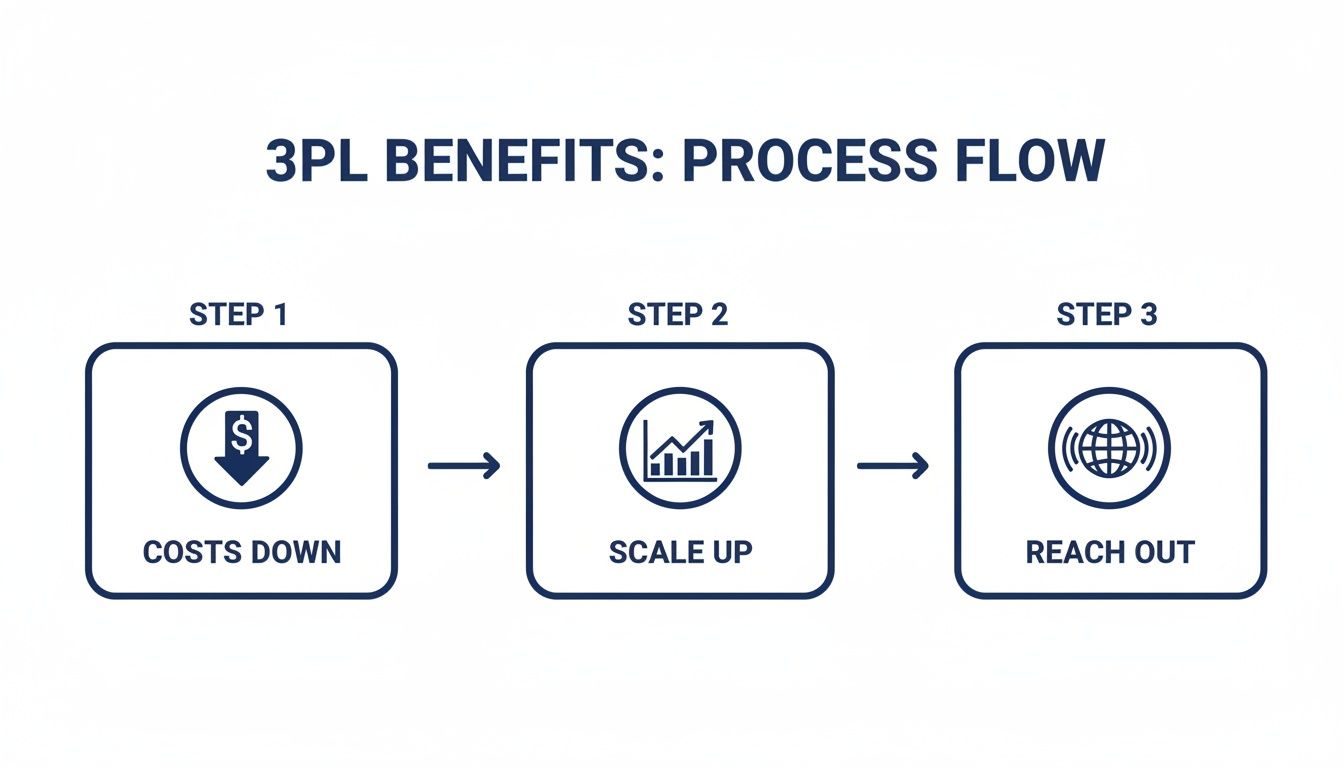
A solid 3PL integration is a strategy that helps cut costs, enables scaling, and opens up new markets.
Overselling is a major issue for any multi-channel seller. For example, if you have only 10 units of a product left and sell seven on your Shopify site and five on Lazada simultaneously, you have sold two units you don’t have. This forces you to cancel orders, which can damage your brand’s reputation.
A direct API integration provides a solution through real-time inventory synchronization.
Here’s a practical look at how it works:
This communication happens in seconds, making it nearly impossible to sell an item you don’t have, regardless of how many storefronts you manage.
API integration is also key for efficient order processing. The process, known as order routing, eliminates the manual task of exporting orders and emailing them to your warehouse partner. As soon as a customer completes a purchase, the API integration ensures the order details — including packing slips and shipping labels — are securely transmitted to the team that will pick, pack, and ship it.
Actionable Insight: A seamless integration transforms fulfillment from a reactive, manual task into an automated workflow. It creates a system where you can focus on selling, confident that the operational side of your business is running smoothly. A practical tip is to regularly test the order flow to ensure there are no communication breakdowns between systems.
For a deeper dive into the tech behind this, you can learn more about the role of ecommerce APIs and how to use them effectively in our detailed guide.
If you’re selling across multiple platforms—like Shopee, Lazada, TikTok Shop, and your own Shopify website—managing individual 3PL integrations can become complex. Each channel may have its own API requirements, creating a complicated network of connections.
A central management platform like OneCart can act as a bridge. Instead of connecting each sales channel to your 3PL individually, you connect them all to a single central hub.
This “hub-and-spoke” model simplifies the entire process. You can manage all your sales and inventory from one place, while your 3PL receives consolidated order data from a single source. It streamlines your workflow and makes it easier to add new sales channels in the future without building new integrations from scratch.
Selecting a third-party logistics (3PL) provider is a significant decision for an ecommerce founder. This partnership directly impacts your customers and your brand’s reputation. A good partner will feel like an extension of your team, while a poor one can create operational problems.
Approach the selection process with a clear plan. Look beyond price quotes and examine the operational details that determine success. Evaluate their technology, warehouse network, and experience with products similar to yours.
A 3PL’s technology is the foundation of your fulfillment. If it’s unreliable, you’ll face manual workarounds and delays. The first question should be about their ability to connect directly with your sales channels, whether it’s Shopify, Shopee, Lazada, or a combination.
Be specific in your questions.
A provider without reliable integrations will create inefficiencies, defeating the purpose of outsourcing.
Different warehouses have different specialties. A 3PL that excels at shipping small electronics may not be equipped to handle apparel, which often has high return rates and numerous SKUs. Similarly, a fulfillment center for shelf-stable food won’t have the climate control needed for delicate cosmetics.
Focus on their experience with your specific product category.
Actionable Insight: A 3PL’s experience in your niche is a critical factor. A partner who understands the unique challenges of your products can prevent costly mistakes and become operational much faster. A practical tip is to ask for references from brands in your industry.
Before you begin interviews, prepare a checklist. A structured evaluation helps ensure you ask every potential partner the same important questions and can compare their answers effectively.
| Evaluation Criteria | Key Questions to Ask | Red Flags to Watch For |
|---|---|---|
| Technology & Integration | Can you demo your WMS? What ecommerce platforms do you natively integrate with? What’s your average API response time during peak volume? | Vague answers about integrations. No client portal for real-time visibility. Lack of experience with your specific shopping cart. |
| Operational Expertise | What other brands in our category do you work with? Can we speak to a reference? What are your procedures for handling fragile/perishable/high-value items? | No experience in your product niche. Unwillingness to provide references. One-size-fits-all operational processes. |
| Warehouse Network | Where are your fulfillment centers located? Do you offer multi-location fulfillment to reduce shipping times and costs? Can we tour one of your facilities? | A single warehouse location that is far from your customer base. Dirty, disorganized facilities during a tour. |
| Performance & SLAs | Can you share your performance metrics for the last quarter (accuracy, on-time shipping)? What are the specific penalties if you miss an SLA target? What is your daily order cutoff time? | Refusal to share performance data. SLAs that are weak or have no financial penalties. Early cutoff times that limit same-day shipping. |
| Scalability & Pricing | How do you handle seasonal spikes in order volume? What does your pricing structure look like? Are there any hidden fees for receiving, storage, or account management? | Inability to provide a clear plan for scaling. Complex pricing with lots of potential hidden fees. High minimum order requirements. |
Using a checklist like this turns a general conversation into a focused interview. It helps you evaluate whether a 3PL can truly support your business as it grows.
The Service Level Agreement (SLA) is a crucial part of your contract. It’s where your 3PL documents their performance commitments in writing. Read this document carefully to ensure the terms align with your customer promise.
Key SLA metrics to scrutinize:
Negotiating a clear and comprehensive SLA provides protection. It sets clear expectations, creates accountability, and offers a path to resolution if performance falls short. For more insights on finding a great local provider, check out our guide on selecting a 3PL in Singapore.

Handing over your fulfillment is a significant step, and mismanaging costs can affect your margins. A good 3PL partner will be transparent with their pricing, but it is your responsibility to understand the costs and measure the value you receive.
View your 3PL as an investment in your brand’s efficiency and customer satisfaction. Every dollar spent should be tied to clear, measurable results.
While each provider has its own pricing model, most costs in a 3pl third party logistics agreement fall into several common categories. Understanding these helps you create an accurate forecast and identify potential hidden fees.
Here are the main charges to expect:
Actionable Tip: Always ask for a line-item breakdown of every potential charge. This includes costs for account management, packaging materials, and special projects like kitting or returns handling. Clarifying these costs upfront prevents unexpected charges on your first invoice.
Once operational, you need a way to evaluate your partner’s performance using Key Performance Indicators (KPIs). These are the metrics you use to hold your 3PL accountable and ensure they are meeting the terms of your Service Level Agreement (SLA).
This is about ensuring your customers receive the fast, accurate shipping they expect.
Here are the essential KPIs to track:
By scheduling regular check-ins with your partner to review these KPIs, you can build a relationship based on data and shared goals. This allows you to identify and fix small problems before they become larger issues.
You may still have some questions about working with a 3PL third party logistics provider. Let’s address some of the most common inquiries from ecommerce sellers.
The distinction is quite simple. A freight broker acts as a matchmaker, connecting a business that needs to ship something with a trucking company that has available space. Once the connection is made and the goods are on the truck, the broker’s job is generally complete. The key document in freight shipping is the bill of lading — it serves as the contract of carriage between shipper and carrier.
A 3PL, however, is a long-term operational partner. They manage your entire fulfillment process, including warehousing your products, managing inventory levels, picking and packing orders, and coordinating final delivery. A broker is a specialist for a single task, while a 3PL is a comprehensive partner for your supply chain.
A successful 3PL partnership requires ongoing communication and shared goals. It is a relationship that needs active management.
Actionable Insight: Treat your 3PL as an extension of your team. Set clear expectations from the beginning, agree on the key metrics (KPIs) that define success, and schedule regular check-ins to review performance.
Here are a few practical steps to maintain a smooth partnership:
While 3PLs work with various businesses, they are particularly essential in industries with complex supply chains and high customer expectations for fast, accurate orders. The sectors that rely most on third-party logistics include:
Any business that wants to grow sales without becoming entangled in logistics can benefit from the right 3PL partner.
If you’re managing sales across Shopee, Lazada, TikTok Shop, and more, centralizing your operations is the key to scaling efficiently. OneCart provides a single dashboard to sync inventory, process orders, and manage listings across all your channels, creating a seamless bridge to your 3PL partner. Learn how OneCart can unify your ecommerce operations.
Automate & Scale Your Online Business with OneCart
Start a Free TrialUsed by hundreds of merchants in Singapore & Southeast Asia