A Founder's Guide to 3PL in Singapore for Ecommerce Growth 2026
Unlock your ecommerce potential with this guide to 3PL in Singapore. Learn how to choose a partner, navigate services, and scale your brand effortlessly.
Unlock your ecommerce potential with this guide to 3PL in Singapore. Learn how to choose a partner, navigate services, and scale your brand effortlessly.
Struggling to pack orders while you should be growing your brand? This is exactly where a 3PL partner in Singapore changes the game.
They act as your outsourced operations team, handling everything from storing your inventory to picking, packing, and shipping orders. This frees you up to focus on what you do best: marketing and selling. With its strategic location, Singapore is the perfect launchpad for brands wanting to serve both local and regional customers with speed and precision.
Most e-commerce founders know the feeling. The journey often begins in a spare room piled high with products and packing tape. It works for a while, but as your brand grows, so does the complexity. Soon enough, you’re spending more time printing shipping labels than you are creating new products or running ads.
This is the classic tipping point where operational bottlenecks start to choke your growth. A Third-Party Logistics (3PL) provider in Singapore steps in to become an extension of your business, taking over the entire physical side of your operations.
Partnering with the right 3PL turns logistics into a genuine strength. They give you access to infrastructure and expertise that would be impossible for most small businesses to build on their own.
Practical Example: During a massive sales event like 11.11, a small team can be overwhelmed by hundreds of orders, leading to shipping delays and unhappy customers. A 3PL is built for these peaks. Their entire system, from warehouse staff to automated sorting, is designed to handle huge volumes efficiently. This means your promotions run smoothly, and customers get their orders on time.
This frees you up to concentrate on the activities that actually drive growth:
A great 3PL provides the operational backbone that allows your brand to scale reliably. By outsourcing fulfillment, you buy back time and gain the ability to compete on delivery speed and accuracy.
The demand for these services is skyrocketing. Singapore’s 3PL market has exploded, hitting a $5.48 billion valuation in 2025 and is projected to grow at a steady 3.81% CAGR through 2033. This makes it a true powerhouse for e-commerce sellers juggling platforms like Shopee, Lazada, and TikTok Shop.
This growth is driven by the massive e-commerce boom, with online retail expected to capture 25.6% of total retail sales by 2028. This incredible demand is pushing merchants to outsource fulfillment so they can handle surging orders without the headache of overselling or stockouts. You can find more details on the growth of Singapore’s 3PL industry on marketreportanalytics.com.
What does this mean for you? It means you have access to world-class infrastructure. Singapore’s incredibly efficient ports and extensive air cargo networks allow your 3PL to move products quickly, both within the city-state and across Southeast Asia. For an online brand, this translates directly to faster delivery times—a huge factor in customer satisfaction and repeat business. This final step is often the most critical, which is why understanding the nuances of last-mile delivery in Singapore is essential for e-commerce success.
So, you’re thinking about working with a 3PL in Singapore. What does that actually involve? A 3PL takes over the entire physical journey of your products, from the moment they arrive in a warehouse until they land on your customer’s doorstep.
The process is designed to make your operations faster, more accurate, and ultimately, more scalable. These services range from essential functions to specialized extras that can give your brand a serious competitive edge.
First, you need a safe place to keep your products. Professional warehousing provides professionally organised storage, real-time tracking, and a secure, controlled environment for your inventory.
Practical Example: Imagine a local Singaporean beauty brand selling high-end organic serums. These products are sensitive to heat and humidity. Storing them in a spare room can spoil them. By using a 3PL with a climate-controlled warehouse, the brand guarantees its serums stay potent and fresh, protecting product quality and reputation. Plus, the 3PL’s software shows them live stock levels, so they know exactly when it’s time to reorder.
This level of control is crucial for a growing brand. Proper inventory management helps prevent selling out of bestsellers while also stopping you from tying up cash in slow-moving products.
The moment a customer clicks “buy,” the fulfillment process begins. This is the classic pick, pack, and ship cycle, where a great 3PL proves its worth. Their trained staff can find the right items, pack them securely, and get them to the right courier quickly.
Practical Example: A fashion retailer on Shopify wants to offer next-day delivery across Singapore to compete with larger brands. Their 3PL partner has an optimized workflow that ensures any order placed before 2 PM is picked, packed, and dispatched the same day. This speed becomes a core part of their brand promise, boosting customer satisfaction and driving repeat business.
To get a better sense of how this all fits together, it’s worth understanding the broader third-party logistics industry and its massive role in modern e-commerce.
Actionable Insight: Create a simple “service checklist” for your business. On one side, list what you need right now (e.g., standard pick and pack). On the other, list what you might need later (e.g., custom packaging, FBA prep). This document will help you effectively evaluate potential partners.
The best 3PLs offer a menu of value-added services (VAS) that let you tailor your logistics to create a standout customer experience.
These services often include:
Partnering with a 3PL in Singapore that offers these services gives you incredible flexibility. You can launch a new bundle or test a new packaging design without having to rework your own operations. It keeps you agile and ready for the next market trend.
Singapore’s real strength for an e-commerce brand lies beyond its own shores. Its location makes it a natural hub for regional trade, and a good 3PL in Singapore is your ticket to unlocking that potential and expanding across Southeast Asia.
International logistics can get complicated quickly. You have to manage freight forwarders, customs agents, and various international regulations. A 3PL acts as your expert guide through this process. They handle the heavy lifting of freight forwarding (moving products across borders) and customs brokerage, managing all the complex import and export paperwork to ensure your shipments comply with each country’s rules.
Let’s say you run an electronics store on TikTok Shop from Singapore and want to expand into Malaysia and Indonesia. A 3PL’s cross-border expertise is essential.
Here’s how they would manage an order for a customer in Kuala Lumpur:
This end-to-end management makes international customers feel like they’re buying from a local store. For a deeper look into the mechanics, you can explore our guide on setting up your cross-border e-commerce operations.
This concept map shows how a 3PL acts as the central brain for core logistics functions like storage, fulfillment, and other value-added services.
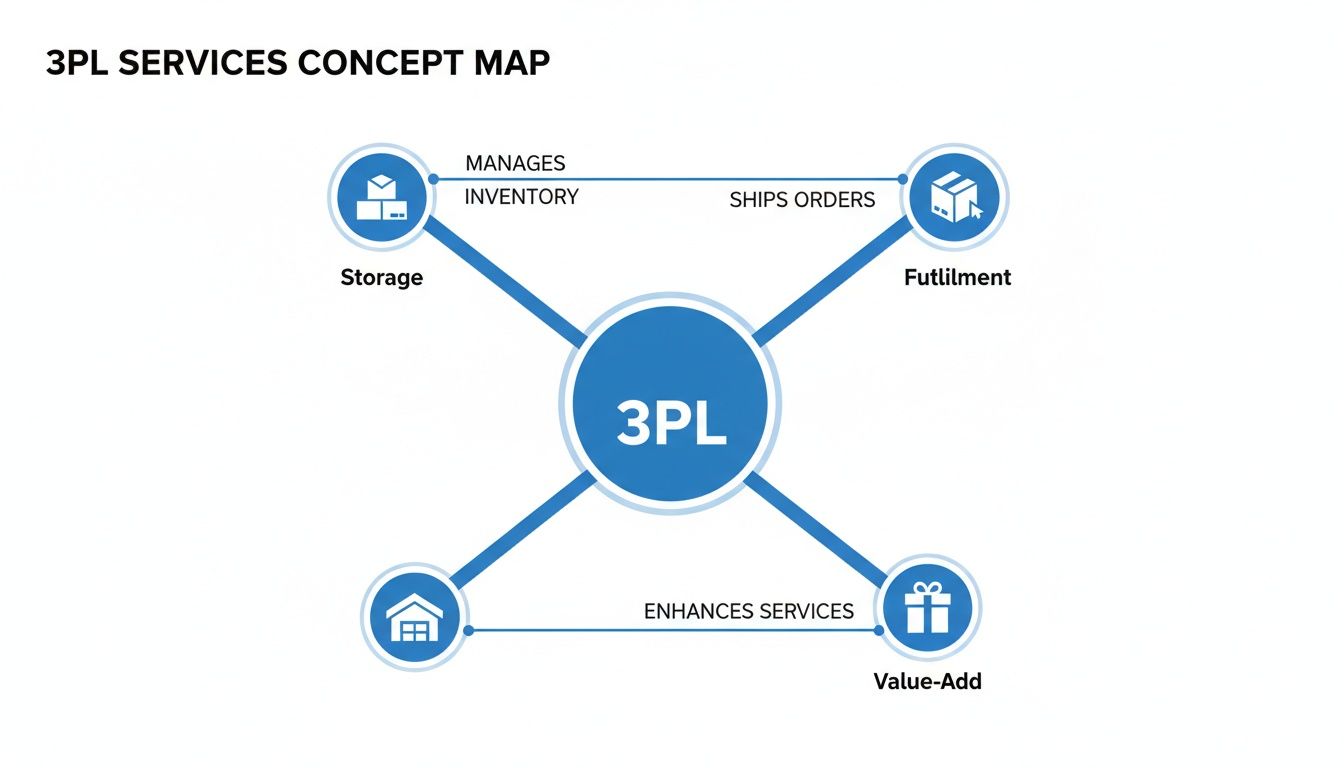
Think of cross-border shipping as a natural extension of these core services. Your 3PL simply plugs its established infrastructure into its international network to reach customers anywhere.
The shift to regional e-commerce is a massive movement. The Singapore 3PL market is expected to grow by USD 1.63 billion from 2024 to 2029, driven by a rapid 6.73% CAGR. This boom is happening because brands on Shopify and WooCommerce are using Singapore’s world-class infrastructure as a launchpad for regional expansion.
The numbers don’t lie. Trade volumes are surging, with Changi Airport reporting a 14% increase in airfreight to 475,000 tonnes in early 2024 alone.
While every business is different, many of the core principles of moving goods internationally are the same. It’s worth checking out a guide on freight forwarders for Amazon FBA supply chains, as many of the insights apply universally.
Actionable Insight: When evaluating a potential 3PL, ask specific, targeted questions about their cross-border capabilities to understand what they can actually do.
Here are the critical questions to ask a potential 3PL in Singapore about their regional network:
Choosing a partner with proven cross-border skills is the single most important step you can take to successfully take your brand regional.
Choosing a logistics partner is one of the biggest decisions you’ll make for your e-commerce business. You’re looking for a long-term partner who will directly impact your customer satisfaction and your ability to grow.
A great 3PL in Singapore becomes a true extension of your team. A bad one can lead to shipping errors, inventory nightmares, and a damaged brand reputation.
The key is to look past a simple price comparison. You need to evaluate potential partners on a practical level, focusing on four critical pillars: their technology, their operational track record, their ability to scale, and their location.
A 3PL’s software is just as important as its warehouse space. You need a partner whose tech can seamlessly plug into your existing sales channels, whether that’s Shopify, Shopee, Lazada, or a mix of all three.
Their Warehouse Management System (WMS) should offer a real-time, two-way connection. When an order comes in on your store, it should appear in their system instantly. When they ship it, the tracking number must sync back to your platform and notify the customer automatically. This automation is non-negotiable for running an efficient business.
A 3PL’s technology is the central nervous system of your fulfillment. Weak integration leads to data lags, which can cause overselling during a flash sale or shipping delays.
This is also where a central platform like OneCart adds immense value. By syncing inventory and orders from all your channels into one unified dashboard, you ensure your 3PL receives clean, consistent data. It eliminates the risk of them pulling from the wrong inventory pool and is your best defence against stockouts.
Every 3PL will promise accuracy and speed, but you need proof. Ask for their specific Service Level Agreements (SLAs) and key performance indicators (KPIs). These are the measurable promises that define their performance.
Drill down on these key metrics:
Ask for references and speak to their current clients. Find out how they perform during peak seasons like 11.11. A provider’s true strength is revealed under pressure. As you get deeper into the selection process, a detailed guide on finding the best 3PL for ecommerce can offer even more valuable perspectives.
Your business goals should drive your choice of partner. If you plan to triple your sales next year, you need a 3PL that can handle that surge in volume. Singapore’s 3PL market was valued at USD 2.70 billion in 2024 and is projected to hit USD 5.02 billion by 2034, growing at a 6.40% CAGR. This growth is powered by e-commerce, making a provider’s technology and ability to scale critical.
Ask them some direct questions:
Finally, consider their physical location. A warehouse situated near major courier hubs and Changi Airport can mean later order cut-off times and faster transit for shipments. For brands where rapid delivery is a core promise, a strategically located 3PL in Singapore provides a clear competitive edge.
Picking the right partner requires a structured approach. Use this checklist to compare potential 3PLs side-by-side, ensuring you cover all the critical operational and technical bases before making a final decision.
| Evaluation Criteria | Key Questions to Ask | Ideal Answer/Feature |
|---|---|---|
| Technology & Integration | Which e-commerce platforms do you integrate with (Shopify, Shopee, etc.)? Is the data sync real-time? | Pre-built, two-way integrations with all major platforms. Real-time order and inventory syncing is a must. |
| Operational KPIs | Can you share your SLA documents? What are your current rates for order accuracy and on-time shipping? | Transparent SLAs with order accuracy at 99.5%+, inventory accuracy at 99%, and on-time shipping above 99%. |
| Receiving (Inbound) | What is your standard dock-to-stock time? How do you handle discrepancies in received inventory? | 24-48 hours maximum. A clear, documented process for managing receiving errors. |
| Scalability & Capacity | What is your daily order processing capacity? Do you have overflow space for peak seasons like 11.11? | Proven ability to handle high volumes and access to flexible overflow storage during peak sales periods. |
| Returns Management | What is your process for handling customer returns (reverse logistics)? | A streamlined process for receiving, inspecting, and restocking returned items, with clear communication. |
| Customer Support | Will we have a dedicated account manager? What are your support hours and response times? | A dedicated point of contact who understands your business and offers prompt, helpful support. |
| Location | Where is your warehouse located? How close is it to major courier hubs and airports? | Strategically located near key transport infrastructure to enable later cut-off times and faster delivery. |
| Pricing Structure | Is your pricing model clear and transparent? Are there hidden fees for things like account management or support? | A simple, all-inclusive pricing model (e.g., per-pick, per-ship) with no surprise charges. |
By walking through these questions, you move beyond the sales pitch and get to the core of what each provider can actually deliver. This systematic approach will help you find a partner that not only meets your needs today but can also grow alongside your business tomorrow.
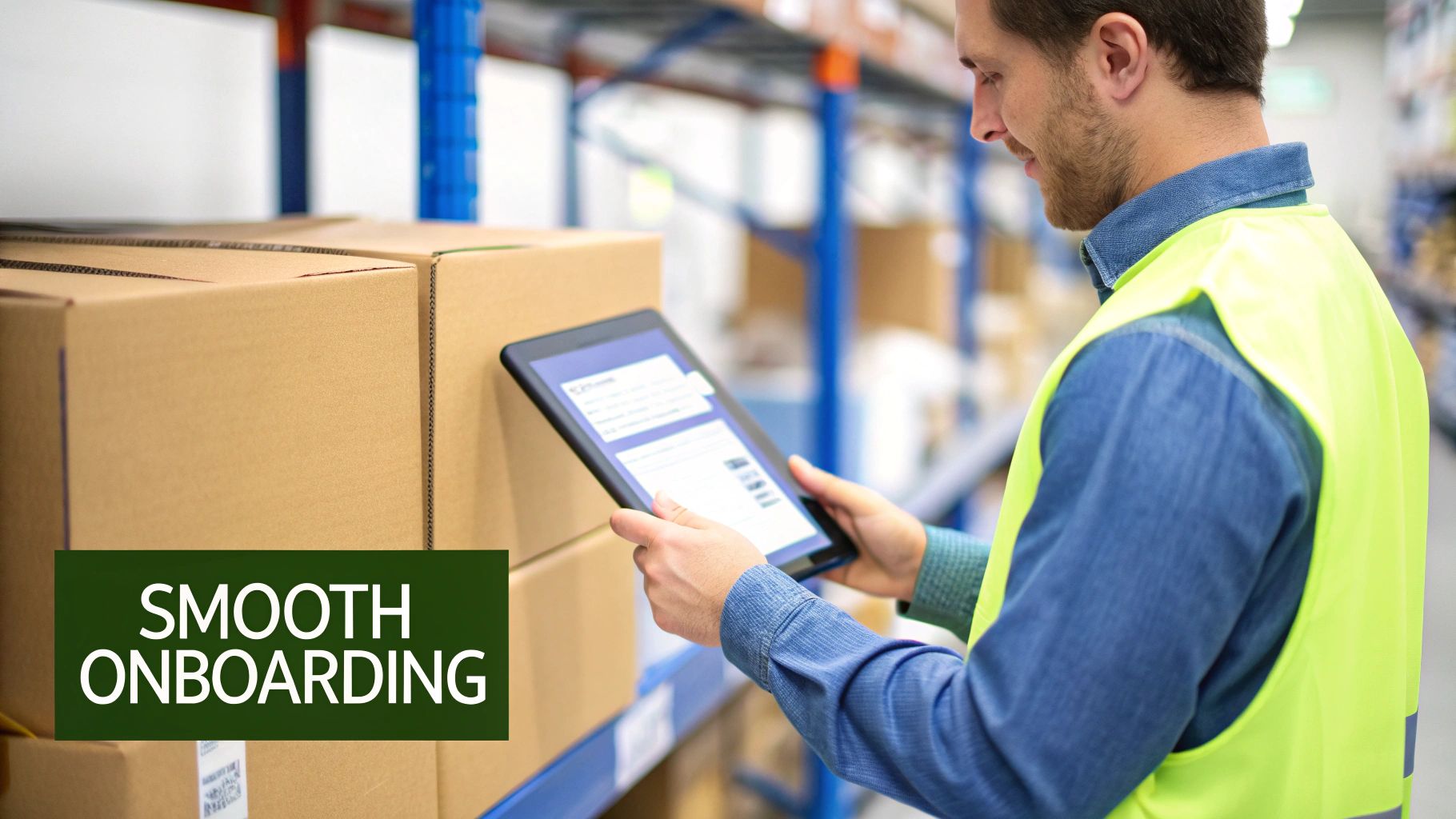
Handing over your logistics to a 3PL in Singapore is a huge step. A seamless onboarding process is key to a strong partnership that keeps your sales running without a hitch. The process should be a structured project broken down into four clear phases.
A rushed or poorly planned handover can lead to lost inventory and angry customers. Following a clear, step-by-step plan ensures everything runs smoothly from day one.
It all starts with a discovery call. This is a strategy session where you and your chosen 3PL align on goals, expectations, and timelines. You’ll discuss your current order volume, future business goals, and any special handling needs for your products.
Practical Example: A local coffee bean roaster needs a 3PL partner. During their discovery call, they highlight that their beans are sensitive to humidity and require strict batch tracking. The 3PL confirms they offer climate-controlled storage and have a warehouse management system (WMS) capable of first-in, first-out (FIFO) logic based on batch codes.
This initial conversation is where you map out a clear project timeline, from technical setup to the first live shipment.
With a shared plan in place, it’s time to connect your technology. This phase involves integrating your e-commerce platforms—like Shopify, Shopee, or Lazada—with the 3PL’s WMS. A direct, automated connection is essential for a scalable operation.
This sync allows orders from all your sales channels to flow directly into the 3PL’s system for immediate processing. It also syncs inventory levels back to your stores in real-time, which is crucial for preventing overselling.
Actionable Insight: Create a simple pre-onboarding checklist to gather all your essential data. This document ensures you and your new partner start on the right foot and can speed up the technical setup.
Your checklist should include:
Once your systems are connected, you can prepare your first inventory shipment for the 3PL’s warehouse. This step demands attention to detail. Your 3PL will give you specific guidelines on how they need products labeled and documented.
You’ll typically need to create an Advanced Shipping Notice (ASN). This is a digital notification that tells the 3PL exactly what to expect in the incoming shipment—which SKUs, how many units of each, and when it’s set to arrive.
Properly labeling each carton with the 3PL’s required information helps their team receive and store your inventory quickly and accurately. Any mistakes here can cause delays.
Before sending all live orders to your new partner, you must run a series of test orders. This final check is your safety net, confirming that the entire workflow is working perfectly.
Create a few test orders in your e-commerce store for different products and shipping destinations. Watch them flow into the 3PL’s system and track their journey through the pick, pack, and ship process. Verify that tracking information syncs back to your store correctly and that the customer receives the right email notifications. This step catches any potential glitches in a controlled environment, ensuring your first real customers have a flawless experience.
Partnering with a 3PL in Singapore is a major decision. It’s natural to have questions about the cost, timing, and details. Here are direct, practical answers to the most common queries from founders.
This will serve as your final checklist before making the leap. We’ll break down the financial side, help you pinpoint the right moment to outsource, and clarify how to handle tricky products.
Understanding the costs is the first step to building a realistic budget. Most fees for a 3PL in Singapore fall into a few standard categories.
Here’s a simple breakdown of what you can expect on your monthly invoice:
Actionable Insight: When you ask for a quote, provide as much detail as possible. Share your average number of monthly orders, the number of unique SKUs you carry, and the typical number of items per order. This helps them provide a more accurate estimate.
Knowing when to make the switch is just as important as choosing the right partner. Switching too soon is an unnecessary expense, but waiting too long can lead to burnout and poor customer service.
Look for these clear signals that it’s time to outsource your logistics:
The goal is to partner with a 3PL before you’re completely overwhelmed. This allows for a smooth, planned transition instead of a frantic one.
Yes. The 3PL market in Singapore has providers who specialize in handling products that need special care. The key is to find a partner with documented experience in your specific niche.
During your vetting process, be clear about your product requirements.
Never assume a standard 3PL can handle these needs. Always ask for proof of their capabilities and get references from other clients in your industry.
Setting up your 3PL becomes much simpler with a central command center for your e-commerce operation. A platform like OneCart acts as the bridge between your sales channels and your logistics partner.
Your 3PL needs clean, unified data to work efficiently. If you’re selling on Shopee, Lazada, and your own Shopify store, you’re juggling three different data streams. This can lead to manual data entry, which is slow and prone to errors.
A system like OneCart fixes this by:
By using a central platform, you give your 3PL in Singapore the clean, organized information they need to do their best work, which means faster, more accurate fulfillment for your customers.
Ready to stop overselling and streamline your operations? OneCart centralizes your inventory and orders from Shopee, Lazada, TikTok Shop, Shopify and more into a single dashboard. See how you can scale your brand by visiting https://www.getonecart.com and booking a demo today.
Automate & Scale Your Online Business with OneCart
Start a Free TrialUsed by hundreds of merchants in Singapore & Southeast Asia